Introduction
Europe's plastic industry turnover dropped 13% between 2022 and 2024 — from €457 billion to €398 billion — with energy costs cited as the primary driver. Against that backdrop, the global plastic additives market is still projected to grow from $48.86 billion in 2023 to $71.43 billion by 2030. Manufacturers under margin pressure are scrutinising every input, including the additives that quietly determine processing efficiency.
Calcium stearate is widely listed as a "standard additive" in plastics, but its real contribution is underappreciated until processing problems appear: surface defects, thermal degradation, or equipment fouling that costs time and output.
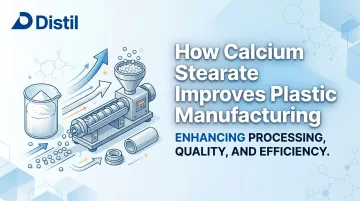
This article explains how calcium stearate improves specific, measurable outcomes in plastic manufacturing: melt flow, surface quality, equipment life, and thermal stability across PVC, polyethylene, polypropylene, and engineering plastics.
Key Takeaways
- Functions as internal lubricant, heat stabilizer, release agent, and acid scavenger in plastic processing
- Improves melt flow, prevents heat degradation in PVC, and reduces adhesion to molds and equipment
- Under-dosing causes surface defects, higher scrap rates, polymer discoloration, and accelerated equipment wear
- Works across PVC, polyethylene, polypropylene, and engineering plastics — making it viable for extrusion, injection molding, and calendering lines without reformulation
- Realizing full performance depends on correct loading (0.1–1.5% by weight), polymer-specific grade selection, and batch-to-batch supply quality
What Is Calcium Stearate?
Calcium stearate is a calcium salt of stearic acid with the molecular formula C₃₆H₇₀CaO₄, appearing as a white to yellowish-white, waxy, water-insoluble powder (solubility 0.004 g/100 mL at 15°C). It is not a structural component of plastic parts: it is a processing enabler added during compounding or dry-blending before extrusion, injection molding, or calendering.
Key Physical Properties:
- Molecular weight: 607.0 g/mol
- Density: 1.08-1.12 g/cm³
- Melting point: 147-155°C (commercial range)
- Calcium content: 6.6-7.4%
- Free fatty acid: ≤0.3-1.0% as stearic acid
Calcium stearate functions on two levels: internally, within the melt to reduce inter-chain friction, and externally, at the mold or die interface to prevent adhesion. These effects translate directly into lower energy consumption, reduced scrap rates, and longer equipment maintenance intervals — improvements measured in operational KPIs, not just finished product specs.
Key Advantages of Calcium Stearate in Plastic Manufacturing
The advantages below are grounded in operational outcomes — the kind that appear in cycle times, scrap rates, energy bills, and equipment maintenance logs.
Internal Lubrication and Improved Melt Flow
As an internal lubricant, calcium stearate reduces friction between polymer chains during melting, lowering melt viscosity and enabling smoother flow through dies and molds. It migrates within the polymer melt, reducing inter-particle resistance during extrusion and injection molding.
This reduction in friction cuts pressure buildup in the barrel, resulting in more consistent part dimensions, fewer surface defects like melt fracture, and lower energy consumption per kilogram processed. In HDPE extrusion testing, 6,000 ppm calcium stearate completely eliminated melt fracture after 60 minutes, while baseline levels (1,000 ppm) showed 100% melt fracture throughout a 120-minute test.
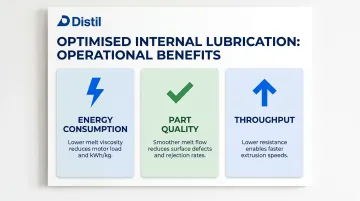
Three operational metrics move in the right direction when internal lubrication is optimised:
- Energy consumption: Lower melt viscosity reduces motor load during extrusion and injection molding, cutting mixing temperatures and kWh/kg processed
- Part quality: Smoother melt flow reduces surface irregularities, flow lines, and weld-line weakness, translating to lower rejection rates
- Throughput: Lower resistance allows faster extrusion speeds without sacrificing surface finish or dimensional consistency
This advantage is most pronounced in high-speed extrusion, thin-wall molding, and polymers with naturally high melt viscosity — rigid PVC and high-molecular-weight polyethylene in particular.
Thermal Stabilisation and Acid Scavenging in PVC
PVC is inherently heat-sensitive. Dehydrochlorination begins above approximately 140°C due to loss of labile chlorine atoms in defective molecular segments. At typical processing temperatures (160–212°C for rigid PVC), HCl release accelerates rapidly. The consequences are compounding: discolouration (yellowing to blackening), loss of mechanical properties, and corrosive wear on screws and barrels.
Calcium stearate acts as both thermal stabiliser and acid scavenger through a two-step reaction:
- Step 1: Ca(C₁₇H₃₅COO)₂ + HCl → CaCOOC₁₇H₃₅Cl + C₁₇H₃₅COOH
- Step 2: CaCOOC₁₇H₃₅Cl + HCl → CaCl₂ + C₁₇H₃₅COOH
The calcium component reacts with released HCl to form calcium chloride, interrupting the degradation chain. Critically, the reaction products do not catalyse further dehydrochlorination — unlike some other metal chlorides — extending the processing window before discolouration occurs.
Cleaner release reduces cycle time per part by eliminating manual de-molding and delayed ejection. Fewer die cleaning stoppages raise machine utilisation directly. Unplanned injection molding downtime costs approximately $5,000 per hour, so release efficiency carries real financial weight.
Tooling wear is the other cost lever. Molds range from $1,000 to $100,000+ depending on complexity; reduced abrasion defers that capital expenditure. Key metrics to track here: tooling replacement interval, die cleaning frequency, and maintenance cost per tonne of output.
This advantage is most significant in high-cavitation injection molding, continuous extrusion lines running complex profiles, and rigid (unplasticised) PVC operations, where the melt is less forgiving and adhesion risk is highest.
What Happens When Calcium Stearate Is Missing or Misused
Under-Dosing or Absence
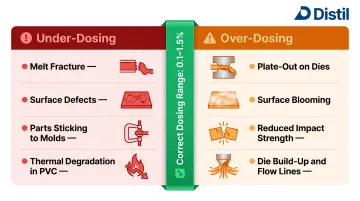
When calcium stearate is absent or under-dosed, manufacturers commonly see:
- Increased melt pressure and motor load during extrusion
- Surface defects such as melt fracture, sharkskin, and streaking
- Parts sticking to molds, causing damage or deformation on ejection
- Thermal degradation in PVC: HCl builds up in the melt, accelerating discoloration and degradation — leading to off-spec product, costly purge cycles, and potential corrosion damage to barrel and screw assemblies
At baseline 1,000 ppm calcium stearate in HDPE, 100% melt fracture persisted throughout a 120-minute extrusion test, confirming that low dosage provides no meaningful processing protection.
Over-Dosing and Plate-Out
Over-dosing calcium stearate causes its own problems:
- Plate-out: Waxy deposits on dies and molds
- Surface blooming: White residue on finished parts
- Reduced mechanical properties: Above approximately 1 phr in UPVC pipe/profiles, impact strength decreases and melt fracture increases
- Processing issues: Die build-up, smoke, fume generation, film roll slippage, and flow lines
At 6,000 ppm in HDPE, significant die build-up occurred after just 30 minutes of extrusion — a rapid failure that illustrates how excess additive undermines the same process stability it was meant to support.
Above saturation concentration, excess calcium stearate forms "lubricant pools" among primary PVC particles, changing character from internal to external lubricant and causing phase inversion above 190°C.
Getting the dose wrong in either direction carries real production costs — which is why application-specific trials and formulation support matter when setting calcium stearate levels for a new compound or substrate.
How to Get the Most Value from Calcium Stearate
Calcium stearate performs best when concentration is calibrated to the specific polymer, processing method, and end-product requirements.
Typical Usage Levels by Application
| Application | Recommended Range |
|---|---|
| Rigid PVC pipe/profiles | 0.4–1.0 phr (max ~1 phr) |
| Polyethylene (acid scavenger) | 0.1–0.2% (1,000–2,000 ppm) |
| EVA low melt film | 0.8 phr |
| Polyamide-6 | 0.5 phr |
| Polycarbonate sheets | 1.0 phr |
| Polyester sheet molding | 0.8 phr |
Consistency of Grade and Supply Quality
Variations in particle size, calcium content, free fatty acid levels, or moisture content between suppliers introduce process drift — showing up as inconsistent flow, color variation, or surface finish differences across production runs.
Critical Quality Parameters:
- Particle fineness: 99.8% through 325 mesh
- Calcium content: 6.6–7.4%
- Free fatty acid: ≤0.3–1.0%
- Moisture: ≤3%
Application-Specific Tuning
Manufacturers who need to match a calcium stearate grade to a specific PVC stabiliser system — or verify compatibility with food-contact or medical-grade polymer requirements — benefit from working with a specialty chemicals partner that offers R&D-backed formulation support.
Distil's polymer solutions team — drawing on R&D experience across Dow, BASF, Huntsman, and Reliance Industries — runs application-specific trials, maintains batch-to-batch quality consistency, and guides formulations from lab scale through to full commercial production. The R&D centre in Navi Mumbai handles this across a unified quality system, so process drift doesn't follow you from development into production.
Conclusion
Calcium stearate's value in plastic manufacturing is not theoretical — it shows up in cycle efficiency, product quality, equipment longevity, and processing stability across PVC, polyethylene, polypropylene, and engineering plastics.
Applied correctly and consistently, a well-tuned calcium stearate formulation reduces scrap, protects equipment, and keeps production lines running at throughput targets. Misapplication generates costs that rarely get traced back to the additive — surfacing instead as equipment maintenance, off-spec batches, and lost production time.
Calcium stearate rewards precision. The grade selection, loading concentration, and formulation support behind it determine whether manufacturers capture its full processing and quality benefits — or leave them on the table.
Frequently Asked Questions
What does calcium stearate do as an internal lubricant in plastic processing?
It reduces inter-chain friction within the polymer melt, improving flow through dies and molds. This results in smoother surfaces, more consistent dimensions, and lower energy consumption per cycle.
How does calcium stearate stabilize PVC during extrusion?
It performs a dual role: slowing heat-induced degradation of PVC at processing temperatures and scavenging the hydrogen chloride released during degradation. This prevents the discoloration and mechanical property loss that HCl causes.
What is the difference between internal and external lubrication in plastics?
Internal lubricants (like calcium stearate at lower loadings) act within the polymer melt to reduce viscosity and improve flow. External lubricants form a thin film at the metal-polymer interface to prevent sticking and aid mold release — calcium stearate performs both functions depending on concentration and polymer type.
What happens if too much calcium stearate is used in a plastic formulation?
Over-dosing causes plate-out on molds and dies, surface blooming on finished parts, and potential compatibility problems with pigments or co-additives. In UPVC above 1 phr, it reduces impact strength and causes melt fracture. Always validate loading levels during trial runs.
Is calcium stearate suitable for food-contact and food-grade plastic applications?
Yes — calcium stearate is affirmed GRAS under FDA 21 CFR 184.1229 and listed as a prior-sanctioned stabilizer for food-packaging materials under 21 CFR 181.29. Verify compliance with applicable FDA and EU food contact regulations for your specific market and end-use.
Can calcium stearate be used with other stabilizer systems in PVC?
Yes. Calcium stearate is commonly used alongside zinc stearate in Ca/Zn stabilizer systems — where zinc provides faster initial HCl scavenging while calcium extends the stabilization window. This combination is widely used in non-toxic PVC applications for pipes, profiles, cables, and food-contact products.