Introduction
Finding the right contract manufacturer for color cosmetics is harder than it looks — and the cost of getting it wrong falls directly on your launch timeline and brand reputation.
The global color cosmetics market hit USD $100.20 billion in 2025 and is projected to reach USD $148.70 billion by 2033, growing at a 5.1% CAGR. Indie beauty brands, direct-to-consumer channels, and social commerce platforms have lowered barriers to entry — but raised the bar on manufacturing partners who need to keep pace with faster product cycles and higher volume demands.
The problem is that not all contract manufacturers are built for color. Unlike skincare, makeup formulations demand specialized expertise in pigment dispersion, cross-batch shade matching, and stability testing for pressed powders, liquid foundations, and wax-based sticks. Choose the wrong partner, and you're looking at color inconsistency, product recalls, or a delayed launch.
Key Takeaways
- Shade consistency, multi-format capability, and pigmentation expertise are non-negotiable in color cosmetics manufacturing
- Prioritize ISO 22716/GMP certification, MOQ flexibility, and market-specific regulatory compliance when shortlisting
- Leading manufacturers in 2026 are concentrated in Italy, South Korea, and the USA — each with different format and scale strengths
- Beyond price, vet partners on IP protection clauses, lead times, and their ability to scale with you
- Request samples from 3–5 shortlisted manufacturers before committing to full production
What Is Color Cosmetics Contract Manufacturing?
Color cosmetics contract manufacturing is the practice of outsourcing formulation, production, and packaging of makeup products—foundations, lipsticks, eyeshadows, blushes, mascaras, concealers—to a third-party specialist manufacturer. Brands provide specifications, and the manufacturer handles everything from raw material sourcing to finished goods.
What sets color cosmetics apart from other personal care categories is the technical complexity involved at every production stage:
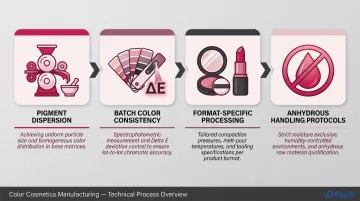
- Uniform color payoff depends on precise dispersion of insoluble pigments in oil, wax, or water systems using specialized milling equipment
- Batch-to-batch consistency is verified through spectrophotometry with CIE L*a*b* and Delta E tolerances, keeping shade variation within tight tolerances
- Pressed powders require compaction to maintain pan integrity, while lipsticks use hot-pour wax/oil/pigment melts cast into bullet molds — each format demands distinct processing equipment
- Anhydrous products like lipsticks, balms, and some primers contain no water, requiring specialized handling protocols to prevent pigment agglomeration
Across all these formats, quality assurance follows ISO 22716:2007 — the international standard for cosmetic Good Manufacturing Practices covering production, control, storage, and shipment.
Top Contract Manufacturers for Color Cosmetics in 2026
The manufacturers below were selected based on color cosmetics specialization, relevant certifications, global client reputation, and production capability across multiple product formats.
Intercos (Italy)
Founded in 1972 and headquartered in Agrate Brianza, Italy, Intercos operates 16 production plants and 11 R&D centers across Europe, Asia, and the Americas. With approximately 5,500 employees, the company serves 24 of the top 30 global beauty companies, with color cosmetics representing its primary and most advanced category.
Intercos leads in R&D depth for color innovation — proprietary technologies include Prisma Shine powder and advanced formulation platforms for lipsticks, pressed powders, mascara, and eyeliners. The company supports brands from concept through commercial scale, with in-house trend forecasting and shade development teams.
| Criteria | Details |
|---|---|
| Key Color Cosmetics Categories | Lipsticks, pressed powders, mascara, eyeliners, nail polishes, foundations, eyeshadow palettes |
| Certifications | ISO 14001:2015, ISO 45001:2018 |
| MOQ | Not publicly specified; typically suited to mid-market and enterprise brands |
Cosmax (South Korea)
Founded in 1992, Cosmax operates manufacturing and R&D facilities across South Korea, China, the USA, Indonesia, Thailand, and Australia. The company's Guangzhou plant spans 60,593 sq m with capacity to produce up to 400 million units annually, making it Asia's largest cosmetics manufacturing facility.
Cosmax carries an extensive certification portfolio including halal and vegan, with strong regulatory support for FDA, Health Canada, and EU markets. Its scale and multi-country footprint suit mid-to-large volume brands that need reliable global distribution.
| Criteria | Details |
|---|---|
| Key Color Cosmetics Categories | Foundations, lipsticks, eyeshadows, mascaras, blushes, pressed and loose powders |
| Certifications | ISO 22716, ISO 9001, ISO 14001, ECOCERT, Halal, Vegan (EVE) |
| MOQ | Not publicly specified; suited to mid-to-large volume brands |
Columbia Cosmetics (USA)
Established in 1978, Columbia Cosmetics operates a 65,000 sq ft facility in San Leandro, California, making it one of the longest-running US-based manufacturers with a dedicated focus on color cosmetics alongside skincare, haircare, fragrances, and sun care.
The facility maintains GMP and OTC compliance, serving North American brands across boutiques, direct-mail, and color consultant channels. Its decades of operational history give it a practical edge for brands that need a US-based partner with established quality processes.
| Criteria | Details |
|---|---|
| Key Color Cosmetics Categories | Lip color, eye makeup, face color, pressed powders, foundations, sun care |
| Certifications | GMP, OTC facility compliance |
| MOQ | Not publicly specified; contact directly for volume requirements |
Radical Cosmetics (USA)
Founded in 2003 and headquartered in Fort Pierce, Florida, Radical Cosmetics is a full-service OEM/ODM contract manufacturer specializing in color cosmetics and mineral makeup. The company serves makeup artists, salons, spas, estheticians, and emerging beauty brands.
The company's mineral makeup expertise covers non-comedogenic and hypoallergenic formulations — a practical fit for brands targeting sensitive-skin consumers. ISO 9001 and ISO 22716 compliance, accessible MOQs, and 3–6 month development timelines make it particularly suited to emerging brands.
| Criteria | Details |
|---|---|
| Key Color Cosmetics Categories | Lipsticks, lip glosses, mascaras, eyeliners, eyeshadows, foundations, concealers, blushes, mineral makeup |
| Certifications | ISO 9001, ISO 22716 |
| MOQ | Contact directly; suited for small-to-mid volume runs |
Nuco (Poland)
With over 30 years of experience and approximately 500 employees, Nuco operates as one of Poland's largest contract manufacturers for decorative cosmetics. The company maintains three production units and a warehouse near Warsaw, offering a wide range of product formats.
Its "Made in Europe" origin is a compliance advantage for brands selling into EU markets. Format capabilities span pressed and loose powders, hot-fill and cold-fill items, and solid and liquid formulations, and certifications include ISO 9001:2015, ISO 22716:2007, IFS HPC, and BRC CP — aligning directly with EU Cosmetics Regulation requirements.
| Criteria | Details |
|---|---|
| Key Color Cosmetics Categories | Pressed powders, loose powders, hot-fill and cold-fill color cosmetics, solid and liquid formulations |
| Certifications | ISO 9001:2015, ISO 22716:2007, IFS HPC, BRC CP, RSPO |
| MOQ | Contact directly; suited for mid-to-large volume runs |
How We Chose the Best Color Cosmetics Contract Manufacturers
The most common mistake brands make is selecting a general skincare contract manufacturer without verifying color-specific capabilities. Pigment expertise, shade matching, hot-fill or wax-based production, and batch-to-batch color consistency are essential for makeup products.
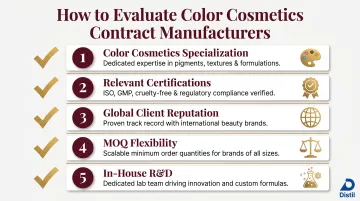
Our evaluation criteria:
- Color cosmetics specialization: Proven expertise in color formulation — not just adjacent skincare capability
- Relevant certifications: ISO 22716, GMP, FDA registration, or EU Cosmetics Regulation compliance for target markets
- Global client reputation: Track record with established beauty brands across multiple categories
- MOQ flexibility: Workable minimums for both emerging labels and scaling operations
- In-house R&D: Formula development, shade customization, and stability testing under one roof
Ingredient quality shapes every criterion above. For brands sourcing the specialty inputs that underpin color cosmetic performance — cosmetic esters for texture, UV filters for SPF-infused foundations, or mineral actives — Distil supplies application-tuned personal care ingredients through a vetted manufacturing network in India. Their R&D team handles formulation trials and application-specific development, with IP protection and a single point of contact from lab sample to commercial volume.
Conclusion
Choosing the right color cosmetics contract manufacturer requires validating pigmentation expertise, color consistency systems, and regulatory alignment with your specific target markets. Generic capability checks are not enough—you need partners who understand the technical nuances of shade matching, batch control, and multi-format production.
Assess scalability, lead times, and IP protection terms before finalizing any manufacturing partnership. Start with sample orders or pilot runs to validate quality and compatibility before committing to full production volumes.
For brands sourcing from India or evaluating Indian manufacturers, access to the right specialty ingredients matters as much as the manufacturer itself. Distil supplies the personal care ingredients—emollients, UV filters, mild surfactants, and specialty actives—that color cosmetics formulators depend on, backed by an R&D team with backgrounds at L'Oréal, BASF, and Dow. Connect with Distil to discuss ingredient sourcing and formulation support for your color cosmetics line.
Frequently Asked Questions
What certifications should a color cosmetics contract manufacturer have?
Look for ISO 22716 (cosmetic GMP), which covers production, control, storage, and shipment. US-bound products require FDA facility registration under MoCRA; EU markets require compliance with Regulation (EC) No 1223/2009. Halal, vegan, and organic certifications apply depending on brand positioning.
What is the typical MOQ for color cosmetics contract manufacturing?
MOQs vary by manufacturer and product format. Industry benchmarks range from 500 units per product for some custom formulations to 5,000+ units per SKU for certain manufacturers. Color cosmetics often require 2,000–10,000 units per shade for custom formulations. Higher MOQs typically deliver lower per-unit costs but require greater upfront capital.
What is the difference between private label and custom formulation for color cosmetics?
Private label uses existing formulas that are rebranded—faster time to market, lower MOQ, and reduced cost. Custom formulation develops a new formula to your specification—higher cost, longer lead time (3–6 months), but exclusive ownership. Many manufacturers offer color matching even with private label, allowing unique shades without full custom development.
How long does it take to develop and manufacture a new color cosmetic product?
Custom color cosmetic development typically takes 3–6 months from initial brief to finished goods, covering formulation, stability testing, sample approval, and packaging sourcing. Private label with color matching can cut that timeline to 6–8 weeks.
Can I protect my formula when working with a color cosmetics contract manufacturer?
Formula ownership depends on your agreement. Always negotiate an NDA and explicit IP ownership clause before development begins. Manufacturers developing custom formulas often retain rights unless a separate formula ownership agreement is signed with associated fees. Getting these terms in writing before development starts is the only reliable protection.
What is the most sustainable cosmetic packaging?
Refillable compacts, packaging made from PCR (post-consumer recycled) materials, glass, aluminum, and biodegradable alternatives lead sustainable options for color cosmetics. Note that the EU Green Claims Directive proposal, advancing through the legislative process, will require substantiation and independent verification of environmental claims on packaging, raising compliance requirements for sustainability messaging.