Introduction
Food and personal care manufacturers are under intense pressure to reformulate. Consumers no longer passively accept ingredient lists—they actively read labels and reject products containing unfamiliar additives. In the U.S., 58% of shoppers now regularly read food labels, up from 35% in 2020, and 50% express worry about artificial ingredients. This shift has turned clean label formulation from a niche marketing strategy into a business-critical priority.
The challenge is specific: replace conventional emulsifiers like DATEM, SSL, and mono- and diglycerides (E471) with ingredients consumers recognize and trust — without sacrificing product performance, shelf life, or manufacturing efficiency.
This guide is a practical resource for formulators navigating that transition. It covers:
- What clean label emulsifiers are and how they differ from conventional options
- Which types exist and their functional properties
- Where they're applied across food and personal care industries
- What technical considerations matter most when reformulating
Key Takeaways
- Clean label emulsifiers are naturally derived ingredients — lecithin, plant proteins, starches, and gums — that replace synthetic emulsifiers in formulations
- Applies across bakery, sauces, dairy, and personal care, each with distinct performance requirements
- "Clean label" means substituting with consumer-recognized ingredients — emulsifiers themselves remain essential
- Transitioning requires formulation optimization—clean label alternatives perform comparably but often need higher usage rates and hybrid approaches
- The clean label ingredients market is projected to reach USD 83.44 billion by 2034 at a 7.18% CAGR
- Clean beauty is growing faster still, at a 16.8% CAGR over the same period
What Makes an Emulsifier "Clean Label"?
There is no universal regulatory definition of "clean label." The FDA, EFSA, FSANZ, and Codex Alimentarius have not established formal criteria. As FoodChainID confirms, "While the term 'clean label' has existed for about fifteen years, there is no legal definition from global regulatory bodies."
Instead, clean label is a consumer-driven concept centered on ingredient transparency, recognizability, and minimal processing. What qualifies varies by region, retailer, and brand positioning.
Practical criteria for clean label emulsifiers:
- Naturally sourced from plant, animal, or microbial origin
- Minimal chemical modification
- Short, consumer-recognizable ingredient names (not E-numbers or chemical nomenclature)
- Absence of synthetic additives
Conventional emulsifiers targeted for replacement:
| Emulsifier | E-Number | Primary Use | Why Brands Are Moving Away |
|---|---|---|---|
| DATEM | E472e | Dough strengthening in bread | Chemical-sounding name, associated with synthetic processing |
| Sodium Stearoyl Lactylate (SSL) | E481 | Crumb softening, dough conditioning | Perceived as artificial; EFSA flagged potential ADI (acceptable daily intake) exceedance in high-consuming children |
| Mono- and diglycerides | E471 | Broad emulsification, anti-staling | Synthetic designation, lacks consumer recognition |
| Polyglycerol esters | E475 | Aeration, crystal modification | Complex chemical structure, unfamiliar to consumers |
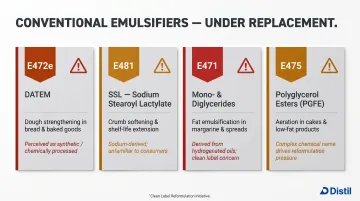
All four ingredients listed above are fully authorized in the EU and U.S. Their replacement is driven by consumer perception, not safety concerns.
Clean label does not mean emulsifier-free. The goal is achieving the same functional outcomes — stable oil-water systems, improved texture, extended shelf life, better mouthfeel — using ingredients consumers recognize and trust.
Main Types of Clean Label Emulsifiers
Lecithins
Soy, sunflower, and rapeseed lecithins are the most widely adopted clean label emulsifiers: naturally derived phospholipid complexes that perform effectively in both food and personal care applications. Lecithin (E322) holds FDA GRAS status and is authorized under EU Regulation 1333/2008.
Market shift toward sunflower: Sunflower lecithin is growing at 8-10% annually versus soy lecithin's 3-4%, driven by allergen-free positioning and non-GMO demand. Soy lecithin remains the market leader with over 60% share, but brands in allergen-sensitive and European markets prefer sunflower.
Functional variants:
- Standard lecithin: Native phospholipid blend effective at low dosages in chocolate, baked goods, and margarine
- Hydrolyzed lecithin: Enzymatically modified to be more hydrophilic; improves gas retention, crumb structure, and performance in low-salt margarine and high-temperature frying
- De-oiled lecithin: Triglyceride oil removed; higher phospholipid concentration in powder form for instant powders, tableting, and personal care
Allergen note: Soy lecithin requires mandatory allergen labeling under U.S. FALCPA and EU Regulation 1169/2011, despite containing only trace protein. This is a key reason formulators switch to sunflower lecithin for allergen-free claims.
Plant Proteins
Pea protein, chickpea broth (aquafaba), and soy protein isolates function as emulsifying agents due to their amphiphilic structure: hydrophobic amino acid sequences adsorb at the oil-water interface while hydrophilic sequences face the aqueous phase.
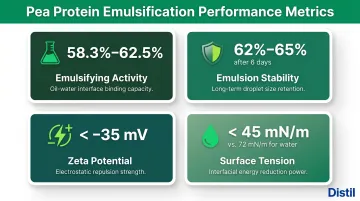
Pea protein performance data:
- Emulsifying activity: 58.3% to 62.5%
- Emulsion stability: 62% to 65% after 6 days at 4°C
- Zeta potential: Below -35 mV (strong electrostatic repulsion)
- Surface tension: Below 45 mN/m (versus 72 mN/m for pure water)
Pea protein can also form Pickering emulsions—particle-stabilized systems that avoid traditional surfactants entirely, validated in mayonnaise-like formulations.
Aquafaba: Chickpea broth has gained traction as a clean label emulsifier in vegan dressings, sauces, and egg-replacement applications. Research shows emulsion stability ranges from 60% to 80%, with centrifuged aquafaba outperforming egg whites in certain preparations.
Optimal results occur at a 2:3 chickpea-to-water ratio cooked for 60 minutes.
Pea protein is not a listed major allergen in the U.S. or Canada, though it must appear on the ingredient statement. For formulators seeking even simpler label declarations, native starches and functional fibers offer another route.
Native Starches and Functional Fibers
Native (unmodified) starches from tapioca, corn, or potato and citrus or chicory fiber provide mild emulsification and stabilization. They work best in hybrid systems, supporting stability rather than replacing lecithin or proteins outright.
Ingredion offers over 35 NOVATION functional native starches that deliver the process tolerance and stability benefits of modified starch with simple ingredient listings: "corn starch," "tapioca starch," "rice starch," or "potato starch."
Hydrocolloids and Gums
Naturally sourced hydrocolloids assist emulsification primarily through viscosity enhancement and droplet stabilization:
| Hydrocolloid | E-Number | Primary Function | Common Applications |
|---|---|---|---|
| Guar gum | E412 | Thickening, viscosity building | Beverage emulsions, dairy alternatives |
| Acacia/Gum arabic | E414 | Emulsification, film-forming | Flavor encapsulation, beverage emulsions |
| Agar | E406 | Gelling, stabilization | Confectionery, dairy |
| Gellan gum | E418 | Gelling, suspension | Dairy alternatives, beverages |
Gum arabic (E414) is notable for its inherent emulsifying capability due to its protein-polysaccharide complex structure. The others primarily function as viscosity builders that stabilize emulsions indirectly by reducing droplet mobility.
Enzyme-Based Systems
Lipases and phospholipases represent a substrate-dependent clean label approach particularly well-established in bakery. These enzymes modify naturally occurring lipids in flour, converting lecithin to lysolecithin and digalactosyl diglycerides to digalactosyl monoglycerides. The result mimics the functionality of DATEM and SSL.
As Art Posch of Kemin Food Technologies stated: "Phospholipase acts upon the polar lipids of flour and converts lecithin to lysolecithin...They act in a similar way to DATEM and SSL."
Key advantage — label exemption: Under EU law (Council Directive 89/107/EEC), food additives used as processing aids are exempt from labeling on the final product. AMFEP confirms that all food enzyme applications except invertase and lysozyme are classified as processing aids and "do not appear on the label of the final foodstuff."
Technical considerations:
- Enzymes are formulation-specific and require optimization
- Depend on sufficient substrate (lipids, proteins, starches) in the base formulation
- Older-generation lipases can release small-chain fatty acids causing off-flavors during prolonged storage; third-generation lipases have largely resolved this
- Most established in commercial bakery applications
Major suppliers include Kemin Food Technologies, Lallemand Baking, Lesaffre, and dsm-firmenich.
Key Applications Across Industries
Bakery
Bakery and confectionery dominate the food emulsifier market at 58.8% revenue share. Clean label emulsifiers in breads, cakes, and pastries strengthen dough, retain gas, improve crumb structure, and extend shelf life—functions traditionally handled by DATEM, SSL, and mono- and diglycerides.
Primary alternatives:
- Sunflower lecithin
- Enzyme systems (lipases, phospholipases)
- Functional native starches
Enzyme-based doughs can feel less conditioned than chemically emulsified versions. To compensate, formulators are combining low levels of lecithin with enzyme systems — a hybrid approach that balances label goals with processing performance.
Baking enzymes also carry a lower cost-in-use than chemical emulsifiers. Lesaffre, for instance, has introduced enzyme-based alternatives to mono- and diglycerides that maintain softness at reduced usage levels.
Sauces, Dressings, and Emulsified Foods
Plant proteins (chickpea broth, pea protein) and lecithins are used in mayonnaise, aioli, Alfredo sauce, vinaigrettes, and ready meals where oil-water stability, mouthfeel, and heat or freeze-thaw stability are critical.
Research published in Journal of Food Science developed a "vegan and clean label mayonnaise by replacing egg yolk with vegetable protein." Pea protein Pickering emulsions have been validated in mayonnaise-like formulations with controlled droplet size and viscosity.
Dairy and Plant-Based Products
Clean label emulsifiers in ice cream, yogurt, plant-based milks, and dairy-alternative beverages prevent phase separation, improve creaminess, and deliver consistent texture. Lecithin and hydrocolloids are commonly paired to achieve this across both dairy and plant-based formats.
Cargill uses plant-based lecithin in coffee creamers to prevent broken emulsions, while BENEO supplies native rice starches and faba bean protein for plant-based dairy alternatives. Faba bean protein is specifically valued for foam stability in barista-style plant milks.
Personal Care and Cosmetics
The clean beauty movement tracks closely with clean label trends in food: consumers now scrutinize cosmetic ingredient lists with the same skepticism they apply to packaged foods. The global clean beauty market was estimated at USD 10.49 billion in 2025 and is expected to reach USD 35.30 billion by 2033, growing at 16.8% CAGR. Skincare leads at 41.4% of the market.
Key clean label emulsifiers in personal care:
- Sunflower lecithin (INCI name: Lecithin or Helianthus Annuus Seed Lecithin) — used as a natural emulsifier and co-emulsifier in creams, lotions, and serums
- Acacia/gum arabic for emulsification and film-forming
- Polyglyceryl esters from plant-based feedstocks (e.g., Polyglyceryl-6 Distearate) recognized as PEG-free emulsifier alternatives
Distil's personal care formulation team, led by Head of Personal Care Kiro Rizk, supports brands in identifying and trialing the right clean label emulsifier systems for specific cosmetic applications, from lab-scale development through commercial production.
Clean Label vs. Conventional Emulsifiers: Key Formulation Differences
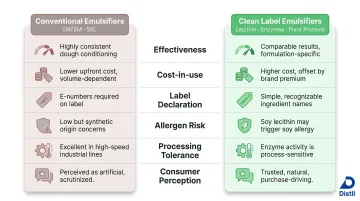
Conventional emulsifiers like DATEM and SSL offer precise, predictable performance at low usage levels and low cost. Clean label alternatives generally require higher usage rates, may behave differently across processing conditions, and can introduce considerations around allergen labelling, flavour impact, or solubility.
The table below compares these two categories across the dimensions that matter most in formulation decisions:
| Dimension | Conventional (DATEM, SSL) | Clean Label (Lecithin, Enzymes, Plant Proteins) |
|---|---|---|
| Effectiveness | Highly effective, reliable at low dosages | Formulation-specific; may require optimization |
| Cost-in-use | Generally predictable | Enzymes may be lower; lecithin/proteins can be higher |
| Label declaration | Must be declared (E-numbers in EU) | Enzymes often exempt as processing aids; lecithin labels as familiar ingredient |
| Allergen risk | Generally non-allergenic | Soy lecithin requires allergen labelling; pea protein does not |
| Processing tolerance | Excellent freeze-thaw, extreme processing tolerance | May require additional technical support |
| Consumer perception | Scrutinized; associated with "chemical-sounding" names | Perceived as natural, familiar, transparent |
Where those trade-offs land in practice depends heavily on the reformulation strategy chosen. Most approaches fall into one of three categories:
- Full replacement using enzymes or natural emulsifiers — generally lowest risk in bakery applications where enzyme systems are well-established
- Label-friendly reframing by switching to consumer-preferred equivalents, for example moving from E471 to sunflower lecithin
- Hybrid systems that combine clean label ingredients with reduced levels of conventional emulsifiers, balancing performance against label goals
Navigating the Transition: Formulation Challenges and Practical Strategies
The reformulation pipeline is accelerating. 64% of food and beverage product developers now prioritize clean label, up from 53% the prior year. Cost reduction was the only factor rated higher at 70%.
Common Technical Challenges
Replicating dough conditioning feel: Enzyme-based systems don't always deliver the same tactile properties as DATEM/SSL during mixing and processing.
Achieving equivalent shelf life: Plant protein emulsifiers may not extend shelf life as effectively as conventional emulsifiers without formulation optimization.
Managing cost increases: Clean label feedstock costs (corn, wheat, specialty crops) rose by 25-60% between 2020 and 2022. However, 58% of manufacturers reported revenue increases after clean label conversion, and 40% successfully increased pricing.
Ensuring batch consistency: Clean label ingredients can be more sensitive to processing variables like hydration, temperature, and dispersion.
Substrate Availability
Enzyme-based systems depend on sufficient lipids, proteins, or starches in the base formulation to function. Lean or highly processed formulations may not provide adequate substrate, limiting enzyme-based options.
Working with an Experienced Partner
Clean label reformulation involves trade-offs that are difficult to resolve without hands-on formulation experience: selecting the right emulsifier system, running meaningful trials, and scaling without disrupting production quality. The right R&D and sourcing partner handles all of this.
Distil's R&D team, led by VP of R&D Dr. Leema Joseph, brings over 45 years of combined experience from Dow, BASF, L'Oréal, Huntsman, and Reliance Industries. The team supports personal care and specialty manufacturers through the full reformulation process:
- Define application requirements, processing conditions, and performance targets upfront
- Develop custom clean label emulsifier solutions matched to specific brand needs
- Run lab trials against defined performance benchmarks before scale-up
- Align formulations with manufacturing conditions for consistent, repeatable production
- Deliver at commercial scale through an asset-light model across 20+ partner facilities
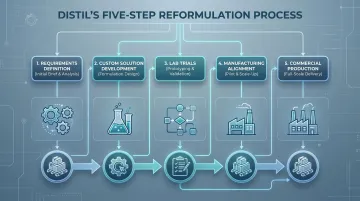
From first brief to commercial batch, Distil manages the entire journey under a single point of contact — with full IP protection at every stage.
Frequently Asked Questions
What are the main clean label emulsifying agents?
The primary categories are lecithins (soy, sunflower), plant proteins (pea, chickpea/aquafaba), native starches, hydrocolloids (guar gum, acacia), and enzyme-based systems (lipases, phospholipases). Functional performance and application fit vary significantly across these categories, so selection depends on the end product and processing conditions.
What clean label emulsifiers are commonly used in bakery products?
Sunflower or soy lecithin, phospholipase and lipase enzyme systems, and functional native starches are the most widely used clean label options in bakery. They deliver dough strength, crumb softness, and shelf life extension without synthetic additives.
Which emulsifiers are considered healthiest for clean label products and which should be avoided?
Naturally derived options like lecithin, plant proteins, and gums are generally preferred in clean label formulations. Conventional synthetic emulsifiers such as DATEM, SSL, and mono- and diglycerides (E471) are the ones most commonly removed during clean label reformulation due to consumer perception, not necessarily proven health risk.
What are emulsifiers E322 and E471?
E322 is lecithin—a naturally derived phospholipid commonly from soy or sunflower, widely accepted in clean label formulations. E471 refers to mono- and diglycerides of fatty acids, a synthetic emulsifier typically replaced in clean label reformulation due to its unfamiliar E-number.
What are clean label ingredients?
Clean label ingredients are perceived by consumers as natural, minimally processed, and recognizable by name. The definition is market-driven, not regulatory—what qualifies varies by region, retailer, and brand strategy.