Introduction
Nearly every cream, lotion, or serum depends on one critical ingredient class: emulsifiers that bind oil and water into stable, uniform products. Without the right emulsifier, formulations separate within hours, actives fail to disperse evenly, and shelf-stable products become impossible.
Formulators and brands are shifting to natural emulsifiers driven by consumer demand for clean-label products, regulatory frameworks like COSMOS and Ecocert, and sustainability commitments. These aren't niche pressures — they're reshaping purchasing decisions at scale.
The green emulsifier segment held 72.0% of the global emulsifiers-in-personal-care market in 2024, valued at USD 565.1 million. Natural emulsifiers have moved from a formulation preference to a commercial baseline.
That shift makes emulsifier selection a high-stakes decision. The wrong choice undermines product stability, skin feel, and certification status. This article covers what natural emulsifiers are, why they matter in cosmetic formulation, the main commercial types, and how to select the right one for your application.
Key Takeaways
- Natural emulsifiers are plant- or microbial-derived amphiphilic molecules that stabilize oil-water emulsions
- Essential for lotions, creams, sunscreens, and conditioners — formulations simply don't hold without them
- Three types dominate: plant wax-based (W/O), phospholipid-based (skin-barrier), and sugar-based glycolipids (O/W)
- Selection turns on emulsion type, texture, pH range, certification needs, and scale-up reliability
What Are Natural Emulsifiers?
Natural emulsifiers are amphiphilic molecules derived from plant or microbial sources. They possess both hydrophilic (water-attracting) and lipophilic (oil-attracting) segments, allowing them to position at the interface between oil and water droplets. This alignment creates a protective film that prevents coalescence and reduces interfacial tension, the force that would otherwise cause immediate phase separation.
Emulsion Types
Oil-in-water (O/W) emulsions disperse oil droplets in a continuous water phase. They're non-greasy, easy to spread, and dilutable with water. Common formats include lightweight moisturizers, serums, day creams, and rinse-off cleansers.
In a W/O emulsion, water droplets are dispersed in a continuous oil phase instead. This reversal provides superior occlusive barriers, making W/O systems standard in night creams, barrier repair products, and water-resistant sunscreens.
The emulsifier type determines which system forms. Sugar-based and phospholipid emulsifiers favor O/W architectures, while plant waxes stabilize W/O and anhydrous systems.
Regulatory Framework
For formulators targeting certified natural or organic claims, understanding how emulsifiers are classified under certification standards is essential. The COSMOS Standard V4.0 divides natural emulsifiers into two categories:
- Physically Processed Agro-Ingredients (PPAI): Extracted using only physical means (for example, lecithin extracted with water or ethanol)
- Chemically Processed Agro-Ingredients (CPAI): Derived through authorized reactions like esterification (for example, glyceryl stearate, cetearyl glucoside)
ISO 16128 provides calculation frameworks for natural origin indices, establishing globally recognized definitions for natural and organic cosmetic ingredients.
Why Natural Emulsifiers Matter in Cosmetics and Personal Care
A well-selected emulsifier produces stable, elegant formulas with controlled viscosity, spreadability, and skin feel. A poorly matched one causes phase separation, inconsistent texture, and reduced shelf life — all critical product failures that force reformulation and delay launch.
What Goes Wrong Without the Right Emulsifier
- Phase separation: Creams and lotions separate into visible oil and water layers within days
- Uneven dispersion: Active ingredients clump or settle, creating efficacy inconsistencies
- Constant shaking required: Products fail to maintain stability during storage
Each failure carries a direct cost: reformulation time, delayed launches, and lost consumer trust.
Certification and Market Access
The clean beauty market reached USD 10.49 billion in 2025, growing at 16.8% CAGR to USD 35.30 billion by 2033. Among consumers, 63% consider natural ingredients extremely or very important, and 45% are willing to pay a premium for certified organic products — rising to 62% among ages 18-29.

Certification requirements draw a hard formulation line:
- COSMOS V4.0 bans ethoxylation and propoxylation, ruling out all PEG-based emulsifiers from certified-natural products — brands must shift to plant wax, lecithin, or sugar-based systems
- Europe leads on certification: 55% of natural personal care products carry third-party certification
- North America trails significantly: Only 8% are certified, creating a meaningful trust advantage for brands that pursue COSMOS or NATRUE approval
Types of Natural Emulsifiers
Natural emulsifiers differ significantly in molecular origin, mechanism, emulsion type produced, and sensory output. Knowing which category fits your formulation goals saves significant development time.
The three commercially dominant categories are:
- Plant wax-based emulsifiers
- Phospholipid-based emulsifiers (lecithins)
- Sugar-based (glycolipid) emulsifiers
Each category suits a distinct product type, skin target, and certification pathway — covered in detail below.
Plant Wax-Based Natural Emulsifiers
Plant waxes are high-melting-point substances derived from plant sources — candelilla wax (from the candelilla shrub), carnauba wax (from Brazilian palm leaves), and rice bran wax (from rice bran oil refining). They provide structural rigidity, thickening, and binding, functioning primarily as W/O emulsifiers or stabilizers in anhydrous systems.
How They Work
Unlike phospholipids or sugar-based emulsifiers, plant waxes stabilize emulsions through physical entrapment of water droplets within a wax matrix during solidification, rather than forming a molecular interfacial layer. This makes them texture-defining agents as much as emulsifiers.
Key Specifications
| Property | Candelilla Wax | Carnauba Wax | Rice Bran Wax |
|---|---|---|---|
| Melting Point | 68.5-72.5°C | 82-86°C | 77-82°C |
| Typical Use Levels | 3-10% | 2-8% | ~6% in lip balms |
| COSMOS/Ecocert | Approved | Approved | Listed as 100% natural |
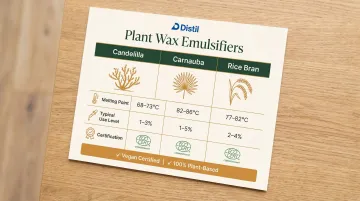
Vegan distinction: Beeswax is animal-derived and incompatible with vegan certification. Plant waxes from candelilla, carnauba, and rice bran are fully plant-based alternatives meeting vegan and COSMOS requirements simultaneously.
Best-Fit Applications
- Solid stick products and lip balms
- Protective salves and barrier creams
- Rich W/O formulations
- Natural sunscreens
- Anhydrous balms
Strengths and Trade-Offs
Strengths:
- Excellent structural body and texture control
- Strong natural origin credentials
- High heat resistance (especially carnauba)
Trade-offs:
- Not suitable for lightweight O/W lotions or fluid emulsions
- Require precise temperature management during processing
- Limited skin-interaction benefit beyond occlusion
Phospholipid-Based Natural Emulsifiers (Lecithins)
Phospholipids — most commonly lecithin from sunflower and soy sources — are naturally occurring amphiphilic lipids consisting of a glycerol backbone, two fatty acid chains, and a phosphate head group. This molecular structure closely mirrors the phospholipid bilayers in human skin cell membranes, creating unique skin affinity.
How They Work
Phospholipid emulsifiers are the only class that forms lamellar liquid crystalline (LLC) structures — highly ordered, alternating hydrophilic and hydrophobic layers that mimic the stratum corneum's own lipid organization. These structures:
- Enhance emulsion stability beyond simple droplet systems
- Create sustained-release reservoirs for active ingredients
- Support skin barrier function and reduce transepidermal water loss (TEWL)
Soybean-derived phospholipids are rich in linoleic acid, a critical precursor for the skin's synthesis of Ceramide 1, essential for an intact barrier.
Available Grades
| Product | PC Content | Source | Form | Certification |
|---|---|---|---|---|
| LIPOID S 75 | 70% | Soy | Phospholipids | Ecocert |
| PHOSPHOLIPON 90 G | ≥94% | Soy | Purified PC (granulated) | Ecocert |
| PHOSPHOLIPON 80 H | 70% | Soy | Hydrogenated (powder) | Ecocert |
| LIPOID H 100 | ≥90% | Sunflower | Purified PC (powder) | Ecocert |
Sunflower-derived grades are naturally non-GMO and meet demand for soy-free formulations. Hydrogenated grades provide enhanced oxidative stability. Typical use levels: 0.5% to 3%.
Best-Fit Applications
- Skin barrier repair formulations
- Serum emulsions
- Sensitive and reactive skin product lines
- Luxury face care
- Baby care products
Strengths and Trade-Offs
Strengths:
- Outstanding biocompatibility and skin affinity
- Penetration-enhancing properties
- Lamellar liquid crystal formation
- Multifunctional (emollient + emulsifier)
Trade-offs:
- Susceptible to oxidative degradation — requires antioxidant co-formulation (tocopherol, ascorbyl palmitate)
- Weak primary emulsifier alone; best used as co-emulsifier
- Slightly oily sensory profile at higher levels
- Soy-derived lecithin may present allergen considerations for some brands (though not restricted under EU Annex III)
Sugar-Based (Glycolipid) Natural Emulsifiers
Sugar-based emulsifiers — including cetearyl glucoside, sucrose stearate, and glyceryl stearate — are esters formed by bonding fatty alcohols or fatty acids with natural sugars through enzymatic or solvent-free esterification. They act as primary O/W emulsifiers and are the most widely used natural emulsifiers in modern commercial formulation.
How They Work
Sugar-based emulsifiers produce exceptionally stable O/W emulsions by forming well-organized interfacial films. Many generate lamellar liquid crystal structures similar to skin lipids, improving stability and supporting long-lasting moisturization.
Critically, they are fully compatible with COSMOS, Ecocert, and NATRUE certification standards, making them the default choice for certified-natural product lines.
Key Examples
Three ingredients define this category in commercial use:
Cetearyl Glucoside:
- Commercially available as Montanov 68 MB (Seppic)
- 100% natural origin and renewable vegetable origin
- COSMOS, NaTrue, Ecocert, HALAL, vegan, and RSPO Mass Balance certified
- Forms lamellar networks with demonstrated moisturization lasting 5 hours post-application
- Readily biodegradable (OECD 301), EO-free, non-GMO
Sucrose Stearate:
- Mild, non-ionic surfactant
- Optimal at 5% w/w for semi-solid consistency through gelling effect
- Forms network of unilamellar vesicles displaying liquid crystalline character
- Stable O/W emulsions over 6 months with no phase separation
- pH approximately 6.8 (fresh) to 6.4 (6 months)
Glyceryl Stearate:
- Combination of glycerin and stearic acid
- Compatible with nonionic, anionic, cationic O/W and W/O emulsions
- Available as COSMOS-compliant grades (e.g., SustOleo GMS)
Distil supplies sucrose cocoate, a sugar-derived surfactant suited for gentle cleansing formulations. Produced through specialized transesterification preventing sucrose caramelization, it maintains a high natural origin index ideal for sulfate-free shampoos, micellar waters, and luxury jelly cleansers.
Best-Fit Applications
- Light to medium-weight O/W lotions
- Fluid creams and eye contour products
- Body milks
- Premium natural/organic certified face care
- All skin types
Strengths and Trade-Offs
Strengths:
- Excellent non-greasy skin feel
- Good pH stability (typically 4–8 depending on molecule)
- High compatibility with most cosmetic actives
- Certification-friendly sourcing
- Lamellar structure formation for enhanced moisturization
Trade-offs:
- Some require co-emulsifiers or thickeners in high-oil-phase formulas
- Sensitive to high electrolyte concentrations — avoid adding strong salts; if necessary, add at elevated temperature
- Higher raw material cost than synthetic alternatives
- pH-sensitive (many optimized near pH 6-7; may not suit low-pH actives like AHAs or ascorbic acid)
How to Choose the Right Natural Emulsifier for Your Formulation
The correct choice is driven by formulation requirements, not ingredient familiarity or marketing trends. Follow this decision framework:
1. Emulsion Type Required (First and Most Decisive Factor)
For O/W systems (lightweight lotions, serums, day creams):
- Primary choice: Sugar-based glycolipids (cetearyl glucoside, sucrose stearate, glyceryl stearate)
- Co-emulsifier/performance booster: Phospholipid-based emulsifiers (sunflower lecithin)
For W/O systems (rich protective creams, water-resistant sunscreens):
- Primary choice: Plant wax-based emulsifiers (candelilla, carnauba, rice bran wax)
For anhydrous/solid formats (lip balms, stick products):
- Primary choice: Plant waxes
2. Desired Texture, Viscosity, and Skin Feel
Map sensory differences to intended consumer experience:
- Clean, non-greasy finish: Sugar-based glycolipids
- Richer, nourishing profile: Phospholipid-based emulsifiers
- Structural body and occlusivity: Plant waxes
3. Compatibility with Active Ingredients and pH
Charge compatibility:
- Non-ionic emulsifiers (sugar-based, lecithin) are compatible with all charge types — safest for complex multi-active formulations
- Cationic + anionic mixing causes precipitation and formula failure
pH requirements:
- AHAs (glycolic, lactic acid) require pH 3-4
- Vitamin C (ascorbic acid) requires pH <3.5
- Niacinamide prefers pH 5-7
- Many sugar-based systems operate optimally near pH 6-7 and may not maintain stability at low pH required for AHA or ascorbic acid actives
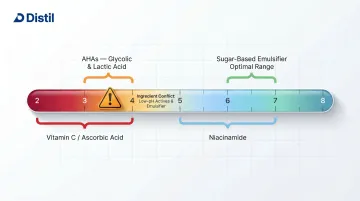
Test compatibility early and conduct accelerated stability testing at target pH.
4. Certification and Sustainability Requirements
If targeting COSMOS, Ecocert, or NATRUE certification:
- Emulsifier must meet standards from point of supply
- Sugar-based emulsifiers from traceable, non-GMO plant sources are strongest fit
- Require supplier documentation of natural origin and processing method
- RSPO-certified feedstocks required for palm-derived ingredients (Mass Balance minimum; Book and Claim not acceptable)
Distil supplies RSPO-certified feedstocks for sugar-based emulsifier production, including sucrose cocoate developed for personal care applications requiring clean-label compliance.
5. Commercial Scale Considerations
Beyond lab bench performance:
- Batch-to-batch consistency of emulsifier supply
- Scalable processing temperature requirements
- Supplier reliability and quality system controls
Specialty chemicals partners that offer application-specific formulation trials and scale-up support reduce development risk at every stage. Distil's R&D team — with formulation backgrounds spanning L'Oréal, BASF, and Dow — provides end-to-end support from lab to commercial scale, backed by unified quality systems that eliminate process drift and ensure consistent batch yields.
Common Selection Mistakes to Avoid
- Choosing based on DIY or lab-scale familiarity without validating at commercial scale
- Ignoring emulsifier concentration requirements (under-dosing = instability; over-dosing = poor skin feel and cost)
- Selecting based on single criterion (for example, only certification compliance) while neglecting full formulation compatibility
- Failing to account for electrolyte sensitivity in sugar-based systems
- Not protecting phospholipid systems with antioxidants
Conclusion
Natural emulsifiers are not interchangeable commodities. The three primary types — plant wax-based, phospholipid-based, and sugar-based glycolipids — serve distinct formulation purposes and produce fundamentally different emulsion architectures, with real consequences for skin performance, certification compliance, and commercial scalability.
Each class has a defined role:
- Plant wax-based emulsifiers — suited for stable O/W and W/O creams, solid formats, and cost-scalable production
- Phospholipid-based emulsifiers — preferred for active-loaded serums, liposomal systems, and skin-barrier repair claims
- Sugar-based glycolipids — optimal for mild, COSMOS-certified rinse-off and leave-on systems targeting sensitive skin
Choosing the right emulsifier means matching the ingredient class to emulsion type, product format, active ingredient system, and production scale. Early selection — before stability testing begins — avoids costly reformulation down the line.
Frequently Asked Questions
Do emulsifiers allow oil and water to mix?
Yes, emulsifiers enable oil and water to mix by positioning at the interface between the two phases. Their dual hydrophilic and lipophilic molecular structure stabilizes droplets and prevents separation, forming a uniform emulsion.
What are examples of natural emulsifiers?
Key examples include candelilla wax and rice bran wax (plant wax-based), sunflower lecithin (phospholipid-based), and cetearyl glucoside, sucrose stearate, and glyceryl stearate (sugar-based). The right choice depends on formulation type and certification goals.
What are natural emulsifiers for lotion?
O/W lotions are best formulated with sugar-based glycolipid emulsifiers (cetearyl glucoside, glyceryl stearate) or phospholipid-based emulsifiers like sunflower lecithin. These produce stable, fluid oil-in-water emulsions that are light, non-greasy, and pleasant on skin.
What is a good emulsifier for skin?
Phospholipid-based emulsifiers (such as sunflower lecithin) are highly skin-compatible because their structure mirrors the skin's own lipid bilayers, supporting barrier function and active ingredient penetration. This makes them ideal for sensitive, compromised, or high-performance skin care formulations.
Is coconut oil a natural emulsifier?
No, coconut oil is not an emulsifier. It is a carrier oil and emollient — it lacks the amphiphilic molecular structure (no hydrophilic component) needed to bind oil and water phases, and will not form a stable emulsion on its own.
What is the healthiest emulsifier?
"Healthiest" depends on context, but phospholipid-based emulsifiers — particularly sunflower lecithin — are the most biocompatible option for skin. Their structure mirrors lipids found naturally in skin cell membranes, making them less likely to cause irritation or disrupt the skin barrier.