Introduction
Today's emerging personal care brands live or die by their specialty ingredients. Biotech actives, fermentation-derived peptides, and rare botanicals are no longer nice-to-have additions—they're the foundation of consumer trust and brand credibility.
The problem is access. While a brand like L'Oréal can call Croda or Evonik and secure bulk shipments of cutting-edge actives, most emerging brands hit the same wall: supplier minimums they can't meet, formulation expertise that's expensive to hire, and real IP exposure when sharing proprietary formulas during development.
That access gap is widening at exactly the wrong time. Specialty ingredients represent the fastest-growing segment of the personal care market, with active ingredients growing at least 50% faster than functional ingredients through 2026. Consumer expectations are rising in lockstep: 74% consider organic ingredients important, and 65% want clear ingredient lists to identify potentially harmful compounds.
This post maps the landscape of specialty ingredient sourcing for emerging brands — from understanding what makes an ingredient "specialty" to evaluating sourcing pathways and protecting IP while scaling quality.
Key Takeaways
- Specialty ingredients (biotech actives, novel botanicals, fermentation-derived compounds) are growing 50% faster than standard functional ingredients
- Emerging brands face high MOQs, limited supplier access, insufficient technical expertise, and IP exposure risk when sourcing directly
- Main sourcing pathways: direct suppliers, specialty distributors, toll manufacturers, and integrated R&D-plus-manufacturing platforms
- Evaluate partners on four criteria: formulation capability, quality systems, IP protection mechanisms, and scale-up track record without capex
- The right partner covers ingredient selection through commercial production — no capex, no fragmented vendor management
What Makes an Ingredient "Specialty" in Personal Care
Commodity vs. Specialty: The Performance Gap
Commodity ingredients—water, glycerin, basic emulsifiers, standard surfactants—are widely available, interchangeable, and compete on price. Any brand can access them from hundreds of suppliers. Specialty ingredients deliver unique or superior performance benefits: specific bioactivity, clinically demonstrated efficacy, novel sensory profiles, or sustainability differentiation. They're available only from select suppliers with proprietary or limited production processes.
The Key Categories Emerging Brands Seek
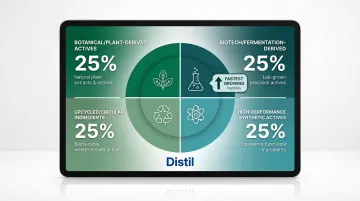
Emerging brands typically seek ingredients across four categories:
- Botanical and plant-derived actives: adaptogens, rare extracts, and high-potency plant compounds
- Fermentation-derived ingredients: biotech peptides, hyaluronic acid variants, and precision-fermented squalane
- Upcycled and circular ingredients: food-industry by-products repurposed as actives, a segment valued at approximately ₹2,490 crore (2025) and projected to reach ₹5,250 crore by 2035
- High-performance synthetic actives: compounds engineered for anti-aging, microbiome balance, or barrier repair
Botanicals and biotechnology actives each claim approximately 25% of the specialty actives market by value, with peptides and biotechnology representing the fastest-growing sub-segments.
The "Derived-Natural" Middle Ground
Ingredients that are more than 50% natural origin by molecular weight but produced through controlled chemical or biological processes sit between fully synthetic and fully natural. Under ISO 16128, these "derived-natural" ingredients hold the largest share of demand in the specialty actives market: perceived by formulators and consumers as close-to-natural, while offering superior stability and consistency. For brands deciding between botanical extracts and fermentation-derived alternatives, this distinction directly shapes positioning and formulation strategy.
Why Emerging Brands Struggle to Source Specialty Ingredients
MOQ Barriers Lock Out Small Players
Most specialty ingredient suppliers calibrate minimum order quantities for enterprise customers. For an emerging brand in early commercial stages, meeting thresholds of 100–1,000 kg either requires capital that could be deployed elsewhere or creates inventory risk. Industry data shows indie brands often struggle at the 100 kg threshold, while large brands routinely purchase 1–10 tons per batch. This forces many small brands to substitute with inferior alternatives or delay launch.
Supplier Access Is Relationship-Gated
Premium specialty ingredient suppliers prioritize brands that bring volume, procurement credibility, and technical dialogue. Without those signals, emerging brands are routinely deprioritized or redirected to distributors—adding cost and reducing information access. That friction compounds in a crowded field: more than 25% of all new brands launched globally are in beauty and personal care, and indie brands now hold 32% of the US beauty market—growing at 22.3% while supplier access remains structured for incumbents.
Lack of In-House Technical Expertise
Selecting a specialty ingredient means navigating multiple technical layers simultaneously:
- INCI naming conventions and regulatory frameworks (COSMOS, ISO 16128, FDA/EU)
- Application-specific performance requirements and concentration ranges
- Compatibility with other formula components
Most early-stage teams don't have a formulation chemist on staff, let alone dedicated regulatory or supply chain functions.
IP and Confidentiality Exposure
Sourcing specialty ingredients often means sharing full or partial formulations with suppliers, brokers, or contract manufacturers. Without explicit contractual protections, formulation know-how can be replicated, repurposed, or shared across multiple clients. Most supplier NDAs don't cover process-level detail—leaving the core of a brand's differentiation exposed.
Batch-to-Batch Consistency Failures
A specialty ingredient that performs beautifully in a 1-kg lab sample may behave differently at 50-kg or 500-kg production batches. Without a partner with dedicated QC systems and manufacturing oversight at scale, process drift compromises product quality—a costly and potentially launch-ending outcome for a company with no buffer for reformulation cycles.
How Specialty Ingredients Are Sourced: The Main Pathways
Sourcing Direct from Ingredient Manufacturers
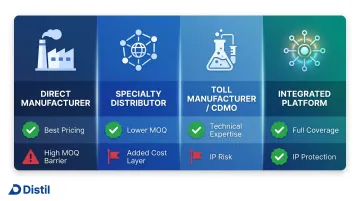
Going direct to manufacturers like Evonik, Ashland, Croda, or BASF—which together control over 50% of the specialty personal care ingredients market—gives brands the best pricing, most complete technical data, and earliest access to innovation. The tradeoff: direct relationships typically require volume commitments and a purchasing track record. This pathway works best for brands that have already reached meaningful commercial scale.
Working with Specialty Distributors and Ingredient Brokers
Distributors aggregate ingredients from multiple manufacturers and sell in smaller quantities, effectively lowering the MOQ barrier to 50-100 kg ranges. They're a practical starting point for emerging brands needing access to a range of ingredients without committing to large volumes. The limitations are real, though:
- Add a 5-12% cost layer on top of manufacturer pricing
- Offer limited application-specific technical support
- May represent competing brands within the same category
Engaging Toll Manufacturers and CDMOs
Contract development and manufacturing organizations develop formulations, source ingredients on the brand's behalf, and produce finished or semi-finished products. This pathway provides access to both technical expertise and manufacturing infrastructure. However, IP ownership is the critical variable—unless you contract it explicitly, the toll manufacturer retains the process know-how. Negotiate IP assignment clauses before engagement starts, not after.
Partnering with an Integrated Specialty Chemical Platform
Each of the pathways above requires brands to manage a tradeoff: pricing against volume, expertise against IP risk, or speed against control. An integrated platform is designed to remove that tradeoff entirely.
An integrated platform combines supplier network access, R&D-led formulation expertise, flexible manufacturing, and IP protection under a single point of contact. This model eliminates the need for emerging brands to manage multiple vendor relationships, build internal supply chain capability, or invest in manufacturing capex.
Distil operates on this model, with a 20+ supplier network and an R&D team drawing on experience from Dow, BASF, and L'Oréal. Brands access specialty ingredients and scale from lab to commercial production without building internal infrastructure.
The platform covers the full journey: ingredient selection, formulation trials, batch reporting, and commercial-scale delivery. IP is protected through process fragmentation and permission-based access controls, so brands retain full ownership of their formulations.
What to Look for When Evaluating a Specialty Ingredient Partner
R&D and Application-Specific Formulation Capability
The most important question: does the partner's technical team understand your category well enough to guide ingredient selection, run trials, and troubleshoot formulation challenges? Look for clear expertise in your specific application—hair care, skin actives, colour cosmetics—and evidence the team can tune ingredients to your performance and sustainability requirements.
Quality Systems and Batch Consistency Infrastructure
A partner sourcing from multiple suppliers or manufacturers must have a unified quality system that eliminates variation across sites and batches. Ask specifically:
- How do they manage process drift?
- What documentation do they provide on batch yields and quality metrics?
- Do they offer real-time visibility into production and supply chain status?
ISO 22716 compliance is the baseline—this standard governs production, control, storage, and shipment of cosmetic products, requiring batch traceability with unique numbering and documentation linking finished products to raw materials and production conditions.
IP Protection Mechanisms
Before sharing any formulation details, understand exactly how the partner controls and protects your data. Look for structural IP safeguards:
- No single party sees your full formulation (process fragmentation)
- Access to your data is restricted to authorized personnel only
- Contracts explicitly assign 100% IP ownership to you — not the manufacturer
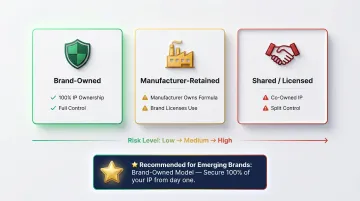
Three primary models exist: brand-owned (100% IP ownership), manufacturer-retained (manufacturer owns formula and licenses use), and shared/licensed (co-owned IP). If a partner pushes back on brand-owned terms, that's a signal worth taking seriously before you share any formulation details.
Scale-Up Track Record Without Capex Requirements
For an emerging brand, the ideal partner can take you from a 100g lab trial to a 500-kg commercial batch without asking you to invest in equipment or lock into a single manufacturing facility. An asset-light model draws on a broad network of manufacturing assets, letting scale-up follow demand rather than front-loading capital risk. In practice, that means:
- No minimum order quantities tied to a single plant's economics
- Flexibility to shift production volumes as your brand grows
- Scale milestones driven by sales, not sunk equipment costs
Protecting IP and Scaling Quality: What Emerging Brands Often Overlook
Protecting IP and Scaling Quality: What Emerging Brands Often Overlook
IP Risk Starts with Access, Not Paperwork
In most ingredient sourcing or toll manufacturing arrangements, formulation data passes through multiple hands — R&D staff, procurement teams, production operators. Contracts alone don't close that gap. Without deliberate access controls and process fragmentation built into the sourcing arrangement itself, IP exposure is structural. Emerging brands need to treat protection as an operational design requirement, not a legal afterthought.
Scale-Up Is Where Quality Problems Actually Appear
Most quality failures don't trace back to the ingredient — they trace back to how it behaves when batch sizes increase, equipment changes, or manufacturing sites vary. The lab-to-commercial transition is where process drift sets in. A partner with a unified quality system across their production network, and clear batch-level performance reporting, gives you the visibility to catch deviations before they become defects.
Both issues — IP exposure and process drift — are avoidable with the right due diligence upfront.
Practical Checklist for First-Time Sourcing Partnerships
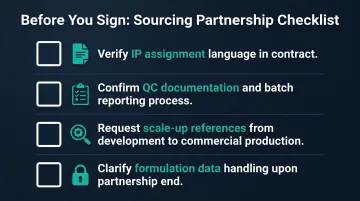
Before entering any specialty ingredient sourcing partnership:
- Verify IP assignment language in the contract
- Confirm the partner's QC documentation process and batch reporting cadence
- Ask for references from brands they have scaled from development to commercial production
- Clarify what happens to your formulation data if the relationship ends
Frequently Asked Questions
What ingredients are commonly used in personal care products?
Personal care formulas typically contain emollients (oils, butters, esters), surfactants, humectants (glycerin, hyaluronic acid), preservatives, and active ingredients (peptides, botanicals, vitamins). A typical cosmetic formula contains 15-50 ingredients spanning both commodity and specialty categories.
What is the 1% rule in skincare?
Ingredients present at 1% or less in a formula can be listed in any order after those above 1% on the INCI label. For specialty actives—often used at low concentrations for high efficacy—this directly shapes label order and the claims a brand can make.
How do emerging brands find specialty ingredient suppliers?
Discovery channels include industry trade shows (in-cosmetics Global drew 10,879 unique visitors in 2025 with over 1,000 exhibitors, PCHi in China), specialty ingredient distributor networks, direct outreach to manufacturers, and integrated sourcing platforms—a reliable starting point for brands that haven't yet built direct procurement relationships.
What is the minimum order quantity challenge for specialty ingredients?
Specialty ingredient MOQs are typically set for enterprise-scale buyers, making it difficult for early-stage brands to trial or commit to volumes. Distributors or integrated platforms that pool volumes across clients can help brands access specialty ingredients below standard thresholds.
How do I protect my formulation IP when working with a contract manufacturer?
Three measures matter most:
- IP assignment clauses in contracts confirming ownership belongs to the brand
- NDAs signed before any formulation discussion begins
- Process fragmentation so no single manufacturing partner holds the complete formula
What is the difference between a specialty ingredient and a commodity ingredient in personal care?
Commodity ingredients are widely available, interchangeable, and compete primarily on price (water, glycerin, basic surfactants). Specialty ingredients deliver unique efficacy, performance, or sustainability benefits —available from a narrower supplier set, at higher cost, but with real differentiation potential on the shelf.