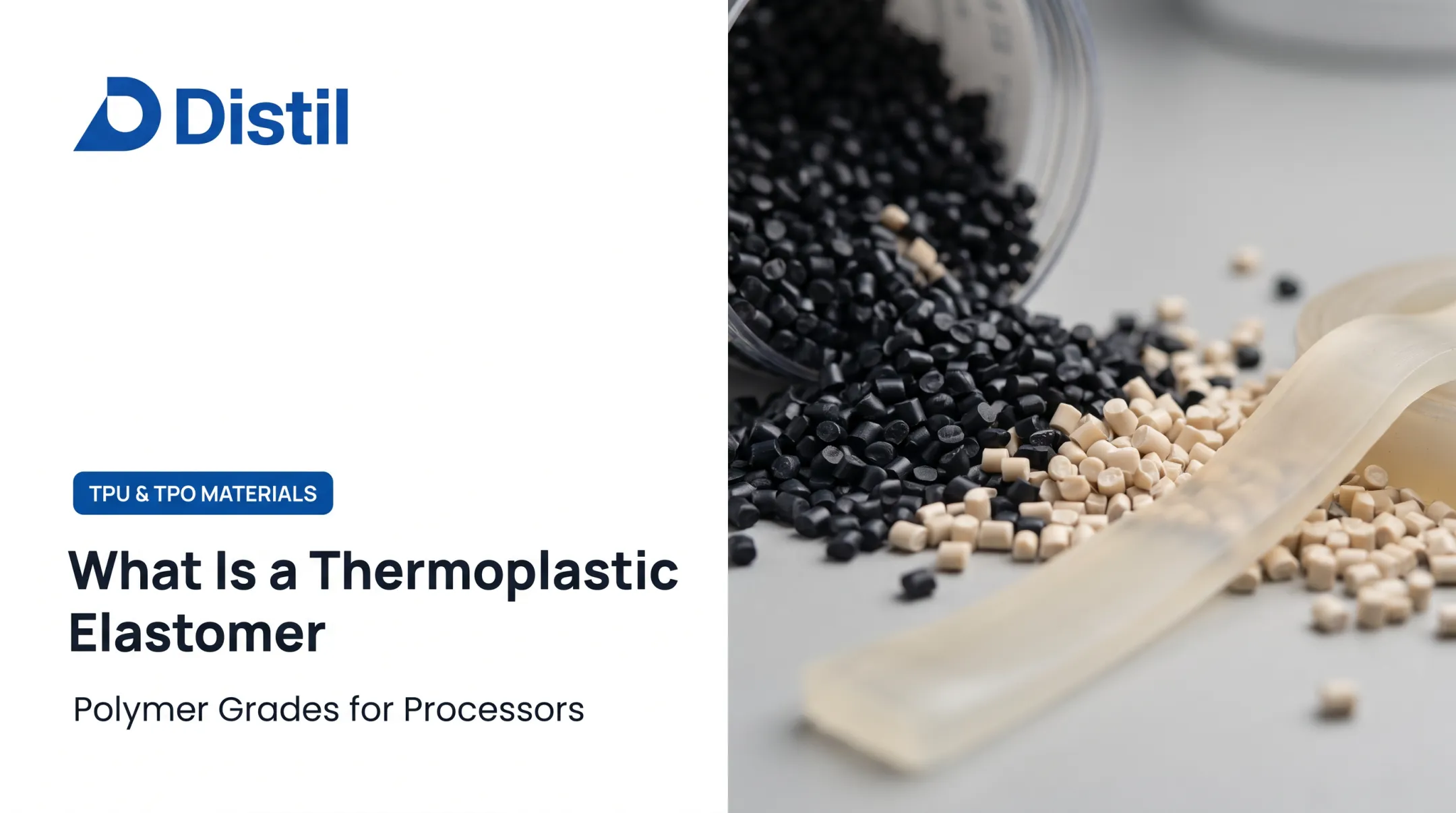

This guide covers what TPU is, how its grades differ, where it is used, how it is processed, and how to shortlist and source a grade. It applies to Indian plastics processors and OEMs working across automotive, footwear, medical, cable, packaging and 3D printing.
Key Takeaways
- TPU is a thermoplastic elastomer: elastic like rubber, processed like plastic.
- Chemistry, hardness, additives and grade all change performance, so read the datasheet.
- Check temperature, chemicals, hydrolysis, UV, processing route and compliance before shortlisting.
- Extrusion, injection moulding, film, overmoulding and 3D printing all work for TPU.
What Is Thermoplastic Polyurethane (TPU)?
Plastic or rubber?
TPU is technically a thermoplastic polymer and a member of the thermoplastic elastomer (TPE) family. It behaves like rubber in use but is not a conventional thermoset rubber.
TPE is the category. TPU is one polyurethane-based material within it, as classified under ISO 18064:2022. So "TPU versus TPE" is the wrong frame: TPU is a type of TPE.
Hard and soft segments
BASF describes TPU as a linear polyurethane built from long-chain diols, diisocyanates and short-chain diols. The soft segments give elasticity. The rigid segments give strength and stiffness.
Manufacturers tune the balance through raw-material choice, segment ratios and additives. The result ranges from soft, flexible grades to harder, engineering-type grades.
Thermoplastic behaviour and forms
TPU is held together by physical crosslinks. It softens when heated and hardens on cooling, so it can be melted and reshaped. Thermoset rubber uses chemical crosslinks that cure irreversibly.
Common forms include:
- Processing pellets
- Films and sheets
- Tubing, profiles and cable jackets
- Injection-moulded parts
- FFF filament and laser-sintering powder
Shore hardness and grade language
Shore hardness indicates softness or stiffness. Commercial datasheets often place flexible grades in the low-to-mid 80 A band:
- BASF Elastollan 1185 A10 W000: 83 A
- Lubrizol ESTANE D91T80 NAT01: 82 A
- Huntsman IROGRAN A85P4394: 85 A
BASF's full range runs from 60 Shore A to 74 Shore D.
Test methods and reading times differ between suppliers (ISO 48-4, ISO 868, ASTM D2240), so values are not strictly interchangeable. ASTM D2240 itself warns against simple relationships between hardness and fundamental properties.
Pair hardness with tensile strength, elongation, tear strength, abrasion, compression set and service conditions.
TPU Properties, Types, and Grades
Core mechanical properties
Each property prevents a specific failure:
- Tensile strength and elongation: tearing or snapping under stretch
- Tear resistance: nicks growing into splits
- Abrasion resistance: wear on rollers, soles and cable jackets
- Compression set: seals that stay squashed
- Resilience and impact absorption: cracking and transmitted shock
Representative named-grade values, not universal TPU figures:
| Grade / chemistry | Tensile | Elongation | Tear |
|---|---|---|---|
| Elastollan 1185 A10 W000 / polyether | 40 MPa | 700% | 50 kN/m |
| ESTANE D91T80 NAT01 / aliphatic PCL | 35 MPa | 700% | 82 kN/m |
| ESTANE 58271 NAT021 / polyester | 42 MPa | 650% | 60 kN/m |

The BASF grade also lists abrasion of 55 mm³ (DIN ISO 4649-A) and compression set of 20% at 23 °C/72 h, rising to 35% at 70 °C/24 h. Always note the test method and conditions when comparing.
Thermal, UV and surface performance
Many TPU grades stay flexible in the cold, but continuous-use temperature, short-term heat and cold-cracking behaviour must be verified per grade.
On UV, Covestro notes that general-purpose (aromatic) TPU can yellow, while aliphatic diisocyanate chemistry avoids UV-induced yellowing. That is not an outdoor-life guarantee. Outdoor parts still need stabilisers, coatings or specific qualification.
Chemical, hydrolysis and electrical performance
TPU generally resists oils and greases, but compatibility depends on chemistry, hardness, temperature, concentration and exposure time. Concentrated acids and alkalis can decompose it, aromatic hydrocarbons can cause swelling, and solvents such as DMF, DMSO, NMP and THF can dissolve it.
Water resistance is not hydrolysis resistance. Water can cleave ester linkages in polyester grades under hot, wet conditions and cut molecular weight and properties. That is why polyether grades are often preferred for prolonged moisture. BASF also points to their low-temperature flexibility and microbial resistance.
For electrical use, BASF cites low conductivity and insulation applications, but behaviour shifts with moisture, temperature and frequency.
Polyester, polyether and PCL compared
| Chemistry | Typically strong in | Watch for |
|---|---|---|
| Polyester | Mechanical strength, heat, mineral-oil and abrasion resistance | Hot/wet hydrolysis |
| Polyether | Hydrolysis, low-temperature flexibility, microbial resistance | Grade-specific testing still needed |
| Polycaprolactone | Polyester-like toughness with better low-temperature and hydrolysis balance; used in seals | Not the same as polyether; check the named grade |
Treat any claim about biodegradability, medical suitability or environmental performance as formulation-specific, and ask for the relevant certificate.
Advantages and limitations
Advantages include:
- Flexibility and toughness
- Abrasion resistance and impact absorption
- Soft-touch feel and design versatility
- Compatibility with many processes
Limitations:
- Moisture sensitivity during processing
- Creep and compression-set concerns in sustained-load parts
- Grade-dependent heat resistance
- Possible UV ageing
- Cost can run higher than commodity plastics; compare quotes on matched grades
Where Is TPU Used?
Automotive and mobility
Covestro lists TPU films in sunroof-curtain laminates, lumbar-support bladders, headrests and armrests, and thermoformable automotive films.
Seals, hoses, bushings, cable protection and soft-touch trim follow the same logic:
- Abrasion resistance for moving parts
- Flexibility for tight routing
- Chemical resistance around fluids
- Impact resistance for protective covers
Lubrizol's ESTANE EV89AT9 targets EV charging cables (IEC 62893 / EN 50620).
Footwear, sports and consumer products
Covestro identifies TPU in ski, inline-skating, ice-hockey and hiking boots, with special Desmopan grades for cold impact and flexibility. Other uses include soles, insoles, grips, watch straps, phone cases, tool handles and wearables.
Resilience, cushioning, grip, transparency and tunable hardness shape comfort and design.
Nova TPU masterbatch from Distil, available in red, brown, grey and black, suits footwear and mobile cases with strong colour intensity and uniform dispersion.
Healthcare and medical
Covestro's 2025 healthcare article lists catheters, IV applications, gastric balloons, wound dressings and ostomy liners. Only appropriately tested medical grades belong here.
Treat these as separate requirements:
- Skin-contact suitability
- Biocompatibility
- Sterilisation compatibility
- Extractables testing
- Device regulatory approval
Covestro says its Rx series is engineered to meet ISO 10993 testing standards, but you must obtain the specific grade's test scope.
Wire, cable, electrical and electronics
TPU suits cable jackets, flexible wiring, sensor assemblies, connectors and protective housings.
Key requirements include:
- Flex fatigue and abrasion resistance
- Oil resistance and flame retardancy
- Insulation and low-temperature flexibility
A resin's flame-test result does not replace qualification of the finished cable construction.
Industrial, agricultural, packaging and 3D printing
- Hoses, belts, profiles and cable sheathing by extrusion
- Lubrizol's polyester ESTANE E855AB3 for high-grip belts and polyether ESTANE 58887 for food and elevator belts
- Breathable and liquid-barrier films
- Ultrafuse TPU 95A filament and Ultrasint TPU 88A powder for prototypes, fixtures, flexible enclosures and low-volume parts
Printed performance depends on printer, grade, drying and settings. Ultrafuse TPU 95A shows tensile stress of 44.2 MPa in XY versus 12.2 MPa in ZX.
How TPU Is Processed and Designed
Manufacturing routes
- Injection moulding: complex, high-volume parts. BASF's 1185 A10 W000 guide suggests 200-220 °C melt.
- Extrusion: tubes, cable jackets, profiles, belts.
- Film: flat film with chill-roll takeoff, or blown film.
- Blow moulding: melt-stable grades for hollow parts like bellows.
- Thermoforming: formable TPU films.
- Overmoulding: soft TPU over compatible rigid plastics. BASF flags polyolefins as unsuitable for this bonding route.
- 3D printing: low-volume or custom parts.
Take melt temperature, residence time, die or mould design, shrinkage and cooling from the grade's technical documentation. Filament, pellet and powder instructions are not interchangeable.

Design considerations
BASF names geometry, wall thickness, gates and moulding conditions as shrinkage drivers, plus post-shrinkage during annealing and storage. Covestro recommends uniform walls for extrusion.
- Use generous fillets and radii to limit stress concentration and tear starts
- Avoid abrupt thickness transitions
- Check draft and undercuts for release, as soft grades stretch
- For overmoulding, validate adhesion, shrinkage compatibility and surface preparation on the finished assembly
Moisture, finishing and quality control
TPU absorbs moisture, and wet pellets cause defects. Store in sealed packaging and dry before processing.
Drying settings are grade-specific. Elastollan 1185 A10 W000 specifies 80-90 °C for 2-3 hours to reach ≤0.02% water, while Ultrafuse TPU 95A filament calls for 70 °C for at least 5 hours. Treat these figures as grade examples only, not universal rules.
Validation typically covers:
- Dimensional inspection
- Tensile and tear testing
- Abrasion, chemical exposure and ageing tests
- Batch-to-batch consistency checks
Record moisture, conditioning, hardness method and time, and specimen orientation.
How to Select and Source TPU
Match the grade to the application
Build a requirements sheet covering:
- Hardness, flexibility, tensile and tear performance
- Compression set, abrasion and impact
- Temperature range, chemical exposure, hydrolysis and UV
- Electrical behaviour, colour and transparency
- Processing method and expected volume
Compare datasheets and test standards from several suppliers, then run application-specific trials. Never choose on hardness or price alone.
TPU versus alternatives
| Material | Key distinction |
|---|---|
| TPE | TPU sits inside this family; TPEs are not one property set |
| PVC | A tubing comparison finds TPU naturally flexible with superior abrasion resistance |
| Silicone | Saint-Gobain notes better heat and steam resilience, and possible swelling in solvents |
| Rubber | Lubrizol says TPU offers better abrasion resistance in many applications |
No single material wins every category. Silicone may suit extreme heat or inertness, while TPU suits abrasion, toughness and thermoplastic processing.
Reprocessing is conditional. BASF allows up to 30% regrind of clean, same-type material, while Covestro's extrusion guide advises against regrind. Follow the grade supplier, and keep scrap reuse separate from end-of-life recycling.
Supplier qualification and scale-up
Request the following from each supplier:
- Exact grade and revision, chemistry and hardness method
- TDS, SDS, batch traceability and processing guidance
- Compliance documents and written change notification
- Local availability and technical support
In India, BIS publishes a product manual for IS 17397 (Part 1):2022 covering TPU designation and specifications. Grand View Research estimates India's TPU market at USD 189.9M in 2025, growing to USD 376.0M by 2033. These are research-firm revenue estimates, not official tonnage.

Processors and OEMs sourcing TPU can work with Distil for material-selection support, samples and technical datasheets, with supply coordinated from trial quantities through commercial scale under a single point of contact.
Conclusion
TPU is not one uniform material. Performance depends on chemistry, hardness, additives, processing method and end-use conditions.
Before commercial scale-up:
- Define the operating requirements first
- Shortlist grades using verified technical data
- Run application-specific trials
- Work with a technically capable supply partner
Frequently Asked Questions
What is TPU material?
Thermoplastic polyurethane is a thermoplastic elastomer that combines rubber-like elasticity with plastic-like processability. Properties vary by grade.
What is TPU material used for?
Typical uses include automotive films and seals, footwear, phone cases, medical tubing and catheters, cable jackets, industrial belts, films and 3D-printed parts.
Is TPU material waterproof and UV resistant?
Both are formulation-dependent. TPU films can block liquid water, but long-term moisture needs hydrolysis-resistant chemistry. Aromatic grades may yellow in UV, while aliphatic grades resist it.
Is TPU material safe for human use?
It depends on grade, additives, contact type and certification. General skin contact differs from medical-device or food-contact approval, so request grade-specific documents.
Is TPU material a plastic or a rubber?
It is a thermoplastic polymer in the thermoplastic elastomer family. It behaves like rubber but is not a conventional thermoset rubber.
What are the mechanical properties of TPU material?
Typical traits are high elongation (about 650-720%, depending on grade), tensile strength of roughly 29-42 MPa, strong tear and abrasion resistance, and good resilience. Compression set and all values vary by grade.