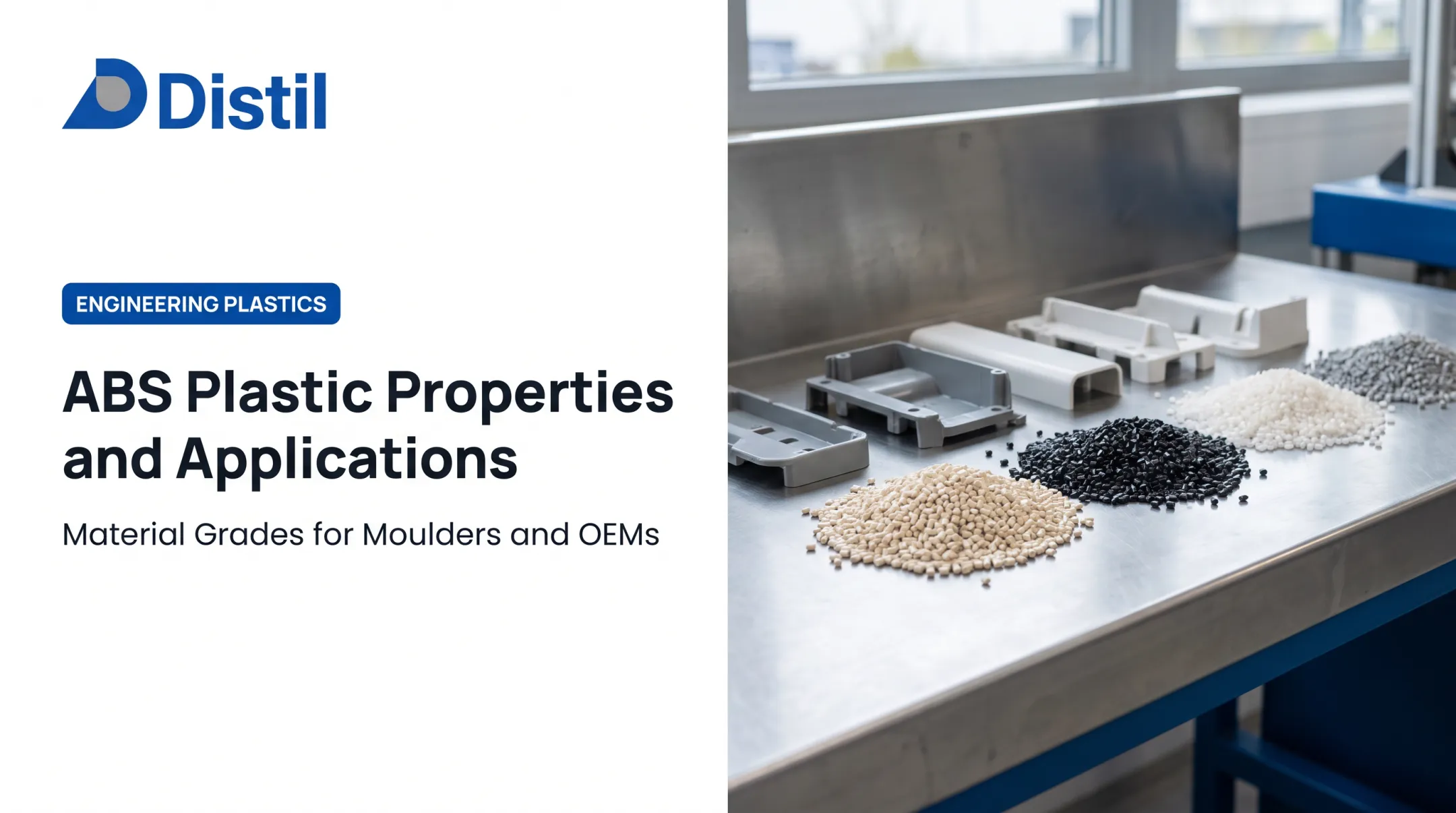

Choosing it is not simple, though. Teams struggle to pick the right grade, keep moisture and temperature under control, design for even filling and cooling, and judge whether ABS suits the product's heat, UV and chemical environment. Market scale is large: Grand View Research estimates global ABS revenue at USD 32.5 billion in 2025, across all processes.
This guide covers composition, properties, applications, the moulding stages, design rules, common defects, quality controls and supplier selection.
Key Takeaways
- ABS blends acrylonitrile, butadiene and styrene for balanced toughness, rigidity and processability.
- Drying, grade-specific temperatures and sound mould design decide part consistency.
- ABS suits indoor, automotive, appliance and electronic parts, but needs checks for UV, heat and solvents.
- A good supplier offers material verification, trials, batch consistency and traceability.
What Is ABS Injection Moulding?
What ABS means and how the material is structured
ABS is acrylonitrile butadiene styrene, an amorphous thermoplastic terpolymer. According to INEOS, each monomer contributes something different:
- Acrylonitrile: thermal and chemical resistance
- Butadiene: rubber-like ductility and impact resistance
- Styrene: stiffness and easy processing
ABS material versus the injection moulding process
ABS resin is the pellet or granule, supplied in a specific grade. Injection moulding is the process: melt the pellets, inject the melt into a closed mould, cool, then eject the part.
Same polymer, two different questions. One is about material selection, the other about process control.
Grades, additives and application-specific formulation
ABS is not one material. Manufacturers modify it for:
- High impact and heat resistance
- Flame retardancy and UV stability
- Antistatic behaviour and plating
- Colour and glass-fibre reinforcement
Lotte Chemical's STAREX range, for example, spans general-purpose, extrusion, flame-retardant, heat-resistant and metal-plating grades. Its general-purpose grades offer flowability and consistent surface quality.
Pick the grade from the technical datasheet and end-use requirements, not from habit.
ABS Properties, Benefits, Applications and Limitations
Key properties that influence material selection
Values below are for one representative grade, INEOS Terluran GP-22, per its datasheet. They are grade-specific, not universal ABS numbers.
| Property | GP-22 value | Method |
|---|---|---|
| Notched Charpy impact | 22 kJ/m² | ISO 179/1eA, 23 °C |
| Tensile modulus | 2300 MPa | ISO 527 |
| HDT | 94 °C | ISO 75, 1.8 MPa |
| Density | 1040 kg/m³ | ISO 1183 |
| Flammability | UL 94 HB | 1.5 and 3 mm |
| Mould shrinkage | 0.4-0.7% | ASTM D955 |
These are specimen results, not finished-part guarantees. HDT is a test result, not a continuous-use temperature.
Why manufacturers choose ABS
- Good flow fills detailed cosmetic parts with consistent surfaces
- Colour, paint, texture or plating options let one resin cover visible and decorative parts
- Impact strength with reasonable stiffness suits housings that get dropped and handled
- Mature supply and processing know-how keep production practical
Common applications
- Automotive: interior components
- Electronics: device housings and keyboards
- Appliances: washing machine and air-conditioner parts, refrigerator liners
- Tools and storage: cases such as the TANOS Systainer3 Eco, made with recycled-content GP-22
- Other: toys, electrical parts, cosmetics packaging and construction components
Healthcare use needs a purpose-tested grade. ELIX M203FC, for instance, declares biocompatibility for up to 30 days of contact, but finished-device suitability stays the device maker's responsibility. Sterilisation compatibility and regulatory review apply too.
Limitations
- Heat: performance drops as temperature rises
- Solvents: Toray's chemical table records swelling or partial dissolution with acetone, MEK and ethyl acetate
- UV and weather: standard grades are not for prolonged outdoor use; UV-stabilised grades exist
- Moisture: poorly dried resin causes surface defects
- Stress: internal stresses from uneven cooling can promote cracking
- Fatigue: verify with trials, since no general cycle-life figure applies
ABS compared with alternatives
Representative grades only, with different test methods and conditions, so treat this as a guide:
| Grade | Notched impact | HDT | Water absorption |
|---|---|---|---|
| ABS, Terluran GP-22 | 22 kJ/m² (Charpy) | 94 °C @ 1.8 MPa | 1% |
| PP, Moplen HP500N | 4 kJ/m² (Charpy) | 95 °C @ 0.45 MPa | Not reported |
| PC, Makrolon 2405 | 65 kJ/m² (Izod) | 124 °C @ 1.8 MPa | 0.3% |
| PA6, Ultramid B3S | 4 dry / 50 conditioned | 65 °C @ 1.8 MPa | 9.5% |
| HIPS, PS 454N | 8 kJ/m² (Charpy) | 78 °C @ 1.8 MPa | Not reported |
No material wins everywhere. PC offers more heat capability, PA6 swings sharply with moisture, and ABS sits in the middle with good finish. Compare on your own requirements and request cost data from suppliers.

The ABS Injection Moulding Process
Mould and part design before production
These factors are locked in before the first trial:
- Part geometry, wall thickness, ribs and bosses
- Gates, vents, runners and cooling channels
- Ejection, draft and shrinkage allowance
A design-for-manufacturing review at this stage is far cheaper than cutting steel again later.
Material preparation and drying
ABS absorbs moisture from air. Wet resin gives splay (silver streaks), bubbles, haze and weaker parts. For GP-22, guidance is 80 °C for 2-4 hours, with residual moisture below 0.1%. Always follow your own grade's datasheet, and check dryer dew point and residence time.
Melting, filling, packing and holding
Pellets feed into the barrel, plasticise, and are injected into the cavity. Then comes pack and hold: pressure compensates for shrinkage until the gate freezes. According to ELIX's injection guidelines, switch over at the right point to avoid overpacking, and hold until backflow is impossible.
- Too fast: shear, burning and trapped air
- Too slow: short shots and flow marks
- Poor gate design: weld lines and weak cosmetic quality
GP-22 melt temperature is 220-260 °C and mould temperature 30-60 °C. These are grade recommendations, not universal machine settings.
Cooling and ejection
Balanced cooling channels, suitable mould temperature and enough cooling time limit warpage and residual stress. Cooling time depends on wall thickness and temperatures, so validate it on the real part. Ejector pins need enough contact area to avoid puncture or distortion.
Inspection, finishing and repeat production
- Trim gates and check appearance, colour and surface
- Measure critical dimensions and run functional tests where relevant
- Record process settings and resin lot numbers
- Lock approved first-off settings as the baseline for scale-up

ABS Design and Processing Guidelines
Geometry and wall thickness
Keep walls reasonably uniform, transition gradually, add radii at corners, and design ribs and bosses so they do not cause sink on the visible face. For GP-22, draft of 0.5-1° is advised, with more for textured surfaces. Specific wall and rib ratios vary with grade and tooling, so confirm with the resin maker's design guide.
Gate, vent, flow and ejection design
- Gate location and size affect filling, weld lines, packing and shrinkage
- Narrow gates need higher temperature and pressure
- Vents release trapped air and prevent burn marks
- Balanced ejection stops parts being pushed out before they stabilise
Temperature, pressure and speed
Set these from the datasheet, then confirm in trials:
- Melt and mould temperature
- Injection speed, hold pressure and back pressure
- Screw speed and cooling time
Published ranges are starting points only.
Shrinkage, tolerances and stability
GP-22 shrinks 0.4-0.7%, with negligible post-shrinkage. Packing, cooling balance, grade and reinforcement all move that number. Glass-fibre grades (LOTTE lists 10, 20 and 30% GF) behave differently.
For tolerances, ISO 20457:2026 replaced the 2018 edition, so state the edition on drawings. It excludes surface imperfections such as sink marks. Tighter-than-commercial tolerances need extra process control and inspection.

Surface finish, colour, additives and outdoor exposure
Texture, gloss, colour matching, painting and plating all affect appearance. These additives and fillers can change flow, shrinkage, strength and processing:
- Flame-retardant packages and UV stabilisers
- Mineral or glass reinforcement
- Recycled content
Retrial after any additive or finish change.
Quality Control, Defect Prevention and Choosing a Partner
Common defects and corrective checks
Based on Entec and ELIX troubleshooting guidance:
| Defect | Likely cause | First check |
|---|---|---|
| Short shot | Low injection velocity | Raise velocity before gate freeze |
| Sink marks | Insufficient holding | Hold longer or at higher pressure |
| Warpage | Differential shrinkage | Lower melt temperature, extend cooling |
| Weld lines | Flow or gate geometry | Raise mould temperature, check venting, move gate |
| Flash | Low clamp force, high cavity pressure | Increase clamp or cut hold pressure |
| Burn marks | Excess speed or trapped air | Reduce velocity, check vents |
| Splay | Moisture | Check dryer dew point and time |
| Bubbles | Underpacking | Raise pack pressure or time |
| Discolouration | Thermal or shear burning | Lower melt temperature, screw speed or back pressure |
| Flow marks | Low melt temperature | Raise within the grade's window |
Also rule out contamination: ABS is melt-incompatible with most polyolefins, polystyrenes and polyamides, which can cause delamination.
Quality and supply-chain controls to request
- Resin grade, batch records and certificates of analysis
- Moisture-control records
- Colour standards and mould-trial reports
- Dimensional inspection plan and process-window documentation
- Lot traceability, non-conformance handling and change control
IATF 16949 and PPAP are useful automotive quality signals, but they are not ABS product approvals. BIS's ABS manual sets lot marking requirements under its certification scheme, which does not prove any particular supplier is certified.
When an integrated polymer and manufacturing partner adds value
Product teams often juggle resin suppliers, processors and testing. One accountable partner can simplify application trials, batch-yield visibility, scale-up and IP protection.
Distil is an R&D-led, asset-light specialty chemicals platform based in Mumbai, with a Navi Mumbai R&D base.
It offers:
- Application-specific tuning and trials through a dedicated R&D team
- A single point of contact from lab to commercial scale
- Customer ownership of data
Its portfolio includes ABS resins and other engineering plastics such as Lotte Chemical STAREX grades, with material-selection support. It supplies materials to processors and OEMs; it does not do contract moulding.
Frequently Asked Questions
What is ABS moulding material?
ABS is acrylonitrile butadiene styrene, a thermoplastic supplied as pellets in many grades. The material is the resin; injection moulding is the process that shapes it.
What are the common uses of ABS moulding material?
Automotive interiors, electronics housings, appliances, tools, toys, industrial covers and electrical parts. Grade and compliance needs depend on the end use.
Is ABS moulding material harmful to health?
Risk depends on grade, additives, exposure and processing. ELIX's 2026 SDS classifies its ABS pellets as not hazardous under CLP, but overheating can release harmful substances, so ventilate. Check the SDS and regulatory documents for your grade.
Is ABS moulding material recyclable?
ABS is a recyclable thermoplastic, and recycled-content grades exist, such as GP-22 MR70 with 70% post-consumer content. Real-world recycling still depends on collection, sorting, contamination, colourants and additives, so not every ABS product gets recycled.