
Buyers still stumble in two places. They compare ABS with PC/ABS, ASA or polypropylene without grade-level data. Or they confuse ABS pellets with ABS filament and "ABS-like" photopolymer resin used in 3D printing, which is a different material.
This guide covers composition, properties, applications, grades, processing, limitations, recycling and how to select and source ABS in India.
Key Takeaways
- ABS is acrylonitrile butadiene styrene; each monomer shapes a different property.
- Strengths: impact resistance, surface quality, easy processing, electrical insulation.
- Weak spots: UV, certain solvents, heat limits, flammability and fumes.
- Always compare grade-specific datasheets, never "ABS" as a family.
What Is ABS Resin Plastic?
ABS is an amorphous engineering thermoplastic. It is not three plastics mixed together. Per Saint-Gobain's materials overview, it has a continuous styrene-acrylonitrile (SAN) matrix with dispersed polybutadiene rubber particles, grafted to the matrix.
What each component does
- Acrylonitrile: thermal and chemical resistance
- Butadiene: the rubber phase, giving ductility and impact resistance
- Styrene: stiffness and processability
How it is made
Producers typically use one of two routes:
- Mass (bulk) polymerisation: styrene and acrylonitrile polymerise in the presence of a rubber substrate
- Emulsion: polybutadiene latex is made first, then styrene and acrylonitrile are grafted onto it
Compounding then adds stabilisers, lubricants, pigments and other modifiers to create grades.
Resin, part and filament
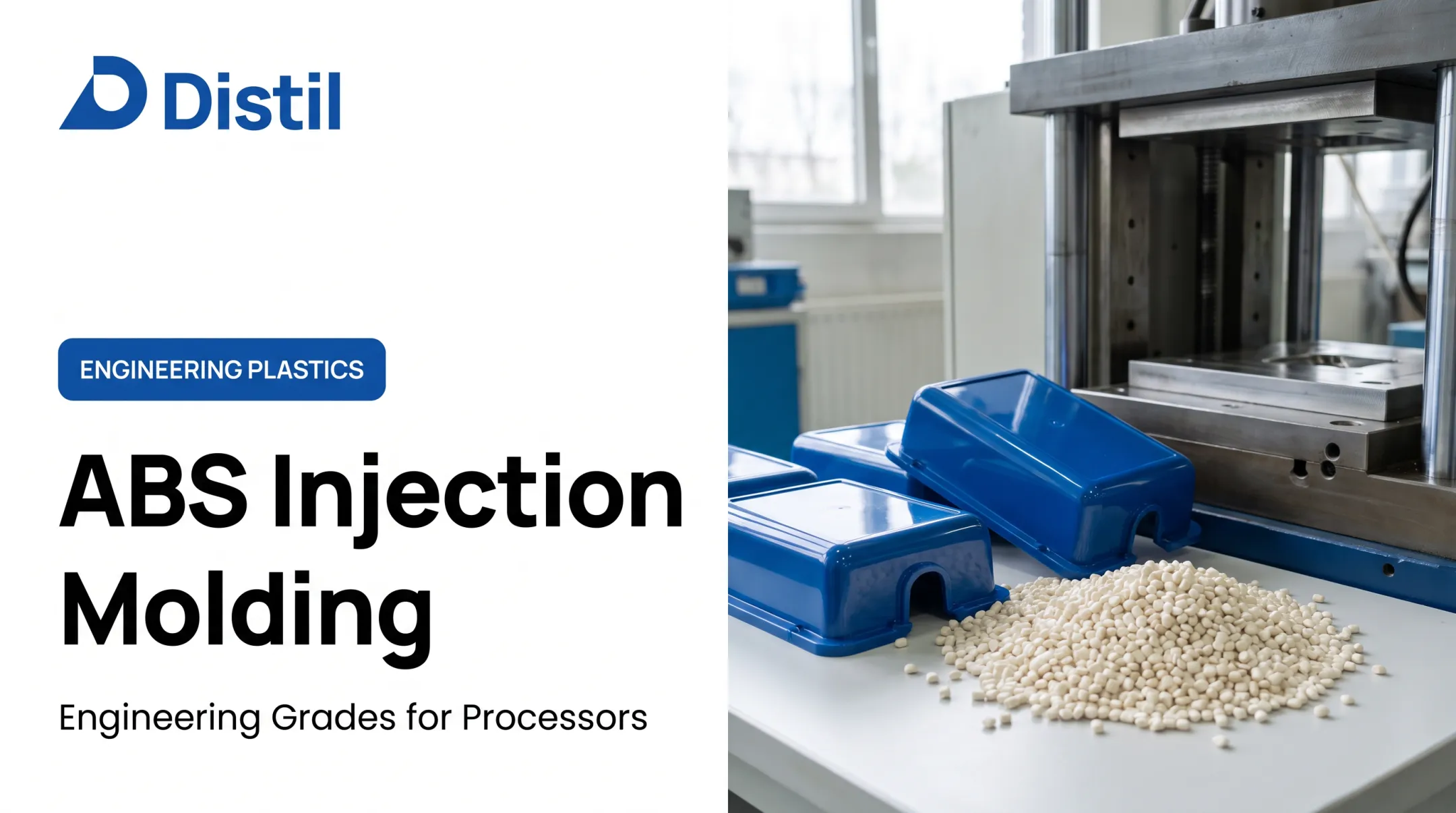
- Pellets: the raw resin for injection moulding and extrusion
- Sheets and profiles: extruded or thermoformed products
- Filament: thermoplastic feedstock for FDM printing, remeltable like the pellets
- Finished part: the moulded or machined component, whose properties depend on grade and process
"ABS-like" SLA resin is a UV-cured photopolymer. Formlabs explains that it is not conventional ABS, so a similar name guarantees neither the same chemistry nor the same performance.
Lotte Chemical lists its STAREX ABS Resins separately from its ABS alloys and transparent MABS, which are different materials.
ABS Resin Properties: Advantages and Limitations
Mechanical, thermal and electrical behaviour
Datasheet values vary by grade and test method. Here are producer benchmarks:
| Grade | Tensile modulus / yield | Notched impact | HDT (1.8 MPa) | Flammability |
|---|---|---|---|---|
| INEOS Terluran GP-22 (general purpose) | 2300 MPa / 45 MPa | Charpy 22 kJ/m² | 94 °C | UL 94 HB |
| INEOS Novodur HH106 (high heat) | 2400 MPa / 51 MPa | Charpy 16 kJ/m² | 99 °C | UL 94 HB |
| LG Chem AF312C (flame retardant) | Flexural 2200 MPa / yield 42 MPa | Izod 22 J/m | 74 °C (6.4 mm) | UL 94 V-0, 2.5 mm |

These are typical values from INEOS's GP-22 datasheet and other producer datasheets, not specification limits. Charpy and Izod, and tensile and flexural modulus, are not interchangeable.
Vicat softening (106 °C for HH106) is also not HDT or a continuous-use temperature.
Electrical insulation is a strength. GP-22 shows volume resistivity above 10¹³ ohm·m, and HH106 has a CTI of 600. GP-22 absorbs about 1% water, so conditioning matters.
Why designers like it
- Takes colour and gloss well
- Can be machined, drilled and die-cut
- Accepts painting and electroplating
Limitations of unmodified ABS
- Weathering: unsaturated polybutadiene oxidises under heat, light and oxygen, so outdoor performance is poor
- Stress cracking: solvents and cleaners on stressed areas cause crazing, whitening and cracks
- Heat: limits differ by grade
- Fire: ordinary grades keep burning after flame removal, and combustion releases irritating or toxic fumes
Stabilisers, flame retardants, pigments and glass reinforcement address these issues but can shift flow, appearance or processing. Test each trade-off for your grade.
Recycling and end of life
Clean, separately collected ABS can be reground and remelted. INEOS sells Terluran GP-22 ECO grades with 50% or 70% post-consumer WEEE content.
In practice, paint, coatings, mixed materials and legacy additives hinder sorting and recovery. Resin code 7 ("Other") does not identify ABS or guarantee recyclability. Recyclability depends on grade, product design, collection and local infrastructure.
What Is ABS Used For?
Automotive and transport
Interior trim, bezels, housings and thermoformed sheet parts are common uses. High-heat grades suit cabins that get hot. Check UV and chemical exposure, and note that FMVSS 302 limits interior burning rate to 102 mm/min, which a UL 94 rating alone does not prove.
Electrical and electronics
Housings, enclosures and appliance parts rely on insulation and flame-retardant grades. LG's AF312C, for example, lists power switches, alarms, UPS units and security cameras. UL 94 is small-scale material testing, so finished products still need end-use testing.
Consumer, industrial and healthcare
- Toys, office equipment and tool housings
- Edgebands, profiles and thermoformed industrial components
- Non-invasive medical-device housings
Medical and food-contact uses need a specifically qualified grade with documented compliance, such as ISO 10993 or USP Class VI where relevant.
Supplier application lists mirror this spread. Lotte Chemical's STAREX ABS covers electrical and electronic products, home appliances, automotive parts, refrigerator liners, construction components and metal-plated decorative parts.
Processing route shapes the application
- Injection moulding: repeatable, complex parts
- Extrusion and thermoforming: sheets and profiles
- Machining: prototypes and low volumes
- FDM printing: selected prototypes and functional parts
ABS Grades, Additives, and Processing Methods
Grade families
| Grade type | Optimised for |
|---|---|
| General purpose | Flow and consistent surface |
| High impact | Toughness |
| High heat | Thermal performance |
| Flame retardant | UL 94 V-0 and similar |
| Plateable | Uniform etching for electroplating |
| Extrusion / mass ABS | Sheet and profile stability |
| Glass-reinforced | Rigidity |
Trade-offs are real: flow versus toughness, stiffness versus impact, flame rating versus appearance. STAREX ABS covers general-purpose, extrusion, flame-retardant, heat-resistant and metal-plating grades.
Additives matter too: impact modifiers, UV and heat stabilisers, flame retardants, glass or mineral fillers, pigments and processing aids. Each changes surface finish, density, shrinkage, recyclability and processing needs.
Injection moulding
Dry first, as the datasheet specifies. Producer figures vary by grade:
| Grade | Drying | Melt temp | Mould temp |
|---|---|---|---|
| GP-22 | 80 °C, 2-4 h | 220-260 °C | 30-60 °C |
| HH106 | 80 °C, 2-4 h | 230-270 °C | 30-60 °C |
| AF312C | 70-80 °C, 2-4 h | 190-230 °C | 40-70 °C |

Higher mould temperature generally improves gloss and weld-line strength and reduces internal stress and warpage. HI-10 linear shrinkage is 0.004-0.007 in/in. Always check the supplier's document for the exact window.
Other routes and finishing
- Extrusion and thermoforming: mass-ABS grades for sheet and profiles
- Machining: sawing, drilling, milling, turning
- FDM: filament, with its own conditions
GP-22 supports hot-plate, spin, vibration and ultrasonic welding, plus painting and vacuum metallisation. Coating solvents can cause stress cracking.
Datasheet values are guides, not batch acceptance limits. Validate the finished part under real heat, chemicals, UV, repeated impact and electrical loads.
How to Select and Source ABS Resin
Selection checklist
- Mechanical loads and impact exposure
- Operating temperature and service life
- Chemical contact and UV or outdoor exposure
- Electrical and flame requirements
- Appearance, wall thickness and joining method
- Manufacturing route
ABS versus alternatives
- PC/ABS: PC adds toughness and heat resistance, ABS adds processability
- ASA: better UV and weather resistance than ABS
- Polycarbonate: higher impact and HDT, transparent grades available
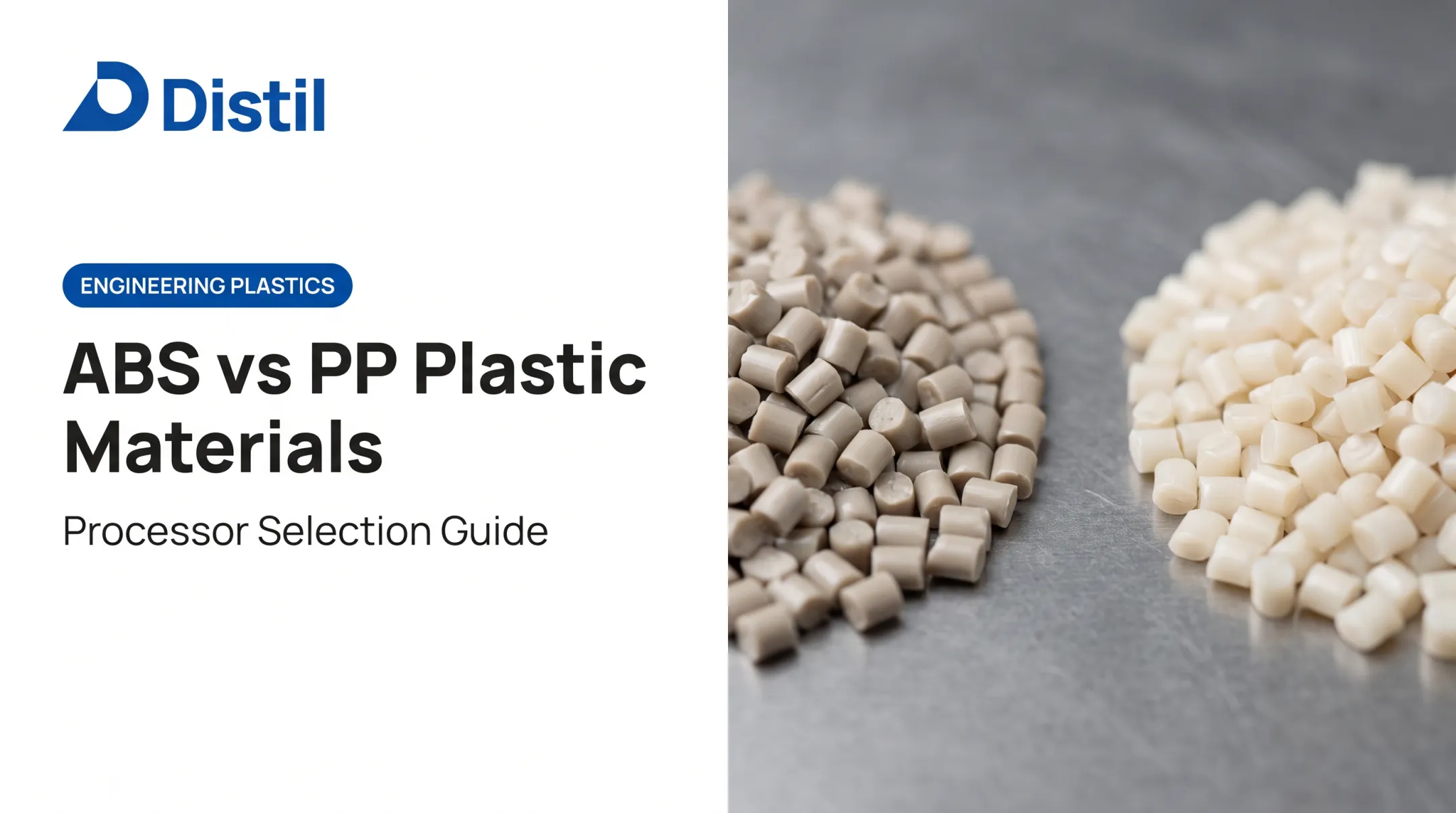
- Polypropylene: generally cheaper and more chemically resistant, less stiff
- HIPS: lower impact and slightly lower HDT than ABS
No universal winner exists. Compare current datasheets and run controlled tests on shortlisted grades.

Documents to request
- Technical data sheet and safety data sheet
- Certificate of analysis and lot traceability
- RoHS or other regulatory declarations
- Colour information and recycled-content disclosure
- Sample or trial material
Ask about lead time, minimum order quantity, supply continuity, formulation consistency and technical support. Also confirm current BIS requirements for ABS. A November 2025 notification (S.O. 5137(E)) rescinded the earlier ABS quality control order, so check what still applies before you lock a grade.
Where Distil fits
Distil is an R&D-led specialty chemicals platform supplying ABS and other engineering plastics. Its team runs application-specific trials, supported by a unified quality system, a partner manufacturing network and a single point of contact from lab to commercial scale. Processors and OEMs use that model to qualify materials and scale up. Confirm the specific ABS grade and its documentation before production.
Frequently Asked Questions
What is ABS resin?
ABS is acrylonitrile butadiene styrene, an amorphous thermoplastic used for durable, rigid, mouldable parts.
What is ABS used for?
Automotive interiors, electronics and appliance housings, consumer goods, industrial components and non-invasive medical housings. Grade choice depends on the service environment.
What are the properties of ABS material?
It offers impact resistance, rigidity, dimensional stability, good surface quality, easy processing and electrical insulation. UV and solvent sensitivity are key limitations.
How is ABS resin processed?
By injection moulding, extrusion, thermoforming, machining and selected 3D printing. Conditions such as drying and temperatures are grade-specific.
Is ABS resin recyclable?
Clean ABS can be mechanically reprocessed. In practice, paint, additives, contamination and collection infrastructure determine whether it actually gets recycled.