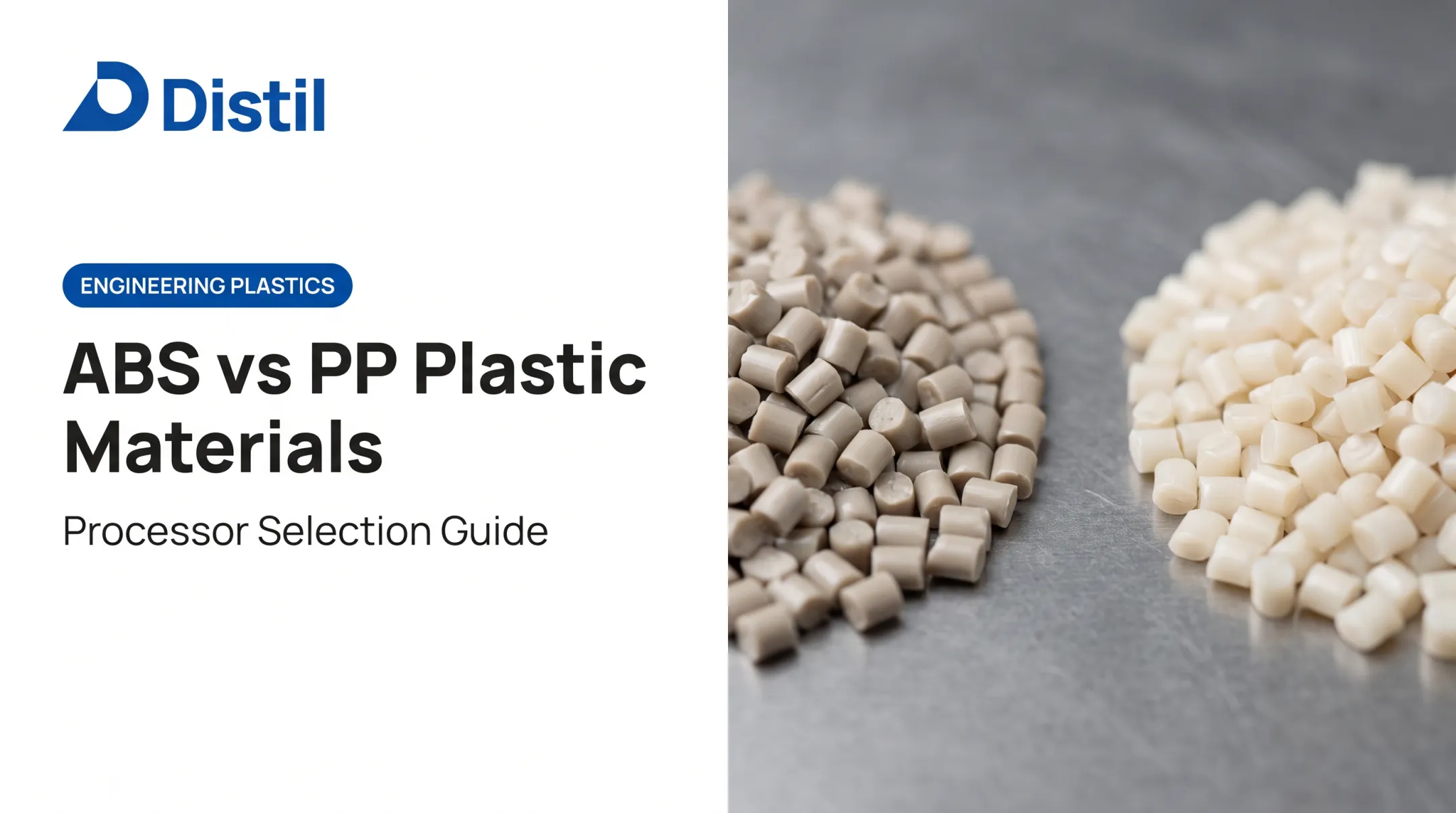

Mordor Intelligence estimates ABS resin demand at 9.35 million tonnes in 2025, so the material is everywhere. Yet many specification errors come from treating "ABS" as one product.
This guide covers what ABS is, how composition shapes performance, the properties that matter, where it is used, how to validate it, and the mistakes that cause field failures.
Key Takeaways
- ABS is a thermoplastic terpolymer, not a metal and not a single grade.
- Acrylonitrile, butadiene, styrene, additives and processing together set toughness, rigidity, finish and chemical resistance.
- Datasheet limits depend on grade, test method, load and exposure time.
- Test finished parts, not resin pellets, before release.
What ABS Plastic Represents in Polymer Systems
Acrylonitrile butadiene styrene (ABS) is an amorphous thermoplastic terpolymer. Because it is thermoplastic, it can be reheated and reshaped during moulding, extrusion and thermoforming.
Each monomer adds a distinct set of properties, according to INEOS Polymers:
- Acrylonitrile adds thermal and chemical resistance
- Butadiene adds ductility and impact resistance
- Styrene adds stiffness, processability and surface finish
Reported composition intervals are roughly 15-35% acrylonitrile, 5-30% butadiene and 40-60% styrene. These are formulation ranges, not one recipe.

A Family, Not a Formula
Monomer balance, rubber content, additives, colourants, flame retardants, UV stabilisers and reinforcement all change the property balance. Toray's glass-reinforced TOYOLAC grades show the trade-off clearly:
| Grade | Glass fibre | Tensile modulus (ISO 527) | Notched Charpy (23 °C) |
|---|---|---|---|
| 100G-10 | 10% | 5,100 MPa | 9 kJ/m² |
| 100G-20 | 20% | 7,300 MPa | 7 kJ/m² |
| 100G-30 | 30% | 9,600 MPa | 5 kJ/m² |
More fibre means a stiffer part and lower impact strength. These values belong to those grades and are not benchmarks for unfilled ABS.
Lotte Chemical's STAREX range illustrates the breadth: general-purpose, extrusion, flame-retardant, heat-resistant and metal-plating grades, plus alloys such as transparent MABS, ABS/PMMA and glass-fibre-reinforced ABS.
Factors That Influence ABS in Real-World Operation
Two parts made from the same resin can perform differently. Processing history and geometry explain most of the gap.
Design and Processing
- Weld lines: weak points that need better venting and gate placement
- Wall thickness: uneven walls cool unevenly and lock in residual stress; gradual transitions and rounded corners help
- Moisture: Toray ties poor drying to silver streaks and targets moisture below 0.1%, preferably 0.05%
- Mould temperature: Toray specifies 40-80 °C for general-purpose ABS; hotter moulds improve finish and reduce stress but lengthen cycles and can increase warpage
Moulded-in stress matters later too. A 120 °C, 4-hour deformation check is used on plated ABS to reveal moulding stress. It is a diagnostic, not a service rating or annealing recipe.
Load, Environment and Time
Short laboratory tests flatter long-term behaviour. Under sustained load, ABS creeps, and the rate depends on stress, time and temperature. Chemicals combined with stress can cause cracking.
UV exposure embrittles the surface. An accelerated UVA study found carbonyl formation and butadiene loss, though its 360 hours at 50 °C is not an outdoor lifetime prediction.
Range of ABS and Material Grades
ABS has no single operating range. It is an envelope set by temperature, load, chemical exposure, environment, process and service duration.
Nominal Operating Range
The values below are short-term heat deflection temperature (HDT) or Vicat softening figures. They are not continuous-service temperatures.
| Grade | HDT | Vicat |
|---|---|---|
| INEOS Terluran GP-22 (general-purpose) | 94 °C at 1.8 MPa; 99 °C at 0.45 MPa | 96 °C |
| INEOS Terluran HI-10 (high-impact) | 93 °C at 1.8 MPa | 90 °C |
| INEOS Novodur HH-112 (high-heat) | 102 °C at 1.8 MPa; 110 °C at 0.45 MPa | 111 °C |
| LG Chem AF366 (flame-retardant) | 87 °C at 1.82 MPa (ASTM D648) | n/a |
| UltiMaker FDM ABS | 86.6 °C at 0.455 MPa | 93.8 °C |

HDT uses ISO 75 unless noted, Vicat uses ISO 306 (50 N, 50 °C/h). Compare like with like: dry versus conditioned samples, filled versus unfilled material, and static versus dynamic loading all change the answer.
Boundary Limits and Safe Margin
Tensile, flexural, impact, HDT, dimensional, chemical, flammability and electrical limits are separate boundaries. No one number defines "safe".
Service ratings differ again. GEHR lists a maximum permissible service temperature of 70 °C for its ABS, referencing UL 746B.
LG's AF366 UL card (revised 2020) shows relative thermal indices of 60/60/60 °C at 1.5 mm but 85/85/80 °C at 2.0 mm. That card is a historical record, not a current listing, yet it shows how thickness changes the rating.
Design with margin below published limits. Operating near the edge risks:
- Warpage and lost stiffness
- Creep, cracking and embrittlement
- Colour change and dimensional drift
Grade Selection
Start from end-use requirements, then check:
- Mechanical load and impact
- Temperature range and cycling
- Chemical and UV exposure
- Finish, colour and regulatory needs
- Joining method, manufacturing route and service life
Terluran, Novodur, CYCOLAC and STAREX are supplier families. Category labels do not make grades interchangeable.
Key Technical Properties of ABS
ABS is useful because of balance across properties, not because any single one is exceptional. Mechanical, thermal, chemical, electrical, aesthetic and processing behaviour combine well in one material.
Impact Resistance, Strength and Toughness
The butadiene phase absorbs impact, though actual performance still depends on grade, temperature, notch geometry, weld lines and defects.
LG Chem's HF380 (unfilled, high-flow) gives grade-specific reference values:
| Property | Value | Method |
|---|---|---|
| Tensile yield strength | 45 MPa | ISO 527 |
| Flexural strength / modulus | 72 / 2,600 MPa | ISO 178 |
| Notched Izod, 23 °C | 24 kJ/m² | ISO 180/1A |
| Notched Izod, -30 °C | 9 kJ/m² | ISO 180/1A |

Note the drop at -30 °C. Also, ISO and ASTM impact results are not interchangeable: AF366 reads 200 J/m at 3.2 mm and 170 J/m at 6.4 mm under ASTM D256.
Thermal Behaviour and Stability
A part can stay intact yet lose stiffness and accuracy well below its melting point. Thermal expansion for GEHR ABS is 0.8 × 10⁻⁴ K⁻¹, which matters for fits against metal.
Wall thickness, mould temperature, cooling, annealing and thermal cycling all affect warpage and tolerances.
Chemical, Moisture and UV Resistance
Toray's data suggest dilute acids and alkalis are tolerated. Solvents are more aggressive:
- Acetone, methyl ethyl ketone and ethyl acetate cause swelling or partial dissolution
- Benzene and toluene swell the material
- 98% methanol and ethanol gave critical strains below 0.5% in stress-cracking tests
Chemical resistance is not the same as stress-cracking resistance. For outdoor use, evaluate a UV-stabilised grade such as SABIC's CYCOLAC MG47U, a coating, an enclosure, or another polymer.
Electrical and Flammability Performance
ABS insulates well. GP-22 shows relative permittivity of 2.9 at 100 Hz and volume resistivity above 10¹³ ohm·m. HH-112 offers electric strength of 41 kV/mm and CTI of 600. Frequency, humidity and thickness all affect these readings.
Flammability is thickness-specific. GP-22 is HB at 1.5 and 3 mm. AF366 is V-0 at 1.5 mm and V-0/5VA at 2.0 mm and above. Self-extinguishing behaviour is not overall fire safety.
Processability and Appearance
ABS processes cleanly across common routes:
- Moulding, extrusion and thermoforming
- Machining, painting and plating
- FDM printing
Higher melt temperature helps flow and gloss but can raise residual stress and cycle time.
How ABS Is Specified, Processed, Applied and Validated
Choosing ABS is a specification decision and a production decision. The grade must meet end-use needs and stay consistent at scale.
Specification and Documentation
A complete specification names:
- Grade, colour and additives
- Mechanical, thermal and flammability requirements
- Chemical exposure and dimensional tolerances
- Processing route and regulatory needs
- Standards: ASTM D4673-23, ISO 19062-1:2015, IS 17077 (Part 1):2019, UL 94
Separate typical from minimum values. LG states that AF366 data are typical reference values, not binding minimums. Demand test conditions, thickness, conditioning and revision-controlled supplier documents.
Verification and Process Control
Check tensile and impact behaviour, HDT, dimensions, colour and gloss, chemical resistance, insulation, flammability and surface defects. Move from lab validation to first-article inspection, process-capability checks, environmental simulation and field monitoring. Test finished parts, not just pellets.

Process windows differ by grade:
| Route | Manufacturer parameters |
|---|---|
| Toray GP ABS | Dry 80-90 °C for 3-5 h; melt 230-250 °C; mould 40-80 °C |
| Toray glass-reinforced | Dry 80-90 °C for 2-4 h; melt 250-270 °C; mould 70-90 °C |
| UltiMaker FDM | Nozzle 225-260 °C; bed 80-90 °C; enclosed printer |
Toray allows up to 20% same-grade, non-degraded regrind. That is a supplier allowance, not a universal limit. For thermoforming, machining and annealing, get grade-specific schedules from the supplier.
Common Applications
- Automotive: INEOS cites centre consoles, door panels and glove-box parts
- Appliances: food-processor walls and coffee-machine housings; STAREX is also used in refrigerator liners
- Toys: LEGO classic bricks
- Electronics: battery and PCB cases
- Pipes: GF ABS systems for process cooling and secondary refrigeration, rated -50 to +60 °C
- Healthcare: specific grades with USP Class VI and ISO 10993 data; this is grade evidence, not blanket approval
- 3D printing: useful for prototypes and functional parts, but needs ventilation, thermal control and layer adhesion. Prototype suitability is not certified end-use performance.
Selection and Scale-Up
- Define load and environment
- Shortlist grades
- Compare conditioned datasheets
- Prototype and test finished parts
- Confirm regulatory needs
- Validate the process before release
Distil supports polymer teams with material-selection support, application-focused grade matching, a unified quality system and an asset-light partner network for scale-up. Grade selection should still rest on verified supplier data.
Implications of Operating Outside the Recommended Range
Operating outside the recommended range shows up in predictable ways:
- Excess heat causes stiffness loss and warpage
- Sustained load causes creep
- Chemicals plus stress cause crazing
- UV exposure causes embrittlement and colour change
- Poor drying or processing leaves hidden weakness in the part
Compliance status can shift as well. When grade, colour, thickness, process or environment changes, reassess:
- Flammability and insulation: UL notes colour and thickness affect recognition
- Food contact: US 21 CFR 181.32 covers specific ABS uses under conditions, not every grade. In India, FSSAI's April 2025 packaging compendium sets an overall migration limit of 60 mg/kg or 10 mg/dm² (IS 9845)
- Healthcare: test packages apply to named grades, not finished devices
Common Misinterpretations of ABS in Practice
- Nominal value as absolute limit: HDT is not a service temperature
- All grades alike: HI-10 and HH-112 differ by 9 °C in HDT at 1.8 MPa
- Lab to field: Indoor 23 °C results do not transfer to outdoor, chemical or long-duration use
Property labels need the same scrutiny. Terms such as "impact-resistant", "heat-resistant", "recyclable" or "safe" need qualification by grade, test, exposure and use. Toray's regrind allowance shows reprocessability. ASTM notes that resin codes do not mean recycling systems exist.
A cheaper or easier-to-process grade, adopted without validation, hides risk in reliability, compliance and scale-up.
Conclusion
ABS is a practical material choice. Composition, grade, processing history and environment decide how it behaves. Reliable selection means reading limits in context, comparing application-specific data, testing finished parts and applying engineering judgement.
Frequently Asked Questions
Which is better, PVC or ABS plastic?
Neither wins universally. ABS leads on notched Charpy (>35 vs >8 kJ/m²), Vicat (≥90 vs ≥76 °C) and low-temperature range (-50 vs 0 °C). PVC-U is stiffer and suits water and chemical systems.
Is ABS plastic good quality?
It offers a strong balance of toughness, rigidity, finish, processability and cost. Quality still depends on grade, formulation, process control and end-use validation.
Is ABS plastic safe?
Safety in normal use differs from risks when burning, overheating or 3D printing. NIOSH recommends ventilated enclosures for printing. Food-contact and medical suitability are grade- and application-specific.
What are the different grades of ABS material?
Common types are general-purpose, high-impact, high-heat, flame-retardant, UV-stabilised, plating, extrusion, injection-moulding and 3D-printing grades. Naming varies by supplier, so compare datasheets.
Is ABS a plastic or metal?
ABS is a plastic: an amorphous thermoplastic terpolymer. Compared with metal, it is far lighter (1.04 vs 2.70 g/cm³) but much less stiff (about 2,210 vs 70,000 MPa modulus for 6061 aluminium).