Toll manufacturing is often discussed in terms of cost savings, but this framing misses the broader value. The real strategic advantages touch supply chain resilience, quality control, IP security, and speed to market — outcomes that compound over time when toll manufacturing is embedded as a supply chain lever rather than treated as a one-off fix.
This article explains the concrete, measurable benefits of chemical toll manufacturing and identifies when each advantage matters most in practice.
Key Takeaways
- Chemical toll manufacturing separates asset ownership from production — clients supply raw materials and IP while tollers handle equipment, processing, and conversion
- Capital avoidance alone can eliminate $85M+ in plant investment; additional gains include supply chain flexibility, retained quality control, and protected IP
- Personal care, polymers, agriculture, automotive, and packaging industries use tolling to scale production without carrying fixed infrastructure risk
- Treated as a standing strategic capability, toll manufacturing delivers compounding advantages across cost, speed, and supply chain resilience
What Is Chemical Toll Manufacturing?
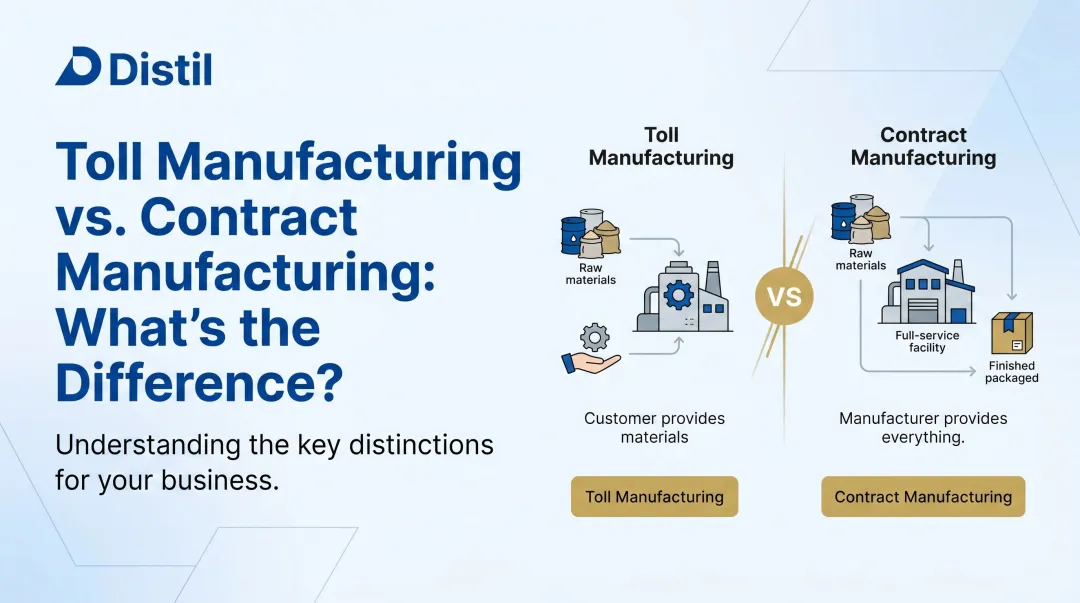
Chemical toll manufacturing is a production arrangement where a client company provides raw materials, formulation specifications, and intellectual property, while a toll manufacturer (toller) provides equipment, labor, and processing infrastructure. The toller charges a conversion fee rather than selling a finished product, and the client retains ownership of materials throughout the process.
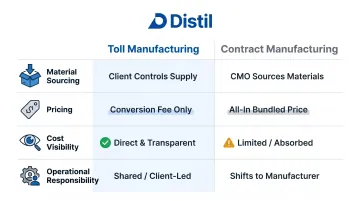
This differs from contract manufacturing in one key structural way:
| Toll Manufacturing | Contract Manufacturing | |
|---|---|---|
| Material sourcing | Client controls and supplies | CMO sources on client's behalf |
| Pricing | Conversion fee only | All-in price (materials bundled) |
| Cost visibility | Direct — client sees raw material costs | Limited — costs absorbed into single fee |
| Operational responsibility | Shared, client-led | Shifts to the manufacturer |
According to SOCMA's industry definition, a toller is "a company that sells its manufacturing capabilities" with "no chemistry development by the toller" — the customer provides a turnkey technical package and retains full IP ownership.
That distinction matters. Toll manufacturing is a deliberate choice for brands that want specialized processing capacity, formulation IP control, and production scale — without the capital commitment of owning the equipment themselves.
Key Benefits of Chemical Toll Manufacturing
The advantages below are tied to specific operational and financial outcomes and are most relevant to procurement, R&D, and supply chain decision-makers evaluating outsourcing options.
Capital Cost Avoidance and Faster Scale-Up
By engaging a toller, companies avoid upfront costs of equipment procurement, installation, engineering, permitting, and ongoing maintenance — accessing production-ready infrastructure on demand without capital commitment.
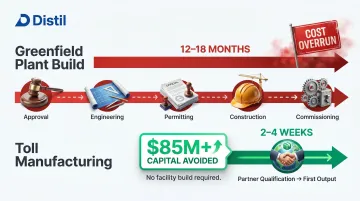
McKinsey data shows that 70% of greenfield chemical projects exceed budgets and 60% run over schedule. A specialty chemicals manufacturer in Maharashtra committed $85 million to build a greenfield plant with a 36-month timeline; by month 18, the project was 40% over budget and required $1.44 million in unplanned foundation work. The plant launched 11 months late and did not hit target OEE (overall equipment effectiveness) for 22 months.
Why this matters:
- Production begins in weeks, not months — versus the 12-18 months typical of capital projects from approval to first output
- Capital is preserved for R&D and customer acquisition — avoiding capex frees cash for growth activities, especially critical for brands in expansion phases
- Market windows stay open — you're not ceding ground to competitors while waiting on facility completion
KPIs impacted:
- Time-to-market
- Capital expenditure
- ROI on production assets
- Production ramp-up speed
- Cash conversion cycle
When this advantage matters most: This benefit is most impactful during new product launches, volume surges that outpace internal capacity, and for companies in growth segments (personal care, advanced polymers) that need to move fast without committing to fixed infrastructure.
Supply Chain Flexibility and Surety of Supply
Toll manufacturing lets companies qualify secondary or regional production sources. This builds redundancy against plant disruptions, raw material shortages, and unexpected demand spikes — without committing to additional owned capacity.
Procurement teams increasingly require multi-site sourcing for critical materials. A qualified toller acts as an approved backup — or primary — production source, providing flexibility to respond to demand without delay.
Why this matters:
- Single-source dependency creates unacceptable risk — downstream customers in regulated markets often contractually require multi-source qualification
- Pre-qualified tollers shorten crisis response time — 60% of companies are now building dual-supply capabilities in response to tariff impacts and supply volatility
- Lead time management reduces inventory costs by 15-25% — effective multi-source strategies directly reduce the cash tied up in safety stock
KPIs impacted:
- Supply continuity rate
- Lead time variability
- Customer service levels
- Inventory carrying cost
- Risk exposure score
Where this applies: Especially relevant in volatile raw material environments, post-COVID supply chain restructuring, cross-border sourcing risks, and for companies serving markets where supply interruptions carry contractual or regulatory consequences.
IP Protection and Retained Quality Control
Contrary to common concern, toll manufacturing does not mean surrendering control. The client retains ownership of the formulation, specification, and raw material sourcing decisions, while the toller executes conversion under a structured agreement.
Toll manufacturing agreements include NDAs and IP clauses that define ownership, restrict disclosure, and prevent the toller from competing using the client's formulation. According to Skadden legal guidance, well-structured agreements require non-compete covenants and internal controls for vetting and management.
Platforms like Distil add a further technical layer through process fragmentation, control layers, and permission-based data access. No single manufacturing partner sees the complete formulation — reducing IP exposure well beyond what an NDA alone provides.
What makes this work in practice:
- Retaining raw material sourcing control means controlling ingredient quality and cost — eliminates the margin opacity that comes with contract manufacturing's bundled pricing
- Client-specified inputs directly influence output quality — making toll manufacturing a quality assurance mechanism, not a quality risk
- Process fragmentation provides technical safeguards — complementing legal protections with operational controls that physically limit access to complete formulations
KPIs impacted:
- Batch consistency
- Formulation integrity
- Ingredient cost per unit
- IP dispute incidence
- Quality rejection rate
Best fit for: Specialty chemical segments with proprietary formulations — personal care actives, flavors and fragrances, advanced polymer blends — where formulation IP is the margin, and any exposure to a manufacturing partner carries direct commercial consequence.
What Happens When Toll Manufacturing Is Ignored or Mismanaged
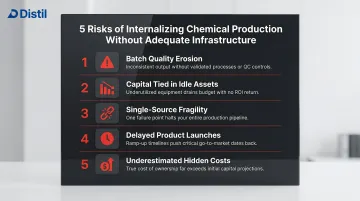
Companies that try to internalize all chemical production without the infrastructure, expertise, or capacity to do so face predictable consequences:
Batch quality erosion: Scaling from lab to commercial volumes without a unified quality system invites process drift. Fragmented coordination across internal departments creates variation that erodes customer confidence.
Capital tied up in idle assets: Chemical manufacturing capacity utilization sits at 74.9%, well below the 79.5% long-term average. Equipment bought for peak demand drags down ROI when demand cycles soften.
Single-source fragility: A plant disruption, compliance failure, or raw material shortage leaves no qualified backup in place. Major producers are already announcing billions in cost cuts and plant closures, raising the risk of discontinued product lines and longer lead times.
Delayed product launches: Internal production queues favor mature lines, pushing new formulations and niche chemistries to the back — costing revenue during critical launch windows.
Underestimated hidden costs: Skilled labor, maintenance, waste disposal, regulatory compliance, and safety liability accumulate in-house without the economies of scale a dedicated toller provides. Hazardous waste alone adds transportation fees, regulatory paperwork, high tipping fees, and ongoing waste profiling expenses.
How to Get the Most Value from a Chemical Toll Manufacturer
Toll manufacturing delivers maximum value when treated as a partnership rather than a transaction. This requires clear specification of outputs, consistent communication, and a toller with demonstrated capability in the relevant chemistry and application area.
Three conditions enable successful toll partnerships:
- The client defines quality parameters, batch yields, and scale targets upfront. Ambiguity creates rework and delays — precision in the brief accelerates execution at every stage.
- The toller provides real-time production visibility and communicates deviations proactively. A deviation flagged mid-batch costs time. The same deviation caught at final inspection costs a full production run.
- The relationship has a single point of accountability. One contact owning the journey from formulation trial to commercial delivery removes the coordination gaps that slow multi-toller setups down.
For brands operating across multiple segments — personal care, advanced polymers, flavours and fragrances — managing several tollers simultaneously introduces real coordination risk. Platforms like Distil address this by combining R&D-led formulation, 20+ vetted manufacturing partners, and a unified quality system under one engagement.
Beyond operational simplicity, Distil's permission-based access controls and process fragmentation model protect customer IP more rigorously than standard NDAs — a meaningful consideration when moving proprietary formulations into external production.
Conclusion
Chemical toll manufacturing is a strategic lever — one that compounds in value as volume grows. Done well, it controls quality, protects IP, scales production without capex, and builds the kind of supply chain resilience that holds up under pressure.
As specialty chemical markets grow more competitive and supply chains more complex, the brands that treat toll manufacturing as an ongoing operational strategy — rather than a one-time fix — will be best positioned to scale reliably, respond faster, and protect what makes their formulations valuable.
The structural advantages are concrete: avoid $85M+ greenfield investments, compress time-to-market from 18 months to weeks, qualify backup sources before disruptions occur, and retain full control over formulation IP and ingredient quality.
The brands winning in specialty chemicals aren't building more plants — they're building smarter partnerships. How you structure those relationships determines whether toll manufacturing becomes a tactical shortcut or a durable competitive advantage.
Frequently Asked Questions
What is chemical tolling?
Chemical tolling is the practice of a client supplying raw materials and IP to a toll manufacturer, which processes or converts them for a fee. The client retains ownership of the formulation and finished product throughout the engagement.
What is the toll manufacturing process?
The typical process follows four steps:
- Client supplies raw materials and formulation specs to the toller
- Toller processes and converts materials using its equipment and labor
- Finished product is returned to the client or shipped directly to their customers
- Toller invoices a conversion fee based on equipment utilization time
What are toll manufacturing costs?
Toll manufacturing pricing is typically based on conversion fees tied to equipment utilization time, plus any agreed ancillary costs (storage, waste handling). The client bears raw material costs separately, giving them full visibility into ingredient spend and removing the hidden costs common in bundled CMO pricing.
What is a manufacturing tolling agreement?
A tolling agreement is a formal contract between a client and toller that defines the scope of conversion, IP ownership, confidentiality obligations (NDA), quality standards, liability, and payment terms. Well-structured agreements also include non-compete covenants and tiered IP disclosure controls to protect proprietary formulations.
What is the difference between contract and toll manufacturing?
In toll manufacturing, the client supplies raw materials and retains direct cost control; in contract manufacturing, the CMO procures materials and charges an all-in price. Tolling is preferable when the client wants tighter quality oversight, cost transparency, and full IP ownership.
What is a toll manufacturing company?
A toll manufacturing company (toller) is a specialist manufacturer that processes client-supplied materials using its own equipment and labor, without owning the underlying formulation or competing in the client's market. The toller sells manufacturing capabilities, not finished products.