Introduction
When a personal care brand hands its proprietary zinc oxide UV filter formulation to an outside toll manufacturer, the NDA is typically the primary legal defense protecting years of R&D investment. In specialty chemicals, formulations are the core competitive asset — often more valuable than brand equity itself.
Unlike commodity chemical production, toll manufacturing requires deep IP sharing: the client supplies raw materials and detailed process parameters, giving the manufacturer direct access to a product's most sensitive technical details. This structural transparency makes confidentiality non-negotiable.
A single breach can expose formulation ratios, synthesis parameters, or supplier identities that took years to optimize. Trade secret litigation globally — including U.S. cases with awards in the hundreds of millions — reflects how seriously courts treat these violations. Yet specialty chemical formulations are often impossible to patent fully, making NDAs and operational controls the only viable legal shield available.
This article covers the types of IP at risk in toll relationships, the clauses every chemical toll manufacturing NDA must contain, structural protections that go beyond legal documents, and how to evaluate a toll partner's true commitment to confidentiality before you sign.
Key Takeaways
- The client retains full ownership of formulations, process parameters, and raw material specifications—the NDA must explicitly confirm this
- A strong NDA defines confidential scope, restricts access, survives contract termination, and specifies governing jurisdiction
- Legal agreements alone are insufficient; operational safeguards such as process fragmentation and need-to-know access controls are equally important
- Evaluate a toll partner's confidentiality culture—NDA responsiveness, employee training, and track record—before signing
Why Confidentiality Is Non-Negotiable in Chemical Toll Manufacturing
Toll Manufacturing Creates Structural IP Exposure
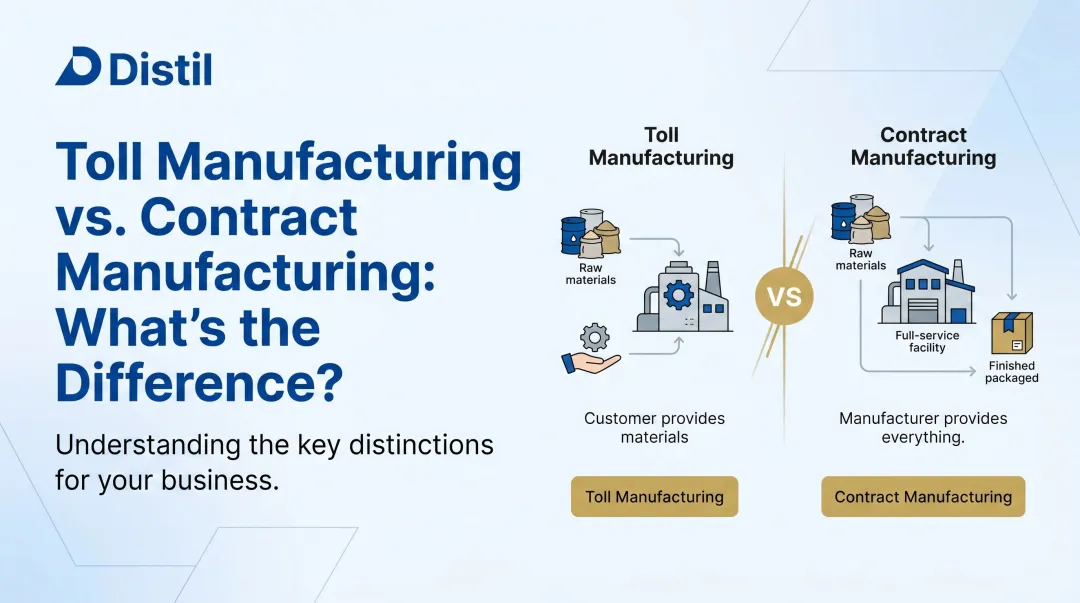
Toll manufacturing is structurally different from standard outsourcing. In a toll arrangement, the client purchases and supplies raw materials while the toll manufacturer provides production equipment, skilled labor, and facilities to process those materials to the client's specifications. The intellectual property of the formulas remains with the client company.
This differs from contract manufacturing, where the external manufacturer controls all raw material sourcing and bears full production responsibility. In toll manufacturing, the manufacturer gains direct visibility into the most proprietary elements of the product—making the confidentiality risk meaningfully higher than in arrangements where the manufacturer controls inputs.
At SOCMA's 2022 Specialty & Custom Chemicals Show, panelists from Evonik, BASF, and Dow described toll manufacturers as "plants that are part of our organization that we just happen not to own," confirming the deep operational integration—and therefore IP exposure—inherent in tolling relationships.
Categories of IP Most Exposed in Toll Relationships
Specialty chemical toll manufacturing exposes several critical categories of intellectual property:
- Finished formulation recipes and ratios - The exact proportions of active ingredients, carriers, and additives
- Synthesis or blending process parameters - Temperature settings, reaction times, mixing speeds, cooling rates
- Analytical test methods - Proprietary quality control protocols and acceptance criteria
- Raw material supplier identities and pricing - Sourcing relationships and negotiated costs
- Batch yield data - Process efficiency metrics that reveal optimization levels
Each category represents competitive intelligence. While individual elements might be publicly known, the unique combination—arrived at through significant time, effort, and investment—is eligible for trade secret protection.
Multi-Partner Models Compound Exposure Risk
Those IP categories become harder to protect once multiple manufacturing partners are involved. In asset-light models, each node in the production network is a potential exposure point—and contractual controls alone aren't enough without structural safeguards built into how work is distributed.
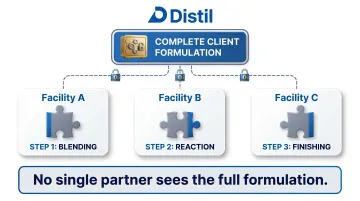
For example, Distil operates an asset-light model with 20+ manufacturing partners across India. To prevent any single partner from gaining full visibility into a client's complete formulation, Distil employs process fragmentation, dividing production into discrete steps distributed across multiple facilities. No single partner has access to the entire formulation or complete process parameters.
Why Trade Secret Protection Often Beats Patents
IP loss in specialty chemicals is particularly damaging because formulations are often difficult or impossible to patent fully. Patents require public disclosure and last only 20 years, while trade secret protection lasts as long as the information remains secret.
In chemical manufacturing, it is often "almost impossible" to determine the specific process used to create a final product by analyzing that product. A patent owner may never know a competitor is infringing their process—which is precisely why trade secret protection, backed by enforceable NDAs, tends to be the more practical shield.
Recent U.S. trade secret verdicts demonstrate extraordinary financial exposure under the Defend Trade Secrets Act (DTSA):
| Case | Award | Context |
|---|---|---|
| Propel Fuels v. Phillips 66 | $604.9M compensatory + $195M exemplary | Chemical/fuel formulations |
| DuPont v. Kolon Industries | $920M jury award (later settled) | Kevlar fiber technology |
| Pennsylvania baking chemicals case | $7.25M | Proprietary formulas and manufacturing processes |
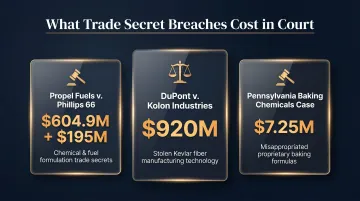
These cases underscore why the NDA—and how it's structured—matters as much as the confidentiality intent behind it.
Essential NDA Clauses for Chemical Toll Manufacturing
Definition of Confidential Information
Vague definitions like "all information exchanged" create enforcement problems. A strong NDA should explicitly list what is covered:
- Chemical formulations and composition ratios
- Process parameters (temperature, pressure, timing, sequence)
- Raw material specifications and supplier identities
- Analytical test methods and acceptance criteria
- Batch records and yield data
- Pricing information and commercial terms
One-way NDAs cover only client disclosures; mutual NDAs cover both parties. In toll manufacturing, mutual NDAs are standard — the manufacturer typically shares proprietary process capabilities or equipment specifications that also warrant protection.
Holland & Knight recommends that NDAs cover both "confidential and proprietary information" and "trade secrets" to ensure the broadest coverage, as courts treat these terms differently.
Ownership and IP Assignment
The NDA must state unambiguously that all formulations, derivatives, and improvements arising from the client's proprietary information remain the sole property of the client — ambiguity in IP ownership has defeated trade secret claims in court. The manufacturer may not claim joint ownership of any modifications made during production. The clause should explicitly cover:
- Pre-existing client IP
- Improvements or derivatives developed during production
- Any newly developed inventions related to the client's formulation
- Assignment obligations for any IP created using client confidential information
Distil addresses this directly: customer data ownership is preserved through a control layer, process fragmentation, and permission-based access — no manufacturing partner can access or claim rights to the full formulation.
Permitted Use and Need-to-Know Access
Confidential information should be restricted to personnel directly involved in production, with explicit prohibition on sharing with other business units, sister companies, or the manufacturer's other clients.
Skadden's toll manufacturing IP checklist specifically recommends:
- Obligation to limit access to specific, identified individuals on a need-to-know basis
- Transaction structure separating the manufacturing process with limits on use and disclosure
- Designated facility obligation for all work involving the transaction
- Isolated teams with no cross-contamination between client accounts
Courts recognize need-to-know compartmentalization as evidence of "reasonable measures" required under the DTSA to maintain trade secret status.
Post-Termination Obligations
Confidentiality obligations must survive the end of the business relationship. Industry best practice uses a two-tier approach:
| Information Type | Survival Period | Rationale |
|---|---|---|
| General confidential information | 3-5 years post-termination | Matches typical commercial lifecycle |
| Trade secrets | Perpetual (or "as long as information remains a trade secret") | Reflects indefinite competitive value |
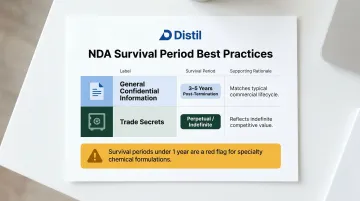
Short survival periods—especially one year or less—are a serious red flag for specialty chemical formulations that remain commercially valuable for a decade or more.
The NDA should also require return or certified destruction of all confidential materials — formulas, test data, process documents — upon termination, with written confirmation to the client.
Holland & Knight warns that if an NDA contains a time limit, expiration may jeopardize trade secret status — courts may treat it as the end of "reasonable measures" to maintain secrecy.
Governing Law, Jurisdiction, and Remedies
For cross-border toll manufacturing—for example, North American brands working with manufacturers in India—the NDA must specify governing law and dispute resolution jurisdiction explicitly. Ambiguity creates enforcement gaps.
India has no standalone trade secret statute. Protection relies on the Indian Contract Act 1872, common law equity principles, and evolving case law. Section 27 of the Indian Contract Act voids agreements in restraint of trade, creating tension with perpetual confidentiality obligations. Indian courts have generally upheld reasonable NDAs protecting legitimate trade secrets, provided they don't amount to non-compete clauses.
For U.S. brands working with Indian toll manufacturers, international arbitration (ICC or SIAC) is recommended as a neutral alternative, with enforceability under the New York Convention for recognition of foreign arbitral awards.
The NDA should explicitly state available remedies, including:
- Injunctive relief — monetary damages alone are rarely sufficient when trade secrets are disclosed
- Liquidated damages — pre-agreed penalties provide an additional contractual deterrent
Red Flags When Evaluating a Toll Partner's NDA
Resistance to NDA Execution
Resistance or unusual delays in signing an NDA before initial conversations is a serious warning sign. Reputable toll manufacturers treat NDA execution as a routine step, not a negotiation.
Attempts to discuss formulation details before an NDA is in place suggest either a lack of confidentiality sophistication or deliberate IP risk. The NDA must be executed before any proprietary technical information is shared.
Overly Broad Carve-Outs in Exclusions
Standard exclusions from confidentiality are acceptable:
- Information already in the public domain
- Information independently developed without reference to disclosed information
- Information already known to the receiving party before disclosure
However, expansive or vaguely worded exclusions can erode protection significantly. Michael Best identifies three carve-outs that can be "trade secret killers":
- Residuals clauses permit recipients to use information retained in "unaided memory" — meaning an engineer who memorizes a proprietary chemical ratio can legally apply it at a competitor without breaching the NDA
- Independent development carve-outs, if written too broadly, let a former partner claim they arrived at your manufacturing process through their own efforts, even with access to your data
- Prior knowledge carve-outs must be anchored by a "Schedule A" at signing that documents what the receiving party already knew — without this, a toll manufacturer can later claim your specifications were never confidential
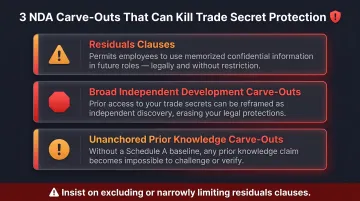
Insist on excluding residuals clauses entirely or narrowly limiting them to exclude trade secrets and technical specifications.
Inadequate Post-Termination Periods
NDAs that lack post-termination obligations or include very short survival periods are red flags. U.S. case law demonstrates that time-limited NDAs can destroy trade secret status:
- In DB Riley Inc v. AB Engineering Corp, the court suggested that a time-limited NDA failed to prove the "eternal vigilance" required to demonstrate reasonable steps to preserve secrecy
- In Silicon Image Inc v. Analogk Semiconductor Inc, courts confirmed that reasonable efforts include limiting access on a need-to-know basis—and NDAs with expiration dates may undermine these efforts
For specialty chemical formulations with decade-long commercial value, a one- or two-year survival period is wholly inadequate.
Additionally, any NDA that does not include a destruction or return-of-materials provision should be rejected. Without this, the manufacturer retains your formulation data indefinitely with no obligation to delete it.
Beyond the NDA: Structural and Operational IP Protections
Process Fragmentation as an Operational Safeguard
Rather than disclosing the complete formulation to a single manufacturing site, well-structured toll arrangements can split process knowledge across steps or sites. No single manufacturing partner ever holds the full recipe.
Skadden's toll manufacturing checklist explicitly recommends "transaction structure separating the manufacturing process" with defined information scopes for:
- The contracting toll manufacturer versus other service providers
- Separate designated facilities of the toll manufacturer
- Isolated teams of the toll manufacturer
Structural separation limits exposure without depending on legal agreements alone. Distil applies this directly — production is divided into discrete steps distributed across multiple partner facilities, so no single partner can access the complete formulation or full set of process parameters.
Permission-Based Data Access
Proprietary formulation data, batch instructions, and analytical specifications should be shared through controlled systems with access limited to named personnel on a need-to-know basis. Audit logs should track who accessed what and when.
Distil structures this through a permissioned control layer: customers retain full data ownership, access is scoped per partner, and no single facility in the network sees the complete picture.
Under the DTSA, "reasonable measures" courts have recognized include:
- Industry-standard cybersecurity and limited computer access
- Document maintenance, retention, and destruction policies
- Confidentiality markings on all engineering drawings and technical documents
- Physical security controls (locks, cameras, on-site security)
Failure cases demonstrate the cost of weak controls:
- Flotec v. Southern Research: providing engineering drawings without confidentiality markings or an NDA was ruled a failure to take reasonable measures
- Dana Ltd. v. Am. Axle: allowing employees to fax/email data without restrictions and retain copies after employment ended constituted failure to protect secrets
Batch Record Confidentiality
Yield data, efficiency metrics, and process deviations are routinely overlooked in NDA negotiations yet represent significant competitive intelligence. Courts have recognized the following manufacturing data as protectable trade secrets:
- Process parameters: cleaning procedures, temperature settings, safety protocols, equipment calibrations
- Product recipes and production techniques
- Component specifications: identity and combination of components, specific coatings
- Material specifications: specific types of oils, greases, rubber used
Define batch reporting protocols and data custody contractually in the manufacturing agreement that follows the NDA. Specify who retains custody of batch records after production, how long records are retained, and whether they must be destroyed upon contract termination.
Employee-Level Confidentiality Training
Batch record controls only work if the people handling them are properly bound. Ask prospective toll partners how they onboard staff handling client formulations:
- Do they maintain individual employee NDAs or confidentiality clauses in employment contracts?
- What confidentiality training do employees receive?
- How do they handle off-boarding of employees with access to client IP?
- Are there protocols to notify clients when an employee with access to their formulations leaves the company?
Employee-level controls are evidence of "reasonable measures" under trade secret law and indicate a mature confidentiality culture.
How to Assess a Toll Partner's Confidentiality Culture Before You Sign
Conduct Confidentiality Due Diligence
During partner evaluation, ask:
- Request the manufacturer's standard NDA template before negotiation begins — this reveals their baseline posture and whether they routinely protect client IP
- Ask whether they work with competing brands in the same segment and how they handle information separation - for example, if two personal care brands both use zinc oxide UV filter formulations, what controls prevent cross-contamination of client IP?
- Request references from existing clients who can speak to their information security practices and NDA compliance
This is a real scenario in specialty chemicals. Distil works with competing brands within the same segment — and handles it through process fragmentation, permission-based access controls, and a dedicated control layer that keeps client data strictly separated between accounts.
NDA Responsiveness Is a Signal
A toll partner's responsiveness and professionalism in NDA negotiation is itself a signal. Partners who:
- Engage constructively
- Propose fair mutual protections
- Flag their own concerns transparently
- Execute NDAs promptly before technical discussions
...are demonstrating the collaborative, trust-based partnership that IP protection requires over the long term.
Red flags include:
- Requesting multiple rounds of unnecessary revisions
- Pushing back on standard protective clauses
- Attempting to discuss formulation details before NDA execution
- Offering only their standard template with no willingness to negotiate
Certifications Support But Don't Substitute for IP Protections
ISO 27001 (Information Security Management Systems) directly addresses confidentiality. ISO 27001:2022 Annex A Control 6.6 specifically mandates that organizations establish confidentiality or non-disclosure agreements with personnel, partners, vendors, and contractors.
Required elements under this standard include:
- Scope of confidential data and permitted use
- Duration of confidentiality obligations
- Ownership of data and IP
- Access controls and monitoring rights
- Notification protocols for unauthorized disclosure
- Termination procedures, including return or destruction of data
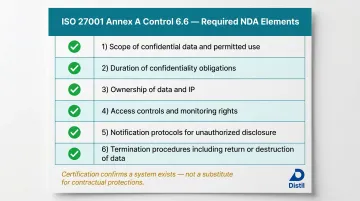
ISO certification confirms that a management system exists — it does not substitute for contractual protections, physical and digital separation of client data, or the legal remedies available under trade secret law.
That distinction matters in practice. Look for partners who can describe how they actually implement access controls, not just point to a certificate.
Ask:
- How do you implement need-to-know access controls in practice?
- What audit logs do you maintain of access to client formulation data?
- How do you handle physical and digital security of client documents?
- What employee training do you provide on confidentiality obligations?
Frequently Asked Questions
What is the difference between an NDA and a confidentiality agreement in toll manufacturing?
The two terms are functionally interchangeable. Both create a legally binding obligation to protect disclosed information, though "NDA" is more commonly used in U.S. contexts and "confidentiality agreement" in some international jurisdictions. The content and enforceability are what matter, not the label.
Who owns the formulation in a chemical toll manufacturing arrangement?
In toll manufacturing, the client retains full ownership of the formulation and any IP embedded in it. The manufacturer's role is to process, not to own. A properly drafted NDA and manufacturing agreement must both reflect this explicitly, with no joint ownership claims permitted.
How long should an NDA last after a toll manufacturing agreement ends?
For trade secrets such as proprietary chemical formulations, confidentiality obligations should ideally survive indefinitely or for as long as the information remains non-public. A minimum post-termination period of 5 years is common, though perpetual protection is best practice for core formulations with long commercial lifecycles.
Can a toll manufacturer use your formulation for other clients?
This is explicitly prohibited by a properly structured NDA and manufacturing agreement. The "permitted use" clause should restrict the manufacturer to producing only the client's product using the client's formulation, with no right to replicate, adapt, or apply the formulation to any third party's work.
What happens to confidential information if a toll manufacturing relationship is terminated?
The NDA should require the manufacturer to return or certifiably destroy all confidential materials—formulas, batch records, and process documentation—with written confirmation to the client. Confidentiality obligations continue beyond termination for the full survival period specified in the agreement.
What should I verify before signing an NDA with a chemical toll manufacturer?
Before signing, confirm:
- The definition of confidential information is specific and comprehensive
- IP ownership is clearly assigned to the client, with no joint ownership clauses
- Post-termination survival periods are adequate (minimum 5 years; perpetual for trade secrets)
- Governing law and dispute resolution jurisdiction suit your geography
A single confidentiality breach can erase years of R&D investment. Strong NDAs, clear IP ownership terms, and careful partner selection work together to make toll manufacturing a viable path to scale—without surrendering the formulations that differentiate your products.