Introduction
Selecting an emollient for an acne-prone skin formulation is never as simple as reading a label. Coco-Caprylate is a case where the name misleads — coconut-derived, yes, but behaving nothing like coconut oil on the comedogenic scale.
Getting that distinction wrong can mean a moisturiser that clogs pores, a sunscreen carrier that breaks out users, or a "clean beauty" claim that falls apart under scrutiny.
Commercial ingredient databases position Coco-Caprylate as low-comedogenic, and its ester structure — short-chain caprylate bound to fatty alcohols — keeps it from occluding follicles the way longer-chain triglycerides do. Yet confusion persists — partly because of naming similarities with other caprylate esters, and partly because "coconut-derived" has become a blanket trust signal that does not hold across all coconut derivatives.
This article covers:
- The ingredient's chemical identity and INCI classification
- How the comedogenic rating is derived and what structural factors drive it
- Formulation performance across key product types
- How it compares to the coconut-derived ingredients it is most often confused with
Key Takeaways
- Coco-Caprylate carries a low comedogenic rating (~1–2 on the 0–5 scale), making it generally suitable for acne-prone skin at standard concentrations
- Its low pore-clogging risk is structural: caprylic acid (C8) is a short-chain fatty acid, unlike the long-chain saturated fats in coconut oil
- Coconut oil (rated 4–5) and coconut alkanes (rated ~4–5) are entirely different materials despite the shared origin
- Comedogenic ratings apply to isolated ingredients under test conditions; finished product performance depends on concentration, co-ingredients, and skin type
- Formulators should validate safety through finished product testing, not ingredient names alone
What Coco-Caprylate Is and How It Functions
Chemical Identity
Coco-Caprylate is a synthetic ester formed from coconut alcohol (a fatty alcohol derived from coconut oil) and caprylic acid, a medium-chain saturated fatty acid with an 8-carbon chain (C8). Its INCI name, confirmed in the EU CosIng database, is COCO-CAPRYLATE.
The combined form, Coco-Caprylate/Caprate, extends this by incorporating capric acid (C10) alongside the C8 chain — producing a mixed ester with a slightly broader fatty acid profile. Both forms share the same coconut alcohol backbone; the difference is the acid component only.
Functional Role in Formulation
In finished products, Coco-Caprylate functions as a lightweight emollient and skin-conditioning agent. Supplier data from BASF (Cetiol C5) and Evonik (TEGOSOFT AC MB) describes it as:
- A fast-spreading, low-viscosity ester (~10 mPa·s) with a spreading value of approximately 1,300 mm²/10 min (Avena TDS data)
- A silicone alternative — delivering the dry, slip-like skin feel of cyclomethicone without silicone content
- Non-greasy with rapid absorption and no occlusive residue
One 2023 emulsion study published in MDPI found that formulations containing 4–5% Coco-Caprylate/Caprate reduced transepidermal water loss (TEWL) by -9.9% at 8 hours: meaningful barrier support without the heaviness of traditional oils. That is formula-level data, not isolated-ingredient performance, but it reflects what formulators can expect at typical usage levels.
Key physical properties for formulation reference:
- Density: 0.856–0.862 g/cm³ (Avena TDS)
- Flash point: approximately 171°C — thermally stable under standard cosmetic manufacturing conditions
- pH stability: not publicly documented; obtain technical data sheets from your supplier for pH-dependent formulation work
The Comedogenic Rating Scale and Coco-Caprylate's Position
How the Scale Works
Two rating systems dominate ingredient comedogenicity references. The Kligman scale (0–3) was developed using a rabbit ear model. The Fulton scale (0–5) extended this work to a wider ingredient set and is what most current ingredient databases use. On both, a score of 0 means no detectable comedone formation; 5 means high comedogenic risk in test conditions.
The threshold that dermatologists and formulators typically apply when screening for acne-prone suitability is 3 and above — ingredients at that level or higher are generally flagged for avoidance or minimisation.
Where Coco-Caprylate Sits
Commercial databases including INCIDecoder consistently classify Coco-Caprylate and Coco-Caprylate/Caprate as low-comedogenic, with ratings in the 1–2 range. Databases cite a rating of 1 for the combined Coco-Caprylate/Caprate form.
One important caveat: neither INCI name appears directly in the Fulton 1989 primary reference (Journal of the Society of Cosmetic Chemists, vol. 40, 321–333). These are database-derived ratings extrapolated from structurally related compounds rather than Fulton-validated numbers.
The closest Fulton comparator is glyceryl tricaprylo/caprate, rated 1, consistent with the low-risk profile of C8/C10 ester ingredients across the board.
For Fulton-verified benchmarks:
| Ingredient | Fulton Rating |
|---|---|
| Isopropyl myristate | 5 |
| Cocoa butter | 4 |
| Coconut butter | 4 |
| Glyceryl tricaprylo/caprate | 1 |
| Coco-Caprylate/Caprate | ~1–2 (database-derived) |
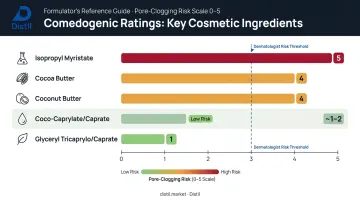
That table covers the well-documented comparators. One naming conflict, however, regularly introduces errors into ingredient screening.
The PG Caprylate/Caprate Confusion
The confusion is worth addressing directly. Some ingredient lists flag PG Caprylate/Caprate as highly comedogenic. Fulton's actual data reports PG caprylate/caprate = 2 and PG dicaprylate/caprate = 1 , neither of which is a 5/5 rating. More importantly, PG Caprylate/Caprate uses a propylene glycol ester backbone, not a coconut alcohol backbone. It is a structurally different molecule with a different identity and separately sourced ratings. Do not conflate it with Coco-Caprylate/Caprate.
How Comedogenicity Testing Works — and Why Ratings Have Limits
The Testing Models
Two primary models have shaped ingredient comedogenic ratings:
- Rabbit ear assay (Kligman & Kwong, 1979) — materials applied to inner rabbit ear skin and evaluated for follicular hyperkeratosis. The rabbit ear is significantly more sensitive than human facial skin, and test concentration, vehicle, and application frequency all affect results.
- Human comedogenicity model (Kligman & Mills, 1982) — substances applied under occlusion to young adult male backs for approximately one month, with microcomedone extraction via cyanoacrylate follicular biopsy. Closer to real-world skin response, though results still vary with subject selection and occlusion conditions.
A 2025 review in JAAD Reviews summarises the clinical relevance limitations of both models and notes that finished product assessment is more predictive for market formulations than single-ingredient testing.
These model-level constraints translate directly into how formulators should interpret and apply comedogenicity data.
What Formulators Must Account For
Single-ingredient ratings are starting points, not verdicts. In practice:
- Concentration matters — even low-rated emollients can increase comedogenic load at high concentrations. Typical usage levels for Coco-Caprylate run 1–10% in finished products
- Co-ingredient interactions — pairing Coco-Caprylate with highly comedogenic co-emollients (coconut oil, shea butter at elevated levels) raises the overall comedogenic load of the finished formula
- Skin type variability — oily, acne-prone skin types are more reactive to even low-rated ingredients than the test models may predict
- Vehicle effects — an ingredient dissolved in alcohol behaves differently on skin than the same ingredient in an oil base
Finished product patch testing under controlled conditions remains the most reliable validation approach.
Coco-Caprylate vs. Other Coconut-Derived Ingredients
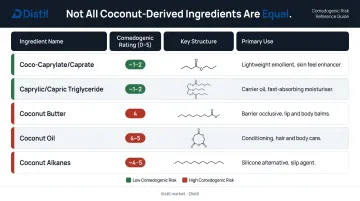
The "coconut-derived" label covers a wide chemical range. The table below separates the most commonly confused ingredients:
| Ingredient | INCI Name | Comedogenic Rating | Fatty Acid / Structure | Primary Formulation Use |
|---|---|---|---|---|
| Coco-Caprylate/Caprate | COCO-CAPRYLATE/CAPRATE | ~1–2 (database) | Coconut alcohol ester, C8/C10 | Lightweight emollient, silicone alternative |
| Coconut Oil | COCOS NUCIFERA OIL | 4–5 | Triglyceride, ~47% lauric acid (C12) | Occlusive moisturiser, skin barrier support |
| Coconut Alkanes | COCONUT ALKANES | ~4–5 | Saturated hydrocarbons (paraffins) | Emollient, texture agent |
| Fractionated Coconut Oil / Caprylic/Capric Triglyceride | CAPRYLIC/CAPRIC TRIGLYCERIDE | ~1–2 | Glycerol triester, C8/C10 | Lightweight carrier oil |
| Coconut Butter | — | 4 (Fulton) | Similar to coconut oil | Rich emollient |
Why the Structural Difference Is the Rating Difference
Coconut oil's high comedogenicity is primarily attributed to its lauric acid content (C12) and its broad long-chain saturated fatty acid profile. Harvard T.H. Chan School of Public Health notes that coconut oil is 80–90% saturated fat, with lauric acid at approximately 47%.
Coco-Caprylate uses caprylic acid (C8) as its acid component, which is four carbons shorter than lauric acid. Combined with esterification (the fatty acid bonded to a coconut alcohol rather than present as a free acid or triglyceride), this significantly reduces the ingredient's ability to intercalate into follicular keratin and occlude pores.
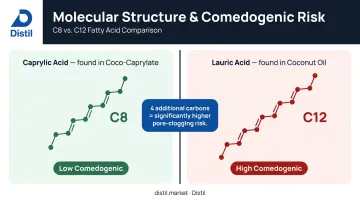
The practical takeaway: chain length and molecular form matter more than botanical origin — and that distinction has direct implications for how formulators should read "coconut-derived" claims on raw material datasheets.
The Clean Beauty Labelling Trap
Brands formulating for acne-prone skin and marketing "natural" or "clean" products face a real credibility risk when ingredient sourcing is conflated with ingredient safety. Coconut oil and Coco-Caprylate are both coconut-derived, but their skin safety profiles are not comparable. Formulators positioning products as clean beauty should specify which coconut derivatives they use and why, rather than relying on origin alone as a safety signal.
For brands incorporating Coco-Caprylate/Caprate, Distil supplies the ingredient as part of its Advanced Esterification portfolio, offering batch-consistent sourcing and application-specific formulation guidance from a single point of contact — no in-house manufacturing infrastructure required.
Common Misinterpretations About Coco-Caprylate
Three misreadings show up consistently in formulator and consumer discussions:
1. Naming confusion with PG Caprylate/Caprate The "caprylate/caprate" suffix appears in multiple INCI names with different backbones and different ratings. Coco-Caprylate/Caprate (coconut alcohol ester) and PG Caprylate/Caprate (propylene glycol ester) are not interchangeable. Don't apply ratings from one to the other.
2. Blanket "coconut = pore-clogging" assumption Dermatology resources that flag coconut oil and coconut alkanes often lead readers to apply the same caution to all coconut derivatives. The molecular profiles are structurally distinct. Coco-Caprylate's C8/C10 ester structure sits closer to caprylic/capric triglyceride — rated around 1–2 — than to coconut oil at 4–5.
3. Over-reliance on ingredient ratings in isolation That molecular distinction matters most when a rating is pulled out of context. A single number doesn't account for concentration, co-ingredient effects, skin type, or application method. A formulation containing Coco-Caprylate at 8% alongside coconut oil at 15% may be significantly more comedogenic than either ingredient rating suggests on its own. Assess the complete formulation system — including interaction effects and use-site factors — before drawing conclusions from any individual score.
Frequently Asked Questions
Is Coco-Caprylate/Caprate comedogenic?
Coco-Caprylate/Caprate is classified as low-comedogenic in commercial ingredient databases, with ratings typically cited in the 1–2 range on the 0–5 scale. It is not considered a significant pore-clogging ingredient at typical formulation concentrations and is widely regarded as suitable for acne-prone skin.
Is Coco-Caprylate/Caprate good for acne-prone skin?
Its lightweight, non-occlusive skin feel and low comedogenic profile make it a practical choice for acne-prone formulations. Finished product concentration and co-ingredient selection still influence real-world outcomes, so individuals with highly reactive skin should patch test before regular use.
What are the worst pore-clogging ingredients?
Fulton 1989 identifies isopropyl myristate (5), cocoa butter (4), and coconut butter (4) among the highest-rated. Coconut oil and coconut alkanes also carry ratings of 4–5 in most reference databases. Formulators targeting acne-prone skin should either exclude these or keep concentrations low enough to reduce occlusive load.
What is the difference between Coco-Caprylate and Coco-Caprylate/Caprate?
Coco-Caprylate is the ester of coconut alcohol with caprylic acid (C8) only. Coco-Caprylate/Caprate combines both caprylic (C8) and capric (C10) acid chains. Both carry similarly low comedogenic profiles and are often used interchangeably in formulation for lightweight emolliency.
Is Coco-Caprylate the same as coconut oil?
They are chemically distinct. Coconut oil is a triglyceride-rich natural oil with approximately 47% lauric acid and a comedogenic rating of 4–5. Coco-Caprylate is a processed ester derived from coconut fatty alcohol and caprylic acid, with a rating of approximately 1–2. Shared botanical origin does not mean shared skin behaviour.
How should formulators verify the comedogenic safety of an emollient?
Cross-reference individual ingredient ratings against established databases, then conduct finished product patch testing under controlled conditions, accounting for concentration effects and co-ingredient interactions. Single-ingredient ratings are useful screening tools — not definitive safety assessments.