Introduction
Every personal care formulator knows the tradeoff: emollients that feel genuinely luxurious tend to leave skin greasy, while silicones deliver the slip and glide consumers love but increasingly face regulatory headwinds and clean beauty rejection. Coco-caprylate addresses both directly. It's a plant-derived ester that delivers lightweight, dry-touch emolliency without the performance compromises of mineral oil or the regulatory exposure of silicone chemistry.
Two converging pressures are reshaping emollient selection. Commission Regulation (EU) 2024/1328 restricts D4, D5, and D6 cyclic silicones in leave-on cosmetics from June 2027, accelerating the hunt for credible alternatives. Meanwhile, the global clean beauty market was valued at USD 10.49 billion in 2025 and is projected to reach USD 35.30 billion by 2033 — meaning ingredient scrutiny is only intensifying.
This guide covers the full picture for formulators: the chemistry behind coco-caprylate, its performance across skin care, hair care, and color cosmetics, how it compares to silicones and MCT oil, and key considerations for scaling it into production.
Key Takeaways
- Coco-caprylate is a coconut-derived synthetic ester — lighter, drier, and more stable than raw coconut oil
- Delivers silicone-like slip and emolliency with a biodegradable, plant-based profile
- COSMOS-approved (Cetiol C5 by BASF) and aligned with clean beauty standards
- Used across skin care, hair care, and color cosmetics at varying concentrations
- The CIR Expert Panel has confirmed its safety for cosmetic use at current concentrations
What Is Coco-Caprylate? Chemistry, Origin & Key Properties
The Chemistry Behind the Ester
Coco-caprylate is a synthetic ester produced by esterifying fatty alcohols derived from coconut oil with caprylic acid (C8). The Cosmetic Ingredient Review (CIR) defines it precisely: a mixture of esters from coconut-derived fatty alcohols and caprylic acid.
Its close relative, Coco-Caprylate/Caprate, includes both caprylic (C8) and capric (C10) acid chains. The two names appear interchangeably in commercial sourcing, but they represent slightly different compositions. From a formulation standpoint, the distinction is subtle — both behave as lightweight, fast-spreading emollients — but it matters for INCI label accuracy.
The esterification process directly changes how the ingredient behaves. Coconut-derived fatty alcohols recombine with caprylic acid to produce a molecule structurally distinct from the parent oil. Compared to raw coconut oil — which contains unsaturated fatty acids prone to rancidity — the result delivers:
- A lighter, drier skin feel
- Better oxidative stability
- Reduced risk of formulation rancidity
Key Physical Properties
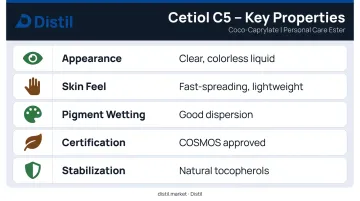
BASF's commercial variant, Cetiol C5 (INCI: Coco-Caprylate), is the most widely cited commercial variant:
- Appearance: Clear, colorless to slightly yellowish liquid with a slight fatty odor
- Feel: Fast-spreading, light skin feel
- Pigment wetting: Good — relevant for color cosmetics applications
- Certification: COSMOS approved
- Stabilization: Protected against oxidation with natural mixed tocopherols
IOI Oleo's MIGLYOL Coco 810 (INCI: Coco-Caprylate/Caprate) offers comparable dry lightness and softness — useful to know when evaluating alternative suppliers. Because commercial variants differ slightly in composition, INCI label accuracy becomes critical at the sourcing stage.
INCI and Labeling
Two INCI names you will encounter:
- Coco-Caprylate — esters of coconut fatty alcohols with caprylic acid (C8) only
- Coco-Caprylate/Caprate — esters of coconut fatty alcohols with both caprylic (C8) and capric (C10) acid
Brands sourcing commercially should verify which INCI designation applies to a specific lot before finalizing label copy. For sustainability-conscious formulations, COSMOS-approved variants meet organic and natural certification requirements.
Key Benefits of Coco-Caprylate for Skin and Hair
Lightweight Emolliency
Coco-caprylate conditions skin by replenishing lipid spaces between skin cells, delivering softness without occlusion. Unlike petrolatum or heavy plant butters, it does not create a thick film — the skin feels smooth and conditioned, not coated.
This makes it well-suited for:
- Oily and combination skin types that need hydration without shininess
- Facial serums where dry-down speed affects consumer acceptance
- Daytime moisturizers worn under makeup
Non-Greasy Sensory Profile
BASF describes Cetiol C5 as a fast-spreading emollient with a light skin feel — a characterization supported by its behavior as a medium-polar oil with good spreadability. Compared to heavier plant oils or mineral oil, the after-feel is dry and silky rather than tacky or occlusive.
For formulators, that distinction matters. Serums, lightweight moisturizers, and color cosmetics all require emolliency that doesn't compromise wear time or texture stability — and coco-caprylate delivers both.
Safety and Skin Tolerance
The CIR alkyl ester assessment includes Coco-Caprylate and Coco-Caprylate/Caprate, concluding the ingredients are safe in present practices of use and concentration when formulated to be non-irritating. The assessment draws on group/read-across data for alkyl esters; ingredient-specific irritation or sensitization data was not independently reported.
CIR also notes that Coco-Caprylate/Caprate appears in 232 cosmetic formulations with concentrations ranging from 0.5% to 62%, which speaks to its established, broad use across the industry.
Hair Care and Silicone Substitution
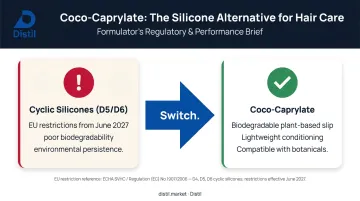
In hair care, coco-caprylate provides slip, manageability, and glide — properties conventionally delivered by dimethicone and cyclomethicone. With EU Regulation 2024/1328 restricting D5 and D6 in leave-on cosmetics from June 2027 (D4 and D5 wash-off restrictions have applied since 2020), formulators are actively reformulating.
Coco-caprylate offers:
- Biodegradable, plant-based slip in leave-in treatments and smoothing serums
- A lightweight conditioning effect without silicone's environmental persistence
- Compatibility with other conditioning actives and botanical extracts
Full sensory parity with silicones typically requires blending with complementary emollients — isododecane or lightweight esters like caprylic/capric triglyceride are common combinations — but coco-caprylate functions effectively as the primary base in most leave-in formats.
Color Cosmetics Performance
Coco-caprylate improves pigment dispersion in foundations, tinted moisturizers, and lip products — wetting pigment particles more effectively and reducing the soaping effect that affects poorly formulated emulsions. BASF specifically calls out "good pigment wetting ability" for Cetiol C5. The result is improved color payoff, better texture uniformity, and more stable pigment suspension across the product's shelf life.
Coco-Caprylate in Personal Care Applications
Skin Care
Verified application areas for coco-caprylate include face care, body care, sun care, and wipes. Within these, formulators commonly use it in:
- Face creams, moisturizers, and lightweight serums
- Eye contour products where low viscosity aids spreadability
- Sunscreens, where it functions as an elegant carrier for UV filters
- Body oils and massage oils where a non-greasy finish is desired
Hair Care
In hair care, coco-caprylate is used across:
- Leave-in conditioning treatments and serums
- Scalp serums requiring lightweight, non-occlusive carriers
- Rinse-off conditioners needing improved slip during application
Color Cosmetics and Rinse-Off Products
Its pigment wetting performance makes it well-suited for:
- Foundations and concealers (pigment dispersion and skin feel)
- Cleansing oils and makeup removers (lightweight carrier with conditioning effect)
- Body washes where a skin-conditioning, non-stripping carrier is needed
Across all three categories, its liquid form at room temperature means no heating is required for incorporation — a practical handling advantage at both lab and commercial scale.
Formulation Guide: Usage Rates, Processing & Compatibility
Usage Rates
CIR data shows Coco-Caprylate/Caprate used across 232 formulations at concentrations between 0.5% and 62% — a wide range that reflects how differently it performs across product types. As a general orientation:
| Product Category | Typical Range |
|---|---|
| Water-based emulsions (serums, lotions) | Lower end (1–10%) |
| Sunscreen emulsions | Moderate (5–15%) |
| Anhydrous products (body oils, dry oils) | Higher (15–40%+) |
| Cleansing oils and makeup removers | Can be dominant phase (40–62%) |
| Lip products and color cosmetics | Moderate to high (5–25%, varies by base) |
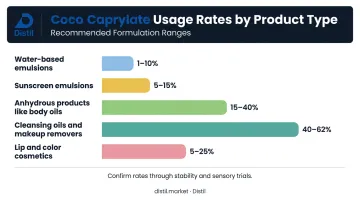
Always confirm final usage rates through your own stability and sensory trials — CIR concentration-of-use data is historical evidence, not supplier dosing guidance. Contact Distil's technical team for application-specific guidance.
Processing and Incorporation
- Liquid at room temperature — no heating required
- Add to the oil phase of emulsions during standard cold or warm process
- In anhydrous bases, incorporate directly with other oil-phase components
- No special order-of-addition requirements
Compatibility
Broad compatibility is a practical strength:
- Works with a wide range of emollients, esters, and silicones
- Compatible with common emulsifier systems
- Good with UV filters and oil-soluble actives
- Provides effective carrier properties for oil-dispersible pigments
One formulation note from CIR: some alkyl esters may enhance dermal penetration of co-formulated ingredients. Where high-potency actives are present, formulators should consider this during safety assessment.
Stability Considerations
The saturated fatty acid structure provides good oxidative stability relative to polyunsaturated plant oils (such as rosehip or sea buckthorn), reducing antioxidant loading requirements. BASF stabilizes Cetiol C5 against oxidation with natural mixed tocopherols as an added precaution.
Store in a cool, dry location away from direct light. For specific shelf life data, request the technical data sheet from your supplier.
Working with Distil
Distil supplies Coco-Caprylate/Caprate as part of its Advanced Esterification portfolio — produced through advanced bleaching and purification processes to deliver water-white, odorless characteristics with low residual catalyst and fatty acid profiles.
Distil's R&D team supports application-specific trials from lab-scale through batch production, managed through a single point of contact. Reach the technical team at contact@distil.market or +91 7902 101 101.
Coco-Caprylate vs. Silicones, Mineral Oil & MCT Oil
| Coco-Caprylate | Cyclic Silicones (D4/D5/D6) | Mineral Oil | MCT Oil | |
|---|---|---|---|---|
| Origin | Plant-based (coconut) | Synthetic (silicon-based) | Petrochemical | Plant-based (coconut/palm) |
| INCI structure | Ester | Siloxane polymer | Hydrocarbon | Triglyceride |
| Skin feel | Light, dry, fast-absorbing | Very light, volatile | Heavier, occlusive | Moderate, slightly heavier |
| Biodegradability | Yes (plant-derived ester) | Poor (vPvB concern) | Poor | Yes |
| Regulatory pressure | None current | EU restrictions from 2020–2027 | Growing clean beauty scrutiny | None current |
| Clean beauty status | Widely accepted | Increasing restrictions | Often excluded | Generally accepted |
| Viscosity reference | Lower (fast-spreading) | Very low (volatile) | Variable | 27–33 mPa.s at 20°C (BASF Myritol 318) |
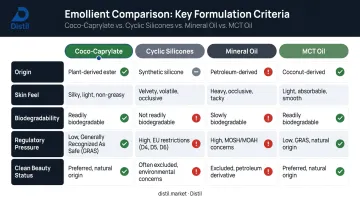
Each comparison has specific formulation implications. The sections below break down the trade-offs that matter most for ingredient selection decisions.
vs. Silicones
EU Regulation 2024/1328 restricts D4, D5, and D6 in mixtures at or above 0.1% by weight, with leave-on cosmetics covered from June 2027. D4 and D5 wash-off restrictions already applied from January 2020. Coco-caprylate delivers comparable slip and emolliency without the environmental persistence concerns. Blending with other esters or emollients may be needed to fully match silicone sensory performance.
vs. Mineral Oil
Mineral oil is a petroleum-derived hydrocarbon; ECHA classifies white mineral oil as obtained from intensive treatment of petroleum. EWG Skin Deep flags it under clean beauty criteria, and "free-from" label trends are pushing formulators toward plant-derived alternatives. Coco-caprylate's lighter feel and plant-based origin make it the more defensible choice for brands targeting transparency-sensitive consumers.
vs. MCT Oil (Fractionated Coconut Oil)
Both are coconut-derived. The structural difference matters:
- MCT oil is a triglyceride: three fatty acid chains attached to a glycerol backbone
- Coco-caprylate is an ester: coconut fatty alcohol esterified with caprylic acid
MCT (Caprylic/Capric Triglyceride, such as BASF Myritol 318) has a viscosity of 27–33 mPa.s at 20°C and a density of 0.945–0.949 g/cm³. Coco-caprylate is lighter and faster-spreading. When a truly dry, fast-absorbing finish is the priority, coco-caprylate is the more appropriate choice. MCT is better suited where a slightly richer feel is acceptable.
Safety Profile & Regulatory Considerations
The CIR alkyl ester assessment concludes that Coco-Caprylate and Coco-Caprylate/Caprate are safe in present practices of use and concentration when formulated to be non-irritating. The assessment is group-based (read-across for alkyl esters), and ingredient-specific comedogenicity data was not reported by CIR. Avoid claiming non-comedogenicity without product-specific testing.
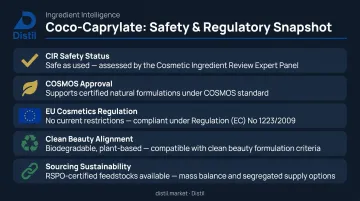
Key regulatory and certification facts:
- CIR safety status: Safe as used, with the non-irritating formulation qualifier
- COSMOS approval: Cetiol C5 (BASF) carries COSMOS approval, supporting use in certified natural and organic formulations
- EU Cosmetics Regulation: Both INCI names appear in commercial cosmetic formulations globally; no current restrictions have been identified
- Clean beauty alignment: Plant-based origin and biodegradable ester structure align with major clean beauty standards and "free-from" frameworks
- Sourcing sustainability: RSPO-certified feedstocks are available from select suppliers; confirm specific certification documentation directly with your supplier before making product-level sustainability claims
Frequently Asked Questions
What is coco-caprylate?
Coco-caprylate is a lightweight synthetic ester derived from coconut fatty alcohols and caprylic acid (C8), used as an emollient and skin-conditioning agent in personal care formulations. It absorbs quickly and leaves a dry, non-greasy finish on skin.
What is another name for coco-caprylate?
The closest variant is Coco-Caprylate/Caprate, which also incorporates capric acid (C10) and is often used interchangeably. Cetiol C5 by BASF is the most recognized trade name; the INCI distinction matters for label accuracy even when sensory performance is similar.
Is coco-caprylate good for skin?
The CIR rates it safe at current use levels, provided the final formulation is non-irritating. It conditions skin, supports the lipid barrier, and leaves a dry, non-greasy finish — making it practical for oily, combination, and sensitive skin types, though non-comedogenicity should be verified through product-specific testing.
Is coco-caprylate the same as coconut oil?
No. Coconut oil is a natural triglyceride; coco-caprylate is a synthetically esterified derivative. They share a coconut origin but have distinct molecular structures. Coco-caprylate is lighter, faster-spreading, and more oxidatively stable than raw coconut oil.
What is the recommended usage rate for coco-caprylate in cosmetic formulations?
CIR data shows real-world use across 232 formulations ranging from 0.5% to 62%. Lower concentrations apply in water-based emulsions; higher concentrations in anhydrous systems like cleansing oils or lip products. Final rates should always be confirmed through stability and sensory trials.
Can coco-caprylate replace silicones in formulations?
It is widely used as a silicone substitute in skin care and hair care, offering comparable slip and glide with a biodegradable, plant-based profile. Full sensory parity with volatile silicones may require blending with complementary emollients, depending on the product format and target skin feel.