Ingredient selection has become the lever that resolves this tension. Pick the wrong emollient and you're either adding greasiness, compromising your clean label, or running additional stability tests to compensate.
Neopentyl Glycol Diheptanoate (NGDH) sits in a narrow category of ingredients that actually deliver on multiple fronts simultaneously. This article breaks down what it does, how it performs across formulation types, and what formulators need to know before using it.
Key Takeaways
- NGDH is a synthetic ester emollient derived from neopentyl glycol and heptanoic acid (a C7 fatty acid)
- Delivers a silky, non-greasy skin feel with no occlusive residue
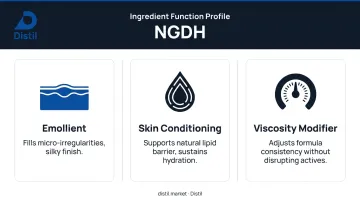
- Functions as an emollient, skin conditioner, and viscosity modifier in finished formulas
- Widely used as a functional silicone alternative in clean beauty formulations
- Found in over 1,000 products per SkinSort data, with sunscreens as the leading category
- Declared safe for topical cosmetic use by the CIR Expert Panel (2017 final report)
- Improves spreadability and sensory profile without the drag of heavier esters
What Is Neopentyl Glycol Diheptanoate?
NGDH is a diester formed by combining neopentyl glycol — a branched diol — with heptanoic acid, a C7 fatty acid. Its IUPAC name is 2,2-dimethyl-1,3-propanediyl diheptanoate. Its molecular formula is C₁₉H₃₆O₄, with a molecular weight of 328.5.
The branched "2,2-dimethyl" neopentyl core is structurally significant. That branching prevents the tight molecular packing you get with linear esters, which is directly responsible for NGDH's low viscosity and non-oily skin feel.
Physical Properties at a Glance
| Property | Value |
|---|---|
| Appearance | Light straw to colorless liquid |
| Odor | Odorless |
| Specific gravity | ~0.927 at 20°C |
| Viscosity | ~10 mm²/s at 20°C |
| Pour point | -85°C |
| Water solubility | <0.05 g/L at 20°C |
| Log P (estimated) | 6.68 |
Physical data sourced from the CIR 2017 Safety Assessment and OQEMA technical documentation.
Its official cosmetic functions per CosIng-derived data are emollient and skin conditioning. In practice, those two labels understate what NGDH actually does in a formula. It functions as the texture-builder and functional carrier — governing spreadability, skin contact feel, and absorption rate. It rarely appears as the primary active; its role is to make the primary active pleasant enough that consumers actually use the product.
Key Skincare Benefits of Neopentyl Glycol Diheptanoate
NGDH earns its place in formulations because it resolves a common tension: delivering emolliency and sensory performance without the downsides of silicones or heavy occlusives. Three functional properties drive its adoption across leave-on, rinse-off, and colour cosmetic categories.
Superior Emolliency Without the Film
NGDH functions as an emollient by forming a fine, breathable layer on the skin surface that fills in micro-irregularities. Skin feels noticeably smoother and softer immediately after application — without the tacky film or heavy occlusive barrier that petrolatum or heavy waxes leave behind.
OQ/OXEA's technical documentation positions NGDH as forming a protective layer that helps retain moisture and prevent drying — consistent with standard emollient ester mechanisms.
This has direct commercial relevance. In leave-on products like body lotions, day creams, and after-sun care, skin feel at application is a primary driver of repeat purchase. An emollient that softens without greasing is harder to formulate than it sounds.
A Credible Silicone Alternative
OQ Chemicals launched NGDH specifically as a light ester alternative to cyclic silicones — D4, D5, and D6 — compounds now subject to EU restrictions in wash-off cosmetics at concentrations above 0.1%. OQEMA describes it as providing a silky, non-oily, luxurious texture comparable to silicones without being occlusive.
What makes this work structurally: the branched ester architecture spreads easily across large skin surfaces, absorbs relatively quickly, and leaves a velvety finish — without the plastic-like residue some consumers associate with dimethicone or cyclopentasiloxane.
For brands formulating SPF products, primers, BB creams, or lightweight serums under a silicone-free or clean beauty positioning, NGDH delivers the sensory performance silicones provided — without the regulatory or consumer-perception baggage.
Skin Conditioning and Formulation Versatility
NGDH also contributes two practical benefits that extend well beyond surface feel:
- Skin conditioning: The fatty acid component blends with skin secretions, supporting the natural lipid barrier and helping sustain hydration over time
- Viscosity control: By adjusting NGDH concentration in the oil phase, formulators can shift product consistency without disrupting active ingredient performance — useful when one base formula needs to work as both a light fluid and a richer cream
SkinSort data confirms this versatility: NGDH appears in over 1,007 products across sunscreens, face moisturizers, serums, and makeup — and typically in the top 25% of ingredient lists, indicating functional loading rather than trace inclusion.
How NGDH Performs in Cosmetic Formulations
Concentration Ranges
The CIR 2017 Safety Assessment reports NGDH use concentrations across 415 formulations:
- Baby lotions/oils/creams: 1.2–2.2%
- Non-spray suntan products: 3.5–33%
- Foundations: 7.1–25.6%
- Eye shadows: 2.8–14.4%
- Lipstick: ~7%
- Pump hair sprays: ~19.5%
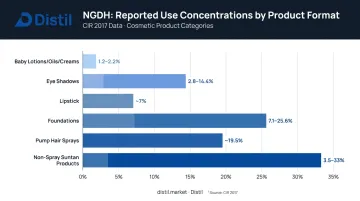
These are reported industry use concentrations — not recommended formulation targets. The right loading depends on your specific product format, oil phase composition, and target skin feel. Formulators should work from supplier-issued technical data sheets and run application-specific trials.
SPF Formulation Advantages
Sunscreens are the leading product category containing NGDH. OQ/OXEA's technical documentation confirms several functional advantages that explain this dominance:
- Provides good solubility for organic UV absorbers
- Helps prevent sunscreen recrystallization — a persistent stability challenge with chemical filters
- Improves spreadability, increasing the likelihood that consumers apply product evenly and in sufficient quantity
- Delivers a non-greasy finish that supports daily-use compliance
High-SPF formulas tend to feel thick and heavy. NGDH directly addresses that sensory barrier, which has measurable consequences for real-world UV protection performance.
Safety and Regulatory Position
The CIR Expert Panel's final report, Safety Assessment of Monoalkylglycol Dialkyl Acid Esters as Used in Cosmetics (November 2017), concluded that NGDH and related esters are "safe in cosmetics in the present practices of use and concentration described in this safety assessment." The CIR further notes no EU cosmetic restrictions are placed on NGDH.
EWG Skin Deep lists NGDH with a low hazard rating and low concerns across cancer, immunotoxicity, and developmental/reproductive toxicity categories.
What Happens When Formulators Skip NGDH
Choosing around NGDH typically means choosing between compromises:
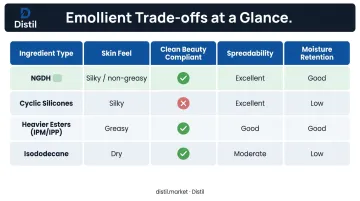
- Heavier esters (isopropyl myristate, isopropyl palmitate) deliver emolliency but add greasiness that consumers flag in sensory testing
- Silicones provide the right slip but create clean beauty compliance issues and face increasing regulatory scrutiny in key markets
- Lighter alternatives like isododecane often sacrifice moisture retention for the dry finish
- Going without a functional emollient produces formulas that feel thin, spread poorly, and leave skin feeling dry post-absorption
That last point compounds in SPF products. Poor spreadability pushes consumers to apply less — which cuts actual UV coverage and defeats the product's core function entirely.
There's also a formulation cost angle. Without a multi-functional ingredient like NGDH handling emolliency, skin conditioning, and viscosity simultaneously, formulators often compensate by stacking additional texture modifiers. That increases formula complexity, extends stability testing timelines, and raises ingredient costs.
Getting the Most Out of NGDH in Your Products
Calibrate Loading to the Format
The same ingredient behaves differently at 3% versus 20%. A lightweight sunscreen fluid needs a different NGDH loading than a rich night cream. Use CIR-reported concentration ranges as a reference frame, then work from supplier technical guidelines and run format-specific trials — particularly for SPF products where spreadability and filter solubility need to be validated together.
Treat Sourcing Consistency as a Formulation Variable
NGDH's performance characteristics — color, viscosity, fatty acid profile — can vary between manufacturers and between batches from the same manufacturer. These variations affect sensory outcomes. Formulators should request batch specifications and Certificates of Analysis consistently, and prioritize suppliers who provide application-specific technical support alongside the material. Distil supplies NGDH with a focus on low impurity profiles and batch-to-batch consistency, backed by an R&D team with backgrounds spanning Dow, BASF, L'Oréal, and Huntsman — available for formulation support across suncare, emollient, and color cosmetics applications.
Build NGDH Into a Total Emollient System
Once sourcing is locked in, the next lever is system design. NGDH performs best alongside complementary emollients, not in isolation — pairing it thoughtfully lets formulators fine-tune the final skin feel:
- Coco-caprylate/caprate adds a dry, fast-absorbing touch suitable for lightweight formulas
- Octyldodecanol enhances texture and increases spread
- Trimethylolpropane tricaprylate/tricaprate improves spreadability and adds body in richer formulations
Distil supplies all four of these esters, which means formulators working on total emollient system development can access technical guidance on combinations and ratios through a single supplier contact.
Conclusion
Neopentyl Glycol Diheptanoate is a high-utility emollient ester with a well-established safety record and a performance profile that addresses several formulation challenges at once: skin feel, spreadability, moisture conditioning, and formula texture — without the baggage of silicones or heavy occlusives.
Its value compounds at the formulation level. Rather than layering multiple functional ingredients to solve for each dimension separately, NGDH handles each through a single ester with a documented safety profile and established regulatory standing. For brands navigating silicone-free or clean beauty positioning, it represents a practical, safety-reviewed option backed by real industry adoption.
That formulation confidence only holds when the raw material behind it is consistent batch to batch. For formulators sourcing NGDH, working with a supplier who manages quality control from development through to commercial scale — and can support scale-up without process drift — is where the decision gets made in practice. Distil supplies high-purity NGDH as part of its cosmetic ester portfolio, with R&D support and supply chain traceability built in from the start.
Frequently Asked Questions
Is Neopentyl Glycol Diheptanoate safe for skin?
Yes. The CIR Expert Panel's 2017 final safety assessment concluded NGDH is safe for cosmetic use at current concentrations. EWG Skin Deep rates it as low hazard, with low concerns across toxicity and irritation categories.
What is Neopentyl Glycol Diheptanoate used for in cosmetics?
NGDH serves three primary functions: emollient, skin conditioning, and viscosity modification. It appears across sunscreens, moisturizers, serums, foundations, and body care products — typically at functional loading levels rather than trace amounts.
Is Neopentyl Glycol Diheptanoate in sunscreen?
Sunscreens are the most common product category containing NGDH. Its non-greasy feel and high spreadability improve the sensory experience of SPF formulas, and it also provides good solubility for organic UV filters while helping prevent recrystallization.
Is Neopentyl Glycol Diheptanoate a silicone alternative?
Yes. OQ Chemicals launched NGDH specifically as a substitute for cyclic silicones (D4, D5, D6). Its branched ester structure delivers comparable slip and spreadability without the regulatory concerns or clean beauty restrictions associated with cyclic silicones.
What skin types can benefit from Neopentyl Glycol Diheptanoate?
Its lightweight, fast-absorbing profile makes it broadly suitable — including for oily and combination skin. The relatively rapid absorption minimises pore-clogging risk compared to heavier occlusive esters, making it a practical choice in non-comedogenic formulations.
What products contain Neopentyl Glycol Diheptanoate?
NGDH appears in sunscreens, day moisturizers, serums, body lotions, and makeup primers — with verified examples including Supergoop! Unseen Sunscreen SPF 40 and Supergoop! Play Mineral Lotion SPF 30. SkinSort tracks it across more than 1,000 products from brands including Neutrogena, D'Alba, and SKIN1004.