
That is why engineering plastics matter across Indian manufacturing: automotive, electrical and electronics, healthcare, industrial equipment, agriculture, wire and cable, and packaging. One commercial estimate by IMARC puts the Indian engineering plastics market at USD 9.40 billion in 2026, growing at a 7.43% CAGR through 2034. That figure covers a broader resin set than this article does.
This guide defines engineering plastics, walks through the main categories and materials, shows where they are used, and explains how to pick the right grade.
Key Takeaways
- Engineering plastics are built for demanding parts where commodity plastics lack strength, stability or durability.
- Three practical groups: general-purpose, reinforced or modified, and high-performance grades.
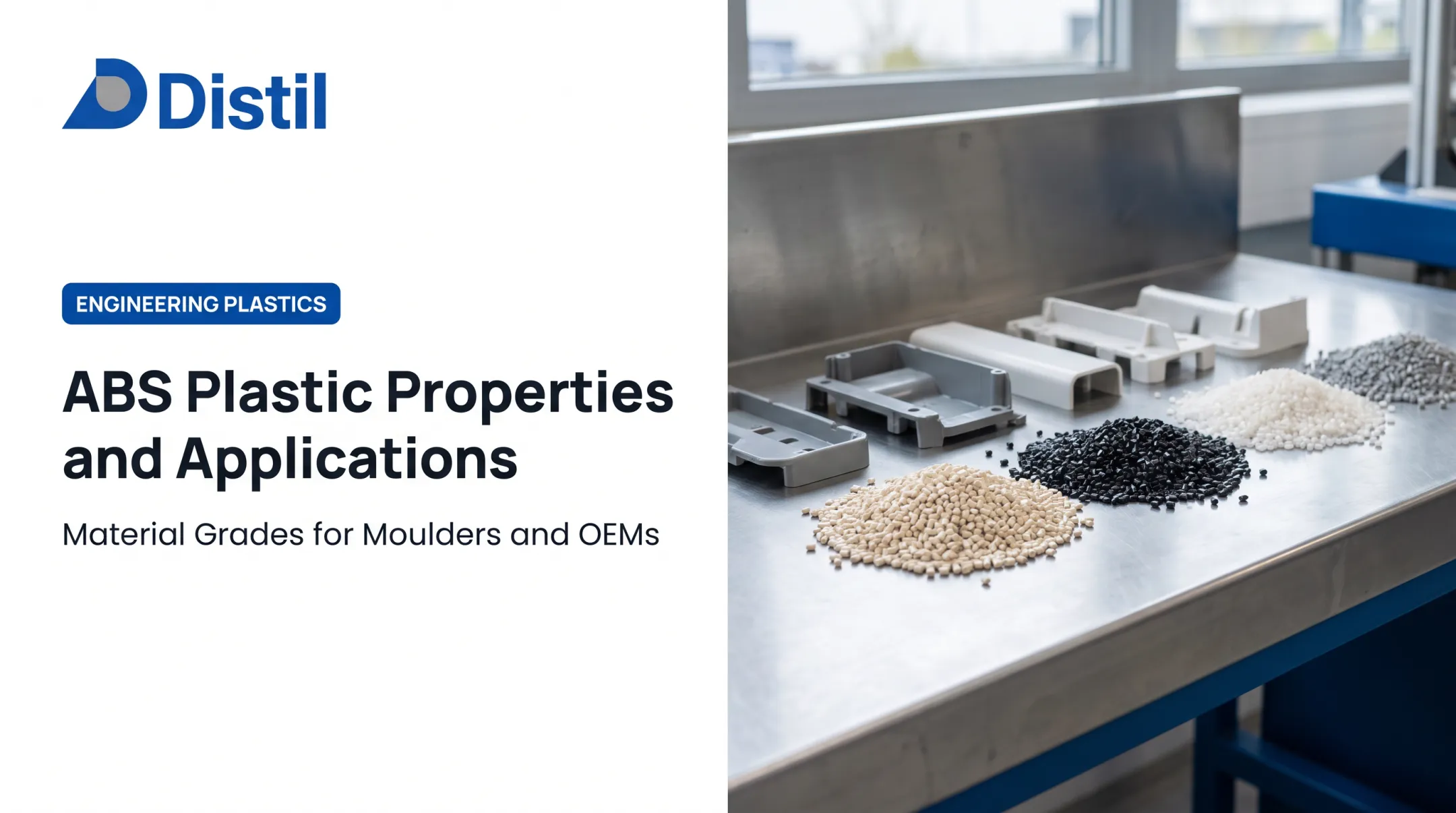
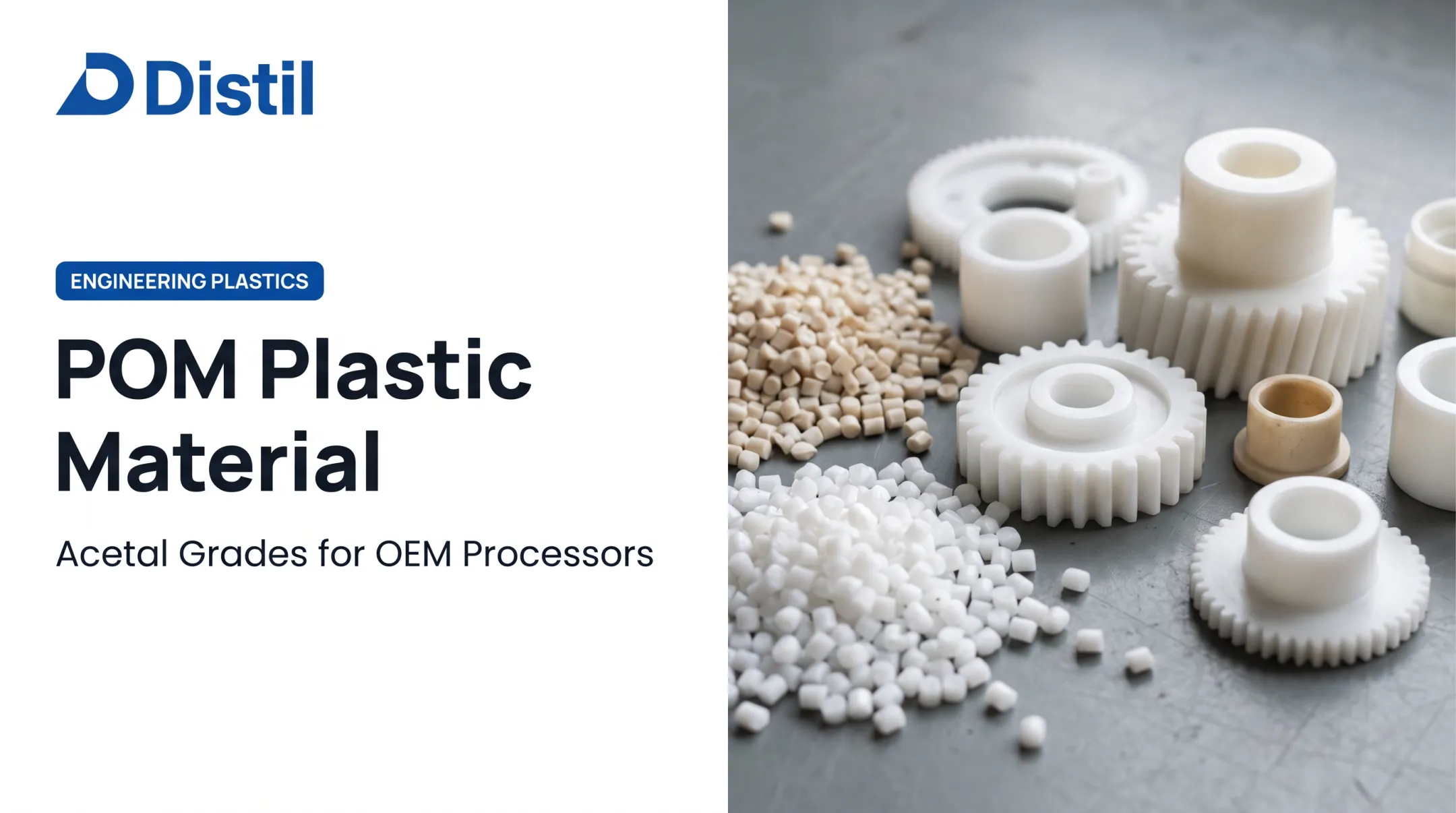
- Representative materials: ABS, nylon, POM, PBT, polycarbonate, modified PPE, PEEK, PPS and PEI.
- Choose by environment, loads, process, compliance, lifecycle cost and supply reliability.
What Are Engineering Plastics?
Engineering plastics are polymers formulated or selected to perform reliably in components facing demanding mechanical, thermal, chemical, electrical or dimensional conditions.
Mitsubishi Chemical Group describes them as mostly thermoplastics with higher mechanical, thermal, chemical and dimensional performance than commodity PE, PP and PS.
A category defined by performance
The term describes what a material does, not a single chemical family. Commodity plastics serve everyday packaging and general products. Engineering plastics are used in finished parts such as:
- Housings and connectors
- Gears, bushes and bearings
- Seals and liners
- Pump components
- Medical components
The boundary is not rigid. Basic PE and PP are commodity materials, yet specialised grades exist, such as mineral-filled or glass-reinforced PP compounds and UHMW-PE bearing grades with built-in dry lubricant. Reinforced thermosets and composites also serve related engineering purposes.
Why Are Engineering Plastics Important?
Engineering plastics matter where metals or commodity resins fall short. Shops and OEMs specify them for outcomes that show up on the line and in the field:
- Lower component weight in structural and under-bonnet parts
- Impact and wear resistance in high-duty assemblies
- Electrical insulation for connectors and housings
- Chemical durability and dimensional stability in harsh environments
Metal replacement, with limits
Asahi Kasei reports an 83% component-weight reduction in a topology-optimised brake-pedal bracket using 33% glass-reinforced PA66. That is a manufacturer design case for one component, not a vehicle-wide saving or a universal substitution ratio. Any swap must account for load, temperature, creep, wear and regulatory requirements.
What goes wrong with poor selection
- Moisture: PA6 Ultramid B3S drops from 3500 MPa dry to 1200 MPa conditioned modulus.
- Stress cracking in polycarbonate from chemical exposure plus applied or residual stress.
- Hydrolysis in PBT when processing moisture exceeds about 0.04%.
- UV yellowing and property loss in unstabilised outdoor parts.
- Warpage from fibre orientation in reinforced grades.
The business cost is rejects, rework, unpredictable scale-up and early part replacement. Consistent material and processing make output predictable.

Types of Engineering Plastics
Categories overlap and vary by polymer structure, reinforcement, additives and process. They never replace a grade-level datasheet review.
General-purpose engineering thermoplastics
This group balances mechanical performance, processability, cost and availability.
| Material | Typical uses |
|---|---|
| ABS | Impact-resistant housings, selected automotive parts |
| Nylon (PA6, PA66) | Gears, bushes, bearings, wear parts |
| POM (acetal) | Low-friction precision components |
| PBT | Electrical and automotive parts |
| Polycarbonate | Impact-resistant or transparent components |
| Modified PPE | Lightweight, dimensionally stable, flame-resistant parts |
Representative datasheet values show how much grades differ (tensile modulus; HDT at 1.8 MPa):
| Grade | Modulus, MPa | HDT, °C |
|---|---|---|
| ABS, Terluran GP-22 | 2300 | 94 |
| PA6, Ultramid B3S | 3500 dry / 1200 conditioned | 65 |
| POM, Delrin 500P | 3100 | 93 |
| PBT, Ultradur B4520 | 2400 | 55 |
| PC, Makrolon 2405 | 2400 | 124 |
These are single grades, not family-wide ranges. Check each material for moisture absorption, weathering, thermal limits, chemical compatibility, flammability and processing constraints.
In India, Distil supplies ABS (STAREX), polycarbonate and PC alloys (INFINO), PA6/PA66 (LUMID) and modified PPE (LUMILOY), among others. LUMILOY goes into TV housings, pump housings and water-purifier tanks.
Reinforced and modified engineering plastics
These grades add glass fibre, mineral fillers, flame-retardant systems, impact modifiers, lubricants, stabilisers or polymer blends to close a specific performance gap.
The PA6 comparison from BASF datasheets is instructive:
| Property | B3S, unreinforced | B3EG6, 30% glass |
|---|---|---|
| Modulus dry/conditioned, MPa | 3500 / 1200 | 9500 / 6200 |
| HDT at 1.8 MPa, °C | 65 | 210 |
| Shrinkage flow/transverse, % | 0.90 / 0.90 | 0.25 / 0.70 |

Stiffness and heat deflection jump, but shrinkage becomes directional. Glass fibre does not eliminate warpage.
Typical uses include structural automotive parts, electrical connectors, appliance components and industrial machinery. Watch for anisotropy, surface finish, brittleness, processing complexity, recyclability and cost. Flame-retardant ratings depend on the tested material and thickness, not the polymer family.
High-performance or super engineering plastics
PEEK, PPS and PEI serve unusually high thermal, chemical, mechanical or sterilisation demands.
- PEEK: Victrex reports 260 °C continuous use. Applications include aerospace cable insulation, seal rings and chemical-processing equipment.
- PPS: Ryton grades run above 200 °C long-term, with grade-dependent UL thermal indices up to 240 °C.
- PEI: ULTEM 1000 carries a 170 °C RTI, and is used in aerospace, surgical devices and pharmaceutical packaging.
Medical, food-contact, flame or aerospace use needs grade-specific confirmation and regulatory documentation. Medical PEEK sterilisation data does not apply to every PEEK grade.
The limits are higher material and processing costs, demanding manufacturing conditions and narrower supplier availability. The largest risk is over-specifying when a general-purpose or reinforced grade would do.
How to Choose the Right Engineering Plastic
The right material comes from required performance, manufacturing route, compliance and lifecycle economics. Not from picking the most advanced or expensive polymer.
- Define mechanical needs. Tensile and compressive load, impact, stiffness, fatigue, friction, wear, creep and tolerances. Separate short-term lab properties from behaviour in service.
- Assess the environment. Continuous and peak temperature, humidity, chemicals, oils, UV, electrical stress, flame, sterilisation and temperature cycling. HDT is a loaded-deformation test, not a continuous-use rating. UL thermal ageing is load-free.
- Match the process. Injection moulding, extrusion, machining or compression moulding. Check flow, shrinkage, fibre orientation, wall thickness and drying. Makrolon 2405, for instance, needs dry air at 120 °C for 2-3 hours and moisture at or below 0.02%.
- Check compliance. FSSAI's Packaging Regulations 2018 specify IS 12247 for Nylon 6 and IS 14971 for polycarbonate, with overall migration limits of 60 mg/kg or 10 mg/dm². For medical use, FDA guidance addresses the final processed device, not the resin alone. Ask for current supplier certificates.
- Compare lifecycle cost. Material price, tooling, scrap risk, maintenance, service life, qualified suppliers, minimum order quantities and scale-up.

For teams evaluating advanced polymers, Distil provides material-selection support across branded engineering plastic grades and supply-chain visibility from sample quantities to commercial scale. Distil is a supplier and platform, not a resin manufacturer.
What to Check Before Finalising an Engineering Plastic
- Don't choose a top-tier polymer on reputation. Compare it with the actual load, environment, process, compliance and cost.
- Read the latest datasheet, safety information and processing guidance. A polymer's general name says little about a specific grade.
- Test representative samples under realistic operating conditions.
- Confirm quality controls, batch consistency, IP requirements and scale-up support with the supplier.
Conclusion
Engineering plastics improve durability, chemical resistance, thermal performance, electrical safety and service life while cutting weight in demanding components. Common materials sit in different performance and formulation tiers, each with its own balance of strengths, limits, cost and fit.
A sound selection combines engineering requirements, grade-level data, manufacturing realities, compliance review, testing and dependable scale-up planning.
Frequently Asked Questions
What are engineering plastics?
They are polymers designed for demanding mechanical, thermal, chemical, electrical or dimensional requirements. Unlike basic commodity plastics, they hold performance in tougher service conditions.
What are the types of engineering plastics?
Three practical groups: general-purpose thermoplastics (ABS, nylon), reinforced or modified grades (glass-filled PA6), and high-performance plastics (PEEK, PPS).
What are some common engineering plastics?
ABS, nylon (polyamide), POM (acetal), PBT, polycarbonate, modified PPE, PEEK, PPS and PEI. The right grade depends on the application.
What are the applications of engineering plastics?
Automotive parts, electrical components, gears and bearings, industrial equipment, chemical-handling systems, healthcare devices, wire and cable components and demanding packaging.
How do you choose the right engineering plastic?
Weigh mechanical load, temperature, chemical and moisture exposure, flame needs, manufacturing method, compliance, lifecycle cost, testing and supply reliability.
Are engineering plastics better than commodity plastics?
Not universally. They suit applications needing higher performance, while commodity plastics are more economical when those demands are absent.