The challenge isn't finding a masterbatch supplier. It's finding one that can deliver batch-to-batch consistency, application-specific formulations, and reliable scale-up — not just a convincing sample.
This article covers five color masterbatch suppliers actively serving key industrial segments in 2025, what differentiates each, and the criteria used to evaluate them. One important correction upfront: Clariant sold its masterbatch business to PolyOne (now Avient) in July 2020 — so the list below replaces Clariant with its successor, Avient Corporation.
Key Takeaways
- The global color masterbatch market reached US$4.78B in 2025, with packaging and automotive as the leading demand sectors
- Suppliers vary on R&D depth, polymer compatibility, certifications, and scale-up consistency — all critical to long-term fit
- Avient, Ampacet, Cabot, Tosaf, and Plastiblends India each serve distinct application niches
- Certifications (REACH, RoHS, FDA, ISO 9001) determine which regulated end markets a supplier can actually serve
- Batch-to-batch repeatability matters more than sample quality when selecting a long-term supplier
Color Masterbatch in the Plastics Industry
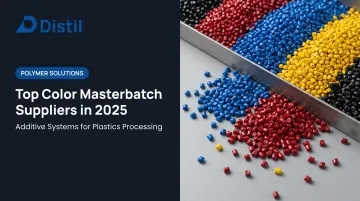
Color masterbatch is a concentrated mixture of pigments or dyes dispersed in a carrier resin, pelletized for direct use during plastic processing. Manufacturers prefer it over raw pigment addition because it delivers superior dispersion uniformity, cleaner handling, better batch consistency, and stable shelf life.
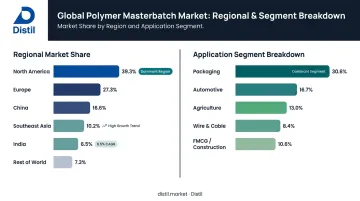
Standard color masterbatches alone account for approximately 45.3% of the global color masterbatch market. End-use demand spans a wide range of sectors:
- Packaging — the dominant segment, led by flexible films and rigid containers
- Automotive — interior and exterior plastic components
- Agriculture — mulch films, greenhouse covers, and drip irrigation
- Wire & cable — insulation and jacketing compounds
- FMCG films and construction — growing application areas driven by brand differentiation
Geographically, North America held 39.3% of the color masterbatch market as of recent data. Southeast Asia is growing fast — color masterbatches represent the highest-share product type in that region's broader masterbatch market. India's overall masterbatch market is growing at approximately 6.5% annually, driven by flexible packaging and automotive production.
Across these regions, supplier selection has become a technical decision that directly affects product aesthetics, processing efficiency, and regulatory access.
Top Color Masterbatch Suppliers in 2025
The suppliers below were identified based on technical breadth, market presence, certifications, and ability to support both standard and custom color formulations.
Avient Corporation (Successor to Clariant Masterbatches)
Avient Corporation completed its acquisition of Clariant's color and additive masterbatch business on July 1, 2020, bringing with it 46 manufacturing operations and technology centers across 29 countries, along with approximately 3,500 employees. That inherited global infrastructure makes Avient one of the most capable color masterbatch providers operating in 2025.
Current product lines include OnColor solid masterbatches, Smartbatch combination colorants and additives, and established brands like Renol and Colorant Chromatics. For brand-specific color development, Avient ColorWorks provides collaborative color design services, translating concepts into colors, shapes, and effects across plastic applications.
On sustainability, Avient's Rejoin PCR colorants use post-consumer recycled content as the carrier resin and are designed to enable 100% PCR packaging solutions, plus a PCR Color Prediction Service for formulators working with recycled substrates.
| Attribute | Detail |
|---|---|
| Key Industries | Automotive, Healthcare, Fiber/Textiles, Wire & Cable, Packaging |
| Polymer Compatibility | Engineering polymers, high-temperature fluoropolymers, general-purpose resins |
| Differentiators | ColorWorks design service, Rejoin PCR colorants, global manufacturing footprint (29 countries) |
Ampacet Corporation
Ampacet is a US-headquartered global masterbatch manufacturer with locations across North America, Latin America, Europe, the Middle East, and Asia. Its color portfolio covers standard color concentrates, RediBatch universal masterbatch, SmartColor, and a range of color effects for flexible and rigid packaging.
A few things stand out technically:
- RediBatch uses a universal carrier compatible with most popular polymers and is FDA-approved across its colors, blacks, and whites (with grade-specific qualifiers)
- SpectroMetric integrates an in-line spectrometer with a LIAD SmartColorSave feeder to correct Delta E deviations in real time — one of the more practical quality-assurance tools available in commercial masterbatch supply
- R3 Sustainable Solutions addresses recyclability through products like REC-NIR-Black, BlueEdge/GreenEdge PCR color correction, and ReVive compatibilizers
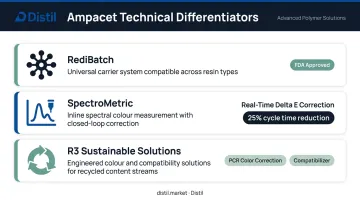
Ampacet's data shows color leveling additives can reduce overall cycle time by up to 25% — a downstream processing benefit that procurement teams evaluating total cost of ownership should factor in.
| Attribute | Detail |
|---|---|
| Key Industries | Flexible Packaging, Consumer Goods, Healthcare, Automotive, Electronics |
| Polymer Compatibility | HDPE, LDPE, LLDPE, PP, PET, PS, PBT, PLA, EVA |
| Differentiators | SpectroMetric in-line color correction, FDA-compliant RediBatch grades, R3 circular economy solutions |
Cabot Corporation
Cabot occupies a specific and well-defined role in the color masterbatch space: it is the go-to supplier for carbon black masterbatches and conductive compounds, with more than 50 years of supply history in plastics.
Its PLASBLAK line covers UV resistance, opacity, jetness, and surface finish performance for automotive components, agricultural applications, pipes, and industrial packaging. TECHBLAK addresses higher-performance black masterbatch requirements. For conductive and static-dissipative applications, CABELEC compounds are the core offering.
Cabot does not offer full-spectrum color masterbatch; non-black colorants are outside its verified portfolio. If your application requires black masterbatch with UV stability or conductivity performance, Cabot belongs on your shortlist. For multicolor programs, look elsewhere.
| Attribute | Detail |
|---|---|
| Key Industries | Wire & Cable, Automotive, Agriculture, Industrial Packaging, Electrical & Electronics |
| Polymer Compatibility | PE family (verified), PP (selected grades) |
| Differentiators | 50+ years in black masterbatch, PLASBLAK/TECHBLAK/CABELEC product lines, UV stability and conductivity expertise |
Tosaf
Tosaf is headquartered in Israel and operates 22 manufacturing facilities and 53 sales offices globally, with production sites in the US (Arlington, TX and Bessemer City, NC) and across Europe (Germany, France, Netherlands). That's a substantial physical footprint for a supplier not always on Western procurement teams' radar.
Its color masterbatch offering is built on 40 years of formulation experience, with custom color matching available from 1 kg sampling through to full truckload production. The application focus spans agriculture, automotive, building and construction, packaging, and textiles.
A few capabilities worth noting for technical buyers:
- UV + color co-optimization: Matched UV stabilizers and color masterbatches are developed together for mulch film applications, where pigment systems and UV inhibitors interact and must be formulated in tandem rather than layered independently
- FogFree masterbatches: A separate product family for anti-fog performance in packaging and agricultural films
- Custom matching scale: Samples from 1 kg, scaling to full truckload production through global R&D teams
| Attribute | Detail |
|---|---|
| Key Industries | Agriculture, Packaging, Building & Construction, Automotive, Electrical & Electronics |
| Polymer Compatibility | PE, PP, PVC, PS, engineering polymers |
| Differentiators | 22 manufacturing facilities, UV + color co-optimization for mulch films, custom matching from 1 kg scale |
Plastiblends India
Plastiblends India is one of the country's largest masterbatch producers by volume, with headquarters in Mumbai, Maharashtra, and product development and application units in Daman, Roorkee, and Palsana. Annual production capacity exceeds 130,000 MT, and the company exports to 60+ countries — making it a meaningful option beyond its domestic market positioning.
Its color masterbatch catalog covers an active database of 2,500+ shades across PE, PP, PET, PBT, HIPS, ABS, EVA, and Nylon systems. Certifications include ISO 9001:2015, ISO 14001:2015, ISO 45001:2018, and the Global Recycled Standard 4.0. The GRS certification is particularly relevant for brands targeting recycled-content supply chains.
For Indian buyers specifically, Plastiblends' domestic manufacturing, broad standard color catalog, and short turnaround on custom shade development make it a strong option. For export markets, the 60+ country reach and ISO credentials provide an adequate compliance baseline.
| Attribute | Detail |
|---|---|
| Key Industries | Packaging, Automotive, Agriculture, Textiles, Appliances, Healthcare, Wire & Cable |
| Polymer Compatibility | PE, PP, PET, PBT, HIPS, ABS, EVA, Nylon |
| Differentiators | 2,500+ shade catalog, 130,000+ MT capacity, ISO 9001/14001/45001 + GRS 4.0 certified, exports to 60+ countries |
How to Evaluate Color Masterbatch Suppliers
Supplier selection decisions made on price or initial sample quality routinely create problems at production scale. The sample looks right; the fifth production batch doesn't. The criteria that matter for long-term supply reliability are different from the ones that surface in a catalog review.
What to Assess Before Committing
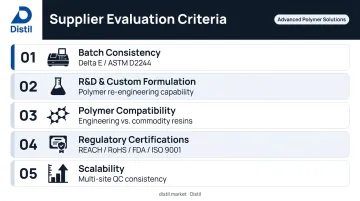
- Batch-to-batch color consistency: Request spectrophotometric data (Delta E values per ASTM D2244) across multiple production lots — not just a single approval sample. Delta E tolerances should be set to your application's specific requirements, not a generic industry threshold
- R&D and custom formulation capability: Can the supplier match a proprietary brand color and re-engineer it for a new polymer substrate or processing condition? This determines flexibility over time
- Polymer compatibility breadth: A supplier covering PE and PP is adequate for commodity packaging. Engineering polymers, PET, or specialty substrates require verified compatibility data — not just a catalog claim
- Certifications for regulated markets: REACH compliance for EU distribution, RoHS for electronics, FDA 21 CFR 178.3297 for food-contact packaging, ISO 9001 for quality management baseline
- Scalability: Can the supplier grow volume without introducing batch drift? This is where multi-site suppliers often struggle — QC consistency across facilities is harder to maintain than within a single plant
The Distil Approach
For brands and manufacturers who need masterbatch sourcing without the overhead of managing multiple suppliers, Distil offers an alternative model. As a specialty chemicals platform with R&D capabilities and a network of 20+ manufacturing partners, Distil handles color masterbatch from formulation development to commercial-scale production — through a single point of contact.
Key elements of the model:
- Unified QC system: Built to eliminate process drift across multi-site production, tracking batch consistency as volumes scale
- Customer-retained IP: Formulation data remains fully owned by the buyer, protected through process fragmentation and permission-based access controls
- R&D-to-scale continuity: The same team that develops the formulation manages scale-up, reducing handoff risk at volume transitions
For procurement teams dealing with batch inconsistency or supplier qualification complexity, that structure removes two of the most common failure points in multi-supplier color programs.
Conclusion
Choosing a color masterbatch supplier in 2025 comes down to more than capacity and price. The right partner needs to demonstrate batch-to-batch repeatability, application-specific technical depth, relevant certifications, and the ability to scale without quality deviation.
Before committing to a supplier, go beyond the product catalog. Request Delta E data across production lots, clarify lead time reliability, and test whether their technical team can actually solve application-specific problems — not just process standard orders.
The criteria above — repeatability, technical depth, certifications, and scalability — are exactly what supplier selection should be stress-tested against. For brands and manufacturers looking to consolidate color masterbatch sourcing with verified R&D support and end-to-end supply chain management, Distil provides a single point of contact from formulation to commercial scale. Reach out at contact@distil.market.
Frequently Asked Questions
What is color masterbatch and how is it different from direct pigment coloring?
Color masterbatch is a pre-dispersed pigment concentrate in a carrier resin, pelletized for use during plastic processing. Compared to adding raw pigment powder directly, masterbatch delivers more uniform color distribution, better batch consistency, and cleaner handling — reducing contamination risk and improving processing repeatability.
What is the typical let-down ratio for color masterbatch in plastic processing?
Let-down ratios typically range from 2% to 6.5% by weight, varying with pigment loading, color depth, base polymer, and processing conditions — pipe applications, for instance, often require 5% to 6.5%. Always request application-specific dosage guidance from your supplier.
How do I evaluate batch-to-batch color consistency from a masterbatch supplier?
Request spectrophotometric color data — specifically Delta E values per ASTM D2244 — across multiple production lots before approving a supplier. Also confirm they operate a quality management system with documented in-process testing tied to your application's tolerance thresholds.
What certifications should a color masterbatch supplier hold for regulated applications?
Key certifications depend on end market: REACH compliance for European distribution, RoHS for electronics, FDA 21 CFR 178.3297 for food-contact packaging, and ISO 9001 for quality management. Verify that certifications cover the specific grades you're purchasing, not just the supplier's general product portfolio.
What is the difference between a universal and an application-specific color masterbatch?
Universal masterbatches are designed to work across multiple carrier resins, which suits short runs and prototyping but may compromise dispersion quality or thermal stability in high-temperature extrusion or tight color-tolerance applications. Application-specific grades are engineered for a defined polymer system and processing environment, typically delivering better performance where consistency and processing tolerances are tight.
What factors affect the pricing of color masterbatch?
Price is driven by pigment type and loading level (organic pigments cost more than inorganic), complexity of the color match, order volume, carrier resin cost, and any special performance requirements such as UV stability, food-contact compliance, or halogen-free formulation. Custom shades and low-volume orders carry a premium over standard catalog colors.