Introduction
Manufacturers in packaging, automotive, and consumer goods face a common production challenge: achieving precise, repeatable colour and performance in plastic products. Handling raw pigment powders directly creates real problems — inconsistent dispersion, dust hazards, measurement errors, and batch-to-batch variation that drives up scrap rates.
Masterbatch solves this. It's a concentrated, pre-dispersed mixture of pigments or additives in a carrier resin, designed to be blended into base polymers at controlled ratios during processing. The result is consistent colour, accurate dosing, and cleaner production — which is why it's become the industry standard across plastics manufacturing.
That adoption is reflected in the numbers. According to MarketsandMarkets, the global masterbatch market is projected to reach USD 16.8 billion by 2028, growing at a 5.4% CAGR from 2023. Packaging accounts for over 30% of demand, with uptake spreading steadily across automotive, agriculture, electronics, and textiles.
This guide covers what masterbatch is, how it works, its primary types, key processing benefits, and what to look for when selecting the right formulation for your application.
Key Takeaways
- Masterbatch concentrates pigments or functional additives in a carrier resin, then disperses them into base plastics at precise let-down ratios
- Three primary types: colour masterbatch, additive masterbatch, and filler masterbatch
- Key advantages over raw pigments: better consistency, safer handling, longer shelf life, and reduced processing complexity
- Carrier resin must be compatible with the base polymer — incompatible pairings cause dispersion failures and alter final part properties
- Applications span packaging, automotive, agriculture, electronics, textiles, and healthcare
What Is Masterbatch and How Is It Made?
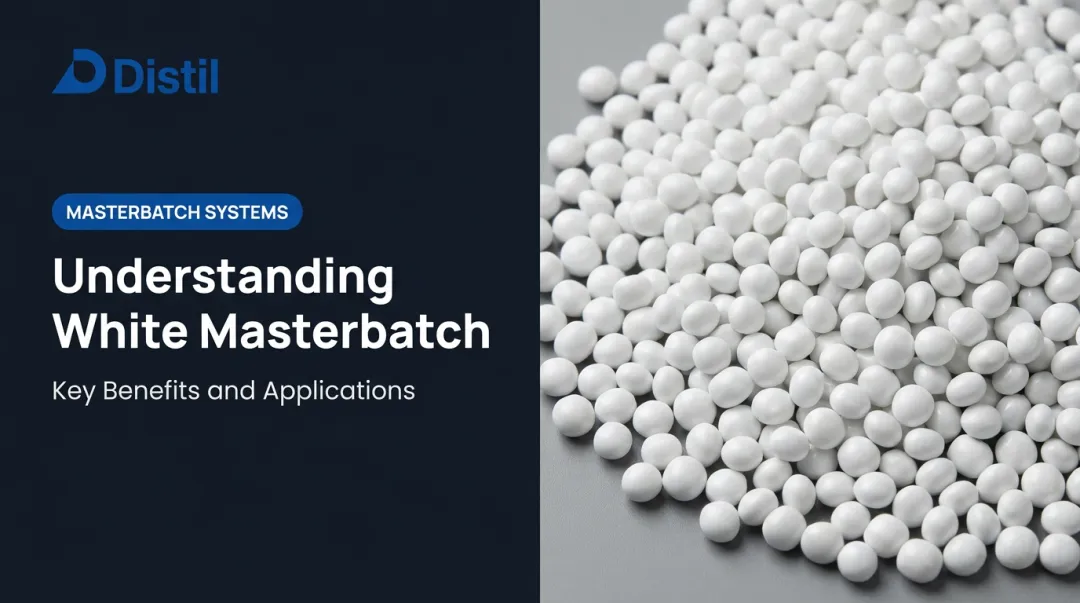
Masterbatch is a solid (or liquid) concentrated mixture of pigments and/or additives dispersed in a carrier resin matrix. During plastic processing, it's blended into the base polymer at a let-down ratio of roughly 1–5% — a small quantity delivers the target colour or functional property across a much larger volume of plastic.
The masterbatch itself typically contains 40–65% active ingredient (pigment or additive), though some formulations reach as high as 80% in specific applications. Omya, for instance, offers calcium carbonate polyolefin masterbatch with filler loads up to 87%.
The Manufacturing Process
Production follows a consistent sequence:
- Weigh and select pigments or additives to precise specification
- Mix with carrier resin in the correct ratio
- Melt-extrude through a high-shear twin-screw extruder (the critical step where homogeneous dispersion occurs)
- Cool the extrudate
- Pelletize into uniform granules ready for downstream use
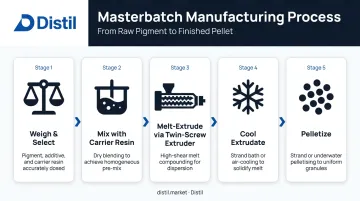
The twin-screw extruder is what separates masterbatch from simply blending dry pigment into resin. As Coperion notes, co-rotating intermeshing twin-screw extruders provide the mixing intensity required for proper pigment dispersion, with side-feeder arrangements used when pigment loadings exceed 20%.
Carrier Resin Selection
Carrier resin choice is made before extrusion begins — and getting it wrong creates problems that show up only after processing. The carrier must be chemically compatible with the base polymer. Common options include PP, PE, PVC, EVA, and PS, each matched to the corresponding base plastic. Universal wax-based carriers offer flexibility but may compromise mechanical properties.
The guiding principle: use the same generic resin family as the base polymer. A PE carrier for PE, a PP carrier for PP. An incompatible carrier impairs dispersion, weakens the finished part, or causes surface defects.
How Masterbatch Is Incorporated
Two main methods are used in production:
- Hopper blending: solid masterbatch granules premixed with base resin pellets, blended in the extruder screw during processing
- Liquid masterbatch dosing: delivered via peristaltic pump for high-accuracy dosing and faster colour changes between production runs
Types of Masterbatch
Masterbatches fall into three main categories. The right choice depends entirely on what the finished plastic product needs to do.
Colour Masterbatch
Colour masterbatch incorporates organic dyes, organic pigments, or inorganic pigments into a carrier resin to impart colour.
The dye-versus-pigment distinction matters practically:
- Dyes dissolve in the polymer — used for transparent, brilliant coloration
- Pigments remain as discrete particles — require proper dispersion, offer opacity, heat resistance, and weathering performance
The two dominant sub-types:
| Sub-Type | Colorant | Primary Uses |
|----------|----------|--------------|
| White masterbatch | Titanium dioxide (TiO₂) | Films, pipes, packaging, fibers — opacity and brightness |
| Black masterbatch | Carbon black | Automotive, electrical, outdoor — UV resistance and durability |
Beyond white and black, coloured masterbatches span the full visible spectrum. They can be custom-formulated to match precise brand colour standards — a critical requirement in consumer packaging and automotive interiors.
Additive Masterbatch
Additive masterbatch delivers functional property enhancements that go beyond colour. Instead of pigments, the concentrate carries performance-modifying agents dispersed in the carrier resin.
Common additive types and their functions:
- UV light stabilisers: protect against photodegradation in outdoor applications
- Flame retardants: limit ignition and flame spread in electrical and automotive components
- Anti-static agents: prevent charge buildup in packaging and electronics
- Anti-fog agents: maintain film clarity in food and agricultural packaging
- Slip and anti-block agents: improve film handling and unwind performance
- Antioxidants/stabilisers: prevent thermal and oxidative degradation during processing and service life
- Antimicrobials: used in healthcare and food-contact applications
The concentrated form ensures each additive is delivered at a precise, consistent level — far more reliable than dosing raw powder additives by hand.
Filler Masterbatch
Filler masterbatch disperses inorganic fillers — most commonly calcium carbonate (CaCO₃), talc, or barium sulfate — in a carrier resin. Its primary purpose is cost reduction: replacing a portion of the more expensive base polymer with a lower-cost mineral filler, while maintaining or improving stiffness, rigidity, and printability.
Typical applications include blown films, bags, and packaging. Talc-based fillers specifically improve flexural modulus and dimensional stability in polypropylene applications. Calcium carbonate masterbatch also reduces energy consumption and can lower the overall carbon footprint of the finished product.
Key Benefits of Using Masterbatch
Precision and Consistency
Because pigments and additives are pre-dispersed at a fixed concentration in the carrier, masterbatch delivers repeatable batch-to-batch consistency that raw powder handling simply cannot match. Manually weighing fine pigment powders introduces human error, environmental variability, and dispersion inconsistency. Masterbatch removes those variables.
Accurate, Safer Dosing
The granular form lets processors handle small quantities of expensive additives accurately without specialised weighing equipment. Gravimetric dosing systems can achieve accuracy of ±0.1% on a 1% setting (per Maguire's WSB gravimetric blender specifications), eliminating dust hazards and measurement errors associated with fine-powder additives.
Precision dosing systems using masterbatch can deliver up to 30% savings on masterbatch and additive consumption, with ROI often achieved within 6–9 months.
Extended Shelf Life
Solid masterbatch granules are solvent-free. The carrier resin physically encapsulates the active pigments and additives, protecting them from:
- Humidity during storage and transport
- Temperature fluctuations
- UV exposure that degrades unprotected pigments
Unlike liquid colorants — which can settle and require agitation before use — solid masterbatch granules are stable and ready to process without preparation. That storage stability translates directly into production readiness: less preparation time, less waste before the first shot runs.
Processing Efficiency
Carrier resins matched to the base polymer improve melt flow compatibility and reduce machine downtime. Liquid masterbatches go further, enabling rapid colour changes between production runs, cutting changeover time and material waste.
Cost-Effectiveness
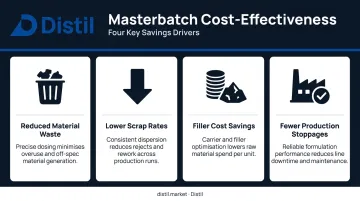
The economic case combines several factors:
- Reduced material waste from accurate dosing
- Lower scrap rates from better dispersion consistency
- Filler masterbatch partially replaces expensive base polymer with lower-cost mineral content
- Fewer production stoppages from colour or property failures
Industries and Applications of Masterbatch
Primary Application Sectors
Plastics and Packaging is the largest single segment, accounting for over 30% of global masterbatch sales in 2025, according to Mordor Intelligence. Masterbatch is used across flexible and rigid packaging, films, bottles, caps, and closures — delivering colour consistency alongside functional properties including UV protection, anti-static behaviour, and barrier enhancement.
Automotive is a growing segment, with Mordor forecasting 5.22% CAGR for automotive masterbatch through the outlook period. Applications span interior components (colour consistency, scratch resistance), exterior parts (UV stability, impact strength), and under-the-hood components (flame retardancy, thermal durability).
Agriculture relies heavily on UV-stabilising masterbatches for greenhouse covers, mulch films, and irrigation pipes. Ampacet's AgriStab formulations, for instance, target 3+ year service life for multi-season greenhouse films under high-pesticide conditions.
Secondary Application Sectors
- Textiles and fibres — solution dyeing of polyester and nylon using colour masterbatch delivers consistent results and eliminates water-intensive dyeing processes
- Electrical and electronics — flame retardant, anti-static, and conductive masterbatches are used in cable insulation, connectors, and device housings
- Construction — pipes, cables, and profiles requiring UV, flame, and weathering resistance depend on additive masterbatch systems
Distil's Advanced Polymer Solutions vertical serves all of these segments — from FMCG flexible packaging and BOPP films to agricultural films, automotive polymer systems, and wire and cable applications. Distil's R&D team develops custom masterbatch systems for each end-use, managing the full journey from lab formulation to commercial-scale production.
How to Choose the Right Masterbatch
Three Critical Selection Criteria
1. Carrier resin compatibility The carrier must be chemically compatible with the base polymer. An incompatible carrier compromises dispersion uniformity, can weaken mechanical properties, and may cause surface defects. The clearest guidance: match the carrier resin family to the base polymer — PE carrier for PE parts, PP carrier for PP parts.
2. Application environment The end-use conditions dictate which additives are needed:
- Outdoor exposure → UV stabilisers and weathering additives
- Food contact → food-grade approved pigments and additives
- Electrical applications → flame retardants and anti-static agents
- Medical applications → precise dispersion control and biocompatibility-oriented formulations
3. Processing method Injection moulding, blown film extrusion, fibre spinning, and pipe extrusion each impose different temperature profiles and shear conditions. A masterbatch optimised for blown film may not perform the same way in an injection moulding press. The masterbatch formulation — including carrier melt flow index, additive loading, and pigment particle size — must be selected for the specific process.
Let-Down Ratio and Concentration
Verify that the masterbatch's additive loading and let-down ratio deliver the target property at the correct dosage. Commercial let-down ratios typically range from 1.0% to 2.5% depending on pigment concentration and the feeding system's accuracy. Overdosing wastes material; under-dosing results in off-spec product.
Working with an expert formulation partner removes the guesswork from this process. At Distil, we start with thorough problem definition: mapping application requirements, processing conditions, and performance targets before moving through formulation design, validation, process optimisation, and commercial-scale production. Our unified quality control system eliminates process drift across the partner manufacturing network, ensuring consistency from development batch to full production run.
Sustainable Masterbatch: The Growing Trend
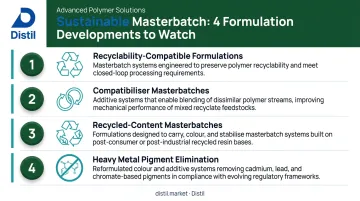
Regulatory pressure and brand owner mandates are pushing masterbatch formulators toward sustainability-first design. Four developments are defining this shift:
- Recyclability-compatible formulations — masterbatches designed to not interfere with mechanical recycling streams, maintaining sortability and reprocessability
- Compatibiliser masterbatches — such as Ampacet's ReVive range, which enables recycling of co-mingled polymer scrap by allowing post-industrial and post-consumer polymers to be processed together
- Recycled-content masterbatches — Ampacet's REC-O-BLACK 216 is made from more than 95% recycled and recovered material, while Cabot's REPLASBLAK uses certified sustainable carbon black from end-of-life tyres
- Heavy metal pigment elimination — EU RoHS and REACH regulations restrict lead and cadmium in defined applications, driving a shift toward compliant organic pigment alternatives
For packaging converters and automotive suppliers, these aren't optional upgrades. Extended producer responsibility (EPR) schemes and recyclability mandates from brand owners are making compliant masterbatch formulation a commercial requirement — not just a materials science preference.
Frequently Asked Questions
What is the purpose of masterbatch?
Masterbatch efficiently delivers concentrated pigments or functional additives into base plastics during manufacturing. It improves colour accuracy, product performance, and processing reliability compared to dosing raw undiluted additives, while reducing dust hazards, measurement errors, and material waste.
What is the difference between colour masterbatch and additive masterbatch?
Colour masterbatch imparts colour using dyes or pigments dispersed in a carrier resin. Additive masterbatch uses the same carrier resin mechanism to deliver functional property enhancements — UV resistance, flame retardancy, anti-static behaviour, anti-fog — without necessarily affecting colour.
What is the typical loading ratio of masterbatch in plastic manufacturing?
Masterbatch is typically used at a 1–5% ratio relative to the base polymer. The masterbatch itself generally contains 40–65% active ingredient, enabling precise delivery of high pigment or additive concentrations at low let-down ratios.
Can multiple masterbatches be combined in a single formulation?
Yes. A colour masterbatch and a UV stabiliser masterbatch, for example, can be combined in a single processing run. The key requirement is that all carrier resins are compatible with the base polymer and that combined additive levels stay within recommended thresholds.
What is a carrier resin and why does compatibility matter?
A carrier resin is the polymer matrix in which pigments or additives are dispersed. Compatibility with the base plastic is essential. An incompatible carrier impairs dispersion uniformity, weakens mechanical properties, or causes surface defects in the finished product.
How does masterbatch differ from using raw pigments directly?
Raw pigments are difficult to dose accurately in small quantities, generate dust hazards, and often disperse unevenly in the melt. Masterbatch pre-disperses those same pigments in a carrier resin, delivering cleaner handling, more consistent dispersion, longer shelf life, and straightforward integration into standard production processes.