Key Takeaways
- Sucrose cocoate is a non-ionic sugar ester (INCI: SUCROSE COCOATE) derived from sucrose and coconut oil fatty acids
- Functions as a mild surfactant, emulsifier, and refatting agent, gentler than anionic surfactants like SLS
- CIR assessed sucrose cocoate as safe at reported use concentrations, up to 20.6% in rinse-off applications
- Typical formulation ranges: 2–4% in cleansers, 3–5% in leave-on emulsions
- Suited for sensitive skin, baby care, and clean-label formulations given its plant-based origin and mild safety profile
What Is Sucrose Cocoate?
Sucrose cocoate is a sugar ester formed when sucrose — sourced from sugar cane or sugar beet — reacts with fatty acids derived from coconut oil. Its official INCI name, as listed in the EU CosIng database, is SUCROSE COCOATE, described as "fatty acids, coco, esters with sucrose" (CAS 91031-88-8; EC 292-993-4).
Classified as a non-ionic surfactant, it carries three registered cosmetic functions:
- Emulsifying surfactant — stabilizes oil-in-water emulsions
- Skin conditioning agent — supports moisture retention and skin feel
- Antistatic agent — reduces static charge in leave-on and rinse-off formats
Its reported HLB value of 15 places it firmly in the hydrophilic range, making it well suited for oil-in-water emulsification and mild cleansing systems.
Physical Characteristics and Form
Sucrose cocoate is a water-loving, relatively viscous liquid — easy to incorporate into both rinse-off and leave-on formats without extensive pre-processing adjustments. Its product pH typically sits between 6.5 and 7.5, though sucrose esters remain stable across a broader pH 4–8 range.
Natural vs. Synthetic Origin
Most commercial sucrose cocoate is naturally derived from plant-based feedstocks (coconut oil and sucrose), giving it a high natural origin index. Synthetic versions exist as well, so brands pursuing natural, bio-based, or clean-label positioning should verify origin with their supplier.
Distil produces its sucrose cocoate via a transesterification process using coconut oil and sucrose, supplying it as a plant-based, mild surfactant suitable for clean beauty formulations.
How Is Sucrose Cocoate Made?
The production of sucrose cocoate involves esterification — sucrose reacts with coconut-derived fatty acids (drawn from a coconut oil fatty acid cut) under controlled conditions to yield a mixture of sucrose monoesters and polyesters.
The monoester-to-polyester ratio matters considerably:
- Higher monoester content: higher HLB, more hydrophilic behavior, better oil-in-water emulsification
- Higher polyester content: lower HLB, more lipophilic behavior, stronger water-in-oil emulsification and conditioning performance
This ratio is supplier-specific and not published as a universal standard, so formulators evaluating grades should request the ester profile from their manufacturer's technical data sheet.
Production Routes and Sustainability
| Route | Notes |
|---|---|
| Conventional esterification | Sucrose reacts with fatty acids or fatty acid derivatives; standard commercial method |
| Solvent-free synthesis | Produces high-purity monoesters; reported to improve HLB consistency |
| Enzymatic (lipase-catalyzed) | Greener processing option; ester profile remains process-dependent |
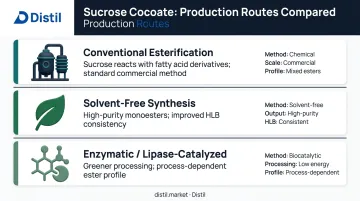
A key processing consideration across all routes: the synthesis must prevent sucrose caramelization, which can degrade the ingredient and compromise formulation stability. Temperature control and process design — whether solvent-free or enzymatic — are the primary levers formulators and manufacturers use to manage this risk.
Both feedstocks — sucrose and coconut oil — are renewable and biodegradable. This aligns with the broader industry shift toward naturally derived personal care ingredients. MarketsandMarkets projects the natural personal care ingredients market to grow from $5.3B in 2022 to $7.9B by 2028, with biosurfactants identified as one of the fastest-growing application segments.
Key Functions of Sucrose Cocoate in Skin Care
Mild Surfactant and Foam Enhancer
Sucrose cocoate lowers surface tension to lift sebum, dirt, and residue from the skin's surface. It produces a fine, stable foam — without the aggressive defatting associated with anionic surfactants like sodium lauryl sulphate (SLS).
Research on anionic versus non-ionic surfactant systems supports this distinction: a 2023 study found that non-ionic surfactants carried the lowest skin-irritation risk, with mixed anionic/non-ionic systems reducing irritability by 24–67% compared to single anionic systems alone.
In cleansers, it also improves foam density and creaminess. Typical applications include:
- Luxury jelly cleansers
- Conditioning foam washes
- Micellar formats
- Sensitive-skin facial cleansers
Emulsifier
With an HLB of 15, sucrose cocoate is well-suited to stabilizing oil-in-water emulsions. Its amphiphilic structure (one end attracted to water, the other to oil) keeps oil and water phases evenly distributed. This extends shelf stability and prevents phase separation in moisturizers, body lotions, and multi-phase serums.
Skin-Conditioning and Refatting Agent
The fatty acid component of sucrose cocoate integrates with the skin's lipid environment, contributing to a refatting, emollient effect after cleansing. This is the mechanism behind the "after-feel" improvement commonly cited in formulator evaluations — skin feels softer rather than stripped.
CIR and functional literature document sucrose cocoate as a non-ionic surfactant and refatting agent used in emollient and skin-moisturizing formulations. Peer-reviewed literature has not established quantified TEWL reduction data specific to sucrose cocoate, so emolliency claims are best framed around refatting and improved skin feel rather than measurable barrier repair percentages.
Penetration Enhancement (Concentration-Dependent)
Sucrose esters as a class have been studied as penetration enhancers via interaction with stratum corneum lipid organization. One study examined sucrose cocoate at 0.5% concentration for enhanced mucosal absorption. This effect is formulation- and concentration-dependent. Treat it as a technical consideration for pharmaceutical-adjacent applications, not a default cosmetic marketing claim without finished-formula evidence.
Sucrose Cocoate Formulation Guidelines
Rinse-Off Cleansers (2–4%)
At these concentrations, sucrose cocoate acts as a primary mild surfactant and foam booster. It pairs well with other gentle, naturally derived co-surfactants to build a balanced cleansing system. Suitable product formats include:
- Baby wash and body wash — benefits from its mildness and refatting character
- Micellar water and no-rinse cleanser — effective gentle cleansing without the aggressive defatting of ionic systems
- Sulfate-free scalp care shampoos — replaces harsher anionic surfactants while maintaining cleansing efficacy
- Luxury jelly cleansers — contributes to the characteristic texture and creamy foam
Leave-On Emulsions (3–5%)
In moisturizers, body lotions, and face creams, sucrose cocoate contributes to emulsion stability and a thicker, creamier texture. Key stability considerations for this format:
- pH 4.5–7 (typical in skin care) sits well within the sucrose ester stability window of pH 4–8
- Below pH 3, gradual degradation into sugar and fatty acid components can occur — worth monitoring in highly acidic treatment formulations
Blend Stabiliser and Trace Applications (below 1%)
Phase separation in complex multi-ingredient systems is where trace levels of sucrose cocoate prove useful. Serums and treatment formulations may include it below 1% to improve ingredient distribution and blend stability without meaningfully affecting the formula's primary character.
Usage Concentration Reference
| Application | Typical Range | Key Function |
|---|---|---|
| Rinse-off cleansers | 2–4% | Mild surfactant, foam quality |
| Leave-on emulsions | 3–5% | Emulsification, texture, skin feel |
| Blend stabiliser / trace use | <1% | Phase stability, delivery aid |
| Maximum reported (CIR) | 20.6% | Shaving soap / rinse-off use |
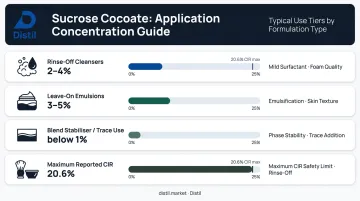
The 20.6% figure from the CIR report represents the maximum reported use concentration in a specific rinse-off format (shaving soap) — not a universal safety ceiling. It does indicate that formulators working at typical 2–5% levels have significant headroom.
For formulators working outside these standard ranges — or developing a novel format — Distil's R&D team, led by Dr. Leema Joseph (VP, R&D) and Kiro Rizk (Head of Personal Care), supports application-specific trials from initial concentration testing through validation and scale-up.
Safety Profile and Regulatory Status
CIR Assessment
The Cosmetic Ingredient Review Expert Panel reviewed sucrose cocoate as part of its Safety Assessment of Saccharide Esters as Used in Cosmetics (Final Report, January 2017; published in Int J Toxicol. 2021;40(2_suppl):52S–116S). The Panel concluded that saccharide esters, including sucrose cocoate, are safe as used in cosmetics in present practices of use and concentration.
That conclusion is concentration-dependent, not a blanket approval at any level. Formulators should still conduct finished-product safety assessments per applicable regulations.
Irritation and Sensitization
Sucrose cocoate's non-ionic character places it in the lower-irritation tier of surfactant classifications. Its established use in baby care formulations — shampoos, body washes, no-rinse solutions — reflects the broad tolerability validated through commercial product safety evaluations over time.
One caveat worth noting for formulators: no sucrose cocoate-specific HRIPT (Human Repeat Insult Patch Test) data were identified in the accessible CIR report excerpts. The safety conclusion rests on group-level data for saccharide esters as a class.
EU and Global Regulatory Standing
- EU CosIng: Listed with INCI name SUCROSE COCOATE, with functions and identifiers confirmed; no specific Annex restriction applicable
- REACH: ECHA holds a registration dossier for fatty acids, coco, esters with sucrose; EU formulators importing or manufacturing at 1 tonne or more per year should confirm supplier REACH registration status
- Global use: Widely used ingredient with no known restrictions in major personal care markets
A Note on Coconut Allergy
Individuals with documented coconut allergies should approach coconut-derived ingredients with caution and consult a dermatologist before use. For formulators, the current evidence presents three key points:
- No sucrose cocoate-specific cross-reactivity studies have been identified in the literature
- Sensitization to sucrose cocoate specifically is not well-documented
- The appropriate response is ingredient transparency and patch testing for reactive individuals, not categorical avoidance
Which Skin Types Benefit Most from Sucrose Cocoate?
Sucrose cocoate's non-ionic structure and mild cleansing profile make it suitable across a range of skin types, but three segments see the most direct formulation benefit:
- Sensitive and reactive skin: Avoids the charge-based irritation mechanisms of anionic surfactants, making it a sound choice for redness-prone, eczema-affected, or barrier-compromised skin. It cleanses without disrupting protective function.
- Dry skin: Delivers effective cleansing alongside a refatting, skin-conditioning effect — leaving skin soft rather than tight after washing. Hydrating cleansers and moisturisers are natural application fits.
- Infants and all ages: Its use across baby care formats — shampoos, body washes, no-rinse cleansers — is the clearest signal of its tolerability. Baby care regulatory standards are among the most stringent in personal care, and sucrose cocoate's presence in that category carries formulation credibility for brands positioning around gentleness or family use.

Frequently Asked Questions
What is sucrose cocoate?
Sucrose cocoate is a sugar ester produced by combining sucrose (from sugar cane or beet) with fatty acids from coconut oil. It functions as a mild, non-ionic surfactant, emulsifier, and skin-conditioning refatting agent used across both rinse-off and leave-on personal care formulations.
Is sucrose cocoate good for skin?
Yes. It cleanses gently without stripping the skin's lipid barrier and provides a refatting, emollient effect that leaves skin feeling soft. It is well-tolerated across skin types, including sensitive and baby skin.
How is sucrose cocoate made?
It is produced through esterification of sucrose with coconut oil-derived fatty acids, yielding a mixture of sugar monoesters and polyesters. Both conventional and solvent-free enzymatic routes exist — the ester profile varies by production method and is supplier-specific.
Is sucrose cocoate safe for sensitive skin?
Yes. Its non-ionic, mild surfactant profile makes it well-tolerated by sensitive skin. It is used in baby care formulations and is confirmed safe as used by the CIR Expert Panel.
Is sucrose cocoate natural or synthetic?
Most forms derive from natural sources — sucrose and coconut oil — and carry a high natural origin index. Synthetic forms exist. Brands making natural or bio-based label claims should verify the origin with their supplier and request supporting documentation.
What skin care products typically contain sucrose cocoate?
It appears in baby shampoos, body washes, micellar waters, no-rinse solutions, jelly cleansers, moisturisers, body lotions, and serums.