For formulators and brand teams, this breadth creates a real challenge: the same ingredient name covers wildly different specifications, regulatory frameworks, and performance expectations depending on the application. A pharmaceutical-grade ZnO at 25% in a sunscreen cream operates under FDA OTC Monograph M020. The same compound in a rubber compound activates sulfur cross-linking under ASTM D79 specifications.
This article covers what zinc oxide powder actually does across its primary applications, what clinical and regulatory evidence supports specific claims, where safety caution is warranted, and what formulators should know before specifying or sourcing it at commercial scale.
Key Takeaways
- Zinc oxide (ZnO) is a white inorganic compound with UV-blocking, antimicrobial, and wound-healing properties across pharmaceutical, cosmetic, and industrial applications
- FDA OTC Monograph M020 (2021) permits ZnO as a sunscreen active up to 25%; FDA M016 permits 1%–40% for skin protectant applications in ointment form
- It functions as a physical UV barrier, absorbing 85–95% of UV radiation across both UVA and UVB ranges
- Non-nano ZnO stays on the skin's surface; EU SCCS found no evidence of nano ZnO penetrating healthy skin
- Inhalation risk is occupational, not a consumer concern; grade, particle size, and carrier compatibility are the critical sourcing variables
What Is Zinc Oxide Powder?
Zinc oxide is an inorganic compound (ZnO, CAS 1314-13-2, molecular weight 81.39 g/mol) produced commercially through three primary manufacturing routes: the French process, American process, and wet chemical process. Zincite is its naturally occurring mineral form, but commercial ZnO is almost entirely synthetically produced.
Physically, it presents as a white, odourless solid or fine powder with a melting point of 1,975°C and water solubility of roughly 0.0004% at 18°C — meaning it disperses in formulations rather than dissolving.
Chemical Properties That Drive Versatility
ZnO is amphoteric: it reacts with acids to form zinc salts and with strong alkalis to form zincates. This dual reactivity, combined with its UV-attenuating, antibacterial, and astringent properties, makes it functional across personal care, rubber compounding, coatings, and electronics applications.
Grades and Particle Sizes — What Actually Differs
| Grade | Purity Standard | Typical Applications |
|---|---|---|
| Pharmaceutical (USP) | 99.0–100.5% ZnO | Sunscreens, wound care, diaper rash ointments |
| Cosmetic | ≥96% (SCCS nano criteria) | Foundations, BB creams, SPF moisturisers |
| Industrial (ASTM D79) | Per pigment specification | Paints, rubber, ceramics, electronics |
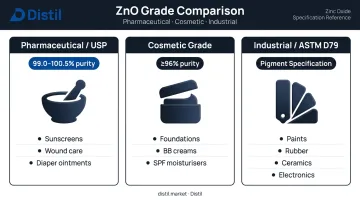
Particle size matters as much as grade. Standard, micronised, and nano/ultra-fine formats affect UV performance, transparency, white cast, and — in the case of nano ZnO — regulatory classification. Formulators sourcing ZnO for personal care applications need both purity and particle size specified explicitly.
Understanding these physical and chemical fundamentals helps clarify why ZnO behaves differently across applications — and why grade selection is a formulation decision, not just a procurement one.
Key Benefits of Zinc Oxide Powder for Skin
Broad-Spectrum UV Protection
ZnO functions as a physical particulate filter, absorbing approximately 85–95% of UV radiation while reflecting and scattering the remainder. Unlike chemical sunscreen filters — which absorb UV rays at specific wavelength ranges — ZnO covers the full UV spectrum from 290 to 400 nm, delivering genuine broad-spectrum UVA and UVB protection from a single active ingredient.
Key regulatory and formulation facts for manufacturers:
- FDA OTC Monograph M020 (2021) lists ZnO as a recognised sunscreen active at concentrations up to 25%
- Both ZnO and titanium dioxide are considered GRASE (Generally Recognised as Safe and Effective) at those concentrations
- SPF is formulation-dependent — the FDA assigns no fixed SPF to specific ZnO concentrations; product-specific testing is required
ZnO's broad-spectrum coverage without chemical co-filters makes it the preferred active in mineral sunscreens for sensitive skin, infant use, and clean-beauty positioning. Avobenzone, the closest chemical alternative for UVA coverage above 360 nm, requires photostabilisers that ZnO does not.
Wound Healing and Skin Recovery
Zinc is essential to collagen synthesis, enzyme activity, and epidermal regeneration. Topical ZnO delivers zinc directly to damaged tissue, bypassing systemic absorption pathways.
Clinical evidence shows dose-dependent effects:
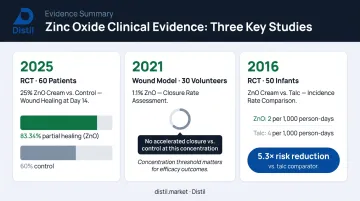
- A 2025 pilot RCT (60 patients) found 25% ZnO cream produced 83.34% partial healing by day 14 versus 60% in the control group; peri-wound erythema fell 50% versus 9.5% in controls
- A 2021 human wound model (30 volunteers) found 1.1% ZnO did not accelerate complete wound closure — suggesting concentration matters significantly
- A 2016 RCT (50 Thai infants) found ZnO cream reduced diaper dermatitis incidence to 2 per 1,000 person-days versus 4 per 1,000 for talc, with 5.3x higher risk in the talc group
A 2021 diaper dermatitis review supports 5% ZnO ointment for reducing symptoms of diarrhoea-induced dermatitis. The FDA's M016 monograph permits ZnO from 1% to 25% in standard skin protectant applications, and above 25% to 40% in ointment dosage forms specifically.
Acne Treatment and Sebum Regulation
ZnO addresses acne-prone skin through two distinct mechanisms:
- Astringent action — reduces excess sebum production at the skin surface
- Antibacterial activity — inhibits Cutibacterium acnes growth and biofilm formation
A 2024 in vitro study found ZnO nanoparticles inhibited C. acnes at 15–62.5 µg/mL. MIC and MBC both measured 250 µg/mL against reference and clinical strains. A 2025 systematic review of topical ZnO nanoparticle formulations identified one exploratory human study where a 0.5% hyaluronic-ZnO nanogel reduced inflammatory lesions by 58% at week 4.
Current clinical acne evidence is early-stage and largely nanoparticle-specific — broad claims about ZnO powder efficacy in antibiotic-resistant acne are not yet supported by clinical trial data. Still, ZnO remains a regulatory-friendly, non-antibiotic option for brands developing acne-care or oil-control formulations.
Anti-Inflammatory and Antibacterial Protection
Beyond acne, ZnO's antibacterial and anti-inflammatory effects extend to a broader range of skin conditions. It reduces bacterial adhesion and modulates cytokine expression rather than acting as a conventional bactericide. Research on enterocytes found that 0.2 mmol/L ZnO reduced E. coli adhesion and blocked invasion, while counteracting cytokine mRNA changes involving IL-8, TNF-alpha, and TGF-beta.
In a 2022 retrospective study (50 infants), calamine lotion (which contains ZnO) used alongside mometasone improved EASI scores, lesion area, and pruritus versus mometasone alone — with 14 infants in the treatment group achieving full resolution.
Conditions where this mechanism is applied clinically:
- Diaper and irritant dermatitis
- Eczema and atopic skin
- Poison ivy / contact irritant reactions
- Post-procedure skin recovery
Industrial and Specialty Chemical Applications
ZnO's industrial footprint extends well beyond personal care into several chemically distinct application areas:
- Rubber manufacturing: Acts as the primary cure activator in sulfur-based vulcanisation systems, used alongside stearic acid to drive cross-linking in tyre and rubber goods production. Particle size and purity directly govern vulcanisation rate.
- Paints and coatings: ASTM D79-86 (2020) sets requirements for ZnO as a pigment (zinc white), covering colour consistency, reactivity, and coverage.
- Food and feed use: The FDA recognises ZnO as GRAS under 21 CFR 182.8991. EFSA concluded in 2012 that ZnO is a safe zinc source for all animal species in feed applications.
- Agriculture: Zinc deficiency is the most widespread micronutrient deficiency in agricultural soils globally, particularly in cereal-growing tropical systems. ZnO-based fertilisers address this gap, with agronomic specifications varying by crop and soil type.
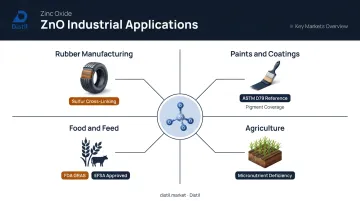
For industrial buyers, batch-to-batch consistency — purity, particle size distribution, surface area — is non-negotiable. Specification drift in any one parameter can disrupt process performance across all four of these applications.
Side Effects and Safety Considerations
Topical Use
Topical ZnO is considered non-irritant and non-allergenic for most skin types, including sensitive and infant skin. A 2024 sunscreen contact-sensitivity review characterises physical blockers as not typically causing phototoxicity or photoallergy. Allergic reactions are documented but rare; standard practice is patch testing before broad application.
Nano vs. Non-Nano
The EU SCCS (SCCS/1518/13, 2014) concluded that nano ZnO poses minimal dermal risk as a UV filter, subject to purity, size, coating, and solubility criteria. Studies have not demonstrated significant dermal penetration through healthy skin.
The ongoing regulatory discussion around nano ZnO centres on:
- Spray and aerosol formats — where inhalation exposure is possible during application
- Long-term systemic exposure data — still under active review by regulatory bodies
Non-nano ZnO remains the default specification for formulators seeking to avoid regulatory complexity, particularly in markets with stricter nano ingredient notification requirements.
Industrial Inhalation Risk
The dermal and inhalation risk profiles for ZnO are distinct — the latter is strictly an occupational concern.
NIOSH lists ZnO dust exposure limits at 5 mg/m³ TWA and 15 mg/m³ ceiling; OSHA sets a fume PEL of 5 mg/m³. Inhaling significant ZnO dust concentrations causes metal fume fever, a flu-like illness with symptoms that include:
- Chills, fever, and muscle ache
- Nausea and dry throat
Onset typically follows acute exposure in poorly ventilated environments.
This is an occupational hazard in high-volume powder handling environments, not a consumer skincare risk. Recommended controls:
- Industrial scale: respiratory protection, local exhaust ventilation
- Lab/formulation scale: standard ventilation, avoid dry powder dispersion in enclosed spaces
Formulations, Grades, and Sourcing Considerations
Inclusion Rates by Application
ZnO is never applied in pure powder form directly to skin. It must be dispersed into an appropriate carrier — oils, butters, or emulsion systems — to achieve coverage and avoid visible white residue.
| Application | Typical ZnO Inclusion Rate |
|---|---|
| Diaper rash / barrier ointment | 1–25% (up to 40% in ointment form per FDA M016) |
| Acne / sebum-control formulations | Application-specific; nano formats at <1% in early-stage studies |
| SPF moisturisers, BB creams | 10–20% range |
| Dedicated mineral sunscreens | Up to 25% (FDA M020 ceiling for US OTC claims) |
Common ZnO Formulation Formats
- Mineral sunscreens (physical SPF)
- Diaper rash and wound care ointments
- Calamine-type lotions
- Acne spot treatments
- Anti-dandruff shampoos
- Mineral makeup: foundations, BB creams, tinted SPF
What to Specify When Sourcing
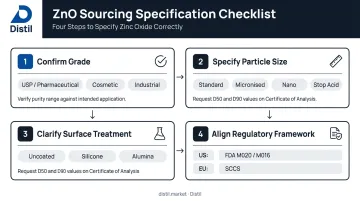
Each of those formulation formats places different demands on the ZnO you source. Getting the specification wrong at commercial scale creates compounding problems: inconsistent SPF results, batch-to-batch colour variation in coatings, or erratic vulcanisation in rubber compounds. Lock down these parameters before committing to supply:
- Confirm grade upfront: USP/pharmaceutical (99.0–100.5%), cosmetic (≥96% per SCCS nano criteria), or industrial (ASTM D79)
- Specify particle size as standard, micronised, or nano/ultra-fine, with confirmed D50 and D90 values in the CoA
- Clarify surface treatment: uncoated, silicone-treated, alumina-coated, or stearic-acid-treated
- Align to the relevant regulatory framework: FDA M020/M016 for US OTC claims; SCCS opinion criteria for EU cosmetics
For personal care brands and formulators working at commercial scale, Distil supplies natural and coated zinc oxide UV filters — in both powder and pre-dispersed dispersion formats — engineered for transparency, SPF performance, and formulation stability. The R&D team, led by Dr. Leema Joseph (VP R&D) with backgrounds spanning Dow, BASF, L'Oréal, Huntsman, and Reliance Industries, manages application-specific formulation trials from lab through to commercial delivery, with customer-retained IP throughout.
Conclusion
Zinc oxide powder remains relevant because it performs. No single alternative replicates its combination of broad-spectrum UV protection, barrier function, wound-healing activity, and utility across regulated categories.
For formulators and brand teams, the critical decision is not whether to use ZnO, but which specification to use. Grade, particle size, surface treatment, and carrier compatibility determine whether the ingredient performs as expected at scale, or produces batch inconsistency, regulatory exposure, or formulation failure.
The global ZnO market is projected to grow from USD 6.29 billion in 2026 to USD 8.17 billion by 2031 at a 5.3% CAGR, with pharmaceuticals identified as the highest-growth application segment. Getting the specification right early is where product performance is determined. Working with a supply partner — like Distil — who manages quality assurance from formulation trial to commercial batch removes the variables that cause late-stage failures.
Frequently Asked Questions
What can I use zinc oxide powder for?
Zinc oxide powder spans a wide range of applications:
- Physical sunscreens (UVA/UVB protection, up to 25% per FDA M020)
- Diaper rash and wound care ointments (1–40% per FDA M016)
- Acne treatments and calamine lotions
- Paints, coatings, and rubber vulcanisation
- FDA GRAS food and animal feed additive
The application determines the required grade and concentration.
Is zinc oxide powder good for skin?
Yes. ZnO provides UV protection, anti-inflammatory, antibacterial, and wound-healing benefits, supported by clinical evidence across sunscreen, diaper dermatitis, and wound care applications. ZnO is non-irritant and non-allergenic for most skin types — including sensitive and infant skin — with only rare allergic reactions documented.
What is the difference between nano and non-nano zinc oxide powder?
Non-nano ZnO stays on the skin's surface with no significant penetration shown in current evidence. Nano/micronised ZnO reduces white cast in sheer sunscreens; the EU SCCS found it poses no or limited dermal risk as a UV filter. Spray and aerosol formats remain under active regulatory review due to inhalation exposure potential.
What percentage of zinc oxide is typically used in skincare formulations?
FDA M016 permits 1–25% for skin protectants (up to 40% in ointment form). Dedicated mineral sunscreens use up to 25% per FDA M020. Everyday SPF moisturisers and BB creams typically fall in the 10–20% range. SPF claims require product-specific testing regardless of ZnO concentration.
Can zinc oxide powder cause side effects?
Topical side effects are rare; ZnO does not typically cause irritation, phototoxicity, or photoallergy. Isolated allergic reactions (redness, itching, swelling) are documented — patch testing before broad application is standard practice. The primary risk is inhalation in industrial powder-handling environments, not consumer skincare use.