Introduction
Black masterbatch appears in more plastic products than most people realise — irrigation pipes, automotive bumpers, cable sheathing, mulch films, food packaging. That ubiquity tends to create a false impression: that it is a simple, interchangeable commodity.
It is not. Black masterbatch is a multifunctional performance additive — one that simultaneously governs colour depth, UV protection, and mechanical reinforcement, and in certain grades, electrical conductivity.
Using the wrong grade in the wrong application produces outcomes ranging from colour streaks to premature structural failure.
According to MarketsandMarkets, the global black masterbatch market is projected to grow from USD 2,830 million in 2025 to USD 3,606 million by 2030 — a signal of how broadly these materials are specified across industries.
This article covers:
- How black masterbatch works at a technical level
- Its defining performance features by carbon black type
- Where it is used across industries
- How to specify the right grade for your application
- Which misconceptions cause the most costly errors
Key Takeaways
- Black masterbatch is a concentrated blend of carbon black in a carrier resin (typically 15–50% carbon black), let down into the base polymer at 1–5% during processing
- Carbon black functions simultaneously as a pigment, UV absorber, and mechanical reinforcer, with each function tuned by particle size and grade
- Key performance attributes include high jetness, UV stability, dispersion quality, heat resistance, and non-bleeding behaviour
- Applications span packaging, automotive, agriculture, wire and cable, and construction, with each sector requiring a different carbon black type and loading level
- Grade selection is application-critical; substituting one grade for another in a performance application will deliver the wrong result
What Black Masterbatch Is and How It Works
The Engineered Delivery System
Black masterbatch is not a raw pigment. It is a concentrated, pre-dispersed system: carbon black pigment and additives uniformly distributed within a thermoplastic carrier resin, supplied as pellets or granules. The pellet format enables precise, dust-free dosing directly into a base polymer at the extruder or moulding machine, eliminating the handling hazards and batch inconsistencies of raw carbon black powder.
As Modern Dispersions defines it: black masterbatches are high concentrations of carbon black — typically 15–50% by weight — dispersed in thermoplastic carrier resins and supplied pre-dispersed for extrusion and moulding. The masterbatch is then added to the base polymer at a let-down ratio, with 1–5% being the typical range for most applications, though pipe-grade masterbatch can be let down at 5–6.5%.
What Carbon Black Actually Does
Colour is only one of three functional roles carbon black plays:
- UV absorption — carbon black absorbs UV radiation across a broad spectrum, physically shielding the polymer matrix from photodegradation
- Mechanical reinforcement — carbon black acts as a filler in the polymer matrix, contributing to tensile strength and impact resistance
- Conductivity modification — in specialised grades, controlled carbon black loading creates a conductive network within the polymer
Not every black masterbatch delivers all three benefits equally. The relative strength of each function depends on the carbon black type, particle size, and loading level.
Particle Size: The Performance Driver
Ampacet describes the carbon black particle hierarchy: primary particles (nanoscale, typically 14–90 nm for plastics-grade carbon black) bond to form aggregates; aggregates loosely combine into agglomerates.
The particle size controls which function dominates:
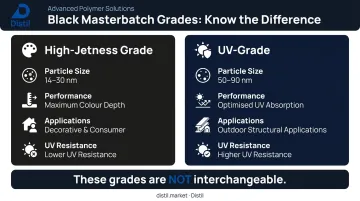
- Smaller particles (14–30 nm): deeper black colour, higher jetness, stronger tinting — but harder to disperse and weaker UV performance
- Larger particles (50–90 nm): easier dispersion, stronger UV protection, more cost-efficient — but lighter colour depth
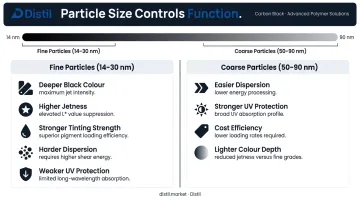
This trade-off is a design parameter, not a material limitation. Selecting a fine-particle grade for outdoor pipe or agricultural film applications — where UV protection outweighs jetness — leads to premature degradation in service.
Carrier Resin Compatibility
The carrier resin must be compatible with the base polymer. PE or LDPE carriers work for polyolefin applications; polystyrene carriers suit ABS or SAN.
A mismatch here is one of the most common causes of dispersion failures and inconsistent processing behaviour. When switching suppliers or base polymers, carrier chemistry must be verified against the new system — not carried over by assumption.
Key Technical Features of Black Masterbatch
Not every grade delivers every feature at the same level. Understanding what determines each characteristic guides correct specification.
High Jetness and Colour Depth
Jetness — the depth and richness of black — is governed by carbon black particle size and surface area. Finer, high-surface-area grades deliver deeper masstone (the colour of a pigment at full concentration) and bluer undertones. As Birla Carbon notes, STSA (statistical thickness surface area) is a primary predictor of colour and jetness in plastics.
Orion Carbons characterises jetness using the My value per DIN 55979 — higher values indicate deeper black. High-jetness grades trade UV performance for colour richness, making them appropriate for decorative and consumer-facing applications, not outdoor structural uses.
UV Stability
Carbon black absorbs UV radiation physically, preventing the polymer from absorbing destructive radiation. This mechanism differs from HALS (hindered amine light stabilisers), which trap free radicals, and benzotriazole UV absorbers, which filter chemically. Cabot confirms that UV performance depends on particle size, aggregate structure, loading level, and dispersion quality — four variables that must all be optimised together.
UV-grade masterbatches use larger-particle carbon black specifically optimised for radiation absorption rather than colour depth. These are not the same product as high-jetness grades and cannot substitute for them in outdoor applications.
Uniform Dispersion and Processing Behaviour
UV performance depends partly on dispersion — and so does everything else. Dispersion quality, how evenly carbon black is distributed through the polymer matrix, determines whether a formulation performs consistently across the entire part. Poor dispersion produces:
- Colour streaks and surface defects
- Mechanical weak points in the moulded part
- Uneven UV protection across the cross-section
ISO 18553:2025 is the current standard for assessing dispersion in polyolefin pipes, fittings, and compounds; ASTM D5596 covers microscopic evaluation in polyolefin geosynthetics.
Well-formulated masterbatch reduces die build-up, machine downtime, and rejected parts — three costs that go directly to throughput, not just aesthetics.
Heat Resistance and Mechanical Contribution
High-quality black masterbatch maintains colour integrity and dimensional stability at the processing temperatures required for engineering resins. Carbon black also reinforces the polymer matrix, an effect relevant wherever structural performance is part of the specification — pipe extrusion, automotive components, and wire and cable jacketing among them.
Non-Bleeding and Non-Blooming Behaviour
Heat resistance handles processing conditions — migration behaviour determines what happens after moulding. Bleeding refers to colour migrating into adjacent materials; blooming refers to additives surfacing onto the product. Both are unacceptable in:
- Multi-layer packaging (risk of contamination between layers)
- Food contact applications (regulatory and safety requirements)
- Automotive interiors (surface staining)
Grade selection and correct loading level both contribute to preventing these defects.
Industry Applications of Black Masterbatch
Application requirements vary significantly by sector. The carbon black type, loading level, and carrier resin must all be matched to the specific end-use demands.
Packaging and FMCG Films
In flexible packaging and industrial films, black masterbatch serves two distinct purposes: creating light-blocking opacity (critical for UV-sensitive products) and providing UV protection for packaging stored or transported outdoors. PE, PP, and PET base resins are common in blown film and cast film extrusion, and carrier resin compatibility must be verified for each.
Automotive
Automotive applications demand simultaneous UV stability, heat resistance, and mechanical performance across interior trims, exterior body panels, under-hood components, and bumpers. Colour consistency across large production runs — and across different component types (interior vs. exterior, injection moulded vs. extruded) — is a quality requirement that decorative-grade masterbatch alone cannot reliably meet.
Meeting these demands requires application-specific formulation from the outset. Distil's Advanced Polymer Solutions team develops masterbatch and additive systems for automotive interior, exterior, and under-the-hood applications, with formulation support managed from problem definition through to commercial-scale validation.
Agriculture
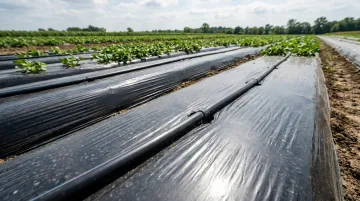
Mulch films, drip irrigation pipes, greenhouse films, and shade nets all require sustained UV stability across multiple outdoor seasons. UV-grade carbon black masterbatch is the mechanism by which the film or pipe survives repeated UV exposure without embrittling and cracking.
Research on LLDPE films demonstrates that increasing carbon black from 1.5% to 3.5% w/w significantly improved UV durability under both xenon arc and fluorescent UV exposure, with smaller-particle carbon black performing best. For agricultural pipe specifically, the Plastics Pipe Institute (PPI TN-47) confirms that 2–3% well-dispersed carbon black in HDPE provides UV stabilisation rated for at least 10 years.
Wire, Cable, and Electrical Applications
Cable sheathing uses black masterbatch primarily for UV protection during outdoor exposure. Standard carbon black loadings for thermoplastic polyethylene cable sheaths are typically around 2.5 ± 0.5% (per BIS IS 7098-2).
Semi-conductive cable applications are a separate category. Here, conductive-grade carbon black masterbatch achieves controlled electrical conductivity through a network of three-dimensional chain-like aggregates. Birla Carbon states that typical carbon black loadings in conductor and insulation shields reach 22–44 wt% — well outside the range of UV or decorative grades.
Construction and Infrastructure
HDPE pipes, geomembranes, and roofing membranes require long-term weather resistance and structural durability. Carbon black content in these applications is standardised:
- HDPE pipe: ASTM D2513 Code C specifies 2–3% well-dispersed carbon black, with a microscopic dispersion rating of less than 3 (per PPI TN-47)
- HDPE geomembranes: GRI GM13 requires carbon black content of 2.0–3.0% (tested per ASTM D4218), with dispersion assessed per ASTM D5596
Pipe-grade masterbatch is typically formulated at 35% carbon black loading for pressure pipe applications. Masterbatches exceeding 40% carbon black should be avoided, per Ampacet's pipe compound guidance.
How to Specify the Right Black Masterbatch
Correct specification requires more than just ordering "black masterbatch." Request the following from any supplier:
| Parameter | Why It Matters |
|---|---|
| Carbon black type and content (%) | Determines UV performance, jetness, and conductivity |
| Carrier resin identity and MFI | Must be compatible with base polymer; MFI mismatch causes dispersion failures |
| Let-down ratio | Governs dosing accuracy and final carbon black concentration |
| Dispersion rating (ISO 18553 or ASTM D5596) | Predicts processing behaviour and end-use uniformity |
| UV performance data (if applicable) | Validated against relevant standard, not just claimed |
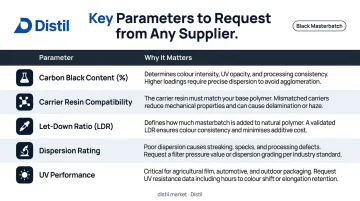
MFI matching between carrier and base polymer is particularly important. A significant mismatch causes the masterbatch to disperse unevenly through the melt, producing streaks and inconsistent properties across the part. Polymer-specific carriers offer better compatibility; universal carriers (such as EVA or LDPE) offer flexibility with some trade-offs.
For complex applications — advanced automotive polymers, wire and cable, or multi-layer packaging — formulation trials with a qualified partner are the most reliable path to consistent commercial performance.
Distil's Advanced Polymer Solutions team manages this through a structured five-stage process:
- Problem definition and application scoping
- Formulation design and material selection
- Validation and testing against relevant standards
- Process optimisation for target equipment and conditions
- Production at scale with batch-level quality traceability
Common Misunderstandings When Using Black Masterbatch
Treating All Black Masterbatches as Equivalent
The most costly error. High-jetness grades use small-particle carbon black optimised for colour depth. UV-grade masterbatches use larger-particle carbon black optimised for radiation absorption. Using a decorative-grade masterbatch in a drip irrigation pipe application — because it was available or cheaper — delivers inadequate UV protection. The pipe embrittles prematurely, often within a single growing season.
These grades are not interchangeable — specifying the wrong one doesn't just affect aesthetics, it compromises structural integrity in the field.
Assuming Higher Loading Always Means Better Performance
More carbon black is not always better. Excess loading beyond the validated range can:
- Reduce impact resistance and tensile elongation
- Cause surface defects and processing instability
- Increase formulation cost without proportional performance gain
For pipe-grade masterbatch, Ampacet explicitly warns against exceeding 40% carbon black content in the masterbatch. Final compound performance is optimised at specific loading ranges — the supplier's tested datasheet range is the ceiling, not a conservative floor.
Ignoring Carrier Resin Compatibility When Switching Suppliers
Qualifying an alternative masterbatch supplier by carbon black content alone is a common and serious mistake. A PE-carrier black masterbatch used in a PET or PC application will produce dispersion failures, and potentially delamination in multi-layer film structures. When changing suppliers, verify the carrier resin chemistry and MFI — not just the carbon black percentage. Application trials before commercial-scale adoption are not optional.
Conclusion
Black masterbatch is an application-specific performance additive. Three variables determine whether it works correctly:
- Carbon black type — governs the balance between jetness, UV protection, and conductivity
- Carrier resin compatibility — governs processability and dispersion
- Loading level — must be validated against the target application, not estimated
Getting the grade selection wrong carries real consequences: rejected cosmetic parts, premature UV failure in outdoor infrastructure, or conductivity that falls outside spec. All of these are preventable through proper specification and application-specific validation.
Frequently Asked Questions
What is black masterbatch?
Black masterbatch is a concentrated blend of carbon black in a thermoplastic carrier resin, supplied as pellets for dust-free dosing during extrusion or moulding. It delivers black colouration alongside UV protection, mechanical reinforcement, and — in specialised grades — controlled electrical conductivity.
What is the typical carbon black content in black masterbatch?
Carbon black content ranges from 15% to 50% by weight depending on grade. Let-down ratios into the base polymer are typically 1–5% for most applications, rising to 5–6.5% for pipe compound grades.
How does black masterbatch provide UV protection?
Carbon black particles absorb UV radiation physically across a broad spectrum, preventing the polymer from absorbing destructive radiation. UV performance depends on the carbon black type and particle size — UV-grade masterbatches use larger-particle carbon black optimised for radiation absorption, not colour depth.
What is the difference between high-jetness and UV-grade black masterbatch?
High-jetness grades use smaller carbon black particles (typically 14–30 nm) for deeper colour, suited for decorative and consumer-facing applications. UV-grade masterbatches use larger particles optimised for UV absorption. They are not interchangeable — substituting one for the other in an outdoor application will deliver the wrong performance outcome.
Can black masterbatch be used with all polymer types?
Compatibility depends on the carrier resin. The carrier must match or be chemically compatible with the base polymer — a PE carrier works for polyolefins, but would cause dispersion failures in PET or PC applications. Always verify carrier identity before processing.
What happens if the wrong black masterbatch grade is used?
Consequences range from cosmetic defects (streaks, surface bloom) to functional failures (premature UV degradation, loss of mechanical strength). Grade selection should always be validated through application-specific trials before commercial-scale production.