This isn't a purely technical question. It's a brand strategy decision that shapes what certifications you can earn, which retail channels you can enter, and how your product performs on skin across all tones and formats.
This article walks through the science, regulatory landscape, aesthetic trade-offs, and a practical selection framework to help formulators and brand owners make the right call.
Key Takeaways
- Non-micronized ZnO (>100nm) is the go-to for natural, clean-label, and sensitive-skin formulations — white cast increases at higher concentrations.
- Nano ZnO (<100nm) reduces white cast significantly, but requires EU [nano] labeling and raises inhalation concerns in sprays and powders.
- Both types deliver comparable broad-spectrum protection when properly formulated; particle size primarily affects aesthetics, not efficacy.
- Format matters: non-micronized is the safer default for aerosols, powders, baby products, and eco-certified lines.
- Retail channel standards diverge: Whole Foods Premium Body Care explicitly rejects nano ZnO (<100nm), making non-nano a requirement for that channel.
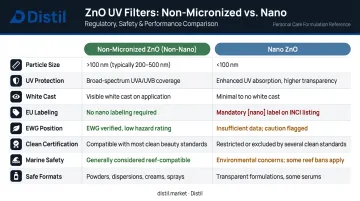
Non-Micronized vs Nano Zinc Oxide: Quick Comparison
| Factor | Non-Micronized (Non-Nano) | Nano |
|---|---|---|
| Particle Size | >100nm (typically 200–700nm) | <100nm |
| UV Protection | Excellent UVA/UVB; higher active load needed | Comparable efficacy at lower concentrations |
| White Cast | More visible, especially above 15% | Minimal to none; sheer finish |
| EU Labeling | No [nano] declaration required | Mandatory [nano] label; Article 16 notification applies |
| EWG Position | Preferred; caution only for sprays/powders | Not recommended in spray/powder formats |
| Clean Certification | COSMOS, EWG Verified, NPA compatible | Coatings may affect COSMOS eligibility |
| Marine Safety | Preferred per government reef guidance | NOAA flags nano ZnO as marine concern |
| Safe Formats | All topical formats including sprays | Creams and lotions only |
What Is Non-Micronized Zinc Oxide?
Non-micronized zinc oxide — used interchangeably with "non-nano" in personal care formulation — refers to ZnO with particle sizes above 100 nanometers. Supplier-specific ranges vary; Advance ZincTek's ZinClear XP, for example, sits at 200–700nm. It's the original mineral UV filter, and its large-particle structure directly shapes how it performs in formulation.
How It Works
A common misconception is that zinc oxide works primarily by reflecting UV radiation. Peer-reviewed research published in Photodermatology, Photoimmunology & Photomedicine shows ZnO protects skin mainly through UV absorption, with reflection accounting for only about 4–5% of the UV attenuation. This applies to both non-micronized and nano grades.
Non-micronized ZnO sits on the outermost layer of skin (the stratum corneum) where it absorbs and scatters UVA and UVB radiation. Critically, it does not penetrate to viable skin tissue or enter systemic circulation, unlike chemical UV filters.
Formulation Characteristics
That non-penetrating, surface-active behavior also shapes how it behaves in a formula. Working with non-micronized ZnO means accounting for:
- Active loading of 15–25% to reach SPF 30+ targets in cream and lotion bases (Hallstar's published SPF 50 formula uses 20% ZnO with an in vitro SPF of ~52)
- Viscosity contribution — larger particles add body, which works in sticks and balms but requires careful emulsion design in lightweight lotions
- White cast management through iron oxide tinting, clear zinc oxide variants (porous-particle non-nano grades engineered for reduced whitening), or optimized dispersion
- Photostability advantage — non-micronized grades generally show lower photoreactivity than nano grades
Clean Beauty Credentials and Certification Fit
Non-micronized ZnO aligns with COSMOS, EWG Verified, and NPA standards. It carries no nano labeling obligation in any major regulatory market (US, EU, or ASEAN), making it the straightforward choice for brands pursuing natural or organic positioning.
EWG lists zinc oxide lotions among the best US sunscreen options and applies its spray/powder caution to zinc oxide of any particle size, not nano specifically.
Best Applications for Non-Micronized ZnO
- Cream, lotion, stick, and balm formats
- Baby and pediatric sunscreens
- Tinted sunscreens (iron oxides offset white cast effectively)
- Reef-friendly and eco-certified product lines
- Brands targeting Whole Foods, natural retail, or COSMOS-compliant channels
- Post-procedure, eczema, rosacea, and sensitive-skin formulations
What Is Nano Zinc Oxide?
Nano zinc oxide is ZnO processed to particle sizes below 100 nanometers. Under EU Cosmetics Regulation (EC) No 1223/2009, any finished product containing nano ingredients must declare "[nano]" after the ingredient name in the INCI list — a labeling obligation with real commercial impact for EU-market formulators.
Why It Was Adopted
The white cast problem historically limited mineral sunscreen adoption, particularly among consumers with medium-to-deep skin tones. Nano ZnO's smaller particles scatter less visible light, producing a sheer or near-invisible finish. That shift made mineral sunscreens competitive with chemical alternatives in daily-use facial SPF and hybrid skincare-SPF formats.
Safety: What the Evidence Actually Shows
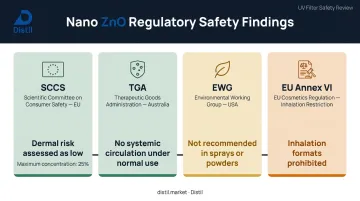
Regulatory bodies in multiple markets have reviewed nano ZnO and reached broadly consistent conclusions — dermal risk is low under normal use, but inhalation is a genuine concern:
- The SCCS concluded that nano ZnO up to 25% as a UV filter does not pose a dermal risk under specified conditions, with no evidence of penetration to viable skin tissue
- Australia's TGA similarly found ZnO nanoparticles do not reach systemic circulation under normal sunscreen use
- The genuine risk is inhalation — EU Annex VI (Commission Regulation (EU) 2016/621) explicitly prohibits nano ZnO in applications where lungs may be exposed, and EWG does not recommend nano ZnO in spray, powder, or aerosol formats
Photoreactivity is a secondary concern. Nano ZnO can generate reactive oxygen species under UV exposure. Coated nano ZnO variants — using coatings such as triethoxycaprylylsilane, dimethicone, or similar treatments permitted under EU Annex VI — address this, though coating chemistry affects COSMOS eligibility.
Those safety findings are reflected directly in how regulators have shaped market requirements.
Regulatory Snapshot by Market
| Market | Key Requirement |
|---|---|
| EU | [nano] label required; Article 16 notification 6 months pre-market; inhalation formats prohibited; max 25% with D50 >30nm, D1 >20nm |
| US (FDA) | No specific nano labeling requirement for OTC sunscreens; ZnO permitted up to 25% |
| Australia (TGA) | ZnO permitted active; nano review completed; nanoparticles found unlikely to harm under sunscreen use |
| China (NMPA) | Safety assessment required before registration/filing; consult current NMPA guidance for nano-specific requirements |
Best Applications for Nano ZnO
- Conventional sunscreen lotions and creams (not sprays or powders)
- Tinted moisturizers, BB creams, and daily-use facial SPF
- Products where cosmetic elegance is the primary brief
- Formulations targeting consumers with darker skin tones
- Hybrid skincare-SPF products where white cast is commercially disqualifying
Which Is Better for Sunscreen Formulations?
Neither type wins universally. The right choice is determined by brand strategy, target market, product format, and regulatory jurisdiction — not by formulation chemistry alone.
The SPF Efficacy Question
Both non-micronized and nano ZnO can achieve equivalent SPF ratings. The practical difference is concentration and formulation work required. Nano ZnO's higher surface area allows it to reach target SPF at lower active percentages; non-micronized ZnO requires higher loading but delivers equivalent protection when properly dispersed and formulated. Any SPF claim requires independent testing regardless of particle type — no universal concentration-to-SPF rule applies across all base systems.
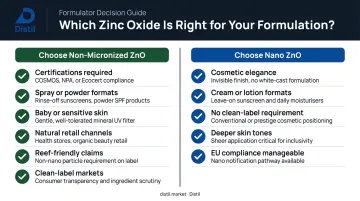
A Decision Framework for Formulators
Choose non-micronized ZnO when:
- The brand is pursuing COSMOS, EWG Verified, NPA, or similar certifications
- The product format is spray, powder, or aerosol
- The target consumer includes babies, children, or sensitive-skin populations
- The brand sells through Whole Foods or other natural retail channels with explicit nano restrictions
- Reef-friendly claims are a brand priority — NOAA identifies nano-zinc oxide as a marine concern, and Maui County and NPS guidance recommends non-nanotized ZnO in reef-sensitive environments
- The regulatory jurisdiction has stringent clean-label or nano-disclosure expectations
Choose nano ZnO when:
- Cosmetic elegance and minimal white cast are the primary commercial requirement
- The product is a cream or lotion (not spray or powder)
- Clean-label certification is not a brand priority
- The formulation is designed for medium-to-deep skin tones where white cast is a barrier to purchase
- EU nano labeling compliance is manageable within the brand's regulatory workflow
Formulation Support Requirements
The two paths have different complexity profiles:
Non-micronized ZnO demands more formulation optimization work. Dispersion quality, white cast management, and emulsion rheology all require attention. Solutions include clear zinc oxide variants, iron oxide tinting, and optimized carrier systems. Texture-optimizing cosmetic esters (such as coco-caprylate/caprate or neopentyl glycol diheptanoate) play a meaningful supporting role in achieving elegant non-nano formulations.
Nano ZnO reduces the aesthetics burden but introduces regulatory compliance work: EU notification timelines, [nano] labeling, coating selection, and format restrictions all require active management.
Distil's personal care team, led by Kiro Rizk (Head of Personal Care) and Dr. Leema Joseph (VP, R&D), supports formulation development across both ZnO types. The scope runs from particle size selection and dispersion optimization through SPF testing coordination and commercial scale-up.
Their zinc oxide portfolio includes non-nano powder and pre-dispersed systems, alongside cosmetic esters and mild surfactants for full sunscreen formulation builds.
Conclusion
Non-micronized zinc oxide is the stronger default for brands prioritizing safety transparency, natural certifications, eco-credentials, and sensitive-skin positioning. Nano zinc oxide remains a viable choice where cosmetic elegance drives the brief, the format is cream or lotion, and EU regulatory compliance is manageable.
The choice between them is a brand strategy decision, not just a technical specification. It shapes:
- Upstream sourcing and formulation complexity
- Regulatory filing burden across target markets
- Which certifications and retail channels remain accessible
Working with a partner who understands both options at a formulation level — and can carry a project from initial trials to commercial-scale production through a single point of contact — removes a significant coordination burden. To discuss your zinc oxide sunscreen formulation, whether non-nano, nano, or a head-to-head trial of both, contact Distil's team at contact@distil.market.
Frequently Asked Questions
What is non-micronized zinc oxide sunscreen?
Non-micronized zinc oxide sunscreen uses ZnO particles larger than 100 nanometers, which remain on the skin surface and absorb UV radiation without penetrating to viable skin tissue. It is the preferred form for natural, clean-label, baby, and sensitive-skin formulations, with no nano labeling requirement in any major regulatory market.
Is nano zinc oxide safe to use in sunscreen formulations?
Current scientific consensus from the SCCS and Australia's TGA indicates nano ZnO in cream and lotion formats does not penetrate healthy skin or reach systemic circulation. The genuine safety concern is inhalation — nano ZnO is not recommended in spray, powder, or aerosol formats, and its use in these formats is prohibited under EU Annex VI.
Does nano zinc oxide provide better SPF than non-micronized zinc oxide?
Both types can achieve equivalent SPF values. Nano ZnO can reach target SPF at lower active concentrations due to higher surface area, while non-micronized requires higher loading. Equivalent protection is achievable with either type when formulated correctly and SPF-tested under standard protocols.
What percentage of zinc oxide is needed in a sunscreen formulation?
Both the FDA and EU permit zinc oxide up to 25% in sunscreen products. Non-micronized grades typically require 15–25% to achieve SPF 30+; nano grades may reach comparable SPF at lower concentrations. The right percentage depends on particle type, carrier system, and SPF target — and must always be confirmed by SPF testing.
Is non-micronized zinc oxide reef-safe?
Non-micronized ZnO (>100nm) is recommended by government guidance — including Maui County, the National Park Service, and NOAA — for reef-sensitive environments, where nano ZnO is identified as a marine concern. Non-nano ZnO is the more defensible choice for eco-certified and ocean-friendly product claims.
How does particle size affect the white cast in zinc oxide sunscreens?
Larger non-micronized particles scatter more visible light, producing a noticeable white residue — especially above 15% concentration — while nano particles give a sheer finish. Formulators working with non-nano ZnO can reduce white cast through iron oxide tinting, clear zinc oxide variants, or better dispersion in compatible emollient carriers.