Introduction
Consumer demand for clean-label, mineral-based sun care has pushed non-nano zinc oxide to the centre of personal care formulation debates — driven by safety scrutiny, shifting regulations, and brand transparency expectations that show no signs of softening.
The term "non-nano" is often dismissed as a marketing label — but particle size in zinc oxide is a technical specification with direct consequences for skin safety, UV protection range, and regulatory standing in markets like the EU and Australia.
This article explains what non-nano zinc oxide does, why its advantages are measurable rather than perception-based, and what brands need to consider when specifying and sourcing it for mineral sun care, protective skincare, and baby care formulations.
Key Takeaways
- Non-nano zinc oxide (particles >100 nm) stays on the skin surface — no penetration concerns linked to nano-sized particles
- Larger particle size extends UV protection into visible and blue light wavelengths — meaningful for hyperpigmentation and melasma-prone skin
- EU Cosmetics Regulation requires [nano] labelling for nano-form ingredients; non-nano specification avoids this trigger entirely
- Ecotoxicity risk drops measurably, supporting alignment with reef-safe product standards
- The white cast trade-off is real but manageable through formulation technique, without compromising safety benefits
What Is Non-Nano Zinc Oxide?
Non-nano zinc oxide is zinc oxide (ZnO) with a particle size greater than 100 nanometres — placing it outside the nanoscale range defined by EU Cosmetics Regulation 1223/2009 (1–100 nm) and ISO 80004-1:2023.
At that size, particles are large enough to remain in the outermost layer of the skin — the stratum corneum — rather than penetrating into living tissue below it.
Where It's Used
Non-nano zinc oxide appears across a wide range of personal care categories:
- Mineral sunscreens (primary SPF products)
- SPF daily moisturisers and tinted bases
- Baby and children's sunscreens
- Diaper creams and barrier formulations
- Reef-safe and clean-label personal care lines
Its presence in these categories isn't arbitrary. Each shares a common need: a UV-active ingredient with a well-established safety record, broad spectral coverage, and a positioning that holds up to scrutiny from regulators, retailers, and consumers alike.
Specification vs. Label Claim
Non-nano status is a specification decision, not a marketing one. Particle size directly shapes three things formulators cannot afford to get wrong:
- Safety classification — whether the ingredient falls under nano-specific regulatory restrictions
- UV protection range — particle size affects UVA/UVB scattering efficiency and SPF outcomes
- Labelling obligations — EU and other major markets require explicit nano disclosure on finished products
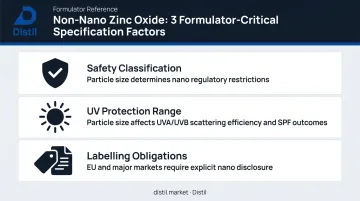
Specifying non-nano without verified particle size data leaves both the formulation and the label exposed.
Key Advantages of Non-Nano Zinc Oxide
Advantage 1: Confirmed Skin-Surface Safety Profile
The most cited benefit of non-nano zinc oxide is where it stays: on the skin, not in it.
TGA's literature review on sunscreen nanoparticles summarises Leite-Silva et al. (2013), in which ZnO particles greater than 100 nm applied to human forearms localised predominantly in the stratum corneum and skin furrows, with no detected penetration into viable epidermis or dermis.
The SCCS similarly notes that larger non-nano forms are theoretically less likely to be absorbed than nano forms. Trace zinc signals detected in blood after sunscreen use are more consistent with dissolved zinc ions than intact particle penetration.
This distinction matters for how brands characterise the ingredient:
- The defensible claim is skin-surface localisation for particles above 100 nm, not "zero penetration"
- Chemical UV filters are molecularly sized and designed to absorb into skin — non-nano zinc oxide is not, and that difference is meaningful for sensitive-skin and pregnancy-safe positioning
- For infant and children's product lines, where systemic absorption of any active ingredient is a primary consumer concern, this safety profile is a concrete advantage, not an abstract one
Primary use cases: Infant care, sensitive/reactive skin lines, pregnancy-safe formulations, and any market where ingredient transparency requirements place the burden of safety proof on the brand.
Advantage 2: Broader Spectrum UV and Blue Light Protection
Non-nano zinc oxide provides protection across UVA, UVB, and the visible light spectrum, including blue light, since its larger particle size physically scatters a wider range of wavelengths.
Smijs and Pavel (2011) report that microsized ZnO particles scatter visible light more broadly than nano-transparent variants. As particle size decreases below approximately 100–200 nm, particles become progressively more transparent, improving aesthetics but reducing UVA balance and visible-light attenuation.
Why Blue Light Coverage Is Clinically Relevant
Blue and visible light protection is not a niche concern. The evidence base is growing:
- Mahmoud et al. (2010) found visible light induced darker and more sustained pigmentation than UVA1 in skin types IV–VI
- Duteil et al. (2014) found blue-violet visible light induced significantly more pronounced hyperpigmentation than UVB, lasting up to 3 months
- Nakashima et al. (2017) found blue light induced oxidative stress in live skin, likely via superoxide generation
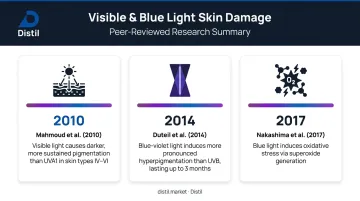
For formulators developing urban sun care, anti-ageing, or hyperpigmentation-targeting products, this is formulation-relevant. A product built around non-nano zinc oxide can support a more complete photoprotection story — covering the wavelengths that standard "broad spectrum" labelling (capped at 400 nm in most regulatory definitions) may not fully address.
Important caveat: Visible-light protection claims require finished formulation testing to substantiate. Particle size supports the mechanism; in-formula data confirms the outcome.
Formulation relevance: Hyperpigmentation and melasma-targeting products, urban daily SPF, anti-ageing sun care, and formulations marketed for digital screen exposure protection.
Advantage 3: Regulatory Compliance and Clean-Label Market Positioning
Particle size classification is now a regulatory matter in several major markets, and non-nano specification carries a direct compliance advantage.
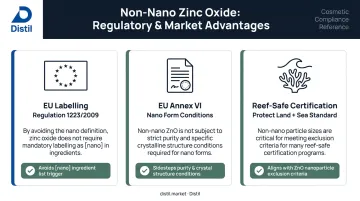
EU labelling: Article 19(1)(g) of EU Regulation 1223/2009 requires all ingredients in nano form to be declared in the ingredient list with the word "nano" in brackets — for example, "Zinc Oxide (nano)." Non-nano zinc oxide avoids this label trigger entirely, keeping the ingredient list cleaner and less likely to flag concerns with consumers or retailers.
EU Annex VI status: EU Regulation 2016/621 authorises both Zinc Oxide and Zinc Oxide (nano) as UV filters up to 25% in ready-to-use preparations. The nano form carries additional conditions: minimum 96% purity, wurtzite crystal structure, and median particle size D50 >30 nm. Non-nano specification sidesteps these conditions while remaining within the same authorised filter framework.
Reef-safe alignment: The Protect Land + Sea certification explicitly excludes zinc oxide nanoparticles. Peer-reviewed evidence supports plausible ecotoxicity risk from very small ZnO particles in marine environments — Tang et al. (2017) documented coral membrane-lipid disruption after ZnO nanoparticle exposure. Non-nano particle sizes reduce (but do not eliminate) this risk. Formulation, coating, and concentration remain relevant variables.
Practical compliance note: Hawaii Act 104 (2018) bans sunscreens containing oxybenzone or octinoxate — it does not address zinc oxide, nano or non-nano. Reef-safe positioning for zinc oxide formulations is better supported by certification schemes like Protect Land + Sea than by direct reference to Hawaii's legislation.
This advantage is most actionable for brands exporting to the EU, targeting natural and organic retail channels, pursuing eco-certifications (COSMOS, Protect Land + Sea), or managing product lifecycle exposure to tightening nano ingredient regulations globally.
What Happens When Non-Nano Is Overlooked
Choosing nano zinc oxide for its aesthetic advantages — mainly reduced white cast — without weighing the downstream consequences introduces risks that compound at every stage of commercialisation:
EU "[nano]" labelling requirements apply to nano-form zinc oxide, and brands that haven't accounted for this typically discover the gap late — during retailer onboarding or international registration, not during development.
Certification schemes that restrict nanoparticles — including Protect Land + Sea and COSMOS — can exclude nano ZnO formulations from eligibility. That reformulation requirement arrives after packaging, claims, and supplier contracts are already in place.
Nano zinc oxide formulations can underperform at longer UV wavelengths and visible light, a gap that tends to surface in third-party SPF testing or clinical trial results — particularly for products positioned at the premium end of the market.
Reactive reformulation — triggered by a late non-nano decision — is consistently more expensive and time-consuming than specifying correctly before development begins.
How to Source and Specify Non-Nano Zinc Oxide
Sourcing non-nano zinc oxide correctly starts with particle size documentation, not supplier claims.
What to Require from Suppliers
- Primary particle size confirmed via electron microscopy (ISO 21363:2020 specifies TEM image capture and analysis for particle size distributions)
- Particle size distribution data (D10/D50/D90) via dynamic light scattering per ISO 22412:2025
- Confirmation that average particle size sits well above 100 nm, not just at the threshold
- Coating or surface treatment details and how they affect dispersibility and UV performance
- Batch certificate of analysis confirming particle size per lot, not just per material grade
Managing the White Cast Trade-Off
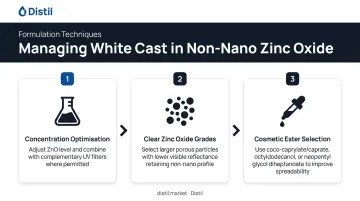
The white cast from non-nano zinc oxide results from larger particles scattering visible light — the same property that contributes to visible-light protection. The trade-off is real, but manageable:
- Optimise ZnO concentration and combine with complementary UV filters where regulations permit
- Select clear zinc oxide variants — larger, porous particles with lower visible reflectance that retain the non-nano safety profile
- Use cosmetic esters such as coco-caprylate/caprate, octyldodecanol, and neopentyl glycol diheptanoate to improve spreadability and particle distribution without altering particle size
Distil supplies natural and coated zinc oxide powders, pre-dispersed systems, and the cosmetic esters listed above as part of its personal care ingredient portfolio.
For brands in active formulation development, Distil's R&D team handles lab-scale trials through to commercial scale — under a single point of contact, with IP and data ownership retained by the brand.
Conclusion
Non-nano zinc oxide earns its specification status on evidence, not convention. The case rests on three distinct dimensions:
- Safety profile: Skin-surface retention confirmed by TGA and SCCS data, with no demonstrated systemic absorption at relevant exposure levels
- UV performance: Broader UV and visible-light scattering driven by particle-size physics — protection that nano grades physically cannot replicate
- Regulatory positioning: Avoids EU nano labelling triggers and supports eco-certification eligibility without reformulation risk
These advantages accumulate over a product's lifecycle. Early specification reduces reformulation risk, supports international market access, and produces a cleaner regulatory record as ingredient transparency requirements tighten across the EU, US, and APAC markets. The white cast trade-off is a formulation challenge with established solutions — dispersant selection, emollient pairing, particle surface treatment — not a reason to default to nano zinc oxide and revisit compliance questions at launch.
Frequently Asked Questions
What is non-nano zinc oxide?
Non-nano zinc oxide is zinc oxide with particles larger than 100 nanometres, placing it outside the EU/ISO nanoscale definition. At this size, particles remain in the stratum corneum — the outermost skin layer — rather than penetrating into living tissue. It is the preferred form in mineral sunscreens and clean-label personal care formulations.
Which is better, nano or non-nano zinc oxide?
Non-nano offers a stronger safety profile, broader UV and visible-light coverage, and avoids EU nano labelling requirements. Nano offers reduced white cast. For brands prioritising sensitive-skin positioning, clean-label compliance, or international market access, non-nano is the stronger specification.
Is non-nano zinc oxide safe for sensitive skin?
Yes. Peer-reviewed evidence and health authority reviews (TGA, SCCS) consistently place zinc oxide particles above 100 nm in the stratum corneum during normal topical use, with no demonstrated penetration into viable skin layers. This non-systemic action makes it a preferred active for reactive, infant, and compromised-barrier skin formulations.
Does non-nano zinc oxide leave a white cast?
It does produce more visible whitening than nano variants, due to its larger particles scattering visible light. Concentration optimisation, clear zinc oxide grades, and appropriate dispersing agents can reduce this — without compromising the particle size that defines non-nano status.
Is non-nano zinc oxide reef-safe?
Non-nano zinc oxide presents a lower ecotoxicity risk than nano-sized particles, and certification schemes like Protect Land + Sea explicitly exclude nanoparticles. Even so, no zinc oxide grade is environmentally impact-free — formulation, concentration, and dissolution behaviour all affect real-world outcomes.
Can non-nano zinc oxide be used in baby and children's products?
Yes, and it is among the most recommended UV actives for this category. Its long safety record, confirmed surface-layer localisation, and alignment with clean-label requirements make it well-suited to infant and children's formulations, where the standard for ingredient safety evidence is highest.