This isn't purely a consumer concern. For personal care brands and formulators, selecting the wrong grade can trigger reformulation cycles, create labeling liabilities in certain markets, or compromise the safety positioning a product was built around. Getting it right from the start matters.
This article covers the core differences between nano and non-nano zinc oxide — particle size science, UV protection mechanisms, safety evidence, regulatory status, and the formulation trade-offs that determine which grade belongs in your next product.
Key Takeaways
- Non-nano zinc oxide stays on the skin surface — nano zinc oxide's smaller particle size raises unresolved questions about dermal penetration
- Both grades provide broad-spectrum UVA/UVB protection, but differ in white cast, texture, and cosmetic elegance
- EU regulations require "[nano]" labeling in INCI lists for nano zinc oxide — a compliance requirement formulators must account for in product documentation
- Non-nano is the preferred choice for baby, sensitive-skin, reef-safe, and clean-label formulations
- Grade selection comes down to target market, product format, and regulatory requirements — there is no single correct answer
Non-Nano vs. Nano Zinc Oxide: Quick Comparison
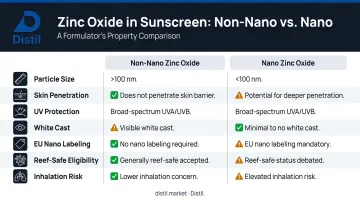
The table below summarises the key formulation, safety, and regulatory differences between non-nano and nano zinc oxide at a glance.
| Property | Non-Nano Zinc Oxide | Nano Zinc Oxide |
|---|---|---|
| Particle Size | >100 nm (typically 200–700 nm) | <100 nm (commonly 30–55 nm D50) |
| Skin Penetration | Remains on stratum corneum surface | Contested; SCCS found no penetration through healthy skin |
| UV Protection | Broad-spectrum UVA + UVB | Broad-spectrum UVA + UVB |
| White Cast | Visible; harder to formulate out | Significantly reduced |
| EU Nano Labeling | Not required | Required ("[nano]" in INCI) |
| Reef-Safe Eligibility | Yes, widely accepted | Restricted under Haereticus Protect Land + Sea certification |
| EWG Stance | Preferred | Not recommended; inhalation risk flagged in sprays |
| Inhalation Risk (Sprays) | Lower concern | SCCS deems spray applications unsafe; EU restricts them |
What Is Nano Zinc Oxide in Sunscreen?
Nano zinc oxide consists of zinc oxide particles engineered below 100 nanometers — the EU Cosmetics Regulation defines nanomaterials as insoluble or biopersistent materials with one or more external dimensions on the scale of 1 to 100 nm. Commercial grades typically fall between 30 and 55 nm (D50), based on SCCS-reviewed materials including Nano TEC 50 (D50 36 nm) and FINEX-50 (D50 30 nm).
Why Manufacturers Choose Nano
The primary driver is cosmetics. Micron-sized zinc oxide particles scatter visible light and appear white on skin. At nano scale, the particles no longer scatter reflected light as readily — the white colour disappears while UV blocking remains, according to the SCCS lay summary. Research from Smijs and Pavel confirms ZnO particles of 200 nm or smaller are virtually transparent.
Reducing particle size generally increases UVB attenuation but can reduce UVA-1 protection. Aggregated particles around 130 nm, not just 20 nm primaries, influenced UVA-1 outcomes in peer-reviewed testing. Formulators optimising for broad-spectrum performance need to account for both primary particle size and aggregation behaviour in the final dispersion.
The Skin Penetration Debate
The SCCS reviewed human volunteer studies and concluded there was no evidence of ZnO nanoparticle penetration through healthy or UVB-damaged skin, with penetration limited to the upper stratum corneum. A 2016 study by Leite-Silva et al. confirmed topical nano ZnO did not penetrate viable epidermis of intact or barrier-impaired skin.
The most-cited human study (Gulson et al., 2010) detected tracer zinc in blood at less than 0.001% of the applied dose — roughly 1/1000th of total natural zinc in the blood compartment. That figure is frequently misquoted; the actual finding is far more conservative than "enters the bloodstream."
These penetration findings matter when interpreting in vitro data. Cytotoxicity studies on HaCaT keratinocytes at 10–100 µg/mL have shown DNA damage signals, but those are hazard signals from cell culture conditions — not evidence of systemic toxicity from normal dermal sunscreen use.
Regulatory Status and Inhalation Risk
Key regulatory positions:
- EU: Nano zinc oxide approved as UV filter up to 25%; "[nano]" labeling required in INCI; spray/inhalation applications restricted
- FDA: No nano-specific sunscreen ban; zinc oxide proposed as GRASE under OTC Monograph M020
- TGA: Considers nano zinc oxide unlikely to cause harm when used in sunscreens as directed
- EWG: Does not recommend nano zinc oxide; strongly discourages sprays containing zinc oxide of any particle size
The SCCS concluded nano ZnO in spray products cannot be considered safe due to lung effects observed after inhalation, and the EU has codified this restriction into law. Any spray format using nano zinc oxide requires careful particle engineering to keep aerosol droplets above the respirable size threshold.
Where Nano Zinc Oxide Is Used
Product categories where nano zinc oxide is most commonly specified:
- Lightweight daily moisturisers with SPF
- BB and CC creams
- Tinted SPF serums
- Sports sprays (with significant inhalation risk caveats)
- Formulations where white cast is commercially unacceptable
What Is Non-Nano Zinc Oxide in Sunscreen?
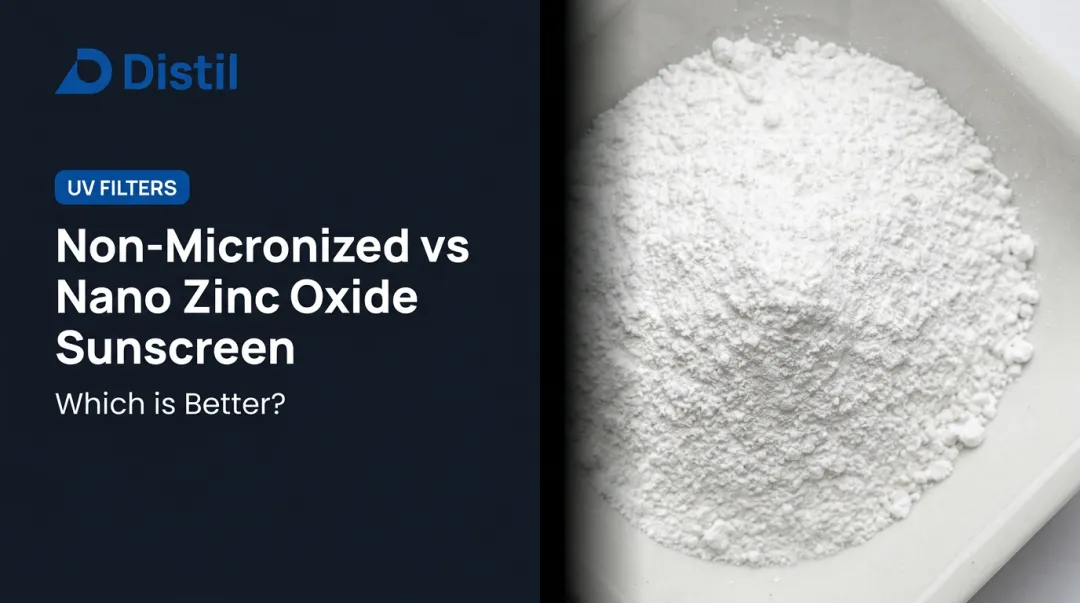
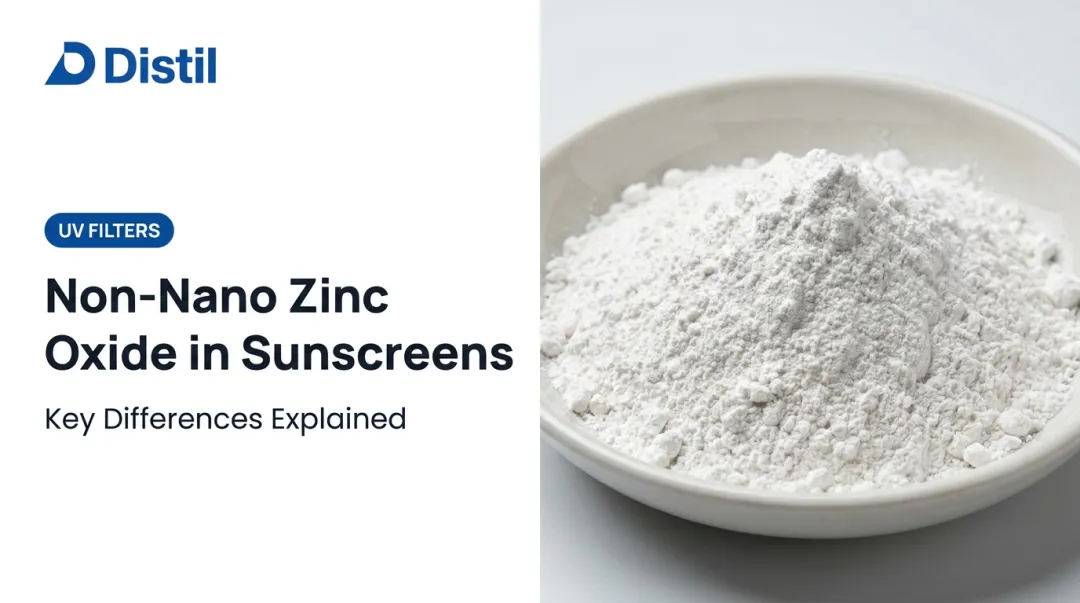
Non-nano zinc oxide has particles larger than 100 nanometers — commercial grades typically range from 200 to 700 nm. At this size, particles physically cannot penetrate intact skin. They sit on the stratum corneum and function as a physical barrier, reflecting and scattering both UVA and UVB radiation from the skin surface.
UV Protection and SPF Performance
Non-nano zinc oxide is accepted by the FDA as a GRASE OTC sunscreen ingredient under Monograph M020, permitted up to 25% concentration. The EU also approves zinc oxide (non-nano) up to 25% under Commission Regulation (EU) 2016/621.
Real-world SPF performance varies significantly based on particle size distribution, surface coating, dispersion quality, and formulation architecture — not concentration alone. Published benchmarks include:
- SPF 30 at 15% ZnO with 251 nm mean particle size
- SPF 50+ at 11–22% ZnO, depending on vehicle and processing conditions
Treat these as directional references, not concentration rules.
The White Cast Challenge — and How to Address It
White cast is the honest limitation of non-nano zinc oxide. Larger particles scatter visible light, leaving a white or chalky residue that's especially pronounced on deeper skin tones.
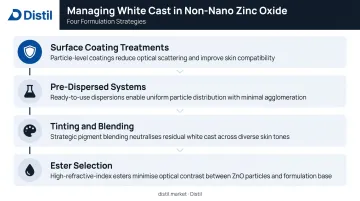
Standard formulation strategies to manage this:
- Surface coating treatments — silica, dimethicone, and amino acid coatings reduce agglomeration and improve dispersibility without compromising UV performance
- Pre-dispersed systems — ready-to-use zinc oxide dispersions eliminate complex milling steps and deliver uniform particle distribution from batch one
- Tinting and blending — iron oxides and titanium dioxide help neutralise whiteness in tinted SPF products
- Ester selection — lightweight cosmetic esters like coco-caprylate/caprate and neopentyl glycol diheptanoate improve spreadability and counteract the chalky feel
Distil's personal care portfolio covers both coated zinc oxide powders and pre-dispersed systems formulated for improved transparency and SPF performance. The R&D team supports dispersion challenges from lab trial through to commercial scale.
Safety, Environmental, and Regulatory Profile
Non-nano zinc oxide requires no special nano labelling in any major regulatory market. EWG rates non-nano zinc oxide positively as a mineral UV filter.
On the environmental side, key regulatory positions are:
- Haereticus Protect Land + Sea certification — accepts non-nano zinc oxide; explicitly prohibits nanoparticles
- Hawaii Act 104 and Palau RPPL No. 10-30 — target oxybenzone and octinoxate; zinc oxide (nano or non-nano) is not listed as prohibited
- Ecotoxicology caveat — both nano and non-nano ZnO can cause marine toxicity under UV irradiation; "reef-safe" claims should reference certification criteria rather than imply zero environmental impact
Where Non-Nano Zinc Oxide Is Used
Non-nano zinc oxide is the standard choice for:
- Baby and children's sunscreens
- Sensitive-skin formulations
- Mineral sunscreen sticks
- Reef-safe sport sunscreens
- Tinted SPF moisturisers
- Clean beauty and eco-conscious product lines
Which Should Formulators Choose?
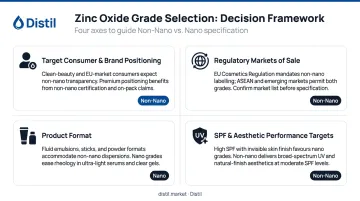
Neither grade is universally superior. The decision comes down to four axes:
- Target consumer and brand positioning — Clean beauty, pediatric, sensitive skin, and eco-conscious brands default to non-nano. Cosmetically elegant daily-wear and hybrid skincare/SPF products often require nano for sheer texture.
- Regulatory markets of sale — Selling into the EU? Nano labeling is mandatory and spray formats are restricted. Selling into reef-restricted markets? Non-nano with certification compliance is the cleaner path.
- Product format — Sticks, high-load formulations, and tinted products are more forgiving of non-nano's white cast. Lightweight serums, sprays, and BB creams almost always require nano or advanced non-nano dispersion technology.
- SPF and aesthetic performance targets — Higher concentrations of non-nano zinc oxide may be needed to hit equivalent SPF compared to nano grades, which affects COGS. Nano reduces loading but adds regulatory complexity and labeling cost. The right trade-off depends entirely on your formulation brief.
Practical Decision Guidance
| Scenario | Recommended Grade |
|---|---|
| Baby or pediatric sunscreen | Non-nano |
| Reef-safe sport sunscreen stick | Non-nano |
| EU clean-label facial SPF | Non-nano |
| Sheer daily moisturiser with SPF | Nano (with nano labeling) |
| Lightweight BB cream | Nano |
| Sensitive-skin mineral sunscreen | Non-nano |
| Spray sunscreen (any market) | Caution; evaluate inhalation risk for both |
A Note on Hybrid Approaches
Combining non-nano zinc oxide with non-nano titanium dioxide is a well-established strategy for achieving broad-spectrum protection with reduced white cast — TiO₂ provides strong UVB performance while ZnO covers UVA-1. Advanced dispersion systems can further improve non-nano ZnO aesthetics without the regulatory complexity of nano grades.
For brands working through these trade-offs, Distil's R&D team works with formulators to select the right grade, surface treatment, and dispersion system for specific performance targets — managing the process from initial brief through commercial-scale production.
Frequently Asked Questions
What is the difference between nano zinc oxide and zinc oxide?
"Zinc oxide" in sunscreens can be formulated in either nano form (below 100 nm) or non-nano form (above 100 nm). The size difference determines skin penetration behaviour, white cast, and regulatory labeling requirements, including the EU's mandatory "[nano]" INCI designation for nano grades.
Is nano or non-nano zinc oxide better?
"Better" depends on the use case. Non-nano suits safety-conscious positioning, regulatory simplicity, and reef-safe claims. Nano delivers cosmetic elegance and sheer texture, but requires nano disclosure compliance in target markets.
What kind of zinc is best for sunscreen?
Non-nano zinc oxide is the broadly accepted, GRASE-approved, reef-safe standard for mineral sunscreens — particularly for sensitive skin, pediatric, and eco-conscious formulations. It carries the fewest regulatory complications across major global markets.
Does non-nano zinc oxide leave a white cast?
Yes, to varying degrees depending on concentration and formulation. Surface coating treatments, optimized dispersion, and blending with tinting agents like iron oxides or titanium dioxide are standard strategies to manage it effectively.
Is nano zinc oxide safe for skin?
Current evidence, including SCCS reviews and human volunteer studies, suggests minimal systemic absorption through intact skin. The EU permits dermal use up to 25% but restricts spray and inhalation applications. EWG recommends against nano zinc oxide as a precautionary measure.
Is non-nano zinc oxide reef-safe?
Non-nano zinc oxide is accepted under reef-safety certifications like the Haereticus Protect Land + Sea standard, which prohibits nanoparticles. Hawaii and Palau legislation targets oxybenzone and octinoxate, not zinc oxide, so certification is more defensible than statutory compliance alone for reef-safe claims.