Get it wrong, and you're looking at formulation failures, rejected label claims, or a product that consumers simply won't wear because of white cast. Get it right, and particle size becomes a strategic asset — not just a technical footnote.
This guide breaks down what separates nano from non-nano zinc oxide, where each form excels, and what formulators need to know before selecting a grade.
Key Takeaways
- Non-nano ZnO (>100nm) sits on the skin surface and scatters UV; nano ZnO (30–100nm) is near-transparent but requires EU [nano] labeling
- Both forms are approved UV filters up to 25% by the EU and FDA — nano ZnO is prohibited in EU spray formats
- Sensitive skin, baby, reef-safe, and clean beauty formulations consistently favour non-nano ZnO
- For daily SPF, tinted sunscreens, and face products, nano ZnO wins on cosmetic aesthetics and skin feel
- Particle size specs (D50/D90) and dispersion quality directly affect whiteness, SPF performance, and skin elegance — often more than the nano/non-nano distinction alone
Nano vs. Non-Nano Zinc Oxide: Quick Comparison
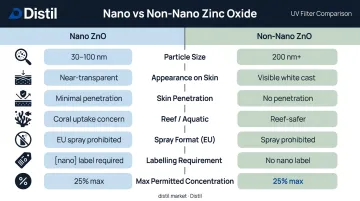
The table below compares nano and non-nano zinc oxide across the parameters that matter most to formulators.
| Parameter | Nano ZnO | Non-Nano ZnO |
|---|---|---|
| Particle Size | 30–100 nm (D50 typically 30–55 nm) | >100 nm (typically 200 nm+) |
| White Cast | Near-transparent on skin | Visible white residue |
| Skin Penetration | Minimal; ions only, not intact particles | Physically unlikely to penetrate |
| Environmental Profile | Associated with coral uptake at nano scale | Considered reef-safer option |
| EU Spray Use | Prohibited | Prohibited |
| EU Nano Labeling | Required on INCI list | Not required |
| Regulatory Approval | Up to 25% (non-spray, EU + US) | Up to 25% (non-spray, EU + US) |
What is Nano Zinc Oxide?
Nano zinc oxide is an inorganic mineral UV filter engineered to particle sizes typically between 30–100nm. The SCCS evaluated nano ZnO materials with D50 values of 30–55nm and D90 below 100nm in their safety assessment. At this scale, ZnO becomes near-transparent on skin, making it the go-to choice for lightweight, sheer-finish sunscreens.
How It Works as a UV Filter
Like all zinc oxide, the nano form works as a physical UV barrier — sitting on the skin surface and reflecting or scattering both UVA and UVB radiation. Unlike chemical filters, it doesn't absorb UV energy and convert it to heat — it deflects it. This photostable, broad-spectrum mechanism is why zinc oxide remains a preferred mineral filter across both particle sizes.
The Skin Penetration Question
Because nano ZnO particles are small enough to sit in skin folds and follicular openings, penetration was the central concern regulators needed to resolve. The EU Scientific Committee on Consumer Safety (SCCS) concluded in SCCS/1489/12 that nano ZnO does not cross the skin barrier in intact or compromised skin.
Any zinc detected in systemic circulation is assumed to be ionic — dissolved zinc released from nanoparticles — not intact nanoparticulate matter. The SCCS calculated a Margin of Safety (MoS) of 7.4 at 25% concentration in sunscreen products, supporting the safety conclusion.
The Spray Format Restriction
This is a hard regulatory constraint brands often overlook: nano ZnO is prohibited in aerosol and spray sunscreens in the EU due to inhalation risk to the lungs. The legal restriction appears in Commission Regulation (EU) 2016/621 under Annex VI entry 30a. Any brand developing a spray format in the EU must use non-nano zinc oxide — or a different UV filter entirely.
Best Fit for Nano ZnO
- Daily SPF moisturizers and face sunscreens where white cast is a dealbreaker
- Tinted sunscreens, BB creams, and foundations with SPF
- Premium personal care brands targeting adult consumers in non-spray formats
- Markets where nano ingredient disclosure is manageable (EU non-spray, US)
What is Non-Nano Zinc Oxide?
Non-nano zinc oxide carries particle sizes above 100nm — typically 200nm or larger — and functions as a physical surface barrier rather than a penetrating filter.
Because the particles are larger, they scatter visible light more aggressively. That scattering effect is both their cosmetic limitation and their safety advantage.
The Surface Barrier Mechanism
Non-nano ZnO particles cannot penetrate the stratum corneum due to their size. This makes them the preferred mineral UV filter for formulators targeting sensitive skin, infant sunscreens, and clean beauty certifications. The SCCS safety framework for non-nano ZnO is referenced in SCCS/1489/12, which cites the earlier SCCP/1215/09 clarification as the basis for its safety at up to 25%.
The White Cast Challenge
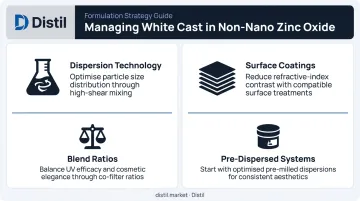
Larger particles scatter visible light, creating a white residue on skin. This is a known trade-off, not a hidden limitation. Formulators can partially address it through:
- Dispersion technology — optimizing particle distribution to reduce agglomeration
- Surface coatings — treatments such as dimethicone or triethoxycaprylylsilane improve dispersibility
- Blend ratios — combining non-nano ZnO with other UV filters or tinting agents
- Pre-dispersed systems — ready-to-use dispersions that eliminate in-house dispersion steps
White cast management requires both the right particle specs and hands-on formulation expertise. Distil supplies non-nano zinc oxide in dry powder and pre-dispersed formats, with R&D-led technical support for brands working through these dispersion trade-offs.
The Reef-Safe Positioning
Research from Tang et al. found that uncoated ZnO nanoparticles induce coral bleaching by disrupting the coral-zooxanthellae symbiosis and altering membrane lipid profiles. At nano scale, particles are small enough to be taken up by coral tissue and marine organisms. Non-nano ZnO particles, being significantly larger, do not exhibit the same uptake behaviour — making them the scientifically supportable choice for reef-safe positioning.
The scale of the problem is significant: the ICRI estimates that 4,000–14,000 tonnes of sunscreen wash off into coral reef areas annually. "Reef-safe" is not a globally regulated claim — brands making this assertion should ensure their formulation choice is defensible, not just marketed.
Best Fit for Non-Nano ZnO
- Baby and pediatric sunscreens
- Mineral sunscreens for sensitive or reactive skin
- Reef-safe and ocean-safe product lines
- Formulations targeting EWG Verified, COSMOS, or natural beauty certifications
- Brands in retail channels where "non-nano" labeling is a genuine differentiator
Key Differences: Efficacy, Safety, and Formulation
UV Protection Efficacy
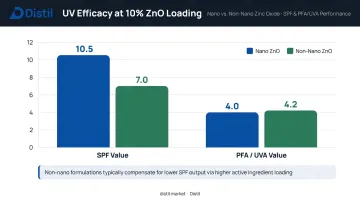
Both nano and non-nano ZnO deliver broad-spectrum UVA/UVB protection — but particle size affects efficiency. Supplier formulation benchmarks from Kobo Products show that at a 10% ZnO loading, nano ZnO achieved SPF 10.5 versus SPF 7.0 for non-nano ZnO with a mean particle size of 110nm. UVA protection (PFA) was comparable at 4.0 vs. 4.2 respectively. In practice, non-nano formulations often compensate through higher active loading or optimised dispersion.
Regulatory Compliance Across Markets
That efficacy gap has direct implications for how formulators position their products — and regulatory frameworks set the outer boundary for both forms.
| Market | Approved Limit | Nano-Specific Requirement |
|---|---|---|
| EU (Regulation 2016/621) | Up to 25% (non-spray applications) | "[nano]" label required in INCI list under Article 19(1)(g) |
| US (FDA OTC Monograph M020) | Up to 25% | None — FDA proposed order OTC000008 (2021) treats both forms equivalently |
The EU's "[nano]" labelling requirement is not just a compliance checkbox. It signals particle form directly to consumers and can shape brand positioning in markets where "non-nano" is an active marketing claim.
Formulation and Stability
Surface coatings are critical for both forms. The SCCS lists coatings used on nano ZnO including silica, dimethicone, and triethoxycaprylylsilane. Non-nano ZnO similarly benefits from dimethicone and triethoxycaprylylsilane treatments to improve dispersibility and prevent agglomeration.
Non-nano particles are harder to stabilise in emulsions. Their larger size and greater tendency to settle create specific formulation risks:
- Particle settling — inadequate dispersion leads to phase separation and inconsistent SPF across the product
- Agglomeration — without proper coating, particles clump, reducing UV filter efficiency and causing visual graininess
- Batch-to-batch variability — wide D90 distributions produce unpredictable SPF outcomes at scale
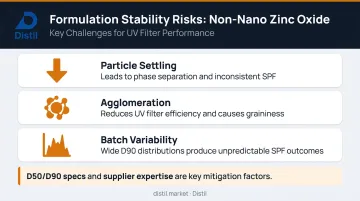
Particle size distribution specifications (D50/D90) and supplier expertise determine whether these risks are engineered out at source or managed reactively in your formulation lab.
Choosing the Right Zinc Oxide for Your Formulation
Neither form is universally superior — the right choice depends on your formulation goals, target market, and end consumer.
Choose nano zinc oxide when:
- Cosmetic elegance is non-negotiable (daily SPF, face formulations, tinted sunscreens)
- The product format is non-spray
- Operating in markets where nano disclosure is standard and manageable
- SPF efficiency per unit weight is a priority
Choose non-nano zinc oxide when:
- Targeting sensitive skin, infant, or baby demographics
- Pursuing reef-safe, clean beauty, or natural certifications (COSMOS, EWG)
- Formulating in markets where "non-nano" labeling is a brand differentiator
- Avoiding EU nano labeling requirements
Particle size selection is only part of the equation. Purity thresholds (≥99% for nano ZnO per SCCS; ≥96% per EU Annex VI), surface coating type, D50/D90 consistency, and batch-to-batch reproducibility all directly affect formulation performance and regulatory defensibility.
Distil supplies zinc oxide in both nano and non-nano grades — powder and pre-dispersed formats — supported by an R&D team with 45+ years of combined experience across Dow, BASF, L'Oréal, Huntsman, and Reliance Industries. A single point of contact manages the full journey from lab-scale trials to commercial production, with unified quality controls across the partner manufacturing network.
Conclusion
The nano vs. non-nano decision is a formulation strategy choice, not a safety binary. Both forms are regulatory-approved, both deliver broad-spectrum protection, and both have legitimate use cases. The quality of the decision comes down to how well particle size selection aligns with your:
- Target consumer and skin-feel expectations
- Product format and emulsion system
- Brand positioning on transparency and naturals
- Market-specific compliance obligations
A non-nano zinc oxide that's properly dispersed and surface-treated can deliver strong, competitive results across many formulations. Nano zinc oxide, without a clear disclosure and regulatory strategy, introduces compliance risk that erodes those performance benefits. In both cases, grade selection and specification discipline determine whether the finished product is market-ready — not particle size alone.
Frequently Asked Questions
Which is better, nano or non-nano zinc oxide?
Neither is objectively better. Nano ZnO offers superior cosmetic aesthetics with less white cast, making it ideal for daily-use and face formulations. Non-nano ZnO is preferred for sensitive skin, reef-safe claims, and clean beauty applications. The right choice depends on product format, target consumer, and market positioning.
Is non-nano zinc oxide good or bad?
Non-nano zinc oxide is considered safe, effective, and preferred by clean beauty and reef-safe brands. Its primary limitation is visible white cast on skin, which can be partially managed through dispersion technology and surface coatings. That white cast is a real trade-off versus nano forms, though optimised dispersion and surface coatings can reduce it.
What is the difference between nano and non-nano zinc oxide?
The distinction is particle size: nano ZnO is under 100nm and nearly invisible on skin, while non-nano ZnO is above 100nm and leaves a visible white layer. This size difference affects optical transparency, potential skin interaction, environmental behaviour near coral reefs, and EU labeling requirements.
Is nano zinc oxide safe for skin?
The EU SCCS concluded in SCCS/1489/12 that nano ZnO does not significantly penetrate intact skin, and is approved for use up to 25% in non-spray cosmetics. Zinc absorption, when it occurs, is ionic rather than nanoparticulate. The Margin of Safety at 25% is 7.4, within accepted safety thresholds.
Is non-nano zinc oxide reef-safe?
Non-nano zinc oxide is widely considered the reef-safer option because its larger particles do not exhibit the same coral tissue uptake behaviour as nano particles. "Reef-safe" is not a globally regulated claim, so brands should ensure their formulation and marketing are aligned with regional standards and available evidence.
What concentration of zinc oxide is used in sunscreens?
Both nano and non-nano zinc oxide are approved as UV filters up to 25% in the EU and US. The FDA approves zinc oxide as a sunscreen active up to 25% under OTC Monograph M020. Most commercial sunscreen formulations use between 10–25% depending on the target SPF and formulation type.