Zinc oxide gets described as the "safe" mineral option — but that shorthand glosses over a distinction that actually matters: particle size. The same compound behaves fundamentally differently at nano versus non-nano scale, and that difference carries real consequences for skin safety, regulatory standing, and market access.
This article is written for formulators, personal care brands, and ingredient sourcing teams — not end consumers. It covers why non-nano zinc oxide is the specification that holds up under scrutiny, and what brands risk when they ignore the distinction.
TL;DR
- Non-nano zinc oxide particles (>100 nm) sit on the skin's surface and physically reflect UV radiation, without penetrating the stratum corneum
- Unlike nano zinc oxide or chemical UV filters, intact non-nano particles have not demonstrated systemic absorption into the bloodstream
- It is one of only two UV filters proposed as GRASE by the U.S. FDA (alongside titanium dioxide) — 12 common chemical filters did not qualify
- Non-nano zinc oxide is photostable, provides genuine broad-spectrum UVA/UVB coverage in a single ingredient, and is recognised as reef-safe in its non-nano form
- For brands, it reduces regulatory exposure as global restrictions on chemical UV filters continue to tighten
What Is Non-Nano Zinc Oxide in Sunscreen?
Non-nano zinc oxide refers to zinc oxide (ZnO) particles larger than 100 nanometres in diameter. At this size, particles are physically too large to penetrate beyond the stratum corneum — the outermost, non-living layer of skin. Instead, they form a reflective layer on the surface that scatters and bounces UV radiation away from the skin.
That surface-action mechanism makes it the active UV-filtering ingredient in mineral (physical) sunscreens, used across rinse-off and leave-on formats: lotions, creams, sticks, and tinted formulations for both face and body.
The non-nano specification is not a marketing distinction. It is a formulation decision with direct safety and regulatory implications. The EU Cosmetics Regulation (EC) No 1223/2009 defines nanomaterials as intentionally manufactured insoluble or biopersistent materials with dimensions on the 1 to 100 nm scale — and requires nano ingredients to be disclosed in the ingredient list as "(nano)." That framework treats nano and non-nano as distinct regulatory categories.
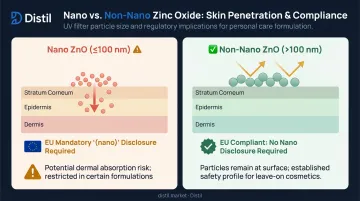
Brands sourcing zinc oxide without specifying particle size are, in practice, making a regulatory and safety decision by default.
Key Advantages of Non-Nano Zinc Oxide in Sunscreen
Advantage 1: Skin Safety and Minimal Systemic Absorption
The most meaningful safety distinction between nano and non-nano zinc oxide is what happens after application. Non-nano particles are physically too large to penetrate viable skin.
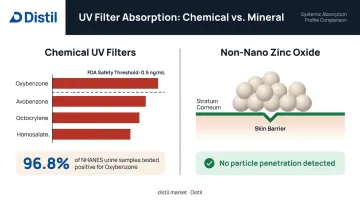
Studies reviewed by the EU's Scientific Committee on Consumer Safety (SCCS) found no penetration of ZnO particles through the stratum corneum — including a study using 110 nm particles that detected no ZnO particle or solubilized zinc penetration through pig stratum corneum.
One important caveat for formulators: A Gulson et al. 2010 stable isotope study did detect trace zinc in blood and urine after ZnO sunscreen application — but could not determine whether the absorbed zinc came from intact particles or dissolved zinc ions. The accurate claim is that intact non-nano ZnO particles have not demonstrated penetration into viable skin, not that zero zinc detection occurs under all conditions.
Contrast this with chemical UV filters:
- Matta et al. 2020 found that avobenzone, oxybenzone, octocrylene, homosalate, octisalate, and octinoxate all exceeded FDA's 0.5 ng/mL plasma threshold on day 1 of maximal-use application
- CDC researchers detected oxybenzone (benzophenone-3) in 96.8% of 2,517 NHANES urine samples, with a geometric mean of 22.9 µg/L
For brands, systemic absorption is not just a consumer concern — it is a regulatory exposure. The FDA's 2019 proposed rule and 2021 proposed order both cite absorption data as central to ingredient safety classification. Formulators who build products on non-nano zinc oxide are less exposed to future mandatory reformulations if systemic absorption thresholds tighten.
Most relevant for: Daily-wear SPF, pediatric and sensitive-skin formulations, and products marketed for pregnant users — where cumulative, long-term exposure is a material safety variable.
Advantage 2: Broad-Spectrum UV Protection with Inherent Photostability
Non-nano zinc oxide covers both UVA and UVB wavelengths in a single ingredient. Research by Beasley and Meyer confirms that only avobenzone and zinc oxide among U.S.-approved filters provide true broad-spectrum protection against UVA wavelengths above 360 nm — and zinc oxide additionally covers shorter UV wavelengths that avobenzone does not.
The mechanism matters: non-nano particles physically scatter and reflect UV radiation. No chemical reaction occurs, so the ingredient does not degrade under UV exposure. Mitchnick et al. (1999) and StatPearls (2025) both describe microfine zinc oxide as highly photostable.
Compare that to avobenzone — one of the most common UVA filters in chemical sunscreens — which is well-documented as photounstable and requires additional photostabilising agents (such as octocrylene or bemotrizinol) to maintain efficacy during UV exposure.
What this means for formulation:
- Fewer combination actives needed to achieve broad-spectrum coverage
- No photostabiliser requirement for the mineral active
- Simpler regulatory submissions with fewer active ingredients to document
- More reliable on-label SPF claims across the product's shelf life
Most relevant for: Outdoor, sport, and extended-wear formulations where prolonged UV exposure makes filter stability a direct determinant of product performance.
Advantage 3: Regulatory Acceptance and Environmental Compliance
The regulatory case for non-nano zinc oxide is unambiguous at the FDA level. In its 2019 proposed rule (Docket No. FDA-1978-N-0018), the FDA reviewed 16 sunscreen active ingredients and proposed GRASE status for only two: zinc oxide and titanium dioxide.
The other 14 fared worse. PABA and trolamine salicylate were proposed as not GRASE. The remaining 12 — including oxybenzone, avobenzone, octinoxate, homosalate, and octocrylene — required additional safety data. The 2021 proposed order maintained this position.
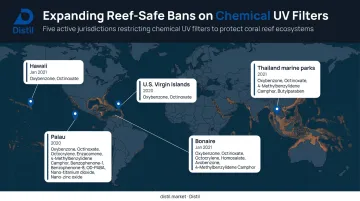
The environmental picture is similarly clear. Chemical UV filter bans are expanding:
| Jurisdiction | Status | Banned Ingredients |
|---|---|---|
| Hawaii | Effective Jan 1, 2021 | Oxybenzone, octinoxate |
| Palau | Effective 2020 | Oxybenzone, octinoxate, octocrylene, 4-MBC, others |
| U.S. Virgin Islands | Effective 2020 | Oxybenzone, octinoxate, octocrylene |
| Thailand marine parks | Effective 2021 | Oxybenzone, octinoxate, 4-MBC, butylparaben |
| Bonaire | Effective Jan 1, 2021 | Oxybenzone, octinoxate (reported) |
Non-nano zinc oxide is the only UV filter that simultaneously meets FDA proposed GRASE status, EWG's top-recommended rating, and reef-safe certification criteria. The Haereticus Environmental Laboratory's Protect Land + Sea Certification explicitly bans nanoparticles of zinc oxide — meaning non-nano specification is required, not just preferred, for that certification.
For brands selling across multiple markets or targeting eco-conscious segments, that combination has a practical consequence: it reduces the risk of ingredient-driven reformulations as regional bans expand, while opening access to certifications that chemical filters are structurally unable to qualify for.
What Happens When Brands Ignore the Nano vs Non-Nano Distinction
The risks are compounding, not isolated.
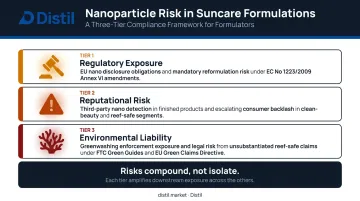
Three distinct risk categories compound when brands skip proper particle size verification:
Regulatory exposure: The EU requires nano ingredients to be disclosed with "(nano)" in the INCI list under Article 19 of Regulation (EC) No 1223/2009. Brands using nano zinc oxide without that disclosure are non-compliant today, not at some future threshold. As guidelines tighten globally, undisclosed nano use creates mandatory reformulation risk.
Reputational risk: EWG currently warns that many "non-nano" claims can be misleading because mineral particles in some sunscreens include nano-sized fractions. Third-party testing can surface nano particle presence even when a product is marketed as mineral or clean. A brand that learns this through a consumer advocacy report rather than its own quality system faces a difficult public position.
Environmental liability: In 2025, Australia's ACCC initiated Federal Court proceedings against Edgewell Personal Care (owner of Banana Boat and Hawaiian Tropic) over allegedly misleading "reef friendly" claims for sunscreens containing octocrylene, homosalate, 4-MBC, and avobenzone. Reef-safe and eco-friendly claims are moving from marketing language into legal liability territory.
Nano zinc oxide has been associated with coral damage in the same research that implicates chemical filters. Brands marketing nano-containing products as reef-safe face greenwashing exposure on that basis alone.
Regulatory pressure, reformulation cost, and reputational damage rarely arrive separately. A brand forced to reformulate under regulatory scrutiny often faces simultaneous consumer backlash and restricted market access. Verifying particle size at the sourcing stage is what keeps all three from landing at once.
How Formulators Get the Most Value from Non-Nano Zinc Oxide
Non-nano zinc oxide's performance in a finished formulation depends heavily on four variables: particle size specification, surface treatment (coated vs. uncoated), concentration, and dispersion quality. Sourcing the right grade and application-specific formulation support directly determine SPF outcomes and texture — the two subsections below address the most common formulation challenge and how to navigate ingredient decisions with the right partner.
Addressing White Cast Directly
The white cast concern is real and worth addressing plainly. Non-nano particles, because of their larger size, create more visible whitening on skin than nano-sized particles. This is a formulation challenge, not an insurmountable barrier.
Practical approaches that reduce white cast without requiring nanoparticles include:
- Optimised dispersion — uniform, fine particle distribution reduces agglomeration and the opaque appearance it creates
- Lightweight emollient esters — low-refractive-index esters like coco-caprylate/caprate and octyldodecanol improve spreadability, helping zinc oxide distribute more thinly and evenly across the skin
- Tinting — even minimal tinting neutralises the blue-white optical effect of zinc oxide particles, and is standard in many commercially successful mineral SPF products
- Surface-treated grades — coated zinc oxide powders engineered for improved transparency reduce visual opacity compared to uncoated equivalents
The key point: these techniques are well-validated. The white cast trade-off is manageable with the right formulation approach, and the particle size difference that causes it is the same difference that makes non-nano zinc oxide safe.
Working with a Supplier Who Understands the Full Picture
Distil's personal care team sources pharmaceutical-grade non-nano zinc oxide in both powder and pre-dispersed forms — including natural and coated grades across ultra-fine, micronised, and surface-treated formats. Distil's zinc oxide dispersions are designed to eliminate complex dispersion steps and maintain uniform particle distribution, directly addressing the consistency challenges that affect batch reliability and on-skin feel.

The R&D team, led by Dr. Leema Joseph (VP, R&D) and supported by Kiro Rizk (Head, Personal Care), draws on expertise from L'Oréal, BASF, Dow, Huntsman, and Reliance Industries.
For brands navigating the nano vs. non-nano transition — whether starting from scratch or reformulating an existing SKU — Distil provides application-specific formulation support from ingredient specification through commercial-scale production, managed through a single point of contact.
Conclusion
The case for non-nano zinc oxide rests on three facts that reinforce each other: intact non-nano particles have not demonstrated penetration into viable skin, zinc oxide is one of only two UV filters proposed as GRASE by the FDA, and it is broadly recognised as safe for marine ecosystems. No other approved UV filter meets all three criteria at once.
The nano vs non-nano distinction is not a fine-print detail. It shapes whether a safety claim survives regulatory scrutiny, determines access to reef-ban markets, and controls reformulation risk as UV filter frameworks tighten globally. With greenwashing enforcement accelerating alongside that regulatory pressure, formulating with verified non-nano zinc oxide from a qualified supplier is the choice that avoids costly mid-cycle reformulations — and the reputational exposure that follows them.
Frequently Asked Questions
What is non-nano zinc oxide in sunscreen?
Non-nano zinc oxide refers to zinc oxide particles larger than 100 nanometres used as the active UV-filtering ingredient in mineral sunscreens. At this size, the particles remain on the skin's outermost layer and do not penetrate the stratum corneum or enter the bloodstream.
Is nano or non-nano sunscreen better?
Non-nano is considered the safer choice based on current evidence. Nano zinc oxide particles have been detected in human urine through absorption studies and are linked to potential marine ecosystem harm, while non-nano zinc oxide has not demonstrated systemic particle absorption and holds proposed GRASE status from the FDA.
Is non-nano zinc oxide good for skin?
Non-nano zinc oxide is widely considered gentle and beneficial for all skin types, including sensitive, acne-prone, and rosacea-affected skin. Its anti-inflammatory properties, non-irritating profile, and physical barrier-forming mechanism make it one of the better-tolerated active UV filters available.
Does non-nano zinc oxide leave a white cast?
Non-nano particles do create more visible whitening on skin than nano-sized particles. However, formulation techniques including optimised dispersion, lightweight emollient esters, and tinting can significantly reduce this effect without compromising the safety or efficacy of the ingredient.
Is non-nano zinc oxide reef-safe?
Non-nano zinc oxide in its non-nano form is recognised as reef-safe. Its particles are too large to be absorbed by marine organisms, it is biodegradable, and it does not contain the chemical compounds — oxybenzone, octinoxate — linked to coral bleaching.
What concentration of non-nano zinc oxide is effective in sunscreen?
Non-nano zinc oxide is commonly used at 10–25% in leave-on formulations — both the FDA OTC Monograph and EU Annex VI permit up to 25% — with higher concentrations generally achieving higher SPF values. Optimal concentration depends on the target SPF, formulation format, and market-specific regulatory requirements.