
Introduction
Zinc oxide particle size controls more than most formulators account for. A single size selection governs UV performance, surface reactivity, optical transparency, dispersion stability, and application suitability — all at once. Get it wrong and you get white cast in a sunscreen, inconsistent rubber cure rates, or a regulatory filing that fails at review.
The problem is that particle size is consistently under-specified in practice. Formulators treat all nano grades as interchangeable. Procurement teams compare datasheets without checking which measurement method generated the number. The critical follow-up question rarely gets asked: does this particle size reflect the raw powder, or the actual dispersion state in the formulation?
This guide covers:
- The full ZnO particle size spectrum and what each range controls
- Application fit by size range — suncare, rubber, coatings, and more
- How to measure and validate particle size correctly
- The misinterpretation traps that cause real-world formulation failures
Key Takeaways
- Commercial ZnO spans ~20nm (nano) to >10µm (coarse industrial); each range enables or restricts specific application performance
- Smaller particles increase surface area, UV absorption, and reactivity; larger particles scatter visible light and suit industrial uses
- Poor dispersion management turns a 30nm crystallite into an effective aggregate of 300–500nm — negating the size advantage entirely
- XRD, SEM, BET, and DLS each measure different aspects of the same material; datasheet numbers reflect the measurement method as much as the material itself
- Selecting ZnO particle size means matching specs to application requirements and verifying performance in the actual dispersion state
What Particle Size Represents in Zinc Oxide
"Particle size" covers at least three distinct measurements, each capturing a different physical reality of the same material.
Primary crystallite size is the smallest structurally ordered unit within the crystal (the fundamental coherent scattering domain), measured by XRD (via the Scherrer equation) or imaged directly by SEM/TEM. This is the smallest structural unit and the number most commonly cited on technical datasheets.
Aggregate size refers to clusters of primary particles held together by van der Waals forces. These form during synthesis, drying, or storage, and persist unless broken apart by mechanical energy during dispersion. Hydrodynamic diameter is what dynamic light scattering (DLS) measures in a liquid medium — it reflects the actual size of the particle plus any solvent layer and aggregates present in the dispersion. For liquid formulations, this is the most application-relevant measurement, and typically the largest of the three values.
A datasheet may report any one of these without specifying which. That ambiguity is where misspecification begins.
Regulatory Threshold at 100nm
Under EC Recommendation 2022/C 229/01 and REACH, a material qualifies as a nanomaterial when ≥50% of particles have at least one external dimension in the 1–100nm range. For personal care and food-contact applications, that classification triggers:
- Nano labelling requirements in EU cosmetic product ingredient lists
- Additional safety assessment documentation
- Specific REACH registration requirements for nanoforms
Getting this wrong at the specification stage means either rework at formulation or compliance gaps at registration — neither of which surfaces cheaply.
The Zinc Oxide Particle Size Spectrum
Commercial ZnO spans roughly 20nm to over 10µm. Which size range is correct depends entirely on the performance parameter the application requires — optical, reactive, or physical.
Nano ZnO: <100nm
Primary crystallite sizes typically fall between 20–80nm as measured by XRD or SEM. BET surface area in this range is commonly reported at 20–60 m²/g, reflecting the large surface-to-volume ratio that underpins reactivity and UV performance.
The key functional split within the nano range:
- <50nm: Absorbs both UVA and UVB across ZnO's 3.37 eV bandgap while remaining largely transparent to visible light — the basis for cosmetically elegant sunscreen formulations
- 80–100nm: Begins scattering visible wavelengths, introducing measurable opacity
Sub-Micron ZnO: 100nm–1µm
UV absorption efficiency drops relative to nano grades in this range, visible light scattering increases, and BET surface area falls significantly — typically into the 5–15 m²/g range for commercial grades.
Sub-micron grades suit applications where some whitening is acceptable or where UV scattering is the intent rather than UV absorption. Many commercial "non-nano" grades for regulatory-compliant personal care formulations fall here, offering a practical route around nano labelling requirements without sacrificing all UV performance.
Micron and Coarse ZnO: >1µm
Micron-scale grades (1–10µm and above) are characterised by:
- Low surface area (typically <5 m²/g)
- Fully opaque, white appearance
- Lower chemical reactivity
- Cost efficiency at high volumes
These grades dominate rubber vulcanisation, ceramics, and agricultural applications where particle size governs sintering behaviour, processing flow, or controlled-release profiles — not optical properties.
Particle size distribution (PSD) width matters here. A broad PSD in industrial ZnO introduces inconsistency in rubber cure rates and ceramic sintering uniformity. Narrow PSD improves batch-to-batch reproducibility, which is why specification of D10/D50/D90 values — not just median size — is standard practice in industrial procurement.
How Particle Size Governs ZnO Performance Properties
Particle size is the upstream variable that determines surface area, optical behaviour, reactivity, dispersion stability, and formulation feel — all at once. Shift the particle size, and every one of these properties shifts with it.
Specific Surface Area
Surface area increases inversely with particle size — and the relationship is non-linear. Halving particle diameter approximately doubles specific surface area. In practical terms, a nano ZnO grade at ~30nm primary crystallite size can deliver a BET surface area of 30–50 m²/g, while a micron-grade at ~3µm delivers roughly 1–3 m²/g. That is a 10–30x difference in surface area for a 100x difference in particle size.
For any reactivity-driven application — antimicrobial performance, catalytic activity, UV absorption — this surface area differential is the performance gap between grades.
UV Absorption and Optical Transparency
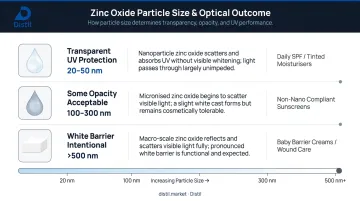
Nano ZnO below ~50nm absorbs UV (both UVA and UVB) while allowing visible light to pass, producing cosmetically transparent formulations. Larger particles scatter visible wavelengths, generating the characteristic white cast associated with conventional physical sunscreens.
The practical application split:
| Desired Outcome | Particle Size | Typical Application |
|---|---|---|
| Transparent, broad-spectrum UV protection | 20–50nm | Daily SPF, tinted moisturisers |
| Some opacity acceptable | 100–300nm | Non-nano compliant sunscreens |
| White physical barrier intentional | >500nm | Baby barrier creams, wound-care preparations |
Antimicrobial and Catalytic Reactivity
Higher surface area in nano ZnO increases the generation of reactive oxygen species (ROS) upon UV activation and in aqueous environments. Research published in PMC confirms that smaller ZnO particles show stronger inhibition against common pathogens including E. coli and S. aureus, with antimicrobial efficacy increasing as particle size decreases from micron to sub-100nm ranges.
This ROS generation mechanism underpins ZnO's use in healthcare coatings, wound care formulations, and antimicrobial packaging. For these applications, specifying nano ZnO and verifying that dispersion maintains sub-100nm aggregate size in the final product matrix is not optional. Aggregate size in the finished product directly determines efficacy.
Zeta Potential and Dispersion Stability
That efficacy, however, depends on the nano ZnO remaining dispersed. Smaller particles have a higher surface area-to-volume ratio, which makes surface charge — and its management — central to preventing aggregation in use. Zeta potential (measured by dynamic light scattering (DLS) or electrophoretic light scattering) is the standard proxy for dispersion stability:
- Values above ±30mV: Generally indicate a stable dispersion
- Values between ±10–30mV: Borderline — prone to slow aggregation
- Values below ±10mV: Likely to aggregate rapidly
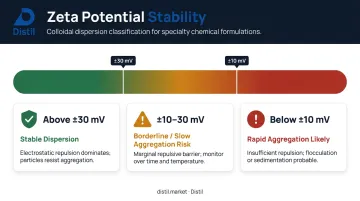
The critical point: pH and surface coating substantially influence zeta potential for a given particle size. The same nano ZnO grade can be stably dispersed at one pH and heavily agglomerated at another. This means dispersion conditions must be co-specified with particle size — they are not independent variables.
Rheological and Sensory Behaviour in Formulations
Particle size directly affects both processability and end-user skin feel:
- Nano ZnO produces lighter, lower-viscosity dispersions with better sensory profiles
- Coarser particles increase formulation viscosity and can create chalky or heavy texture on application
- Pre-dispersed systems (dispersions rather than dry powders) further reduce aggregation risk and improve batch-to-batch consistency
For personal care formulators, particle size is the variable that controls the three-way balance between transparency, SPF efficacy, and skin feel — and moving one affects the others. Distil's zinc oxide portfolio covers both dry powder and pre-dispersed formats, with surface-treated grades available for sunscreen, daily wear, and mineral UV protection applications where that balance needs precise control.
Application Fit: Matching Particle Size to Use Case
There is no universally optimal ZnO grade. Over-specifying nano ZnO for an application that does not require sub-100nm performance adds cost, regulatory complexity, and handling requirements without functional return.
Personal Care and Sunscreens
- Nano ZnO (20–80nm): Standard for transparent, broad-spectrum UV-protective cosmetics; requires surface treatment and careful dispersion management to maintain primary particle size in formulation
- Sub-micron / non-nano (100–300nm): Used where physical barrier and whitening are intentional, or where EU nano labelling must be avoided; lower cost and simpler regulatory pathway
- Pre-dispersed systems: Reduce formulation development time and dispersion variability; particularly valuable for SPF moisturisers, tinted suncare, and long-wear foundations
Distil works with personal care brands to select the right particle size and surface treatment across nano and non-nano grades, managing SPF performance, transparency, and compliance requirements through a single formulation and supply chain partner.
Rubber and Industrial Applications
Micron-grade ZnO (typically 200nm–5µm, median around 1–3µm for standard rubber grades) acts as a vulcanisation activator alongside stearic acid. In this application, particle size governs dispersion homogeneity in the rubber matrix rather than surface reactivity or optical properties.
Key considerations for rubber-grade ZnO:
- Finer particles improve dispersion uniformity within the rubber matrix
- Better dispersion can reduce the ZnO loading needed for equivalent cure performance
- PSD consistency batch-to-batch matters more than absolute median size for process reliability
Agricultural Applications
Nano and sub-micron ZnO (<200nm) is used in agrochemical formulations for micronutrient delivery and crop protection. Smaller particle size improves foliar absorption and bioavailability. However, research published in Environmental Science & Technology demonstrates that particle size determines ZnO phytotoxicity — smaller particles at high concentrations increase toxicity risk. The trade-off between enhanced bioavailability and phytotoxicity must be managed through both particle size specification and concentration control.
Advanced Materials: Ceramics, Electronics, and Coatings
- Ceramics and electronics: Particle size controls sintering temperature and final grain structure; smaller particles enable denser packing and more consistent electrical properties in piezoelectric and varistor applications
- UV-blocking coatings and textiles: Sub-100nm dispersions where transparency and washfastness are both required
- Precision applications: PSD width and purity are as critical as median particle size — narrow distribution and controlled impurity profiles are standard requirements
How ZnO Particle Size Is Specified, Measured, and Validated
The number on a datasheet is only meaningful if the measurement method, dispersion medium, and pre-treatment conditions are also specified.
Measurement Methods Compared
| Method | What It Measures | Typical Result | Best Used For |
|---|---|---|---|
| XRD (Scherrer equation) | Primary crystallite size | Smallest value | Bulk powder; regulatory nano classification |
| SEM/TEM | Primary particle morphology | Near-XRD | Visual confirmation; size distribution |
| BET | Surface-area-equivalent diameter | Intermediate | Bulk powder comparison; reactivity estimation |
| DLS | Hydrodynamic diameter in suspension | Largest value | Dispersion stability; formulation work |
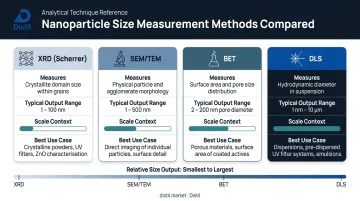
No method is universally correct — each answers a different question. The right choice depends on your application:
- Regulatory nano classification (EU frameworks): SEM and XRD used together are typically required
- Dispersion stability and formulation development: DLS in the relevant medium is most representative
- Bulk powder comparisons across grades: BET surface area is the most reproducible
The Lab-to-Formulation Gap
Lab measurements of nano ZnO are typically performed on freshly prepared, ultrasonicated dispersions at controlled pH. In actual formulations — with emulsifiers, salts, oils, and variable shear during manufacturing — the aggregation state will differ.
Validating particle size in the actual formulation matrix — not just the raw powder — is necessary whenever dispersion state governs performance. In sunscreen transparency, antimicrobial efficacy, and UV absorption, the dispersion state in the finished product is the relevant specification. The crystallite size on the certificate of analysis tells only part of the story.
Common Misinterpretations in ZnO Particle Size Selection
Conflating Crystallite Size with Aggregate Size
The most frequent error: treating XRD crystallite size (e.g., 30nm) as equivalent to in-formulation particle size. Untreated nano ZnO commonly forms aggregates of 200–500nm or larger in aqueous media, defeating the optical and reactivity rationale for specifying a nano grade.
Specifications should cover both primary crystallite size and the dispersion conditions required to achieve it, then verified using DLS in the actual formulation vehicle.
Assuming Nano Is Always Higher Performance
Nano ZnO costs more, carries EU nano labelling requirements, and requires specialised surface treatment and dispersion expertise. In applications like rubber vulcanisation or coarse coating systems, over-specifying nano creates unnecessary burden:
- Higher raw material cost with no performance gain
- EU nano labelling obligations that add regulatory complexity
- Dispersion and surface treatment requirements that complicate processing
- No meaningful advantage over well-dispersed sub-micron or micron grades
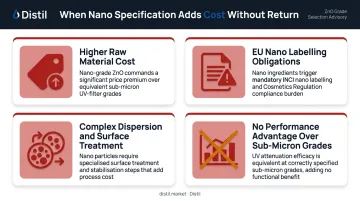
Specifying nano requires a clear functional justification — otherwise it adds cost and compliance overhead without a performance return.
Applying One Specification Across Multiple Contexts
A ZnO grade specified for sunscreen formulation is not interchangeable with one specified for rubber compounding or agricultural sprays. The same nominal particle size number on two different datasheets may represent different measurement methods, different surface treatments, and different dispersion behaviours.
Particle size is always context-dependent. Specifications must be reviewed against the measurement method and end-use dispersion conditions, not treated as a transferable standalone number.
Frequently Asked Questions
What is the size of a ZnO particle?
Commercial ZnO spans from approximately 20nm (nano-grade) to over 10µm (coarse industrial). The reported size depends entirely on the measurement method — XRD crystallite size, SEM primary particle size, and DLS hydrodynamic diameter each yield different values for the same material.
What is the relationship between particle size and zeta potential?
Smaller ZnO particles have higher surface area and surface charge density, making zeta potential more sensitive to formulation pH and coating chemistry. Values above ±30mV generally indicate stable dispersion, though this threshold can shift significantly depending on those same variables.
What is 25% zinc oxide good for?
25% zinc oxide concentrations are typical in barrier and protective formulations — nappy rash creams and wound-care ointments — where a thick physical barrier and antimicrobial action are both required. These applications generally use non-nano grades where the opaque white barrier film is the desired outcome.
What is zinc oxide 39.5% SC?
39.5% SC refers to a suspension concentrate at 39.5% active ZnO content. It is a pre-dispersed liquid format used in agricultural formulations, where consistent particle dispersion in the concentrate is critical for uniform coverage after dilution in the field.
How does ZnO particle size affect UV protection performance?
Nano ZnO below ~50nm absorbs both UVA and UVB while remaining largely transparent to visible light; larger particles scatter visible wavelengths, producing a white cast. SPF performance depends on surface area and dispersion state in the final formulation, not particle size alone.
Does particle size affect the safety of zinc oxide in cosmetics?
EU SCCS assessments conclude that ZnO nanoparticles in sunscreen do not penetrate beyond the stratum corneum in intact skin. Nano classification does, however, trigger additional EU labelling requirements, so particle size specification carries both a compliance and a performance dimension.