This article addresses those questions directly, drawing on regulatory opinions from the SCCS and FDA, peer-reviewed research, and formulation science. The goal is a clear, honest picture that brands can actually use — not a marketing narrative.
Key Takeaways
- Non-nano zinc oxide (particles ≥100nm) is confirmed safe as a UV filter at concentrations up to 25% by both the FDA and SCCS.
- Intact non-nano ZnO particles do not penetrate the stratum corneum — trace zinc detected in studies is dissolved ionic zinc, not particles.
- Inhalation risk in spray/aerosol formats is real and well-documented — dermal safety data does not apply to spray products.
- The 2021 OSU photostability study applies to hybrid ZnO + organic filter formulas only — not to pure mineral sunscreens.
- Particle coatings, purity documentation, and dispersion method matter as much as particle size alone.
What Is Non-Nano Zinc Oxide and How Does It Work in Sunscreens?
Zinc oxide is a naturally occurring mineral UV filter that attenuates UV radiation through a combination of reflection, scattering, and absorption — not solely reflection, as is commonly overstated. This mechanism makes it a genuine broad-spectrum filter, covering both UVA and UVB ranges. Peer-reviewed photochemistry data indicate that ZnO provides stronger UVA coverage than titanium dioxide, while TiO₂ performs better across UVB wavelengths.
What "Non-Nano" Actually Means
The term refers specifically to particle size. Under EU cosmetics regulation and ISO/TR 18401:2017, the nanoscale is defined as 1–100 nanometers. Non-nano zinc oxide therefore means particles with dimensions of 100nm or larger — large enough that they behave very differently from nanoparticles in terms of skin interaction and surface reactivity.
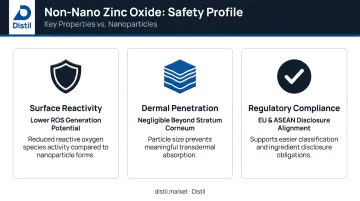
Particle size governs surface area-to-volume ratio, which directly shapes how zinc oxide interacts with biological tissue, co-formulated ingredients, and UV radiation. For formulators, this means non-nano grades offer a meaningfully different safety and reactivity profile:
- Lower surface reactivity compared to nanoparticles, reducing potential for ROS generation
- Negligible dermal penetration beyond the outermost skin layers
- Easier compliance with particle-size disclosure requirements under EU and ASEAN cosmetics regulations
FDA Regulatory Status
Zinc oxide is one of only two sunscreen actives — alongside titanium dioxide — that the FDA proposed as GRASE (Generally Recognized as Safe and Effective) in its 2019 proposed rule.
The current governing document — FDA Final Administrative Order OTC000006 (Monograph M020), posted September 24, 2021 — lists zinc oxide as a permitted active at concentrations up to 25%. The remaining 12 chemical filters under FDA review still require additional safety data before any GRASE designation can be made.
Is Non-Nano Zinc Oxide Safe? What the Regulatory Evidence Shows
The SCCS Safety Opinion
The European Commission's Scientific Committee on Consumer Safety (SCCS) addressed zinc oxide comprehensively in Opinion SCCS/1489/12, adopted in 2012. The conclusion: dermal use of zinc oxide at up to 25% concentration does not pose an adverse-effect risk under assessed conditions. Commission Regulation (EU) 2016/621 subsequently authorized zinc oxide (in both nano and non-nano form) as a UV filter up to 25% under EU cosmetics law.
Non-nano (micro-sized) particles carry lower dermal penetration concern than nano-sized ones — a meaningful distinction for safety assessment.
Skin Penetration: What the Studies Actually Show
Multiple human volunteer studies and SCCS review findings converge on a consistent conclusion:
- Intact non-nano ZnO particles do not penetrate the stratum corneum.
- Any trace zinc detected in blood or urine following topical application appears as dissolved zinc ions (Zn²⁺), not intact particles.
- Gulson et al. (2010) detected trace zinc in volunteers after ZnO sunscreen application; both the authors and SCCS confirmed this reflects ionic dissolution, not particle penetration.
- Mohammed et al. (2019) reached the same conclusion: repeated ZnO nanoparticle application did not penetrate viable epidermis.
The toxicological distinction matters here. Dissolved zinc ions at trace levels are handled by normal physiological mineral metabolism. Intact nanoparticles raise entirely different questions about cellular interaction — ones that don't apply to non-nano grades used dermally.
The Inhalation Exception — Often Omitted, Always Important
Dermal safety data only goes so far. SCCS/1518/13 is unambiguous: the safety conclusions for dermal ZnO use do not extend to sprayable products that could lead to inhalation. Key findings from that opinion:
- 90-day inhalation NOAEL: 0.3 mg/m³ — with lung macrophage activation identified as the primary concern
- EU Regulation 2016/621 explicitly restricts ZnO in applications that may expose lungs by inhalation
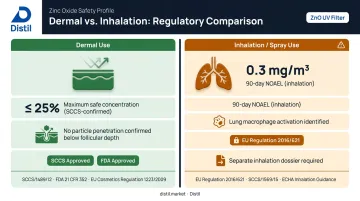
This applies to both nano and non-nano grades. Brands formulating zinc oxide into aerosol or spray sunscreens need a separate, dedicated inhalation safety dossier — dermal safety data alone is not sufficient justification.
Non-Nano ZnO vs. Nano ZnO: Safety and Performance Trade-Offs
Comparative Safety Profile
The size difference has real toxicological implications:
- Nano ZnO (below 100nm) has a greater surface area-to-volume ratio, increasing theoretical concerns about cellular interaction and photoreactivity.
- Non-nano ZnO particles are too large to penetrate intact skin, and the SCCS assessment found micro-sized ZnO demonstrated either similar or lower toxic effects compared to nano-sized ZnO across general toxicity, genotoxicity, and liver histopathology testing.
- Pei et al. (2022) found that 20–50nm ZnO nanoparticles caused more severe rat hepatotoxicity than conventional ZnO — though this was not a dermal sunscreen study. This is comparative toxicology data, not a direct consumer safety finding.
For formulators choosing between grades, the non-nano profile carries the stronger established dermal safety narrative — and that safety case translates directly into a regulatory one. It is the grade more straightforwardly supported by existing regulatory opinions, which matters when selecting ingredients for global market access.
The White Cast Trade-Off
Non-nano grades scatter visible light more than nano grades, producing the characteristic white cast that mineral sunscreens are known for. Nano ZnO produces a more transparent finish because smaller particles interact less with visible wavelengths.
This is a genuine formulation challenge — not a reason to default to nano grades. Dispersion technology, surfactant systems, and cosmetic ester carriers can meaningfully reduce visible cast while maintaining the non-nano safety profile. It requires formulation investment, but the tools exist.
Non-Nano ZnO vs. Chemical Sunscreen Filters
The contrast between mineral and chemical filter systemic profiles is one of the clearest distinctions in sunscreen science.
Chemical filter systemic exposure findings:
- Calafat et al. (2008), CDC/NHANES 2003–2004: Oxybenzone (benzophenone-3) detected in urine across a broad U.S. population sample.
- Matta et al. (2020), JAMA: Several organic filters — including oxybenzone and octinoxate — exceeded the FDA's 0.5 ng/mL plasma threshold under maximal-use conditions.
- UV filter residues have been detected in breast milk: Molins-Delgado et al. (2018) found UV filter residues in 27 of 79 milk samples analyzed.
On endocrine activity, the science is more measured than popular coverage suggests. The SCCS regarded endocrine-disrupting evidence for benzophenone-3 as "inconclusive and at best equivocal" (SCCS/1625/20, 2021).
EHMC/octinoxate was separately described as "endocrine-active" due to estrogenic and weak anti-androgenic activity — yet still considered safe at concentrations up to 10%.
Non-nano zinc oxide has not been detected in the bloodstream as intact particles in human studies. For formulators, that absence of systemic absorption is the most defensible differentiator when positioning mineral UV filters against organic alternatives.
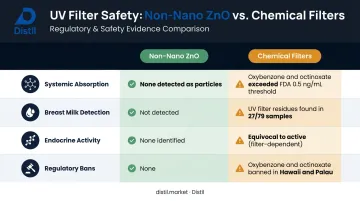
On regulatory bans: Hawaii (effective January 1, 2021) and Palau (effective January 1, 2020) banned oxybenzone and octinoxate specifically due to coral reef concerns. These bans target named chemical filters, not all non-mineral sunscreens broadly.
Brand claims in this space require care:
- "Reef-safe" lacks formal regulatory definition — avoid using it without qualification
- Nano-ZnO has been flagged by NOAA as a potential marine concern; non-nano status matters here
- "Biodegradable" is not technically supported for an inorganic mineral — do not use this claim
- Safer positioning: lead with "oxybenzone-free and octinoxate-free," with reef considerations as supporting context
What the OSU Photostability Study Found — and What It Doesn't Mean
The 2021 Oregon State University study (Ginzburg et al., Photochemical & Photobiological Sciences) generated significant concern when it was published, and the consumer-facing coverage often missed the most important nuance.
What the study found:
- Both nanoparticulate and microparticulate ZnO degraded mixtures of organic UV filters under two hours of UV exposure.
- Degradation caused more than 80% loss of UVA protection from the organic filter blend.
- Zebrafish assays detected phototoxicity concerns in the irradiated mixtures.
What the study did not find:
- The study tested hybrid formulations — combinations of ZnO with small-molecule organic filters. It did not test, and did not implicate, pure mineral (ZnO-only) sunscreen formulations.
- The finding is not evidence that non-nano zinc oxide is dangerous. It is evidence that zinc oxide's surface reactivity can destabilize co-formulated organic filters under UV stress.
The study's lead researcher noted that "any size of metal oxide particle can have reactive surface sites," identifying surface coatings and crystal structure as the critical variables formulators need to control. The SCCS (SCCS/1518/13) evaluated several coatings for ZnO particles and found that triethoxycaprylylsilane, dimethicone, and octyl triethoxy silane did not significantly alter uptake, bioavailability, or the overall safety profile under assessed conditions.
Hybrid ZnO + organic filter formulations require thorough photostability testing and careful ingredient selection. Pure mineral ZnO formulations are not implicated by this research — the distinction matters most at the formulation design stage.
Formulation Considerations for Brands Working with Non-Nano Zinc Oxide
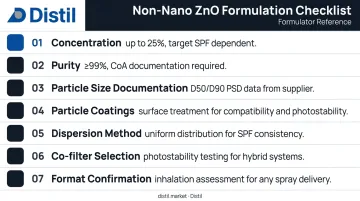
Non-nano zinc oxide formulation requires attention across several interdependent variables. Each one affects the finished product's safety profile, SPF performance, and regulatory standing:
- Concentration: Up to 25% per SCCS and FDA; most commercial formulas use 10–25% depending on target SPF
- Purity: SCCS assessed material purity of ≥99%; CoA and impurity profile documentation are required for regulatory dossier alignment
- Particle size documentation: Supplier-provided particle size distribution (PSD) data — including D50 and D90 values — is necessary to substantiate the non-nano claim; ingredient-level SCCS compliance does not replace finished-product testing
- Particle coatings: Surface treatment choice affects ingredient compatibility, dispersibility, and photostability in hybrid systems
- Dispersion method: Uniform particle distribution directly affects SPF consistency and skin feel; pre-dispersed systems reduce batch-to-batch variability
- Co-filter selection: If blending with organic filters, photostability testing under relevant UV exposure conditions is non-negotiable
- Format: Confirm inhalation non-relevance if any spray delivery is involved
Distil's personal care team — including Dr. Leema Joseph (VP, R&D) and Kiro Rizk (Head, Personal Care), with backgrounds spanning Dow, BASF, and L'Oréal — supports brands through this process from ingredient selection and particle engineering through SPF application development and commercial scale-up.
Zinc oxide powders (ultra-fine, micronized, and surface-treated), pre-dispersed systems, and cosmetic ester carriers such as coco-caprylate/caprate for mineral UV applications are all available. Brands can reach Distil's team at distil.market/partner-with-us or contact@distil.market.
Frequently Asked Questions
Is non-nano zinc oxide toxic?
Non-nano zinc oxide is not considered toxic at concentrations up to 25% in topical sunscreens per both SCCS and FDA assessments. Intact particles do not penetrate the skin, and trace zinc ion absorption falls well within established safe thresholds. The exception is spray or aerosol formats, where inhalation exposure presents a documented lung risk.
What is the difference between non-nano and nano zinc oxide?
The distinction is particle size. Non-nano particles measure 100nm or larger and cannot penetrate intact skin. Nano particles are smaller than 100nm and carry greater theoretical surface reactivity. Both work as UV filters, but non-nano grades are considered safer for dermal use — the trade-off being a more visible white cast in finished formulations.
What is the least toxic sunscreen to use?
Mineral sunscreens formulated with non-nano zinc oxide as the sole active represent the lowest-risk option among common sunscreen actives. They block UV physically without systemic absorption, and they lack the endocrine activity and bloodstream detection profile associated with several chemical filters.
Can non-nano zinc oxide penetrate the skin?
Scientific consensus — across multiple human volunteer studies and the SCCS review — is that non-nano ZnO particles do not penetrate the stratum corneum. Any trace zinc detected internally is dissolved ionic zinc, present at levels far below thresholds of concern.
Is non-nano zinc oxide safe for sensitive skin?
Zinc oxide is well-tolerated by sensitive and reactive skin. Dermatology literature documents its anti-inflammatory properties and its use in conditions including rosacea, eczema, and acne. It is preferred over chemical filters for compromised skin types because it blocks UV physically without triggering irritation.
What concentration of non-nano zinc oxide is considered safe in sunscreens?
Both the SCCS (EU) and FDA permit non-nano zinc oxide at concentrations up to 25% as a UV filter in sunscreens. Most commercial formulations use between 10–25%, with the specific level determined by target SPF, preferred skin feel, and overall formula complexity.