The challenge isn't the ingredient itself. It's execution. Achieving consistent SPF performance requires accurate concentration measurement, proper particle dispersion, correct phase incorporation, and validated testing — and the margin for error compounds at commercial scale. Skipping or rushing any of these steps is how formulators end up with batches that test below label claims or develop texture defects on shelf.
This guide covers the full formulation sequence: what to prepare, how to disperse and incorporate zinc oxide powder correctly, where it fits in the production workflow, and what best practices separate reliable commercial batches from inconsistent lab runs.
Key Takeaways
- Target 15–20% zinc oxide by weight for SPF 30–50; actual SPF depends on dispersion quality, not just concentration
- Always pre-disperse zinc oxide into the oil phase or a carrier blend before adding to the main batch to prevent agglomeration and SPF gaps
- Wear a NIOSH-approved N95/P95 respirator, nitrile gloves, and eye protection when handling powder; inhalation is the primary safety risk
- Nano zinc oxide reduces white cast but requires "[nano]" labelling in the EU; non-nano grades are required for reef-safe and baby product claims
- Validate finished formulations with in-vitro or in-vivo SPF testing before making label claims — never rely on theoretical calculations alone
When Should You Use Zinc Oxide Powder in Sunscreen?
Zinc oxide is the right choice in four specific formulation contexts:
- Broad-spectrum mineral sunscreens requiring FDA GRASE-compliant actives or EU Annex VI-approved UV filters
- Sensitive and reactive skin products — zinc oxide is well-tolerated and recommended by dermatologists for these skin types
- Reef-safe formulations sold in markets restricting chemical UV filters, including Hawaii (Act SB2571), Palau, and the US Virgin Islands
- Baby and pediatric products where ingredient safety standards are highest and physical protection claims are preferred
Where Zinc Oxide Underperforms
Most underperformance traces back to formulation errors, not the ingredient itself. The most common:
- Insufficient concentration — using 8–10% and expecting SPF 30 without validating the actual output
- No dispersant in oil-based systems — zinc oxide particles agglomerate without a dispersant, creating uneven UV coverage across the film
- Treating it as a secondary ingredient — adding zinc oxide at low percentages to a formula without accounting for its actual SPF contribution to the label claim
Dispersion and mixing protocols validated at 500g must be formally re-validated at 50kg — scale-up introduces shear and thermal variables that a lab beaker simply cannot replicate.
What You Need Before Formulating with Zinc Oxide Powder
Zinc Oxide Grade and Particle Size
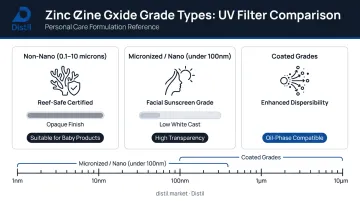
Choose the grade based on your formulation's end claims:
- Non-nano (0.1–10 microns): Preferred for reef-safe certification and baby products; expect a more opaque, visible finish on skin
- Micronized/nano (under 100 nm per EU/FDA definitions): Reduces white cast and improves skin feel; well-suited for facial and tinted sunscreens
- Coated grades (triethoxycaprylylsilane, dimethicone): Improve dispersibility in oil-phase systems and lower particle surface energy for smoother blending
Purity benchmarks differ by application:
- EU Regulation 2016/621: Nano zinc oxide ≥96% purity
- USP monograph: Pharmaceutical-grade zinc oxide ≥99.0% purity
For commercial formulations, always request batch-level documentation — Certificate of Analysis, particle size distribution, and purity assay. Consistent documentation from your supplier removes one of the most common sources of SPF batch variability.
Additional Formulation Prerequisites
| Item | Purpose |
|---|---|
| Emulsion type confirmed (O/W or W/O) | Determines which phase zinc oxide enters |
| Dispersant selected | Polyhydroxystearic acid (PHSA) for oil-phase systems; silicone-treated ZnO for easier blending |
| Precision digital scale | Weight-percentage accuracy — never use volumetric measures |
| High-shear mixer or homogeniser | Breaks up agglomerates during pre-dispersion |
| NIOSH-approved respirator (N95/P95), nitrile gloves, eye protection | Non-negotiable for powder handling |
| In-vitro SPF testing access | Validates actual UV performance before label claims |
Distil supplies zinc oxide UV filters in powder and pre-dispersed formats — nano, non-nano, natural, coated, ultra-fine, and micronized — with grade selection guidance based on your SPF target and finish requirements.
How to Use Zinc Oxide Powder in Sunscreen (Step-by-Step)
The formulation sequence matters. Steps cannot be reordered without compromising either SPF uniformity or emulsion stability.
Pre-Dispersion Preparation
- Weigh accurately — use a calibrated digital scale to measure zinc oxide to the target weight percentage (typically 15–20% of total batch weight). Powder density varies significantly between grades; volume measurements are unreliable.
- Full PPE before opening — respirator, gloves, and eye protection are non-negotiable. Work in a low-airflow environment or under local exhaust ventilation at batch scale. The NIOSH Pocket Guide sets the REL for zinc oxide dust at 5 mg/m³ TWA with a 15 mg/m³ ceiling.
Dispersing the Zinc Oxide Powder
Poor dispersion causes more SPF failures than any other formulation error.
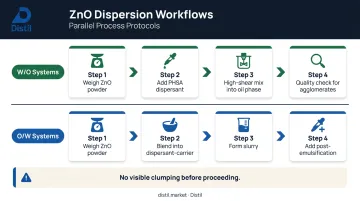
- For W/O systems: pre-disperse zinc oxide into a small portion of the oil phase using a high-shear mixer or three-roll mill. PHSA is a well-documented dispersant for oil-phase systems — Active Concepts' SPF Pigment Dispersion Assay showed PHSA reduced agglomerate area by 65–71% over 30 days compared to undispersed controls.
- For O/W systems: disperse zinc oxide into a compatible dispersant-carrier blend before incorporating as a slurry post-emulsification.
- Quality check: confirm no visible clumping before proceeding. Run particle size distribution measurement when instrumentation is available — this is the most direct way to catch agglomeration before it affects SPF uniformity.
Incorporating into the Formulation Base
- Add the pre-dispersed zinc oxide mixture to the main emulsion after emulsion formation, at below 45°C, to avoid thermal stress on emulsifiers or co-actives.
- Mix with paddle or low-shear homogenisation at this stage. Excessive high-shear post-emulsification can destabilise the system.
- Verify uniform distribution visually — or by refractive opacity check — before proceeding.
Monitoring During Formulation
Watch for these dispersion failure indicators:
- Grittiness or visible white streaks
- Phase separation or uneven opacity
- Unexpected viscosity changes
Zinc oxide can also raise the pH of water-phase systems slightly — track pH throughout and confirm compatibility with any pH-sensitive preservatives or co-actives in the formula.
Completing and Storing the Batch
- Run a bench-level SPF assessment (ISO 24443 in-vitro UVA method, or equivalent) before finalising. Industry technical data shows SPF loss during aging ranges from -2% to -37% depending on dispersant quality — theoretical concentration alone cannot predict real-world performance.
- Fill into UV-protective, airtight containers.
- Store finished batches and unused powder in cool, dry conditions away from direct light.
Dispersant selection and dispersion quality — not zinc oxide concentration — are the variables that most determine whether a finished formula performs to specification at shelf life.
Best Practices for Using Zinc Oxide Powder Effectively
SPF Estimation and Validation
Industry technical sources (UL Prospector/Kobo, Applechem) support a formulation-dependent range of 1.5–2.5 SPF units per 1% zinc oxide by weight as a development screening benchmark. At 20% zinc oxide with a well-dispersed system, this suggests an SPF range of 30–50 before testing.
Treat this as a starting estimate only. For US OTC label claims, 21 CFR 201.327 requires in-vivo SPF testing using at least 10 valid subjects. In-vitro methods (ISO 24443) are used for UVA claims but do not replace in-vivo SPF labeling under FDA rules.
Addressing White Cast
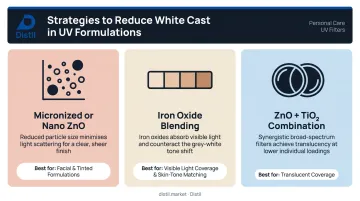
Three practical approaches, matched to product positioning:
- Micronised or nano zinc oxide — for facial and tinted formulations targeting cosmetic elegance
- Iron oxide blending — tinting with skin-tone-matched iron oxides addresses visible light spectrum and white cast simultaneously
- Zinc oxide + titanium dioxide combination — lower total ZnO at a more transparent concentration, supplemented with TiO₂ for coverage and SPF contribution
For baby and reef-safe products, accept the opacity of non-nano and position it as a feature of physical mineral protection.
Water Resistance Claims
Water resistance performance is as much a formulation decision as a zinc oxide grade decision. FDA permits only two claims:
- "Water Resistant (40 minutes)" or "Water Resistant (80 minutes)" — "waterproof" and "sweatproof" are not permitted
- The 80-minute rating requires four 20-minute water immersion periods, with SPF measured after the final soak
- Film formers and waxes in the base have as much influence on water resistance as the zinc oxide grade itself
Stability Testing
Run accelerated stability at 40°C/75% RH for a minimum of 3 months as a proxy per CHPA voluntary guidelines for OTC nonprescription products. Key parameters to track:
- SPF (in-vitro)
- pH
- Viscosity
- Particle agglomeration (visual or instrumental)
The emulsion base degrades faster than zinc oxide itself, so stability monitoring should cover the full system, not just the active ingredient.
Where Zinc Oxide Powder Fits in the Production Workflow
In commercial manufacturing, the placement of zinc oxide depends on emulsion type:
- W/O sunscreens: zinc oxide is typically incorporated during oil-phase preparation, before emulsification
- O/W systems: zinc oxide is added as a pre-dispersed slurry post-emulsification, after the emulsion is formed and cooled
At lab scale, bench-top homogenisation with manual dispersion is standard. At pilot or commercial scale, the same dispersion principle applies but requires industrial high-shear mixers, in-line particle size monitoring, and process documentation to meet GMP requirements for OTC sunscreen products.
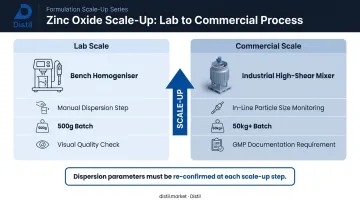
Scaling up doesn't change the underlying chemistry. What changes is the equipment shear profile and the documentation requirements. Dispersion parameters validated at lab scale must be re-confirmed with particle size data at each scale-up step.
Frequently Asked Questions
What percentage of zinc oxide powder is needed to achieve SPF 30?
Approximately 15–20% zinc oxide by total formulation weight is the typical starting range for SPF 30–50, based on an industry benchmark of 1.5–2.5 SPF units per 1% active. Actual SPF depends heavily on dispersion quality and carrier base — in-vitro or in-vivo testing is required before making any label claims.
Does zinc oxide help with hyperpigmentation?
Zinc oxide primarily functions as a UV filter and protectant. It helps prevent UV-induced darkening and stops post-inflammatory hyperpigmentation from worsening with sun exposure, but it is not a depigmenting agent. Targeted actives like niacinamide or kojic acid are needed for active treatment of hyperpigmentation.
Is nano or non-nano zinc oxide better for sunscreen formulation?
Nano zinc oxide reduces white cast and suits facial and tinted sunscreens; non-nano is required for reef-safe certification and is standard in baby products. Both are safe for dermal application, though EU regulations require "[nano]" in the ingredient list when nano materials are present.
How do you prevent white cast when using zinc oxide powder in sunscreen?
Three main approaches: use micronised or nano-grade zinc oxide for inherently better transparency; blend with skin-tone-matched iron oxides to create a tinted formulation; or combine zinc oxide with titanium dioxide at a lower total concentration for a more translucent finish.
Can zinc oxide powder be used in water-based sunscreen formulations?
Yes. Zinc oxide can be incorporated into O/W emulsions, but it requires a compatible dispersant and should be added as a pre-dispersed slurry after emulsification. Surface-treated or silicone-coated grades generally perform better in aqueous systems than untreated powder.
Does zinc oxide powder expire or degrade over time?
Raw zinc oxide powder is chemically stable in sealed, dry storage, but finished formulations are the greater concern — the emulsion base degrades before the zinc oxide itself. SPF can decline measurably in poorly stabilised products, making accelerated stability testing on the finished formulation essential.