Introduction
Regulatory pressure is reshaping sunscreen formulation. The EU's restriction of oxybenzone and the FDA's ongoing scrutiny of chemical filter systemic absorption — combined with rising demand for sensitive-skin-friendly, reef-safe products — have pushed zinc oxide from a niche ingredient to the default starting point for serious mineral UV formulations.
Yet "mineral is better" isn't a formulation strategy. Personal care brands and ingredient buyers need specifics: how zinc oxide's UV mechanism actually works, where it outperforms alternatives, and what formulation decisions determine whether a product delivers on its label claims.
What follows is a technical reference for formulators who need more than marketing claims — covering mechanism, performance benchmarks, skin benefits, and the variables that make or break a finished product.
Key Takeaways
- Zinc oxide is a broad-spectrum mineral UV filter covering both UVA (320–400 nm) and UVB (280–320 nm) through a physical barrier mechanism
- It offers a stronger safety profile than chemical filters — negligible systemic absorption, no hormone-disruption concerns
- Co-benefits include antimicrobial, anti-inflammatory, and wound-healing activity that add formulation value beyond sun protection
- Grade selection (nano vs. non-nano), concentration, and filter combinations each directly affect performance and safety outcomes
- Right grade and formulation choices upfront prevent costly compliance and tolerability failures down the line
What Is Zinc Oxide?
Zinc oxide (ZnO) is an inorganic mineral compound derived from zinc ore and processed into a fine white powder. It has a long history in pharmaceuticals and personal care — and it's one of only two active ingredients the FDA currently recognizes as both safe and effective for OTC sunscreen use (the other being titanium dioxide).
That regulatory status reflects its classification: ZnO sits in the inorganic/mineral category of UV filters. Unlike organic (chemical) UV filters — which absorb UV radiation and convert it to heat through light-triggered chemical reactions — zinc oxide works by physically scattering and reflecting UV at the skin surface.
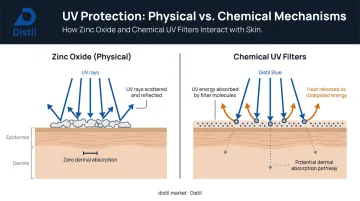
It doesn't need to be absorbed to work. That distinction matters both mechanically and from a safety standpoint, which is why it's a preferred choice for sensitive, baby, and atopic skin formulations.
Where zinc oxide appears in personal care:
- Primary sunscreen products (face and body)
- Daily SPF moisturizers and tinted formulations
- Baby and children's sun protection
- Sport and outdoor high-SPF products
- Sensitive and atopic skin lines
- Acne-prone skin formulations requiring UV protection
That breadth spans six product categories — making ZnO one of the most versatile UV filter ingredients in personal care formulation.
Key Advantages of Zinc Oxide for UV Protection
Broad-Spectrum Coverage from a Single Ingredient
Most UV filters specialize. UVB filters protect against burning; UVA filters address photoaging and immunosuppression. Combining them adds complexity to the formula and introduces compatibility questions.
Zinc oxide covers the full UV spectrum — UVA and UVB — from a single active ingredient. Research published in the Journal of the American Academy of Dermatology demonstrated that zinc-oxide-only formulations can achieve high protection factor against UVA (PFA), outperforming leading all-mineral sunscreen combinations in direct comparison.
For formulators, this matters for several practical reasons:
- Simpler ingredient decks support clean label positioning
- Fewer active ingredients reduce compatibility challenges during formulation development
- Single-filter broad-spectrum coverage enables cleaner regulatory pathways
- Aligns with consumer preference for shorter, recognizable ingredient lists
This advantage is most relevant in high-SPF outdoor and sport formulations, baby and children's sunscreens where minimalism is a design requirement, and products targeting photosensitive skin conditions.
Superior Safety Profile vs. Chemical Filters and Titanium Dioxide
The core safety advantage of zinc oxide comes from its mechanism. Because it works at the skin surface rather than absorbing into it, ZnO doesn't enter the bloodstream at meaningful levels.
Chemical UV filters carry a meaningfully different risk profile. A study published in JAMA found that avobenzone, oxybenzone, octocrylene, and ecamsule were all absorbed systemically after a single day of sunscreen application — at concentrations exceeding the FDA's threshold for requiring additional safety studies. The EU has since imposed restrictions on oxybenzone and homosalate concentrations.
Zinc oxide also compares favorably against titanium dioxide across several formulation-relevant factors:
| Factor | Zinc Oxide | Titanium Dioxide |
|---|---|---|
| UV spectrum coverage | Full UVA + UVB | Primarily UVB |
| Free radical generation (nano) | Lower | Higher under UV |
| Skin absorption risk | Low (especially non-nano) | Low |
| Safety for sensitive skin | Well-established | Generally accepted |
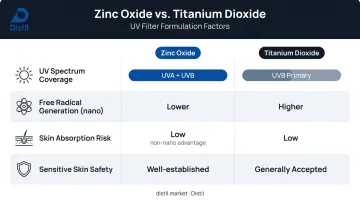
Non-nano zinc oxide grades are particularly well-positioned here — larger particle sizes have significantly lower skin penetration potential, making them the preferred choice for baby care and sensitive skin applications.
For brand owners, this translates directly into formulation decisions: reef-safe certification requirements, pediatric product mandates, and regulatory environments with tightening restrictions on chemical filters all favour zinc oxide as the active of choice.
Immediate, On-Application Efficacy
Chemical UV filters require 15–30 minutes post-application to absorb and activate. Zinc oxide doesn't. As a physical blocker, it starts working the moment it's applied.
This is a practical advantage in two ways:
- Label claims — "Apply 30 minutes before sun exposure" is a standard instruction for chemical sunscreen products. Zinc oxide formulations eliminate this, enabling stronger, simpler on-pack claims.
- Real-world compliance — Sunscreen that works immediately is more likely to be used correctly. Consumer compliance is already a challenge; removing an activation window reduces one more barrier to effective protection.
For daily SPF moisturizers, tinted formulations applied during morning routines, and children's products where pre-application timing is impractical, this distinction directly affects actual protection outcomes.
Beyond UV: Additional Skin Benefits That Add Formulation Value
Zinc oxide brings a set of verified skin health benefits that extend its value well beyond SPF performance. Each is documented and directly relevant to how you position a finished product.
Key co-benefits supported by the evidence include:
- Antimicrobial activity: Inhibits bacterial growth at the skin surface — useful in acne-prone formulations where bacterial colonisation is a primary concern alongside UV protection
- Anti-inflammatory action: Well-documented soothing properties for irritated and reactive skin, with studies supporting reduced redness and inflammatory markers in rosacea, eczema, and post-procedure care
- Wound healing and collagen support: Assessed in human wound-healing models, with evidence for accelerated repair and collagen synthesis support
- Sebum and oil control: Inhibits 5α-reductase, the enzyme that converts testosterone to DHT and overstimulates sebaceous glands — functional for oily and acne-prone formulations that need UV and oil management in one ingredient
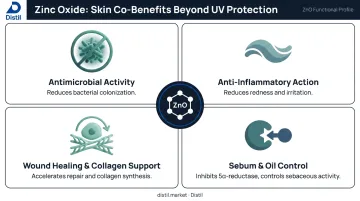
The formulation implication is direct. These co-benefits let brands build combined claims — SPF + anti-acne, SPF + skin repair, SPF + anti-aging — without stacking additional actives. Fewer ingredients, cleaner INCI lists, and a stronger positioning rationale in one mineral UV filter.
Formulation Considerations: Grades, Stability, and Compatibility
Nano vs. Non-Nano: Aesthetics vs. Safety
Nano-grade ZnO (particles under 100nm) applies more transparently and minimises white cast — the primary aesthetic limitation that drove formulators toward chemical filters. Non-nano grades prioritise safety for sensitive populations.
The practical tradeoff:
| Nano | Non-Nano | |
|---|---|---|
| Aesthetics | More transparent, less white cast | Heavier texture, visible on skin |
| Safety profile | Standard use; some penetration concern | Lower penetration potential; preferred for sensitive skin |
| Regulatory | Requires nano labeling under EU Regulation 1223/2009 | Standard cosmetic labeling applies |
| Best for | Daily SPF cosmetics, tinted products | Baby, pediatric, and sensitive skin formulations |
For brands targeting multiple markets, grade classification under EU Regulation 1223/2009 should be determined at the start of development — not retroactively.
Distil supplies zinc oxide in both nano and non-nano grades, available as powders (natural and coated) and pre-dispersed systems. The pre-dispersed formats simplify dispersion in mineral sunscreens, SPF moisturisers, and tinted suncare, and reduce the processing steps required to achieve consistent ZnO distribution in final emulsions.
Concentration, White Cast, and SPF Achievement
Achieving a high SPF with zinc oxide alone requires concentrations typically above 20%. This has historically meant a difficult tradeoff: more protection, heavier white cast, thicker texture.
Emulsion system selection changes that calculus. A formulation approach cited in JAAD research achieved strong UVA protection using 22.6% ZnO in a water-in-silicone emulsion — demonstrating that white cast can be managed at high concentrations when the surrounding system is designed for it.
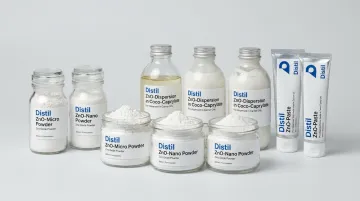
Distil's coated and surface-treated zinc oxide grades are optimised specifically for this — giving formulators the starting material to reconcile SPF targets with aesthetics before the emulsion design work begins.
Compatibility with Organic UV Filters
This is a critical formulation risk that's often underestimated. Research published in PMC from Oregon State University found that zinc oxide particles — both nano and micro grades — caused greater than 80% loss in UVA protection from organic (chemical) UV filters after two hours of UV exposure. The degradation also produced phototoxic byproducts.
The practical implication: a formula that passes initial SPF testing in the lab may fail significantly under real-use UV exposure conditions. This risk is typically discovered late in the development cycle, after stability testing timelines have passed.
For formulators combining ZnO with chemical filters:
- Treat stability under UV exposure as a mandatory testing parameter, not an optional one
- Account for filter degradation when setting initial SPF targets
- Consider zinc-oxide-only systems for applications where safety claims need to be airtight
Reapplication and Photodegradation
Switching to zinc-oxide-only systems reduces compatibility risk — but it doesn't eliminate the need for reapplication protocols. Even all-mineral formulations lose efficacy over time under continuous UV exposure. Standard sunscreen guidance — reapplication every two hours, or after sweating and swimming — applies to mineral formulations too. Product instructions and SPF claims should reflect this to remain defensible under regulatory review.
Distil's personal care team, led by Kiro Rizk (Head of Personal Care) and Dr. Leema Joseph (VP of R&D), works with brands from initial grade selection through validation testing and commercial-scale production. The development pathway is managed through a single point of contact, covering formulation design, stability testing, process optimisation, and scale-up.
What Happens When UV Filter Selection Goes Wrong
Poor UV filter decisions compound. The consequences are predictable and avoidable:
- Wrong grade, concentration, or filter combination produces formulations that fail SPF claims under real-world conditions — triggering regulatory non-compliance and consumer complaints.
- Chemical filters on atopic or sensitive skin cause adverse reactions. For baby-category products, the regulatory exposure alone can end a product line.
- ZnO and organic filter degradation is a documented compatibility risk. A formula that passes initial testing may fail under actual UV exposure — often discovered only after the development cycle has closed.
Each failure mode has a known cause. The right filter specification — grade, particle surface treatment, concentration, and compatibility testing — addresses all three before they reach the development stage.
Frequently Asked Questions
Does zinc oxide have UV protection?
Yes. Zinc oxide is one of the most effective broad-spectrum UV filters available, physically blocking both UVA (320–400 nm) and UVB (280–320 nm) radiation by forming a barrier at the skin surface. The FDA recognizes it as a safe and effective sunscreen active ingredient.
How long does zinc oxide protect from sun?
Zinc oxide works immediately upon application, but efficacy degrades after roughly two hours of UV exposure — a risk confirmed by research from Oregon State University. Reapply every two hours, or sooner after sweating or swimming.
What sunscreen is best for lupus?
Mineral sunscreens containing zinc oxide are generally recommended for photosensitive conditions like lupus, as ZnO doesn't penetrate the skin or trigger systemic reactions. Formulators developing products for this segment should account for individual photosensitivity severity when selecting SPF levels — clinical guidance recommends SPF 50+ for most lupus patients.
Is zinc oxide safe for sensitive skin?
Zinc oxide is well-tolerated by sensitive, atopic, and baby skin. Its physical mechanism avoids the stinging and absorption concerns of chemical filters, and its anti-inflammatory properties can actively calm irritated skin rather than aggravate it.
What is the difference between nano and non-nano zinc oxide?
Nano-grade ZnO (under 100nm) reduces white cast for better cosmetic aesthetics. Non-nano grades are preferred for sensitive and pediatric applications due to lower skin penetration potential. Both require appropriate labeling under EU cosmetic regulations.
Can zinc oxide be combined with other UV filters?
Combinations are used to achieve higher SPF ratings, but the compatibility risk is significant: zinc oxide has been shown to degrade organic UV filters under UV exposure, reducing their efficacy by over 80% and potentially generating phototoxic byproducts. Formulation testing under real-world UV conditions is essential before commercialization.