
Buyers and processors usually struggle with the same four questions. Which PE carrier fits? Will the carbon black disperse properly? Does the grade suit the production process? And does it perform in the intended application? This guide covers composition, carbon black function, PE grades, applications, processing, quality checks and supplier evaluation.
Key Takeaways
- Masterbatch is a concentrate added to base resin, not finished black PE.
- Carbon black gives colour, opacity and UV shielding, but only with good dispersion and the right formulation.
- Match the carrier to your HDPE, LDPE or LLDPE resin and process.
- Buy on data sheets, line trials, compliance documents and batch consistency.
What Is Black PE Masterbatch?
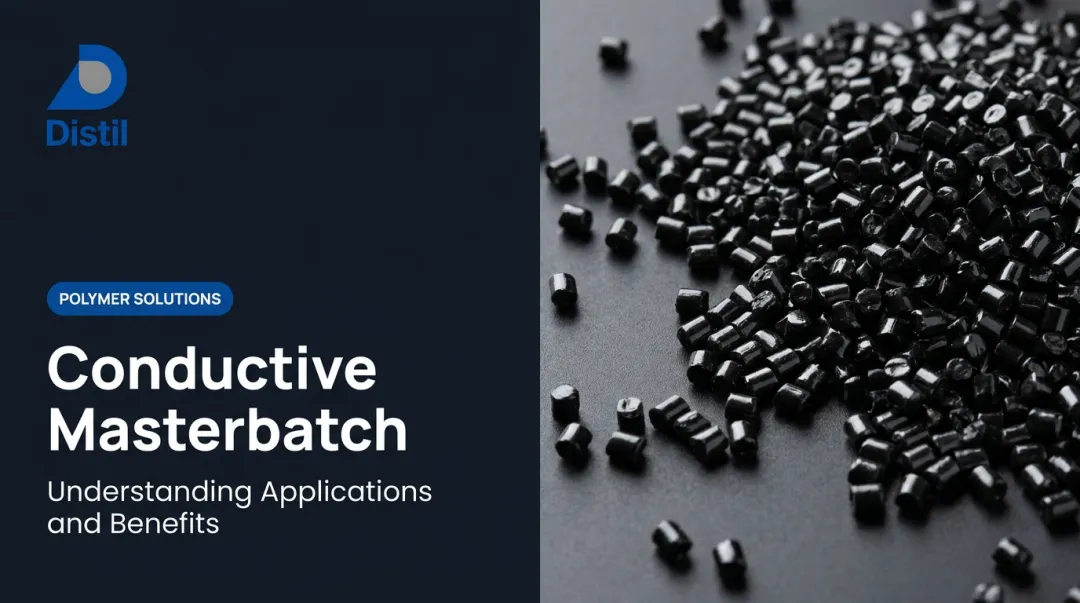
Black PE masterbatch is a concentrated preparation of carbon black dispersed in a compatible polyethylene carrier, with any required additives. You dilute it into a base PE resin during manufacturing, a step called let-down.
Masterbatch is an input. Black PE is what you get after processing: the finished compound or product. Cabot's PE6271 data sheet makes the same contrast between adding masterbatch to natural resin and using a ready compound.
What does it contain?
- Carbon black: pigment and possible UV shielding
- PE carrier resin: compatibility and carrying the pigment into the melt
- Additives: processing aids, stabilisers or application-specific functions
Loading varies by use. Cabot's PE-carrier examples contain 40% or 50% carbon black, but those are product examples, not a universal range. Always rely on the grade's technical data sheet (TDS).
Why does the PE carrier matter?
Carrier choice affects melt flow, dispersion, mechanical performance and processing behaviour. A carrier suited to one PE grade or process may not suit another, especially where film clarity, stiffness, flexibility, sealing or impact strength matter.
Compatibility is product-specific. Cabot's PE1371 uses an LDPE carrier and lists compatibility with LDPE, LLDPE and HDPE. Another grade may not.
What properties can it provide?
- Uniform colour and better appearance
- Opacity
- UV shielding
- Static dissipation or conductivity, only in specially formulated grades
Conductivity, weatherability and food-contact suitability must be confirmed from grade-specific data. Black colour alone proves none of them.
How Black PE Masterbatch Works
Carbon black's role in PE
Carbon black absorbs ultraviolet radiation that would otherwise attack polyethylene chains, causing chalking, embrittlement, fading and loss of strength. Cabot notes that protection depends on particle size, aggregate structure and dispersion.
Concentration, stabiliser package, base resin, product thickness and actual exposure also count.
Dispersion, tint strength and appearance
Well-dispersed carbon black gives uniform shade, opacity and surface finish. Poor dispersion shows up as:
- Streaks and specks
- Weak spots in the product
- Inconsistent colour
- Melt filter blockage and pressure rise
- Unstable extrusion
Carbon black selection variables
Particle size, structure, surface chemistry and loading influence jetness, tint strength, UV performance, conductivity, viscosity and dispersion. Smaller particles give higher jetness and tint strength but are harder to disperse.

So don't pick the darkest sample on the table. Use supplier test data and application trials to balance colour strength against processing behaviour.
Let-down and processing
The right let-down ratio depends on masterbatch concentration, target colour, carbon black system, base resin, processing technology and end-use needs. Follow the TDS, control weighing and mixing, and validate the ratio in production-representative trials.
One caution on numbers. ISO 4427-1:2019 specifies 2.0-2.5% carbon black by mass in black pipe compound. That is a finished-compound requirement, not a masterbatch dosage.
Black does not always mean UV resistant
A black product can weather badly if the carbon black is poorly dispersed, the formulation was not built for outdoor use, or the resin and stabiliser package are unsuitable. For outdoor, agricultural, pipe, cable or long-life applications, ask for UV or weathering test data.
Types and Applications of Black PE Masterbatch
Matching grades to HDPE, LDPE and LLDPE
LyondellBasell's film guide gives these density ranges:
| PE family | Density (g/cm³) | Typical character |
|---|---|---|
| LDPE | 0.916-0.925 | Flexible, tough, easy to process |
| LLDPE | 0.900-0.939 | Overlaps other families |
| HDPE | 0.941-0.965 | Stiffer, fewer side branches |
Density and melt flow are separate properties. ExxonMobil lists an LLDPE and an HDPE grade with the same melt index of 20 g/10 min. Choose by your actual base resin and process, not the product name.
Film, packaging and agriculture
Black masterbatch is used in:
- Films and liners
- Refuse bags and pallet covers
- Mulch films and protective sheeting
Cabot links mulch-film opacity to weed suppression, and opacity to concealing contents in refuse sacks.
For food, drinking water or pharma contact, check compliance. FSSAI's packaging compendium lists IS 10146 for PE and requires colourants to conform to IS 9833. Overall migration is capped at 60 mg/kg or 10 mg/dm².

Under India's Plastic Waste Management Rules, carry bags and packaging must be natural shade or use IS 9833-conforming colourants. That is not a ban on black PE.
Injection and blow moulded products
Containers, crates, closures, tanks and industrial parts need shade consistency, surface finish and impact behaviour. Trial the masterbatch at your real moulding temperature, shear, residence time and mould design.
Pipes, wire and cable, infrastructure
Pipes, conduits, cable jackets and outdoor infrastructure bring long-term weathering, durability and electrical needs. Ordinary black colouring is not the same as a formulation tested for pressure service, electrical performance or prolonged outdoor exposure.
Relevant Indian standards include:
- IS 4984:2016 (water pipes): carbon black content and dispersion
- IS 14333:2022 (sewerage and chemical pipes): carbon black content and dispersion
- IS 7098 Part 2 (3.3-33 kV cables): carbon black content on black PE outer sheaths
Recycled PE
Black masterbatch can give a consistent look to recycled or mixed-colour feedstock. Cabot describes its LL4943 as particularly suitable for pigmenting recycled materials. It does not fix contamination, odour, melt flow or mechanical variation.
Check compatibility, contamination control and traceability. Also confirm end-use rules: India's 31 March 2026 amendment sets recycled-content targets for some packaging categories, and these do not authorise recycled PE for food contact.
How to Select and Use Black PE Masterbatch
Build a specification before requesting samples
Define:
- Base resin and processing method
- Target shade and opacity
- Indoor or outdoor exposure
- Product thickness and mechanical needs
- Recycled content
- Regulatory needs: food contact, potable water, agriculture, electrical use, pipe standards, packaging rules, BIS/ISI marks
Validate with documents and trials
Ask for:
- TDS (and the specification separately; Cabot labels TDS values as typical, not specifications)
- Safety data sheet
- Certificate of analysis
- Tint data and dispersion information
- Processing guidance
- Weathering or regulatory reports
Then trial on your line or a representative pilot setup. Check:
- Colour and dispersion
- Melt pressure
- Surface quality
- Mechanical properties
- Process stability

Dispersion can be checked with the filter pressure value test (ISO 23900-5), where retained agglomerates raise filter pressure.
Control variables after approval
- Weigh and mix consistently
- Store dry and control moisture
- Hold temperature, shear and residence time steady
- Keep batch traceability
- Test incoming batches and retain reference samples
Retained samples let you trace shade drift, contamination or processing changes quickly.
How to Evaluate a Black PE Masterbatch Supplier
Quality systems and consistency
Ask how the supplier controls:
- Raw materials and carbon black dispersion
- Carrier compatibility and colour
- Contamination, testing and batch release
- Traceability Some suppliers, such as Ampacet, report dispersion ratings on the certificate of analysis for every lot. Compare repeatability and documented performance, not just a low quote or one good sample.
Technical support and scale-up
A good partner supports:
- Application-specific formulation and trial planning
- Troubleshooting and scale-up
- Documentation and supply coordination
Distil is one platform buyers can assess on these points when sourcing black PE masterbatch:
- R&D-led, application-specific tuning and trials run by a dedicated team
- A 20-member team with 45+ years of combined experience from Dow, BASF, Huntsman and Reliance
- A single point of contact from lab to commercial scale, with visibility into batch yields
- Asset-light manufacturing through partners, scaling without capex
- A unified quality system aimed at eliminating process drift
- Real-time visibility across production and the supply chain
Confirm the specific grade and its documentation directly with Distil.
Commercial and compliance questions
Ask about:
- Minimum order quantities and packaging
- Lead times and delivery to your Indian plant
- Change-control procedures and technical contacts
- Confidentiality
- Recycled content and compliance documents
Get a written specification naming the agreed grade, target performance, test methods and the conditions under which future batches will be accepted.
Frequently Asked Questions
What is black PE?
Black PE is polyethylene coloured with carbon black or another black pigment, usually with better opacity and possible UV protection. It is the finished material, not the masterbatch used to make it.
Is black HDPE UV resistant?
Carbon-black HDPE generally has better UV protection. The result depends on carbon black quality, dispersion, formulation, stabilisation, product design and verified weathering data.
Is polyethylene a plastic or rubber?
It is a thermoplastic. Some flexible grades feel rubber-like, but they soften and process as thermoplastics rather than behaving like conventional rubber.
What is the difference between black PE and black PE masterbatch?
Black PE is the finished polyethylene. Masterbatch is the concentrated pellet added to natural PE during production to make it.
How do I choose black PE masterbatch for my application?
Match the carrier to your base resin and process. Then verify colour, dispersion, UV or other performance, regulatory suitability, documentation and trial results.