The stakes are real. According to the Skin Cancer Foundation, approximately 86% of melanomas are attributed to UV radiation exposure. And for outdoor athletes specifically, research links beach and water-sport activities to increased basal cell carcinoma risk, while skiing correlates with higher squamous cell carcinoma incidence.
Choosing the right outdoor sunscreen isn't about finding the highest SPF on the shelf. It's about matching chemistry to conditions.
Key Takeaways
- Choose SPF 50+ broad-spectrum (UVA + UVB) for any extended outdoor activity
- Only use sunscreens rated water-resistant for 80 minutes — "waterproof" isn't a permitted label term
- Mineral filters (zinc oxide, titanium dioxide) work immediately and are reef-safe; chemical filters are lighter but need 20–30 min to activate
- Apply 15–30 minutes before exposure, reapply every two hours or immediately after swimming or heavy sweating
- Format matters: sticks for face reapplication mid-activity, sprays for large-area coverage, lotions for base application
What Makes Outdoor Sunscreen Different From Daily SPF?
Standard daily-wear sunscreens are designed for low-intensity, incidental exposure — a commute, a lunch break. Outdoor sport is a different environment entirely.
UV intensity compounds at altitude and on reflective surfaces
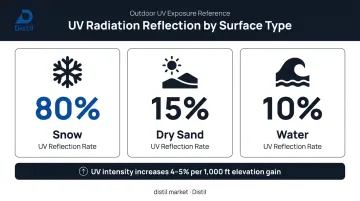
UV levels increase 4–5% for every 1,000 feet of elevation gain, according to the Skin Cancer Foundation. Add reflective surfaces and the exposure multiplies further:
- Snow reflects up to 80% of UV radiation
- Dry sand reflects approximately 15%
- Water reflects around 10% — while also exposing submerged skin from below
A skier at 10,000 feet on a clear day faces UV intensity that can run two to three times higher than at sea level — before reflective snow is factored in.
Sweat, heat, and movement degrade protection faster
That elevated UV load arrives at exactly the moment the product is under the most physical stress. Heat opens pores and raises skin surface temperature, altering how the sunscreen film bonds to the skin.
Sweat then physically dilutes and displaces the product — particularly from high-contact areas like the forehead, nose, and shoulders. A standard daily SPF applied before a two-hour trail run may offer a fraction of its labelled protection by the end of the first hour.
Extended duration demands sustained efficacy
Most outdoor activities — hiking, surfing, a long ride — run well past two hours of continuous sun exposure. Daily-wear formulas weren't built for that window. Water resistance, film integrity under friction, and reapplication-friendly formats all matter in ways they don't for routine use.
What to Consider When Choosing Sunscreen for Outdoor Activities
The right outdoor sunscreen aligns SPF level, filter chemistry, water resistance, and texture with the actual conditions of the activity. Here's how to evaluate each factor.
SPF Level
The AAD recommends a minimum of SPF 30 for any outdoor use, with SPF 50 preferred for extended exposure or high-altitude environments.
The difference in UVB filtration is modest — SPF 30 blocks 97% of UVB rays, SPF 50 blocks 98% — but that gap matters under active conditions. When athletes sweat heavily, apply too little, or miss spots, the effective SPF drops significantly from the labeled value. SPF 50 provides a meaningful safety buffer when product coverage is uneven, which is standard during high-exertion activity.
Broad-Spectrum Coverage
UVB rays cause sunburn. UVA rays penetrate more deeply, driving premature skin ageing and contributing to skin cancer risk over time. For outdoor athletes logging hours in the sun, cumulative UVA damage is a genuine concern — not just acute burn.
"Broad-spectrum" on the label is a regulated claim indicating protection against both UVA and UVB. For any outdoor activity, a product without this designation leaves UVA exposure unaddressed.
Water and Sweat Resistance Rating
The FDA recognises two standardised water-resistance classifications:
| Rating | Suitable For |
|---|---|
| Water Resistant (40 minutes) | Light activity, minimal sweating |
| Water Resistant (80 minutes) | Swimming, high-exertion sport, prolonged sweat |
For active outdoor use, 80-minute resistance is the minimum acceptable threshold. Notably, "waterproof" is not a permitted label term under FDA rules — any product making that claim is mislabelled.
Even 80-minute-rated formulas must be reapplied after swimming, towel drying, or heavy sweating — friction and absorption physically strip the protective film before any chemical breakdown occurs.
Mineral vs. Chemical UV Filters
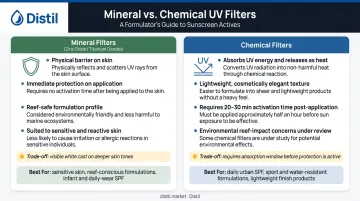
Mineral filters (zinc oxide, titanium dioxide):
- Act as a physical barrier on the skin surface
- Provide immediate protection upon application — no wait time
- Generally reef-safe; preferred for ocean and water sport use
- Suit sensitive skin and active skin types
- Trade-off: thicker texture, potential white cast (minimised in modern micronised or surface-treated formulations)
Chemical (organic) UV filters:
- Absorb UV radiation and convert it to heat
- Lighter, more cosmetically elegant textures that blend easily
- Require 20–30 minutes before protection is fully active
- Some filters — oxybenzone, octinoxate — face environmental scrutiny; Hawaii banned their sale without prescription from January 2021 due to coral reef impacts
- "Reef-friendly" is not an FDA-regulated label term; check the active ingredient list directly
Formulation Format and Texture
Format affects whether a sunscreen actually gets used consistently — which matters more than any SPF number.
- Lotions/creams: Best for full-body base application; thorough coverage
- Sticks: Precision application on face, ears, nose; no-drip, easy mid-activity reapplication without contaminating hands
- Sprays: Fast large-area reapplication; less precise coverage, requires rubbing in
For athletic use specifically, look for non-greasy, fast-absorbing textures that won't migrate into the eyes during exertion or feel heavy under helmets and headgear.
Best Sunscreen by Outdoor Activity Type
Hiking and Mountain Sports
UV intensity rises with every gain in elevation, compounded by rock and snow reflection. At altitude, sunscreen requirements tighten considerably:
- SPF 50+ mineral or hybrid formula — the UV environment at high elevation doesn't leave margin for error
- 80-minute water resistance — essential for multi-hour ascents where continuous sweating is expected
- Stick format preferred for face reapplication while moving on trail or mid-climb
- Don't forget the lips — SPF lip balm is consistently overlooked in mountain environments and lips burn easily
Swimming and Water Sports
Water reflects UV back at the skin while the body is partially submerged — a double-exposure problem that compounds quickly over a session.
- Apply 15 minutes before entering the water to allow bonding with skin
- Mineral-based, 80-minute water-resistant formula is the standard recommendation for reef environments
- Reapply every time you exit the water and towel-dry — regardless of elapsed time or SPF number
- For ocean swimming and diving, check active ingredients: oxybenzone and octinoxate face restrictions in Hawaii and were targeted by Key West ordinance. NOAA confirms both chemicals can cause coral bleaching and structural reef damage.
Field Sports and Running
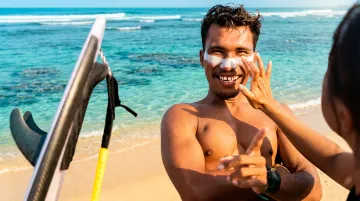
Running, cycling, tennis, and football share the same core demand: a formula that stays off the eyes and absorbs fast. It also can't feel tacky or heavy during sustained effort.
- Lightweight chemical or hybrid formulas tend to outperform pure mineral options for wearability during high-exertion field sport
- Apply a non-greasy lotion base before activity; carry a stick for face touch-ups at half-time or rest stops
- UV index peaks midday — for sessions between 10 a.m. and 4 p.m., SPF 50 is the right starting point
Casual and Everyday Active Exposure
Not all outdoor UV exposure comes from planned sport. Gardening, commuting, outdoor dining — cumulative exposure adds up. According to the AAD, up to 80% of UV radiation penetrates cloud cover, making overcast days genuinely hazardous for unprotected skin.
For daily active use, an SPF 50 broad-spectrum formula with a lightweight, moisturizing finish encourages consistent compliance. A formula that fits seamlessly into your daily routine is far more effective than a higher-SPF product that gets skipped.
How to Apply and Reapply Sunscreen for Maximum Protection
Getting sunscreen right is as much about application discipline as product selection.
Application basics
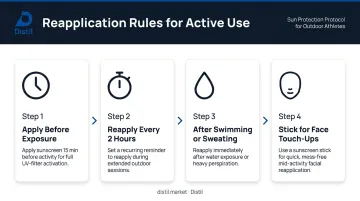
- Apply at least 15 minutes before sun exposure — this is the FDA-recommended minimum for protection to be active
- Use approximately 1 ounce (a shot-glass volume) to cover the full body; use at least 1 teaspoon for the face alone
- The AAD reports most people apply only 20–50% of the required amount, which can reduce effective SPF to roughly one-third of the label value
Commonly missed areas:
- Ears and back of the neck
- Tops of feet
- Scalp and hairline
- Lips
Reapplication strategy
- Every two hours minimum during outdoor activity
- Immediately after swimming, heavy sweating, or towel drying
- For ultra-endurance sessions, set a timer — don't rely on memory
- Use a stick for quick face touch-ups mid-activity; it's faster and doesn't require washing your hands first
Layer with complementary protection
Sunscreen alone carries the full burden when it's the only line of defence. Reduce that burden with:
- UPF-rated clothing for arms, shoulders, and torso
- Wide-brim hats protecting face, neck, and ears
- UV-blocking sunglasses — eye protection is frequently overlooked
- Avoiding peak UV intensity hours (10 a.m. to 4 p.m.) when the index is highest
Combine these layers consistently and sunscreen becomes part of a system — not a last-minute afterthought.
How Distil Can Help
For personal care brands developing or reformulating high-performance outdoor sunscreens, performance depends on the right combination of specialty ingredients: UV filters, emulsifiers, cosmetic esters, and film formers.
Distil's personal care team, led by Vice President of R&D Dr. Leema Joseph and Head of Personal Care Kiro Rizk, brings formulation expertise from backgrounds at Dow, BASF, L'Oréal, and Huntsman.
Distil supplies both zinc oxide powders (natural and surface-coated mineral UV filters engineered for reduced white cast and strong SPF performance) and pre-dispersed zinc oxide systems that simplify the formulation process and improve batch-to-batch consistency. Consistent particle performance is critical for water-resistant and sweat-resistant SPF products.
For sensory performance, high-purity cosmetic esters including coco-caprylate/caprate and neopentyl glycol diheptanoate deliver the fast-absorbing, dry-touch finish that sport sunscreen users demand.
Distil partners with personal care brands from early R&D through to commercial-scale production — managing ingredient sourcing, trial formulations, and supply chain execution with no capex required from the brand.

Key capabilities for outdoor/sport sunscreen development:
- Formulates to application-specific UV filter selection and sensory profile requirements
- Engineered zinc oxide across nano and non-nano domains for tailored SPF performance
- Scalable production through a vetted network of 20+ partner facilities — no capex needed
- Manages end-to-end supply chain from lab trials to commercial delivery
- Full IP protection: the brand retains all formulation data and ownership
- Single point of contact from development through scale-up
- Team of 20 specialists with 45+ years of combined experience across personal care chemistry
Conclusion
Choosing the right outdoor sunscreen is a performance decision. SPF level, filter chemistry, water resistance rating, and formulation texture must all align with real field conditions — not just what looks good on a product label.
The key selection criteria, in brief:
- SPF and broad-spectrum rating matched to UV intensity and exposure duration
- Filter chemistry (mineral, chemical, or hybrid) chosen for activity type and skin compatibility
- Water resistance rating validated against sweat and submersion conditions
- Formulation texture suited to application method and environment (face, body, high-motion use)
Sun protection is also a continuous commitment. Even the most technically advanced formulation delivers nothing without consistent reapplication, adequate quantity, and the right format for the conditions.
For brands and formulators, revisiting sunscreen systems periodically makes practical sense. UV filter science continues to advance — next-generation coated mineral filters and hybrid UV systems are steadily closing the performance gap between chemical and mineral formulations in both texture and skin elegance.
Frequently Asked Questions
Which sunscreen is best for outdoor use?
Look for SPF 50+, broad-spectrum coverage, and an 80-minute water resistance rating — these are the three non-negotiables for any active outdoor use. Mineral-based options with zinc oxide suit sensitive skin and reef environments, while lightweight hybrid formulas often perform better for high-exertion sport where wearability matters.
What is the difference between mineral and chemical sunscreen for outdoor activities?
Mineral sunscreens (zinc oxide, titanium dioxide) form a physical barrier on the skin surface, work immediately, and are reef-safe. Chemical sunscreens absorb UV rays and convert them to heat, but need 20–30 minutes before protection activates. For water and sweat conditions, mineral or hybrid formulas are the more reliable choice.
How often should I reapply sunscreen during outdoor activities?
Reapply every two hours during outdoor activity, and immediately after swimming, sweating heavily, or towel drying. Higher SPF does not extend the reapplication window — consistency of reapplication matters more than SPF number alone.
Can sunscreen reduce hyperpigmentation?
Sunscreen doesn't treat existing hyperpigmentation directly, but it prevents UV-triggered melanin production from darkening existing spots and stops new sun-induced pigmentation from forming. Daily broad-spectrum use — even on cloudy days — is what makes the difference over time.
Is SPF 30 enough when using tretinoin?
Tretinoin increases skin photosensitivity, making SPF 30 the absolute minimum — but SPF 50 is the better choice, especially outdoors. Users on tretinoin should prioritize mineral sunscreens to reduce irritation risk, as some chemical filters may aggravate already-sensitised skin.