Introduction
According to the IARC, approximately 267,000 of the 332,000 global cutaneous melanoma cases recorded in 2022 were attributable to UV radiation — that's over 80% of cases linked to a single, largely preventable exposure. The Skin Cancer Foundation estimates that around 90% of nonmelanoma skin cancers share the same cause.
Yet most people reach for sunscreen only when the sky is visibly sunny, and pack away their UV precautions the moment summer ends. A 2024 AAD survey found nearly one in five adults did not know sunburn can happen in winter. That gap between perceived risk and actual exposure is where most UV damage accumulates.
UV radiation is a year-round, all-weather hazard — one that affects both skin and eyes regardless of season. Effective protection requires a layered, daily strategy, not just a single product. This guide covers:
- How UV radiation works and what it does to your body
- How to protect yourself across different environments
- How sunscreen ingredients function
- The errors that erode protection even when you think you're covered
Key Takeaways
- UVA (315–400 nm) and UVB (280–315 nm) cause different types of damage — both require simultaneous protection.
- A complete UV defense combines SPF 30+ broad-spectrum sunscreen, UV-blocking sunglasses, UPF-rated clothing, and shade.
- UV exposure remains significant on cloudy days, in winter, at altitude, and indoors near tanning beds.
- UV damage is cumulative; consistent daily habits protect far more effectively than occasional precautions.
Understanding UV Radiation: UVA, UVB, and What They Do to Your Body
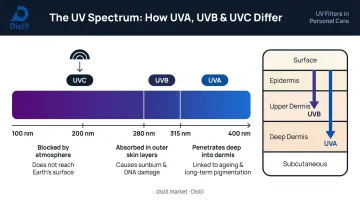
Ultraviolet radiation is electromagnetic energy with wavelengths shorter than visible light. The sun is the primary source, but artificial sources — welding arcs, tanning beds, UV curing lamps — also emit significant UV. The spectrum divides into three bands: UVC (100–280 nm), UVB (280–315 nm), and UVA (315–400 nm).
UVC is almost entirely absorbed by the atmosphere before reaching ground level. UVA and UVB both reach the skin and eyes, but behave very differently.
What UVA Does
UVA makes up roughly 95% of the UV radiation reaching Earth's surface. It penetrates deeper into skin than UVB, damaging collagen and elastin — the structural proteins responsible for skin firmness. This drives premature aging and contributes to photocarcinogenesis over time.
UVA intensity stays relatively constant throughout the day and across seasons compared to UVB, meaning afternoon clouds or winter months offer less protection than most people assume.
It also penetrates to the eye's lens and retina, contributing to long-term cataract risk.
What UVB Does
UVB is absorbed in the outer skin layers. It's the primary cause of sunburn and induces direct DNA damage — specifically cyclobutane pyrimidine dimers (CPDs), which account for over 80% of UVB-induced mutations in mammalian cells.
UVB is strongest between 10 am and 4 pm and peaks in summer, at altitude, and near the equator. Its link to basal cell and squamous cell carcinoma is well-established through this direct DNA damage mechanism.
Acute and Chronic Effects
Acute overexposure:
- Photokeratitis — a "sunburn of the eye" — causes eye pain, redness, tearing, light sensitivity, and a gritty sensation; symptoms typically resolve within 48 hours
- Skin erythema (sunburn)
- Flash burns from arc welding or UV sterilization equipment
Chronic cumulative exposure:
- Melanoma, squamous cell carcinoma, accelerated photoaging
- Cataracts, pterygium, and eyelid malignancies
- Macular degeneration risk (evidence is still developing)
The threshold for cumulative damage is not precisely defined. For formulators, this is the case for broad-spectrum coverage: protecting against both UVA and UVB from the first application, not just SPF-rated UVB attenuation.
UV Safety Precautions for Skin, Eyes, and Daily Exposure
No single measure covers the full UV spectrum across all body surfaces. The standard approach combines shade, protective clothing, sunscreen, and UV-blocking eyewear — each addressing gaps the others leave.
General Skin Protection
The CDC's protection hierarchy starts with shade, then clothing, then sunscreen. In practice:
- Seek shade between 10 am and 4 pm when UVB intensity peaks
- Wear UPF-rated clothing — long sleeves, wide-brimmed hats, and tightly woven fabrics rated UPF 30 or higher
- Apply broad-spectrum SPF 30+ sunscreen to all exposed skin, including ears, neck, and lips
- Reapply every two hours, or immediately after swimming or heavy sweating
UPF (Ultraviolet Protection Factor) measures how much UVA and UVB a fabric allows through. A UPF 50 garment blocks 98% of UV radiation. Fabric construction determines the actual protection level:
- Dark or bright colors absorb more UV than pale shades
- Dense, tight weaves outperform loose constructions
- Polyester and nylon provide better baseline UV resistance than untreated cotton
- A white T-shirt has an estimated UPF of only around 7 — and when wet, that can drop to approximately 3
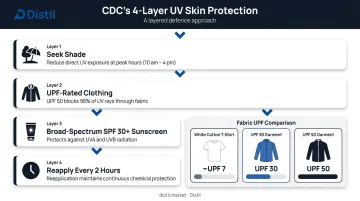
Wet or stretched fabric can substantially reduce a garment's rated protection, so swimwear and athletic gear warrant extra attention.
FDA SPF testing uses 2 mg/cm² of product. Studies show the average person applies closer to 0.5 mg/cm² — roughly one-quarter of the test dose — which means real-world SPF can drop to one-quarter of the labeled value. For full-body coverage, adults need approximately one ounce (about a shot glass) of sunscreen; the face alone requires at least one teaspoon.
For infants under six months, shade and protective clothing are the primary recommendation. Sunscreen can be applied to small exposed areas when shade is unavailable, and pediatrician guidance should be followed.
Eye Protection
UV damage to the eyes is real and cumulative. Long-term unprotected exposure increases the risk of cataracts, pterygium, and eyelid malignancies.
When choosing sunglasses:
- Look for "UV 400," "UV absorption up to 400 nm," or "Meets ANSI UV Requirements" — these indicate 99–100% UVA and UVB blockage
- Lens tint or darkness does not indicate UV protection — dark lenses without a UV-blocking coating can actually increase damage by causing the pupil to dilate while admitting UV
- Large-frame or wraparound designs reduce UV entering from the sides
- Polycarbonate or Trivex lenses offer the highest impact resistance for sports or outdoor work
FDA regulates nonprescription sunglasses as Class I medical devices. ISO 12312-1:2022 specifies the applicable transmittance standards.
Workplace and Indoor UV Risks
UV hazards don't stop at the building entrance.
Key occupational sources:
- Welding arcs — UV flash can cause photokeratitis within seconds; OSHA requires filter lenses at appropriate shade numbers (for example, shade 8 for 60–160A shielded metal arc welding)
- Tanning beds — classified by IARC as Group 1 carcinogens; some devices expose users to 4–13 times the UVA intensity of midday summer sun in Washington, DC
- UV curing lamps, nail salon UV dryers, and UV sterilization equipment
Workers with regular artificial UV exposure should wear wavelength-appropriate protective eyewear, and employers should assess occupational UV risk as part of routine health evaluation.
Environmental Factors That Amplify UV Exposure
UV intensity is not fixed — location, season, altitude, and surface reflections can push exposure far beyond what most people expect.
Altitude and Latitude
UV levels increase approximately 10% for every 1,000 metres of altitude. Skiers, climbers, and high-altitude workers face significantly higher exposure even on overcast days. Equatorial regions receive more direct overhead UV year-round, while temperate zones see strong seasonal variation in UVB — though UVA remains relatively persistent throughout.
Surface Reflections
Proximity to reflective surfaces effectively multiplies UV dose, even in shade:
| Surface | Approximate UV Reflection |
|---|---|
| Fresh snow | Up to 80% |
| Sea foam | ~25% |
| Sand | ~15% |
| Water | Generally less than 10% |
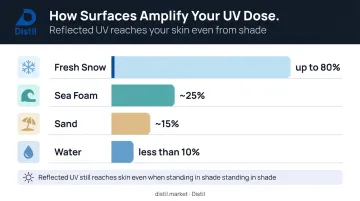
Snow reflection explains why skiers often sustain serious sunburn at UV index levels that wouldn't register as alarming in a summer urban setting.
The Cloud Cover Misconception
According to the Skin Cancer Foundation, up to 80% of UV radiation can penetrate cloud cover. Light and thin clouds can even enhance UV by scattering it. The WHO/WMO Global Solar UV Index is the practical tool for daily risk planning, relevant year-round — not only in summer. A UV Index of 3 or higher warrants protection measures regardless of how the sky looks.
How UV Protection Ingredients Work in Sunscreen Formulations
Sunscreen active ingredients fall into two categories: mineral (inorganic) filters and chemical (organic) absorbers. Effective broad-spectrum sunscreens typically rely on ingredients that together cover the full UVA and UVB spectrum.
Mineral vs. Chemical UV Filters
A common misconception is that mineral filters "physically block" UV while chemical filters absorb it. The reality is more nuanced:
- Mineral filters (primarily zinc oxide and titanium dioxide) absorb approximately 85–95% of the UV they attenuate, with the remainder reflected or scattered — they are not purely physical blockers
- Chemical filters (avobenzone, oxybenzone, octinoxate, and others) absorb UV energy and release it as heat through molecular excitation
Coverage differences matter:
| Filter | Primary Coverage |
|---|---|
| Zinc oxide | Broad-spectrum: UVA1, UVA2, and UVB |
| Titanium dioxide | Mainly UVB and UVA2; limited UVA1 coverage |
| Avobenzone | Strong UVA1; photounstable without stabilizer |
| Oxybenzone | UVB and UVA2 |
| Octinoxate | Potent UVB |
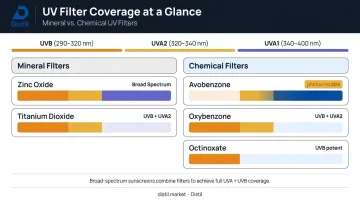
Zinc oxide's broad-spectrum performance makes it particularly valuable as a standalone mineral filter, since titanium dioxide alone leaves UVA1 coverage incomplete.
Formulation Challenges
Three technical problems define the difficulty of sunscreen formulation:
- Photostability — avobenzone can lose 50–90% of its efficacy after one hour of UV exposure through keto-enol tautomerism; stabilizers such as octocrylene, bemotrizinol, and antioxidants like vitamin E are used to address this
- Cosmetic elegance — zinc oxide and titanium dioxide create a white cast at standard concentrations; particle size reduction (micronization, ultra-fine grades) and surface treatment are the primary tools for improving transparency
- Skin compatibility — achieving required filter concentrations without irritation, particularly in sensitive or pediatric formulations
Advances in particle engineering, encapsulation technologies, and UV filter blending strategies have improved how modern mineral sunscreens look and feel on skin. These same formulation challenges are central to what Distil's personal care R&D team works on. Drawing on experience from L'Oréal, BASF, and Huntsman, the team develops zinc oxide UV filters optimized for transparency and SPF performance, in both coated powders and pre-dispersed systems for personal care brands.
What "Broad Spectrum" Actually Means
The SPF number measures only UVB protection. Under FDA standards, a "broad-spectrum" label requires demonstrated UVA protection through a mean critical wavelength of ≥370 nm. The EU Commission Recommendation 2006/647/EC requires UVA protection of at least one-third of the labeled SPF value, with minimum critical wavelength of 370 nm. SPF alone does not confirm UVA protection — the broad-spectrum label is the indicator to look for.
Common UV Safety Mistakes to Avoid
The most common UV protection gaps aren't product failures — they're application habits that quietly undercut even well-formulated sunscreens and protective gear.
Applying Too Little Sunscreen
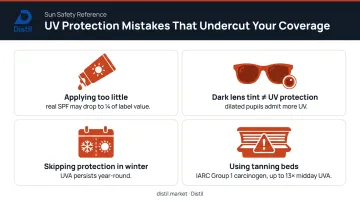
FDA SPF testing is conducted at 2 mg/cm². Studies consistently find average real-world application at approximately 0.5 mg/cm² — meaning users often get roughly one-quarter of the labeled SPF in practice. Using less sunscreen is the single biggest gap between tested and real-world performance.
Assuming Water Resistance Means Waterproof
FDA water-resistance claims only indicate that tested SPF holds for either 40 or 80 minutes of immersion. After that period — or after toweling off — reapplication is required, regardless of labeling.
Broader Habits That Undermine UV Protection
Sunscreen application errors are only part of the picture. These behavioural patterns account for a large share of real-world UV exposure that protection products alone cannot offset:
- Trusting everyday clothing for UV coverage — most untreated garments carry a UPF of 5–8; wet fabric can drop lower still
- Equating dark lens tint with UV protection — tint affects visible light only, not UV transmission; a UV-blocking coating is what matters
- Treating UV protection as seasonal — UVA persists year-round; winter walks, skiing, and driving all involve real UV exposure
- Using tanning beds as a "controlled" alternative — tanning devices are IARC Group 1 carcinogens. People who begin using tanning beds before age 30 face a 75% higher risk of melanoma, and some devices deliver 4–13 times the UVA of midday summer sun
Conclusion
UV protection is a set of daily habits, not a single product purchase. Shade, UPF-rated clothing, correctly applied and reapplied broad-spectrum sunscreen, and UV-blocking eyewear each address different parts of the exposure problem — and none performs well without the others working alongside it.
The chemistry inside these products determines whether they actually protect. Photostable formulations, precise particle engineering in mineral filters, and verified broad-spectrum coverage are not marketing details: they are the difference between rated performance and what protection a person actually receives.
For personal care brands and formulators developing UV protection products, ingredient integrity is as foundational as any consumer behavior. Coated zinc oxide grades, particle size distribution, and dispersion stability all affect real-world SPF and UVA performance — which is why the starting quality of UV filter ingredients matters at every stage, from lab formulation through to commercial-scale production.
Frequently Asked Questions
What is UV protection for?
UV protection shields skin and eyes from the harmful effects of ultraviolet radiation by blocking, absorbing, or reflecting UV rays before they cause cellular damage. Harms include sunburn, premature aging, cataracts, and skin cancer — with both UVA and UVB contributing across the full spectrum.
Does UV 400 mean 100% UV protection?
"UV 400" on sunglasses indicates the lenses block UV wavelengths up to 400 nm, covering the full UVA and UVB spectrum — equivalent to 99–100% UV blockage. It refers only to UV radiation, not glare reduction or visible light filtering, and says nothing about lens tint or darkness.
Is UV protection necessary for your eyes?
Yes. The eyes are vulnerable to cumulative UV damage, and unprotected long-term exposure increases the risk of cataracts, pterygium, and eyelid malignancies. UV-protective sunglasses are recommended whenever outdoors, regardless of season, cloud cover, or ambient temperature.
Can UV rays damage your skin on a cloudy day?
Yes — up to 80% of UV radiation can penetrate cloud cover, meaning skin can burn and accumulate UV damage on fully overcast days. Sun protection measures should be applied based on the UV Index, not on how bright or warm it feels outside.
What is the difference between UVA and UVB rays?
UVA penetrates deeper into skin, drives premature aging, and damages the eye's lens; it remains relatively consistent throughout daylight hours year-round. UVB is absorbed in the outer skin layers, causes sunburn, and induces direct DNA damage linked to most skin cancers.
How do I know if a sunscreen provides broad-spectrum UV protection?
Look for the words "broad spectrum" on the label — this indicates the product has passed standardized testing confirming UVA and UVB protection. The SPF number alone reflects only UVB sunburn protection, so the broad-spectrum designation is the only reliable indicator of full-spectrum coverage.