The reason zinc oxide (ZnO) and titanium dioxide (TiO2) sit at the centre of this growth is straightforward: they are the only two sunscreen active ingredients the FDA classifies as Generally Recognised as Safe and Effective (GRASE). Every other UV filter — including oxybenzone, avobenzone, and octinoxate — remains under further review.
This guide covers how each mineral works, where they differ, when to use them together, and what formulators and brand owners need to evaluate when sourcing and building mineral sunscreen formulations.
TL;DR: Key Takeaways
- ZnO is the only single UV filter to cover the full UVA + UVB spectrum, including deep long-wave UVA1 rays
- TiO2 excels at UVB and short-wave UVA2 protection with a lighter texture, but cannot deliver broad-spectrum coverage alone
- Both are FDA-GRASE, the strongest regulatory baseline available for sunscreen actives in the US
- Combining both minerals is the industry standard: broader UV coverage, improved texture, and reduced white cast
What Are Zinc Oxide and Titanium Dioxide, and How Do They Work?
Mineral Filters vs. Chemical Filters
Mineral (physical) sunscreens work differently from chemical filters — ZnO and TiO2 form an opaque film on the skin's surface that scatters, reflects, and absorbs UV radiation (a mechanism confirmed by recent photochemical research). Chemical filters, by contrast, absorb UV energy and convert it into heat through a molecular reaction.
Two practical advantages follow from this:
- Immediate protection — no activation time needed after application
- Inherent photostability — mineral filters do not degrade on UV exposure, unlike chemical filters such as avobenzone, which requires stabilisers to maintain efficacy
That stability difference matters because UV radiation itself spans a wide range — and complete protection requires covering the full spectrum.
The UV Spectrum: What Sunscreen Must Block
Both ZnO and TiO2 are needed precisely because UV radiation covers distinct bands with different skin effects:
| Band | Wavelength | Primary Skin Effects |
|---|---|---|
| UVA1 | 340–400 nm | Deep photoaging, pigmentation, melasma triggers |
| UVA2 | 320–340 nm | Pigmentation, some burning |
| UVB | 280–320 nm | Sunburn, DNA damage, skin cancer risk |
| UVC | 100–280 nm | Fully absorbed by the atmosphere — irrelevant at the skin |
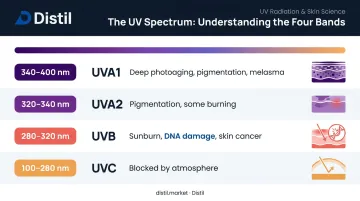
Broad-spectrum protection means blocking both UVA and UVB. SPF ratings primarily reflect UVB protection; UVA performance is measured separately via ISO 24443 in vitro testing or PA grades in Asian markets.
Why Only Two Minerals Make the Cut
The FDA's regulatory picture is clear. Under the proposed sunscreen order, the agency sorted active ingredients into three groups:
- GRASE: Zinc oxide and titanium dioxide only
- Not GRASE: PABA and trolamine salicylate
- Further data required: 12 chemical filters including avobenzone, oxybenzone, octinoxate, octisalate, and octocrylene
That GRASE designation is a regulatory advantage no chemical filter currently holds. For formulators targeting sensitive skin, paediatric applications, or clean-beauty positioning, it's also the clearest compliance foundation available.
Zinc Oxide vs. Titanium Dioxide: Key Differences Explained
UV Spectrum Coverage
This is the most consequential difference:
- ZnO covers the full UVA-UVB spectrum, with documented efficacy in the long-wave UVA1 range (340–400 nm) responsible for deep skin ageing, pigmentation, and melasma
- TiO2 is stronger in UVB and short-wave UVA2 (320–340 nm), but has poor efficacy against long-wave UVA1 — meaning it cannot deliver true broad-spectrum protection on its own
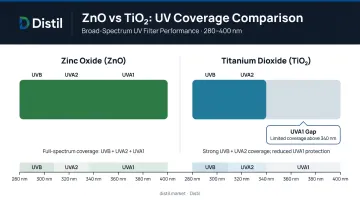
This gap is why formulators typically combine both filters — TiO2 for UVB efficiency and cosmetic lightness, ZnO to close the UVA1 window that matters most for photoageing.
White Cast and Photostability
Counterintuitively, ZnO typically produces less visible white cast than TiO2. ZnO's refractive index (1.9) is lower than TiO2's (2.6), and a higher refractive index means stronger visible-light scattering — which is why TiO2 can appear more opaque despite its reputation as the "lighter" mineral filter.
Two formulation approaches reduce whitening in practice:
- Micronised and nano-grade particles drop particle size below visible-light wavelengths, sharply reducing opacity
- Iron oxide-tinted bases effectively neutralise residual cast for medium to deep skin tones
Both minerals are inherently photostable — they do not degrade on UV exposure. This distinguishes them from chemical filters like avobenzone, which breaks down under UV light and requires dedicated photostabilisers to maintain SPF performance over wear time.
Texture and Feel
- TiO2 is generally lighter, easier to spread, and preferred for fluid facial formulations where cosmetic elegance matters
- ZnO at higher concentrations can feel heavier and slightly tacky, particularly in humid conditions
- Particle size (micronised vs. standard) significantly affects sensory performance for both
Environmental Profile
Hawaii Act 104 (2018) banned sunscreens containing oxybenzone or octinoxate to protect reef ecosystems. NOAA notes that specific chemical UV filters found in chemical sunscreens can harm aquatic life, including corals. Mineral filters are generally considered more reef-compatible alternatives. That said, non-nano mineral particles are the more defensible choice for reef-safe claims — nano-particle forms remain under active environmental review, and regulators in several jurisdictions have yet to draw a clear line on their aquatic impact.
Why the Best Natural Sunscreens Use Both Ingredients Together
Complementary UV Coverage
The pairing exists because each mineral fills the other's gap. Research supports combining ZnO and TiO2 to achieve broad-band UV protection:
- ZnO covers the long-wave UVA1 range that TiO2 misses
- TiO2 reinforces UVB and short-wave UVA2 coverage
- Together, they protect across the full 280–400 nm range
No single mineral achieves this on its own.
Texture, SPF, and PA Optimisation
Combining the two minerals gives formulators more control over the final product:
- TiO2's lighter texture improves overall spreadability and skin feel
- Formulators can reduce total ZnO concentration (which drives heavier feel and white cast) while maintaining SPF performance
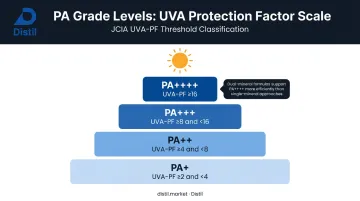
- The combination supports higher SPF values and PA++++ ratings (UVA-PF ≥ 16 per JCIA standards) more efficiently than single-mineral approaches
PA grade thresholds from the Japanese Cosmetic Industry Association:
| PA Grade | UVA-PF Required |
|---|---|
| PA+ | ≥2 and <4 |
| PA++ | ≥4 and <8 |
| PA+++ | ≥8 and <16 |
| PA++++ | ≥16 |
Finished-formula SPF and UVA testing is still required — no generic concentration guarantees a specific SPF or PA rating.
Skin Tolerance
ZnO carries well-documented anti-inflammatory and antimicrobial properties, with dermatology literature supporting its use in inflammatory skin conditions including acne and rosacea. TiO2 contributes a lighter skin feel. Together, they produce formulations that perform across sensitive, acne-prone, and reactive skin types — without requiring separate ingredient systems for different consumer segments.
Choosing the Right Mineral Sunscreen for Your Skin Type
Sensitive Skin and Rosacea
The AAD specifically recommends sunscreens containing zinc oxide, titanium dioxide, or both for rosacea-prone skin. ZnO is the preferred active because it is anti-inflammatory and far less likely to cause stinging or irritation than chemical UV filters. Fragrance-free, dual-mineral formulas with soothing actives like bisabolol or chamomile offer additional calming benefit.
Acne-Prone Skin
Both minerals are non-comedogenic and suitable for breakout-prone skin. ZnO has a mild edge due to its antimicrobial properties, though lighter TiO2-forward formulas are often better tolerated cosmetically. Pairing mineral filters with niacinamide improves oil control and visibly reduces redness — a useful combination for reactive, breakout-prone skin.
Oily and Combination Skin
In humid conditions, high ZnO concentrations can feel tacky — a real formulation challenge for oily and combination skin types. TiO2-forward formulas perform better here: less occlusive, lighter on skin, and easier to finish matte.
Key formulation pointers for this skin type:
- Choose matte-finish bases with silica or powder components
- Keep ZnO concentration moderate to avoid tackiness
- Prioritize TiO2 as the primary UV filter for a weightless feel
Mature Skin and Hyperpigmentation (Melasma)
For melasma, ZnO's long-wave UVA1 coverage is non-negotiable. Research published in PMC identifies UVA1 (370–400 nm) and high-energy visible light (400–450 nm) as primary drivers of melasma development — and TiO2 alone cannot adequately block this wavelength range. The dermatologist-recommended approach:
- High-ZnO broad-spectrum mineral formula
- Iron oxide pigments for visible light (HEVL) protection
- Tinted formulation for additional camouflage and shade-inclusive options
Darker Skin Tones
For deeper skin tones, white cast remains the single biggest adoption barrier — and ZnO is typically more visible than TiO2 at equivalent concentrations. Tinted mineral sunscreens with iron oxide pigments solve two problems at once: they neutralize the cast and extend protection into the visible light range. Shade range in tinted formulations matters for genuine inclusivity.
What Brands and Formulators Need to Know When Sourcing Mineral UV Filters
Particle Size and Grade Selection
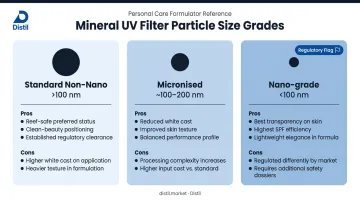
Particle size is one of the most consequential decisions in mineral sunscreen formulation:
| Grade | Particle Size | Key Trade-offs |
|---|---|---|
| Standard (non-nano) | >100 nm | Higher white cast, preferred for reef-safe claims, clean-beauty brands |
| Micronised | ~100–200 nm | Reduced white cast, improved texture |
| Nano-grade | <100 nm | Best transparency and SPF efficiency, regulated differently across markets |
For brands working through this selection, supplier grade availability matters as much as the technical specs. Distil stocks zinc oxide UV filters across nano and non-nano formats — including standard powders, coated mineral UV filters, and pre-dispersed systems designed to simplify formulation and improve stability. Surface-treated formats are available for improved dispersibility in both oil and water-based bases.
For transparent daily SPF or tinted formulations, the carrier system is equally important. Distil's cosmetic ester range — coco-caprylate/caprate, neopentyl glycol diheptanoate, and trimethylolpropane tricaprylate/tricaprate — is formulated to pair with mineral UV filters. These esters improve spreadability and reduce the heavy or tacky feel common at higher ZnO concentrations.
Regulatory Compliance Across Markets
Key limits and conditions across major markets:
- FDA: ZnO and TiO2 each permitted up to 25%; GRASE classification proposed (final order still pending)
- EU Annex VI: Both permitted up to 25%; nano forms authorised with inhalation restrictions — not to be used in aerosol or spray formats
- Australia TGA: TiO2 restricted to 25% maximum; ZnO approved as sunscreen active
- Japan/India: Positive-list frameworks apply; specific concentration limits require verification against current regulations
EU surface treatment requirements add another layer of complexity. For nano TiO2, the EU requires documented photocatalytic activity ≤10% versus an uncoated reference — meaning the choice of coating (silica, dimethicone, alumina, stearic acid) has direct regulatory implications, not just formulation ones.
Brands targeting multiple markets need supplier-level documentation support from day one. Distil's R&D team — drawing on experience from Dow, BASF, L'Oréal, and Huntsman — provides application-specific trials and grade selection guidance, with a structured pathway from lab prototype to commercial-scale production through a single point of contact.
For technical specifications, grade selection support, or to request samples and data sheets, contact Distil at contact@distil.market.
Frequently Asked Questions
Are zinc oxide and titanium dioxide safe in sunscreen?
Yes. Both are FDA-classified as GRASE — the only two sunscreen actives with this status. Unlike chemical UV filters, they form a physical film on the skin's surface rather than being absorbed systemically, giving them a well-established safety record across decades of use and making them the standard choice for sensitive skin, children, and clean-beauty formulations.
What is the difference between zinc oxide and titanium dioxide in sunscreen?
ZnO offers broader UV coverage — full UVA (including long-wave UVA1) and UVB. TiO2 covers UVB and short-wave UVA2 with a lighter texture, but falls short on long-wave UVA1. Most high-performance mineral sunscreens combine both for complete protection and better cosmetic feel.
Which natural sunscreen contains both zinc oxide and titanium dioxide?
Many dermatologist-recommended and clean-beauty sunscreens do — both actives are listed in the Drug Facts box. Dual-mineral formulas appear across price points, from drugstore SPF 50 lotions to premium tinted mineral SPFs and daily moisturisers with UV protection.
Does zinc oxide or titanium dioxide leave a white cast?
Both can, due to their natural opacity, though TiO2's higher refractive index (2.6 vs. ZnO's 1.9) can actually produce more visible scattering. Micronised and nano-grade formulations significantly reduce white cast. Tinted mineral sunscreens with iron oxide pigments are the most effective solution for medium to deep skin tones.
Which sunscreen is best for melasma?
A broad-spectrum mineral sunscreen with high ZnO concentration is the recommended approach. ZnO is the only filter that adequately blocks long-wave UVA1, the primary trigger for melasma. Tinted formulas with iron oxides add HEVL (visible light) protection, which peer-reviewed research links to melasma development.
What kind of sunscreen should I use if I have rosacea?
Mineral sunscreen with zinc oxide is the first choice for rosacea-prone skin. ZnO is anti-inflammatory, avoids the stinging typical of chemical UV filters, and is directly recommended by the AAD for this condition. Fragrance-free formulas with calming ingredients like bisabolol or chamomile offer additional benefit.