Introduction
Mineral sunscreen demand is accelerating fast. The global mineral sunscreen market was valued at USD 4,198.1 million in 2024 and is projected to reach USD 8,855.7 million by 2030, growing at a 13.5% CAGR — driven by regulatory pressure on chemical filters and consumer preference for cleaner formulations.
Zinc oxide sits at the center of this shift. It is the only UV filter that delivers true broad-spectrum coverage as a single ingredient, carries GRASE Category 1 status under the US FDA OTC monograph, and is accepted in all major global markets. No alternative single-ingredient filter matches that regulatory and market profile.
That regulatory strength, however, comes with real formulation trade-offs. The same properties that make ZnO effective — particle density, hydrophilicity, ion-releasing behavior — create pitfalls that derail stability, aesthetics, and SPF performance.
This guide addresses the four decisions that determine success: emulsion format selection, ZnO grade and excipient compatibility, dispersion quality, and pH and ion migration management. It is written for cosmetic chemists and personal care brand R&D teams who need precise, actionable guidance at each stage of development.
Key Takeaways
- ZnO is photostable, broad-spectrum (covering UVA I through UVB), and classified GRASE Category 1 by the US FDA
- Emulsion format — W/O, O/W, or anhydrous — determines every downstream formulation decision
- Dispersion quality is the single biggest driver of SPF performance and white cast
- Ionic ingredients interact with Zn²⁺ ions and cause irreversible texture failures — stick to nonionic emulsifiers and thickeners
- Coated ZnO grades reduce ion migration risk and offer broader excipient compatibility than uncoated grades
Why Zinc Oxide Is the UV Filter of Choice
UV Protection Mechanism
ZnO works through a combination of reflection, scattering, and absorption across the UV spectrum. Critically, microfine ZnO attenuates UV radiation including UVA I across the 340–400 nm range — a range where titanium dioxide provides minimal coverage. That single-ingredient, full-spectrum performance makes ZnO the preferred choice for broad-spectrum claims without combining multiple UV filters.
ZnO is also inherently photostable: it does not degrade or lose efficacy under sustained sunlight exposure. Titanium dioxide requires no special stabilization either, but organic filters like avobenzone degrade rapidly without a stabilizer system. That chemical stability — no photodegradation, no reactive byproducts — is a key factor underpinning ZnO's strong regulatory standing worldwide.
Regulatory Standing
ZnO's regulatory position is unusually strong:
- United States: Listed as an OTC sunscreen active up to 25% under 21 CFR 352.10; FDA's 2019 proposed rule classifies it as Category I (GRASE)
- European Union: Authorized in Annex VI at up to 25% in both nano and non-nano forms; nano form requires "(nano)" labeling and cannot be used in inhalable formats
- South Korea: Peer-reviewed risk assessments support a 25% regulatory limit
- Australia: TGA guidance recognizes nanoparticulate ZnO as commonly used in sunscreens
No major market has restricted ZnO use in leave-on or rinse-off products, which simplifies global product development.
Why This Matters Commercially
That market growth figure — 13.5% CAGR through 2030 — reflects genuine demand, not hype. Consumers actively seek mineral-only formulations for sensitive skin, pediatric use, and reef-safe positioning. For formulators and brand owners, getting ZnO right — particle size, dispersion, carrier system — is the variable that separates a competitive mineral sunscreen from one that sits on shelf.
Formulation Format: Choosing Between O/W, W/O, and Anhydrous
Format selection should be the first decision in any ZnO brief. Emulsifier type, rheology system, and pH management all follow from it. Each of the three main formats handles ZnO differently, with distinct trade-offs in stability, skin feel, and processing complexity.
W/O Emulsions: The Recommended Starting Point
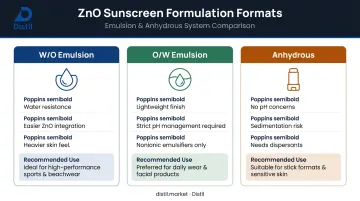
Water-in-oil is the most forgiving format for ZnO. Because oil is the external phase, ZnO remains in its natural environment and pH management becomes a non-issue. Water resistance is built in without additional film-forming agents, and ZnO integrates stably at higher loading levels.
Polymeric nonionic emulsifiers such as PEG-30 Dipolyhydroxystearate and Polyglyceryl-3 Diisostearate are well-suited here, helping manage viscosity even at high ZnO concentrations. The main trade-off is skin feel — W/O emulsions are heavier and less cosmetically elegant than O/W.
O/W Emulsions: Higher Performance Ceiling, Stricter Rules
O/W emulsions offer lighter skin feel and better consumer acceptance, but ZnO behaves poorly in them. ZnO is highly hydrophilic and migrates into the aqueous phase, raising pH, triggering Zn²⁺ ion formation, and destabilizing the emulsion over time.
Required formulation rules for O/W ZnO systems:
- Use only nonionic emulsifiers (for example, C14-22 Alcohols and C12-20 Alkyl Glucoside, Glyceryl Stearate-based blends)
- Avoid all ionic emulsifiers — they react with Zn²⁺ ions to produce a characteristic cottage cheese-like texture and eventual phase separation
- Manage pH continuously (see the pH section below)
Anhydrous Formats: Sticks and Balms
Anhydrous systems (sticks, balms) eliminate pH and ion migration concerns entirely. The challenge is ZnO's density, which creates sedimentation risk over time. Formulators must incorporate appropriate dispersants and suspending agents, and wax content in stick formats can improve skin feel during application.
Format Decision Framework
| Formulation Brief | Recommended Format |
|---|---|
| Water resistance required; easier to formulate | W/O emulsion |
| Lightweight, non-greasy consumer finish | O/W with strict pH management |
| Lip balm or portable stick format | Anhydrous |
Note on high solids loading: Across all three formats, agglomeration risk rises as ZnO concentration increases. Compensate by raising emulsifier levels and nonionic rheology modifier concentrations — xanthan gum and polyacrylate-13 blends are proven options here.
Selecting the Right ZnO Grade and Supporting Ingredients
Nano vs. Non-Nano: The Core Trade-Off
Particle size directly determines both aesthetics and regulatory classification.
Nano ZnO (primary particle size ~20–30 nm):
- Higher SPF efficiency: Kobo data shows 20–30 nm particle sizes can deliver 1.0–2.0 SPF per % ZnO
- Reduced white cast and greater skin transparency
- Requires EU "(nano)" labeling; cannot be used in inhalable spray formats in the EU
- US FDA does not impose separate nano-specific conditions for ZnO
Non-nano ZnO (primary particle size >60 nm):
- SPF efficiency drops to approximately 0.5–1.0 SPF per % ZnO
- More visible whitening effect
- Stronger narrative for "non-nano" or "clean" positioning claims
- Requires more aggressive rheology management to prevent settling
Switching from nano to non-nano is not a direct 1:1 substitution. The heavier particle density increases settling tendency, requiring more emulsifier and increased rheology modifier loading. This is among the most commonly overlooked mistakes when brands pivot to non-nano claims.
Surface Coatings and Compatibility
Coating type has an outsized effect on ZnO grade selection — and is frequently treated as an afterthought.
Uncoated ZnO:
- Requires high-polarity emollients (cocoglycerides, dibutyl adipate)
- Higher Zn²⁺ migration risk
- More reactive with ionic excipients
Coated ZnO (triethoxycaprylylsilane, stearic acid, alumina, silica):
- Compatible with lower-polarity emollients (dicaprylyl carbonate, hydrogenated polyisobutene)
- Reduced ion migration and improved formulation stability
- Stearic acid-coated grades in particular produce lower-viscosity pre-dispersions
Match emollient polarity to coating type. Adding propylene glycol at 3–5% w/w in the oil phase can further improve dispersion and stability in both cases.
Rheology Modifiers: What Works and What Doesn't
Once the emollient system is locked, rheology modifier selection becomes the next critical variable. Zn²⁺ ion reactivity narrows the options considerably.
| Compatible with ZnO | Avoid with ZnO |
|---|---|
| Xanthan gum (0.1–0.4%) | Carbomers (all grades) |
| Hydroxyethyl cellulose | Polyacrylates (ionic) |
| Magnesium Aluminium Silicate (0.5–1.25%) | Acrylate-based thickeners |
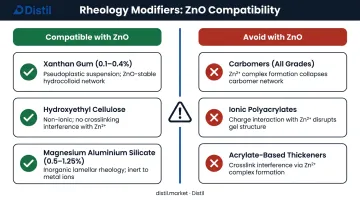
Carbomers and acrylate-derived polymers form complexes with Zn²⁺ ions, disrupting the polymer matrix. The result is cottage cheese-like texture and eventual phase separation — this is not recoverable.
These trade-offs compound quickly across application briefs. Distil's Personal Care team — led by Kiro Rizk, with R&D support from Dr. Leema Joseph's team (BASF, L'Oréal, Dow backgrounds) — provides application-specific ZnO grade selection and sourcing guidance.
Distil supplies both coated ZnO powders and pre-dispersed ZnO systems engineered for SPF performance and formulation compatibility.
Dispersion and Processing: The Steps That Determine Success
Poor dispersion is the most common root cause of formulation failure in ZnO sunscreens. Large ZnO aggregates reduce UV protection, increase white cast by scattering visible light, and create graininess that fails consumer sensory evaluations.
Pre-Dispersion for Powder ZnO
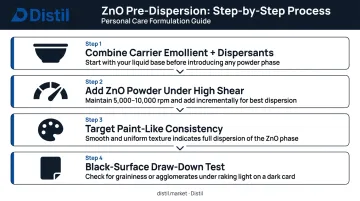
When working with ZnO powder, a dedicated pre-dispersion step is non-negotiable:
- Combine carrier emollient with dispersants first — polyhydroxystearic acid is the industry-standard dispersant for ZnO systems
- Add ZnO powder under high shear — target 5,000–10,000 rpm; add powder incrementally to avoid air entrapment
- Target paint-like consistency — the pre-dispersion should be smooth, uniform, and free of visible particles
- Conduct a black-surface draw-down test — spread the dispersion on a black card; any graininess or agglomeration is immediately visible
Wetting agents such as glycerin or caprylyl glycol can further aid particle wetting during this step.
Oil Phase Incorporation
Add the ZnO pre-dispersion as the last ingredient into the hot oil phase, after all other solids have melted. Lower oil-phase viscosity at elevated temperature improves wetting and particle distribution. Mix thoroughly to displace air pockets, then homogenize until the mixture achieves a uniform, paint-like appearance.
Pre-Dispersed Products: A Simpler Path
Pre-dispersed ZnO products — suspension concentrates with ZnO already incorporated in a carrier — can be added directly to the oil phase with overhead stirring, skipping the powder pre-dispersion step entirely. This significantly reduces processing variability, a practical advantage when scaling from lab to commercial production.
Process drift is a real risk at scale: homogenization conditions that work at lab batch sizes don't always translate directly to commercial equipment. Distil's ZnO dispersions come pre-dispersed in a carrier, ready to add directly to the oil phase — removing one of the more variable steps in the process. For brands scaling commercially, Distil's single point-of-contact model covers formulation development through production across a 20+ manufacturing partner network, with a unified quality system designed to keep batch-to-batch consistency intact as volumes grow.
Managing pH and Zinc Ion Migration
The pH Stability Window
In O/W systems, pH is the primary formulation risk. ZnO is partially soluble in water and migrates into the aqueous phase, where it interacts with pH to form destabilizing ionic species.
The target pH range for O/W ZnO emulsions is 7.0–7.5:
- Below 7.0: Zn²⁺ ions form and dissolve the ZnO, causing agglomeration
- Above 7.5: Alkaline zinc complexes form, also destabilizing the system
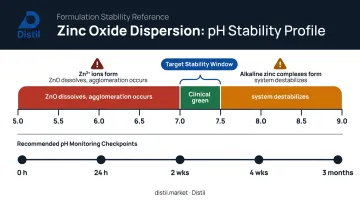
Use citric acid or lactic acid for initial pH adjustment. A 2% w/w solution of 50% citric acid is a common starting point. Always check pH at both 0 hours and 24 hours post-manufacture before making further adjustments.
Repeated acid additions destabilize the system. The formulation should hold within range after the initial adjustment.
Monitoring pH Drift
pH naturally rises over time in ZnO-containing O/W emulsions. This is expected behavior, but it must be tracked. Recommended pH monitoring schedule during stability testing:
- 0 hours, 24 hours
- 2 weeks, 4 weeks
- 3 months (at ambient, 40°C, and freeze-thaw conditions)
The formulation should stabilize before reaching pH 8.0. If it continues rising, investigate ionic emulsifier presence or insufficient ZnO coating.
Chelating Agents
Disodium EDTA at 0.1–0.2% w/w in the aqueous phase helps bind free Zn²⁺ ions, reducing their interaction with emulsifiers and thickeners.
In hybrid formulations combining ZnO with organic filters like avobenzone, switch to tetrasodium EDTA placed in the oil phase — this minimizes Zn²⁺–avobenzone interactions that standard aqueous-phase chelation does not address.
Stability Testing and Formulation Troubleshooting
Stability failures in ZnO formulations often show up early — if you know where to look. Three quick bench checks catch agglomeration, phase instability, and dispersant incompatibility before they become batch-level problems.
Three Essential Assessment Tools
- Spatula test: Spread the emulsion across a spatula. Smooth and shiny indicates good emulsion quality; dull or grainy appearance signals ZnO agglomeration
- Optical microscopy: ZnO particles should appear small, evenly distributed, and non-agglomerated. Visible clustering indicates either incompatibility or insufficient dispersion energy
- Black-surface draw-down: Spread on a black card under good lighting; surface graininess is an early warning of agglomeration or dispersant-ZnO reaction
Troubleshooting Reference
| Symptom | Most Likely Cause |
|---|---|
| Cottage cheese texture | Ionic emulsifier or acrylate thickener incompatibility |
| Settling at elevated temperatures | Insufficient suspending agent or ingredient incompatibility |
| Graininess on black card | Wrong emollient polarity or inadequate dispersion energy |
| Rising pH over time | Ionic emulsifier present or Zn²⁺ migration |
| Phase separation | Incorrect emulsifier type or concentration |
Nano-to-Non-Nano Switching
Many of the symptoms above are triggered by grade changes rather than formulation errors. A direct nano-to-non-nano swap is never a one-to-one replacement — non-nano ZnO carries greater particle density and a higher settling tendency that requires a full formulation review. Formulators must:
- Increase rheology modifier concentration (start at 20–30% higher than the nano formulation)
- Reassess emulsifier loading
- Re-validate SPF performance — SPF-per-percent efficiency drops measurably with non-nano grades and the original SPF claim may no longer hold
Frequently Asked Questions
What are the ingredients in zinc oxide sunscreen?
A ZnO sunscreen contains zinc oxide as the active UV filter, supported by emollients, emulsifiers, rheology modifiers, humectants, chelating agents (typically disodium EDTA), and pH buffers. The specific combination varies by format: W/O, O/W, and anhydrous systems each require a different excipient architecture.
What is zinc oxide 39.5 SC formulation?
"SC" refers to suspension concentrate — a pre-dispersed, high-concentration ZnO slurry that allows direct incorporation into finished formulations without a separate powder pre-dispersion step. The 39.5% figure indicates ZnO active content in that dispersion, with the remainder being carrier medium and dispersants.
Which sunscreen is best for melasma?
Broad-spectrum mineral sunscreens formulated with zinc oxide are the preferred choice for melasma, because ZnO blocks both UVA and visible light — the primary pigmentation triggers. Its low irritation profile supports daily use on hyperpigmentation-prone skin.
Why does zinc oxide sunscreen leave a white cast, and how can it be minimized?
White cast is caused by visible light scattering from ZnO particles. It can be reduced through several formulation strategies:
- Use nano or micronized ZnO grades to lower particle size
- Optimize dispersion quality to prevent agglomeration
- Select lower-polarity emollients that improve skin spreading
- Incorporate iron oxides as tinting agents for a skin-tone-adaptive finish
What is the maximum concentration of zinc oxide allowed in sunscreen?
In the United States, the FDA permits ZnO up to 25% as a single OTC sunscreen active. The EU authorizes ZnO and nano ZnO in Annex VI at up to 25% for both rinse-off and leave-on products. Formulators should confirm applicable limits for each market before locking product specifications.