The SPF a zinc oxide sunscreen delivers on skin is the combined result of ZnO concentration, particle size, dispersion quality, emulsion architecture, and—critically—how the product is tested. Get any one of these wrong, and a formulation that performs well in vivo may fail an in vitro screen, or a label claim of SPF 50 may not survive independent laboratory verification.
This article works through each of those variables in technical detail: what SPF actually measures for ZnO, the realistic operating range, the key material properties that drive performance, and the testing landscape that has created significant measurement challenges for high-ZnO formulations.
Key Takeaways
- SPF in ZnO sunscreens is a formulation outcome—not a fixed ingredient property.
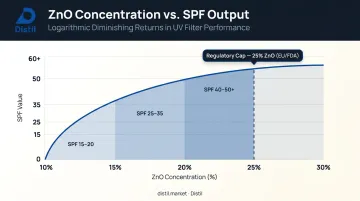
- As a rough guide: 10–15% ZnO delivers approximately SPF 15–20; 15–20% reaches SPF 25–35; 20–25% can achieve SPF 40–50+.
- ISO 24444 (in vivo) is the only validated method for label SPF claims.
- In vitro methods can underreport SPF in high-ZnO formulations by up to 50%—making test method selection critical.
- Both the FDA (OTC Monograph M020) and EU SCCS cap ZnO at 25% in sunscreen formulations.
- Particle size, surface coating, and dispersion quality are the main variables that determine SPF efficiency per percentage of ZnO used.
What SPF Represents in Zinc Oxide Sunscreens
The Definition
ISO 24444:2019 defines SPF as the ratio of the minimum erythema dose (MED) on protected skin to the MED on unprotected skin. In practical terms:
SPF = MED (protected skin) ÷ MED (unprotected skin)
The measurement uses a solar simulator emitting UV across 290–400 nm, and the erythema response is weighted against the CIE erythema action spectrum. This is not a measure of total UV blockage—it is a measure of how much additional UV exposure is required to cause visible reddening when a product is applied at 2 mg/cm².
How ZnO Creates That Protection
ZnO functions as an insoluble particulate filter sitting on the skin surface. Its protection mechanism is primarily UV absorption, with scattering and reflection contributing a smaller share. Research by Cole (2016) found that reflection accounts for only approximately 4–5% of the UV protection delivered by metal oxide filters.
ZnO's advantage over organic filters is breadth: it attenuates across the full UVA and UVB spectrum from a single ingredient, including UVA1 (340–400 nm), which many organic filters do not fully address.
Because ZnO is a particulate filter rather than a dissolved molecule, the SPF delivered depends on the quality and uniformity of the film formed on skin—not on a fixed molecular absorption coefficient. Two formulations containing identical ZnO concentrations can produce meaningfully different SPF values if their dispersion quality, particle size, or emulsion architecture differ.
SPF as a Design Parameter
This distinction matters practically: SPF in a ZnO formulation is the result of deliberate engineering, confirmed through standardised testing. The ZnO percentage is an input, not the output. Formulators work through a defined sequence of decisions before any SPF claim can be made:
- Select a ZnO grade appropriate to the target particle size and surface treatment
- Set concentration based on target SPF range and regulatory limits
- Optimise dispersion to ensure film uniformity on skin
- Choose an emulsion base that supports stable, even coverage
- Validate the final SPF via ISO 24444:2019 testing at 2 mg/cm²
The SPF Operating Range of ZnO Sunscreens
Nominal Concentration-to-SPF Ranges
The following ranges reflect industry formulation guidance and should be treated as starting points, not guarantees. Actual SPF will vary with particle size, dispersion quality, and emulsion type.
| ZnO Concentration | Approximate SPF Range |
|---|---|
| 10–15% | SPF 15–20 |
| 15–20% | SPF 25–35 |
| 20–25% | SPF 40–50+ |
These ranges assume adequate dispersion, standard particle size selection, and a conventional O/W emulsion base tested at 2 mg/cm² per ISO 24444. W/O emulsions and high-density formulations can behave differently (see the density effect section below).
The relationship between ZnO concentration and SPF follows a logarithmic, not linear, curve. Increasing from 10% to 20% ZnO may approximately double SPF; moving from 20% to 30% yields a much smaller gain while adding formulation cost, density, and white-cast challenges. Optimising particle size and dispersion is more efficient than escalating concentration.
Regulatory Label Categories
SPF claims are not reported as raw numbers—they are rounded into regulated categories:
- FDA (OTC Monograph M020): SPF 15–29 labels as SPF 15, 20, or 25; SPF 30–59 labels as SPF 30, 40, or 50; proposed maximum label is SPF 60+.
- EU (Commission Recommendation 2006/647/EC): Low (6, 10), Medium (15, 20, 25), High (30, 50), Very High (50+).
Measurement Variability and Development Margins
Those label category thresholds make measurement variability a commercial risk, not just a technical one. ISO 24444:2019 requires a minimum of 10 valid individual SPF results (up to 20), with the 95% confidence interval within ±17% of the mean. Observed interlaboratory variability in the literature can exceed 30%.
A product that measures SPF 28 in one laboratory may fall below the SPF 30 threshold in another—dropping it into a lower regulatory category. The 2023 NVWA (Dutch Food and Consumer Product Safety Authority) investigation illustrates this risk clearly: 36 of 54 SPF 30+ products tested lower than their labelled claim after irradiation, and 8 measured below SPF 10 using the in vitro double-plate method.
Formulators should build margin into development targets from the outset. Key reasons to overshoot the intended label claim include:
- Interlaboratory variability — a measured SPF of 28 can register below 30 at a different accredited lab
- Consumer under-application — real-world use averages 0.5–1.0 mg/cm², against the 2 mg/cm² test standard
- High-ZnO density effects — concentrated formulations are subject to in vitro underestimation (covered in the density effect section below)
Key Technical Properties That Determine SPF Performance
Particle Size and SPF Efficiency
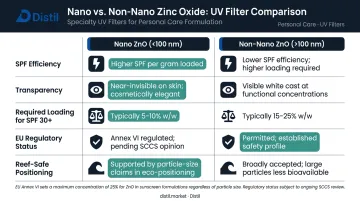
Particle size is the most influential material variable after concentration. The key tradeoffs:
| Property | Nano ZnO (<100 nm) | Non-Nano ZnO (>100 nm) |
|---|---|---|
| SPF efficiency (per % used) | Higher | Lower |
| Transparency | Better | More opaque |
| Required loading for SPF 30+ | Lower | Higher |
| Regulatory status (EU) | Permitted ≤25% with SCCS approval | Permitted ≤25% |
| Reef-safe positioning | Debated | Preferred |
Surface coatings—silicone, silica, alumina, triethoxycaprylylsilane—affect both dispersion stability and SPF consistency over shelf life. Coated grades resist particle agglomeration, which otherwise reduces effective surface area and lowers measured SPF as a product ages. Formulators sourcing ZnO should specify both particle size distribution and coating type for their target application. Distil's ZnO portfolio spans nano and non-nano formats, including surface-treated grades, with application-specific technical support for personal care formulators.
Dispersion Quality and Stability
Aggregated ZnO particles present a smaller effective surface area to incoming UV radiation—and produce lower, less consistent SPF. Achieving and maintaining dispersion quality requires:
- High-shear mixing during manufacture
- Pre-dispersion in a compatible oil or ester carrier (coco-caprylate/caprate and neopentyl glycol diheptanoate are commonly used)
- pH control in the 6.5–7.5 range, where ZnO is stable
- Characterisation of particle size and agglomeration state before and after emulsification
Dispersion quality is assessed using techniques including dynamic light scattering (for particle size in suspension), rheology (for stability indicators), and optical microscopy. Distil also offers pre-dispersed ZnO systems specifically designed to eliminate the dispersion optimisation burden during formulation.
The Density Effect: Why High-ZnO Formulations Behave Differently in In Vitro Testing
This is the most consequential technical issue for formulators working with high-ZnO sunscreens, documented by Osterwalder et al. in Photochemical and Photobiological Sciences (2024).
The problem:
- Standard organic UV filter emulsions have a density close to 1.0 g/mL.
- High-ZnO formulations have densities of approximately 1.3–1.7 g/mL.
- In vitro SPF tests apply product by weight (typically 1.2–1.3 mg/cm²).
- At the same applied weight, the denser ZnO formulation creates a physically thinner film on the PMMA test plate.
- That thinner film transmits more UV radiation, producing an artificially low in vitro SPF—sometimes approximately 50% below the in vivo result.
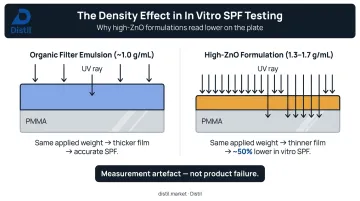
This is not a product performance failure. It is a measurement artefact caused by weight-based application methodology calibrated for organic-filter emulsions.
Switching to volume-based application (1.2 μL/cm² rather than mg/cm²) substantially closes the gap between in vitro and in vivo SPF for high-ZnO systems. ISO 23675:2024—now published—is the new in vitro SPF standard, and Pissavini et al. (2025) found strong correlation with ISO 24444 (Pearson r = 0.967) for high-inorganic-filter products containing ≥15% ZnO. Even so, formulators should not treat in vitro screening results as equivalent to in vivo for high-ZnO products without confirming the application method used.
How SPF Is Specified, Measured, and Validated for ZnO Sunscreens
The Standard Pathway
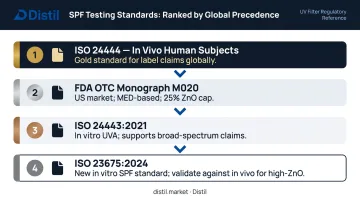
The measurement and documentation path for ZnO sunscreen SPF follows a clear hierarchy:
- ISO 24444 (in vivo, human subjects) — gold standard globally for SPF label claims in Europe and most international markets. Requires 10–20 valid subject results meeting the ±17% confidence interval criterion.
- FDA OTC Monograph M020 — governs SPF testing for US-market products; uses the same MED-based concept. ZnO is listed at a maximum of 25% (not unlimited, as is sometimes claimed—this is a misconception).
- ISO 24443:2021 — in vitro UVA photoprotection method; supports broad-spectrum claims alongside in vivo SPF data.
- ISO 23675:2024 — newly published direct in vitro SPF standard; applicable to high-ZnO products but should be validated against in vivo data for any specific formulation before relying on results for labelling.
What Proper Validation Looks Like
Knowing which standards apply directly shapes how a validation programme is structured. A well-constructed SPF validation programme for a ZnO sunscreen includes:
- In vitro screening at the development stage for relative comparisons between formulation variants — not for absolute label claims
- In vivo ISO 24444 testing pre-submission, with a target margin above the intended label claim to account for interlaboratory variability
- For high-ZnO products: confirming whether the testing laboratory applies a volume-based or weight-based protocol, and noting formulation density when interpreting results
- Ongoing awareness of ISO/TC 217 WG7, which continues adapting test standards for mineral-only, high-concentration inorganic filter products
Common Misinterpretations of ZnO SPF in Formulation Practice
Three errors appear repeatedly in practice, each with distinct consequences.
1. Treating In Vitro SPF as Equivalent to In Vivo for High-ZnO Products
A formulator using in vitro screening to confirm an SPF 50 label claim on a 22% ZnO formula may see a result of SPF 25–30. Acting on that number by increasing ZnO loading would be wrong. The result reflects the density/thin-film artefact described above, not actual product underperformance. In vivo ISO 24444 testing remains non-negotiable before any label claim is finalised.
2. Assuming the Concentration-to-SPF Relationship Is Linear
Each percentage point of ZnO added above approximately 20–25% delivers diminishing SPF returns. Before escalating concentration, formulators should first optimise particle size and dispersion quality — both of which improve SPF efficiency without the cost, density, and whitening penalties of additional ZnO loading.
3. Transferring SPF Predictions Between Emulsion Types
A concentration-to-SPF relationship established in an O/W emulsion does not directly apply to a W/O system. Water evaporation from an O/W emulsion after application increases ZnO concentration in the remaining film, and further reduces film thickness, amplifying the density effect.
W/O emulsions without a significant aqueous phase behave differently again. Bench-level predictions must account for emulsion architecture, and in vivo confirmation is required regardless.
Frequently Asked Questions
Is zinc oxide a good SPF ingredient?
ZnO is one of the most complete UV filters available—it provides true broad-spectrum UVA and UVB protection from a single ingredient, is photostable, and is approved under the FDA OTC Monograph and EU SCCS evaluations. Its SPF performance in practice depends on concentration, particle size, and dispersion quality in the final formulation.
How much SPF is in zinc oxide?
ZnO does not carry a fixed SPF value on its own. As industry guidance: 10–15% ZnO typically achieves approximately SPF 15–20; 15–20% achieves SPF 25–35; 20–25% achieves SPF 40–50+. Results vary meaningfully with particle size, surface treatment, and dispersion quality.
Is 40% zinc oxide safe for the face?
Concentrations around 40% ZnO are typical of therapeutic barrier products such as diaper rash creams, not facial sunscreens. Regulatory limits (FDA OTC Monograph M020; EU SCCS) cap leave-on sunscreens at 25%, and the extreme white cast and heavy texture at 40% loading would make facial use commercially unviable regardless.
Why does in vitro SPF testing often show lower values for zinc oxide sunscreens?
High-ZnO formulations are denser (approximately 1.3–1.7 g/mL) than organic UV filter emulsions (~1.0 g/mL). Applied by weight on a PMMA test plate, the denser product forms a thinner film, transmitting more UV and producing an in vitro SPF sometimes ~50% below the in vivo result. This is a measurement artefact, not a product failure.
What is the maximum zinc oxide concentration allowed in sunscreen?
Both the FDA (OTC Monograph M020) and EU (Annex VI, Regulation 2016/621) set the maximum permitted ZnO concentration in sunscreens at 25%, covering both nano and non-nano forms. The EU additionally restricts applications that could lead to inhalation exposure.
How does particle size affect the SPF of zinc oxide sunscreens?
Nano-grade ZnO (<100 nm) delivers higher SPF efficiency per percentage used and better transparency due to greater surface area and UV interaction. Non-nano particles (>100 nm) require higher loadings to achieve equivalent SPF but are favoured for reef-safe positioning and in markets where nano ingredients face additional regulatory scrutiny.