This article addresses the question from a formulator's perspective: what concentration is actually needed, what the regulatory ceilings are, how concentration translates to SPF and UVA coverage, and where the common misinterpretations occur.
Key Takeaways
- Zinc oxide is the only single UV filter covering the full UVB + UVA2 + UVA1 spectrum (290–400 nm)
- The US FDA and EU both cap ZnO at 25% in sunscreen formulations
- SPF 30 broad-spectrum coverage typically needs 15–20% ZnO; SPF 50+ targets generally require 20–25%
- High SPF labels on low-ZnO formulas often rely on SPF boosters that inflate test scores without improving actual UV attenuation
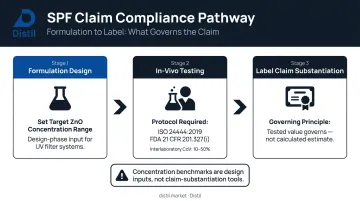
- ZnO concentration is a formulation input; in-vivo SPF testing per ISO 24444 is still required for any label claim
What Zinc Oxide Concentration Actually Represents
When formulators ask how much ZnO a sunscreen should contain, the answer starts with what that number actually represents. ZnO concentration is expressed as weight percentage of total formulation mass (w/w) — functioning both as a design input (set to hit a target SPF and UVA ratio) and a regulatory constraint bounded by market-specific limits.
What makes ZnO unique among UV filters is its mechanism. It both scatters and absorbs UV radiation across the full 290–400 nm spectrum, covering UVB, UVA2, and UVA1 in a single ingredient. No other inorganic filter achieves this alone. As concentration increases, the optical density of the filter layer on skin increases proportionally: more ZnO means more UV photons intercepted before reaching the dermis.
That said, concentration alone does not tell the complete performance story. Unlike organic UV filters, where activity can be modelled computationally, ZnO's real-world performance depends heavily on:
- Particle size and grade — non-micronized, micronized, or nano
- Surface treatment — uncoated vs. coated (which affects dispersion stability and photostability)
- Dispersion quality — agglomerated particles reduce effective UV-absorbing surface area
- Film thickness on skin — determined by application rate and formulation viscosity
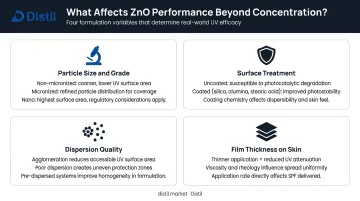
Specifying concentration is the starting point — but the same percentage can deliver meaningfully different protection depending on how each of these variables is resolved in the final formulation.
Approved Concentration Ranges and Regulatory Limits
ZnO's allowable concentration is defined by each regulatory authority. There is no single global standard, but convergence at the upper end is strong.
Regulatory Ceilings by Market
| Market | Maximum ZnO Concentration | Key Regulatory Reference |
|---|---|---|
| United States | 25% | FDA OTC Monograph M020 |
| European Union | 25% (non-nano + nano combined) | Commission Regulation (EU) 2016/621 |
| Australia | No verified numeric cap in current TGA guidance | TGA ARGS 2023 |
| Japan | No defined ZnO upper limit found in MHLW Standards | MHLW Standards for Cosmetics |
FDA's 2019 and 2021 sunscreen rulemaking identified zinc oxide and titanium dioxide as the only legacy filters with sufficient data to support GRASE status up to 25%. As of June 2026, bemotrizinol has also been added to OTC Monograph M020 as GRASE, expanding the field beyond the two-filter framework that is frequently cited.
These ceilings define the regulatory boundary, not the performance target. Reaching 25% does not automatically mean optimal protection.
Practical Concentration Ranges by Use Case
Rather than a single threshold, there is a functional spectrum:
- <15% ZnO — Limited UVA1 coverage even where SPF appears adequate; appropriate only for low-exposure, indoor-adjacent daily wear
- 15–20% ZnO — The practical range for standard outdoor use and most SPF 30 mineral claims in well-optimised formulations
- >20% up to 25% — Required for SPF 50+ targets, high-exposure environments, and formulas where meaningful UVA1 breadth is a core claim
Why Formulating at Maximum Is Not Always Optimal
Approaching 25% ZnO creates its own set of challenges. High-ZnO formulations have significantly higher density — roughly 1.3–1.7 g/ml compared to approximately 1.0 g/ml for organic-filter formulas. Osterwalder et al. (2024) documented that this density differential causes thinner films on PMMA plates at standard weight-based application rates during in-vitro SPF testing , meaning in-vitro SPF values for high-ZnO formulas are often systematically lower than in-vivo values. The product may be genuinely protective, but in-vitro screening will underread it.
These testing gaps compound real-world formulation trade-offs at high concentrations:
- Increased white cast and opacity
- Greater formulation viscosity and texture challenges
- Reduced consumer acceptance in some market segments
How Concentration Shapes SPF and Broad-Spectrum UV Coverage
UVB vs. UVA Coverage Gradient
SPF measures only UVB-induced erythema protection (290–320 nm). ZnO's absorption curve peaks in the UVB range and tapers toward UVA1, meaning that as concentration decreases, UVA1 attenuation drops disproportionately relative to the erythema-based SPF value. A formula with 10% ZnO and SPF 30 achieved through boosters will have a materially different UVA1 coverage profile than a formula with 20% ZnO at SPF 30.
This gap matters for anti-ageing, pigmentation, and certain skin cancer protection claims — all of which are driven by UVA1 wavelengths that SPF does not capture.
Concentration-to-SPF Efficiency
No universal, peer-reviewed SPF-per-percent constant exists across all particle sizes, coatings, and dispersion states. Three variables drive the most variation:
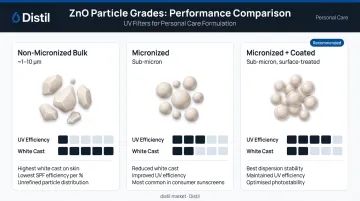
- Non-micronized (bulk) ZnO contributes less SPF per unit concentration due to larger particle size and lower surface area
- Micronized grades improve UV efficiency and reduce white cast; Mitchnick (1999) established microfine ZnO as a genuinely broad-spectrum filter including long-wavelength UVA
- Well-dispersed micronized or coated grades outperform poorly dispersed higher-concentration formulations
An instructive market-level signal: The Sunscreen Company's 2024 analysis of 69 all-mineral sunscreens found that a low-ZnO/high-SPF subset averaged 4.21 SPF points per 1% ZnO — a figure that significantly exceeds what ZnO alone would be expected to deliver, and which the analysis attributed in large part to salicylate-based SPF boosters. This is a named industry dataset, not peer-reviewed data, but it illustrates the scale of the booster effect.
The PA Rating Complication
The PA system (PA+ through PA++++) is based on UVAPF/PPD thresholds rather than SPF. Anti-redness and anti-inflammatory agents like bisabolol and niacinamide can influence the PPD test endpoint by suppressing skin darkening as a biological response — without blocking additional UV radiation. The result can be a PA rating that overstates actual UVA filter performance in low-ZnO formulas.
Two points of evidence frame the uncertainty here:
- SPF endpoints: Kolbe (2019) found that anti-inflammatory and antioxidant ingredients did not influence SPF erythema endpoints
- PPD endpoints: Direct PPD-specific data on bisabolol is less conclusive — claims in this area require caution and supporting spectral data
Factors That Influence Performance Beyond Raw Concentration
Two formulas with identical ZnO percentages can deliver measurably different UV protection. The variables that explain this:
Particle Size and Surface Treatment
Three grades are commercially relevant:
- Non-micronized (bulk, ~1–10 µm) — Highest opacity and white cast; lowest SPF efficiency per percent
- Micronized (sub-micron) — Improved UV efficiency and reduced white cast; the grade most commonly used in consumer cosmetic sunscreens
- Micronized + coated — Surface treatment (silane, silicone, or alumina-based) improves dispersion stability and photostability while maintaining UV efficiency
Nano-grade ZnO (<100 nm) introduces a separate consideration: under EU Regulation (EC) No 1223/2009 and Commission Regulation (EU) 2016/621, nano-form ingredients must be labelled as "[nano]" in the ingredient list. SCCS/1489/12 evaluated nano ZnO and concluded it poses limited risk for dermal sunscreen use under the evaluated conditions, while noting inhalation remains a separate restriction concern.
Dispersion Quality and Film Formation
Poorly dispersed ZnO — where particles have agglomerated — reduces effective UV-absorbing surface area regardless of the quantity present. A well-dispersed 18% micronized formulation can outperform a poorly dispersed 20% formulation in both SPF and UVA coverage.
Distil's R&D team — which draws on backgrounds spanning BASF, L'Oréal, Huntsman, and Dow — works with personal care brands to match the right ZnO grade and dispersion system to their specific formulation targets. The team offers both zinc oxide powders (ultra-fine, micronized, and coated formats) and pre-dispersed ZnO systems that replace high-shear milling steps and deliver consistent particle distribution across batches. Grade selection and dispersion method belong in the formulation brief alongside target concentration.
SPF Boosters and Their Effect on Concentration Decisions
SPF boosters — butyloctyl salicylate, tridecyl salicylate, and related esters — appear in inactive ingredient lists but are not recognized UV filters. Their regulatory status across key frameworks:
- FDA OTC Monograph M020 — not listed as an approved UV filter
- EU Annex VI — not recognized as a UV filter
- EU CosIng — classifies butyloctyl salicylate as a skin conditioning and solvent ingredient
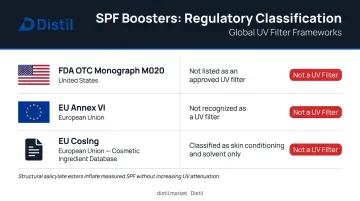
Structurally, these salicylate esters shift the in-vivo erythema endpoint in a way that inflates the measured SPF value without increasing actual UV attenuation.
For brands positioning products as "all-mineral" or "mineral-only," the presence of salicylate boosters in the inactive ingredients creates a misbranding exposure under both FDA OTC and EU cosmetics regulations. For brands carrying "clean" or "reef-safe" claims, auditing the full inactive ingredient list is not optional.
Consequences of Getting Concentration Wrong
Under-Specification
Formulas below ~15% ZnO that rely on SPF boosters to reach SPF 30 labels will typically deliver inadequate UVA1 protection regardless of their SPF or PA+ labeling. Consumers using these products against photoageing, pigmentation, or UV-driven skin cancers are receiving less coverage than the label implies. For brands with mineral-only positioning, undisclosed salicylate boosters create both consumer trust and regulatory exposure.
Over-Specification
Formulas near the 25% ceiling face the in-vitro SPF underestimation artifact documented by Osterwalder (2024) and McCormick (2012). The higher density means in-vitro SPF screening will systematically read lower than actual in-vivo performance, creating compliance uncertainty in markets moving toward in-vitro SPF methods under ISO 23675:2024. Very high concentrations also compound formulation challenges:
- White cast that is difficult to correct without additional actives
- Texture drag and reduced spreadability on skin
- Stability issues, particularly in emulsion systems
The Compliance Floor
SPF claims require in-vivo testing per ISO 24444:2019 (or FDA-equivalent 21 CFR 201.327(i) for the US market). Cole (2025) found interlaboratory SPF reproducibility varies substantially (coefficient of variation: 10%–50% across 36 laboratories). That variability is precisely why theoretical concentration benchmarks cannot substitute for validated testing. ZnO concentration range is a design starting point, not a claim-substantiation mechanism.
Common Misinterpretations
SPF on the label says nothing about UVA1 coverage. SPF measures UVB-induced erythema only — a mineral sunscreen with 8–12% ZnO can carry a high SPF while providing disproportionately weak UVA1 protection. Evaluate UVA/UVB ratios independently through PPD, UVAPF, or spectral data.
"All-mineral" on packaging does not guarantee an all-ZnO formula. Formulas containing butyloctyl salicylate or similar salicylate esters in the inactive ingredients do not qualify as all-mineral — part of the SPF is attributable to a chemical filter mechanism, not ZnO concentration alone.
Concentration-based SPF estimation is a formulation design tool, not a label value. In-vivo SPF testing carries inter-laboratory variability of up to 30%. Treating calculated figures as equivalent to tested results is a regulatory and liability risk across every major market.
Frequently Asked Questions
How much zinc oxide should be in SPF 30 sunscreen?
For reliable broad-spectrum SPF 30 protection in a standard mineral formulation, most formulators target 15–20% ZnO. Concentrations below 15% can achieve an SPF 30 label with boosters, but typically lack adequate UVA1 coverage alongside adequate UVB protection.
Does zinc oxide work as SPF?
Yes. ZnO is an effective broad-spectrum UV filter covering UVB, UVA2, and UVA1 wavelengths. Under FDA's 2019/2021 sunscreen rulemaking, it was proposed as GRASE — one of few filters with sufficient safety data. It sits on the skin surface as a physical barrier and is well-suited for sensitive skin and children.
Is 40% zinc oxide safe for the face?
Regulatory limits cap ZnO at 25% in the US and EU for cosmetic sunscreens. A 40% ZnO formulation falls outside the approved safety and efficacy data for OTC sunscreen actives in these markets and would not be permissible as an SPF-labeled product.
What is the maximum zinc oxide concentration allowed in sunscreen?
The US FDA OTC Monograph M020 and EU Cosmetics Regulation Annex VI both set the maximum at 25%. Caps for Australia and Japan vary — verify the applicable limit for each target market before finalizing a concentration.
Does higher zinc oxide percentage always mean better sun protection?
Generally yes — higher ZnO concentration improves both SPF and UVA breadth — but only when dispersion quality is maintained. A poorly dispersed high-ZnO formula can underperform a well-dispersed lower-concentration formula. Beyond approximately 20–25%, concentration increases deliver diminishing returns alongside growing texture and testing challenges.
How does particle size affect zinc oxide concentration requirements?
Micronized ZnO delivers more SPF efficiency per percent than non-micronized bulk grades — a well-optimized micronized formula can reach SPF 30 at a lower concentration. Nano-grade ZnO (<100 nm) carries separate EU disclosure requirements and should be selected with that compliance obligation in mind.