Introduction
Choosing between mineral and chemical UV filters is one of the earliest decisions in sunscreen formulation — and one with the longest downstream tail. The choice shapes SPF ceiling, texture profile, regulatory pathway, and how the finished product lands with its target consumer.
The distinction runs deeper than marketing labels. These two filter classes work through different protective mechanisms, carry different regulatory footprints across the US and EU, and suit fundamentally different end-user profiles — misaligning these factors early means costly reformulation before a product ever reaches submission.
What follows covers:
- How each filter type works at a chemistry level
- The key actives involved and their regulatory status
- A direct side-by-side comparison
- Formulation contexts where each approach — or a hybrid of both — makes the most sense
Key Takeaways
- Mineral filters — zinc oxide and titanium dioxide — are the only two UV actives the FDA has proposed GRASE status for; both work primarily through UV absorption, not reflection
- Chemical filters (avobenzone, oxybenzone, octinoxate, and others) absorb UV and release it as heat; no single filter covers the full spectrum, so blends are standard
- ZnO delivers genuine broad-spectrum coverage (UVA1 + UVA2 + UVB); TiO₂ is stronger on UVB and short-wave UVA but weaker on long-wave UVA1
- The EU approves filters like Tinosorb S and Mexoryl that fall outside the FDA monograph — global brands require region-specific filter strategies
- Hybrid formulations (mineral + chemical) are now common but demand photostability validation, especially when ZnO is combined with organic filters
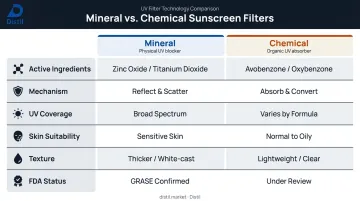
Mineral vs. Chemical Sunscreen: Quick Comparison
| Dimension | Mineral | Chemical |
|---|---|---|
| Active Ingredients | Zinc oxide (ZnO), titanium dioxide (TiO₂) | Avobenzone, oxybenzone, octinoxate, octocrylene, homosalate, octisalate |
| Mechanism | Primarily UV absorption; reflection/scattering <5% of protection | UV absorption → converted to heat via photochemical reaction |
| UV Coverage | ZnO: full UVA1+UVA2+UVB; TiO₂: strong UVB/UVA2, weaker UVA1 | Varies by filter; multi-filter blends required for broad spectrum |
| Skin Suitability | Sensitive, acne-prone, pediatric, pregnancy-safe | Better suited to normal/oily skin; some actives (oxybenzone) can cause contact sensitization |
| Texture & Elegance | Can leave white cast; mitigated by particle engineering | Lighter, non-whitening; more cosmetically versatile |
| FDA Status | ZnO and TiO₂: proposed GRASE | 12 marketed organic filters pending additional safety data |
| Environmental | Non-nano forms not subject to reef bans; nano/excipient profile requires case-by-case review | Oxybenzone and octinoxate restricted in Hawaii (from Jan 2021) and Palau (from Jan 2020) |
One important correction to the common narrative: ZnO and TiO₂ are commonly labelled "physical blockers" that reflect UV. Research by Cole et al. found that both metal oxides protect primarily through absorption, with reflection and scattering contributing less than 5% to protection. The term "physical sunscreen" persists in consumer labelling — formulators citing reflection-based protection in technical documents or claims should update their language accordingly.
What Is Mineral Sunscreen?
Mineral sunscreens use inorganic particles — zinc oxide (ZnO) and titanium dioxide (TiO₂) — as their UV-active ingredients. These are the only two sunscreen actives the FDA has proposed as GRASE (Generally Recognized as Safe and Effective) under FDA OTC Monograph M020, listed at concentrations up to 25% each.
Zinc Oxide: The Broad-Spectrum Mineral
ZnO is the stronger broad-spectrum option of the two. It attenuates UV across UVA1, UVA2, and UVB, making it the primary mineral choice when long-wave UVA protection is a formulation priority. This protection works primarily through absorption rather than reflection — a distinction that matters for formulation stability and photostability claims.
Concentration matters. FDA monograph limits allow ZnO up to 25%, and finished-product SPF and broad-spectrum testing — not ZnO percentage alone — determines whether a formula meets labeling requirements. Formulators should validate UVA coverage via critical wavelength testing on the finished product.
Titanium Dioxide: The UVB Workhorse
TiO₂ excels at UVB and short-wave UVA2 attenuation but provides weaker long-wave UVA1 coverage compared to ZnO. This spectral gap is why TiO₂ is rarely used as a stand-alone mineral filter in formulations claiming full broad-spectrum protection. Combining ZnO and TiO₂ gives complementary spectral coverage — TiO₂ handles UVB efficiency and opacity, ZnO fills in the long-UVA gap.
Particle Engineering Variables That Drive Performance
The performance of a mineral filter isn't just about which oxide you use — it's about how the particle is engineered:
- Particle size: Nano-sized particles improve transparency by reducing visible scattering; non-nano grades are preferred for reef-safe claims and sensitive-skin positioning
- Surface coatings: Silica, dimethicone, or fatty acid coatings prevent agglomeration and improve dispersion uniformity. For TiO₂, coatings are particularly important to suppress photocatalytic free radical generation
- Dispersing agents: Polyhydroxystearic acid (PHS) and similar agents are used in pre-dispersed systems to ensure uniform particle distribution and consistent SPF per application
- Dispersion consistency: Agglomerated particles create uneven UV attenuation — the primary reason pre-dispersed zinc oxide systems offer formulation advantages over straight powder incorporation
Distil supplies particle-engineered ZnO in powder and pre-dispersed formats — ultra-fine, micronized, and surface-treated grades — for formulators building mineral sunscreens and SPF moisturizers where white cast reduction and broad-spectrum performance are both required.
When to Choose Mineral Filters
Mineral filters are the natural fit for:
- Baby and pediatric sunscreens
- Sensitive, reactive, or rosacea-prone skin formulations
- Products targeting hyperpigmentation (particularly when paired with iron oxide pigments for visible light/HEV protection)
- Brands pursuing reef-safe or clean beauty positioning
- Formulations where immediate protection on application (no wait time) matters
What Is Chemical Sunscreen?
Chemical (organic) UV filters are synthetic aromatic compounds that absorb UV radiation and release it as low-level heat through a photochemical reaction. Unlike mineral filters, they don't form a surface barrier; they integrate into the upper skin layers, which is why a 15–20 minute application wait time is needed before full protection activates.
Key Chemical UV Filter Actives
No single chemical filter covers the full UV spectrum. Broad-spectrum protection requires combinations, and photostability management adds another layer of formulation complexity.
| Filter | UV Role | FDA Monograph Limit |
|---|---|---|
| Avobenzone | Primary UVA1 absorber (photounstable; needs stabiliser) | Up to 3% |
| Oxybenzone | UVB + short UVA | Up to 6% |
| Octinoxate | UVB | Up to 7.5% |
| Octocrylene | UVB + avobenzone stabiliser | Up to 10% |
| Homosalate | UVB | Up to 15% |
| Octisalate | UVB + avobenzone solubiliser | Up to 5% |
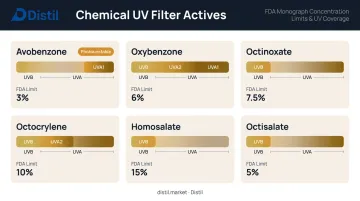
Avobenzone deserves particular attention: it is the only FDA-listed chemical filter with meaningful UVA1 coverage, but it degrades under UV exposure. Formulators typically pair it with octocrylene or another photostabiliser to maintain UV performance. A 2023 peer-reviewed review confirmed avobenzone photoinstability remains a core formulation challenge — and it's a key reason why EU-approved next-generation filters have attracted significant formulator interest.
EU vs. US Regulatory Divergence
The EU Cosmetics Regulation Annex VI operates as a positive list that includes UV filters absent from FDA Monograph M020 — including Tinosorb S (BEMT), Tinosorb M (MBBT), Mexoryl SX, and Mexoryl XL. These next-generation EU-approved filters offer improved photostability and broader spectral profiles, enabling broad-spectrum coverage with fewer stabiliser dependencies.
Brands targeting both US and EU markets need distinct UV filter strategies for each region. What's formulation-legal in Europe may not be permitted in a US OTC sunscreen.
Regulatory Caution on Systemic Absorption
The FDA's proposed order notes that 12 marketed organic filters — including oxybenzone, octinoxate, and octocrylene — require additional safety data before a GRASE determination can be made. This is not a finding that these filters are unsafe, but it does represent regulatory uncertainty that brand owners in the US market should factor into positioning decisions.
Separately, oxybenzone and octinoxate face sales restrictions in certain jurisdictions for environmental reasons. Hawaii's Act 104 prohibited the sale of sunscreens containing these two filters without a prescription, effective January 1, 2021. Palau enacted a broader ban covering multiple sunscreen chemicals, effective January 1, 2020.
When to Choose Chemical Filters
Chemical UV filters are the preferred route for:
- Lightweight daily SPF moisturisers and serums
- Tinted foundations and hybrid beauty-SPF products
- Water-resistant and sport formulations, where film-forming agents support durability
- High-SPF targets where mineral-only routes would compromise texture
- Markets with access to EU-approved next-generation filters
Which Filter Type Is Right for Your Formulation?
Neither filter class is categorically superior. The decision depends on target consumer, desired texture, regulatory market, SPF/UVA target, and brand positioning. Here's how to think through it:
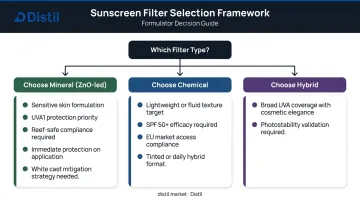
Decision Framework
Choose mineral (ZnO-led) when:
- Formulating for sensitive, reactive, pediatric, or pregnancy-safe profiles
- Broad UVA1 coverage is a priority and you want regulatory simplicity in the US
- Reef-safe claims are part of brand positioning
- Immediate protection on application is a feature worth communicating
- Plan for white cast mitigation: nano particle selection, surface coatings, iron oxide tinting
Choose chemical filters when:
- Lightweight texture and non-whitening finish are non-negotiable
- You're targeting SPF 50+ where mineral-only routes create cosmetic challenges
- You're formulating for markets with EU-approved filter access
- Daily-wear or tinted hybrid products are the target format
Choose a hybrid approach when:
- You need the UVA breadth of mineral filters with the cosmetic elegance of chemical ones
- Note: hybrid systems require photostability and broad-spectrum validation as a system. Research shows that ZnO combined with small-molecule organic filters can introduce unintended efficacy changes under UV exposure.
A Note on SPF Boosters
An important formulation integrity issue: certain non-UV-active ingredients (such as butyloctyl salicylate, tridecyl salicylate, and anti-inflammatory agents like niacinamide) can inflate in-vivo SPF test scores by reducing the skin redness endpoint used in SPF testing, rather than by attenuating UV light. This practice — sometimes called "sunscreen doping" — raises questions about whether labeled SPF reflects real-world UV protection.
For brands competing on genuine performance, the quality of raw materials, accurate active concentrations, and rigorous finished-formula testing matter more than any single formulation shortcut.
The Role of Ingredient Quality
That same commitment to formulation integrity extends to raw material quality. Regardless of filter type, real-world sunscreen performance depends on:
- Active ingredient purity — benzene was detected in sunscreen batches documented in Valisure's 2021 citizen petition, underscoring why verified suppliers with consistent quality systems matter
- Particle dispersion quality — agglomeration in mineral filters creates uneven SPF across the film
- Concentration accuracy — under-dosing actives directly undermines protection, regardless of claims
- Stabilizer and preservative systems — particularly critical for avobenzone-based chemical formulations

Distil's R&D-led approach to personal care ingredient sourcing is built around these variables. Their team — with backgrounds at Dow, BASF, L'Oréal, Huntsman, and Reliance Industries — manages ingredient selection, formulation development, and scale-up through a single point of contact, with IP retained by the brand.
Conclusion
Mineral and chemical sunscreens represent two distinct protective chemistries, each with defined strengths and trade-offs. For formulators, the question is never which is simply "better" — it's which aligns with the formulation's performance targets, regulatory requirements, and the end consumer it's designed for.
What determines whether a sunscreen actually works as labeled isn't the filter category. It's ingredient quality, concentration precision, dispersion integrity, and validated finished-formula testing. Brands that treat those variables with rigor — and source from ingredient partners who hold the same standard — consistently produce sunscreens that perform as labeled and withstand both regulatory review and consumer expectations. That's where ingredient sourcing decisions, including the choice of mineral UV filter supplier, become a formulation variable in their own right.
Frequently Asked Questions
What ingredients are in mineral sunscreen?
The active ingredients in mineral sunscreen are zinc oxide and titanium dioxide — the only two UV filters the FDA has proposed GRASE status for. Formulations also include inactive ingredients such as emollients, humectants, dispersing agents, and (in tinted versions) iron oxide pigments.
What should not be in mineral sunscreen?
Formulations marketed as mineral-only should avoid chemical UV filters (oxybenzone, octocrylene, avobenzone), synthetic fragrance, and high-risk preservatives that undermine the gentle positioning. Nano-particle zinc oxide or titanium dioxide may also warrant disclosure depending on regional regulations and target use case. On the formulation-testing side, SPF-inflating agents — such as butyloctyl salicylate or anti-inflammatory actives used purely to reduce test-endpoint redness — should not appear in mineral-only claims, as they do not provide meaningful UV attenuation.
Do dermatologists recommend mineral sunscreen?
Dermatologists widely recommend mineral sunscreens — particularly zinc oxide-based formulas — for sensitive skin, children, pregnant women, and those with acne or rosacea. Their inert, non-irritating profile and immediate broad-spectrum protection make them the lower-risk choice for these groups.
Can mineral and chemical sunscreens be combined in one formula?
Yes. Hybrid formulations combining mineral filters (typically ZnO) with one or more chemical UV filters are common. They can offer the broad UVA coverage of mineral filters alongside the lighter texture of chemical formulations, but photostability validation of the complete system is essential before finalising the formula.
Which sunscreen is better for sensitive skin?
Mineral sunscreens are generally preferred for sensitive, reactive, or eczema-prone skin. Zinc oxide and titanium dioxide are inert and non-irritating, whereas some chemical actives — particularly oxybenzone — can cause contact sensitisation in predisposed individuals.
Is mineral sunscreen reef-safe?
Non-nano zinc oxide and titanium dioxide are not subject to the oxybenzone and octinoxate bans enacted in Hawaii and Palau. However, nano-particle forms and certain formulation excipients carry different environmental profiles, so reef-safe claims should be evaluated at the finished-product level rather than assumed based on filter category alone.