This guide covers the true mineral and geological origins of zinc oxide, how it is derived from natural sources during industrial production, and what this means for personal care applications — from sunscreen to barrier creams to anti-aging formulations.
Key Takeaways
- The only naturally occurring mineral form of zinc oxide is zincite — rare, geologically concentrated, and not a viable commercial source
- All commercial ZnO originates from naturally occurring zinc-bearing ores — primarily sphalerite — sourced from nature regardless of processing method
- The French (indirect) process produces the highest-purity ZnO preferred for personal care
- Particle size and surface treatment matter more than the "natural" label for formulation performance
- FDA permits zinc oxide in sunscreen up to 25%; it is the only approved broad-spectrum mineral UV filter
- Biogenic ZnO synthesis — via plant extract–mediated processes — is proven at lab scale but not yet commercially viable for cosmetics
What Is Zinc Oxide and Where Does It Come From in Nature?
Zinc oxide is an inorganic compound with the formula ZnO (CAS 1314-13-2). It is a white, odourless powder with an important chemical property: it is amphoteric, meaning it dissolves in both acids and strong alkalis. That dual reactivity explains why ZnO performs across such a wide range of formulation types.
Zincite: The Only True Mineral Form
The naturally occurring mineral form of zinc oxide is zincite. In its ideal chemical state, zincite is pure ZnO, but in practice, natural crystals are rarely white. Manganese and iron substitute into the crystal lattice, producing colours ranging from yellow and orange to deep red. Well-formed zincite crystals are exceedingly rare; most natural occurrences are massive, foliated, or granular.
The most significant natural occurrences include:
- Franklin and Sterling Hill, New Jersey, USA — Classic and globally significant zincite localities, where zincite carries approximately 80 wt.% Zn and makes up roughly 1% of the bulk ore
- Tsumeb, Namibia — A notable secondary occurrence
- Zawar, Rajasthan, India — One of the world's earliest zinc metallurgy sites, with radiocarbon dating placing smelting activity here at approximately 2,000 years ago
Why Natural Zincite Is Not a Commercial Source
Natural zincite deposits are geologically rare and concentrated in a handful of locations. They have never been commercially viable for industrial or cosmetic ZnO production. The compound is too scarce, too impure, and too unevenly distributed.
The real "natural source" story for commercial ZnO lies upstream, in the zinc-bearing ores that feed the manufacturing process. Commercially produced ZnO is nature-derived in origin, processed rather than mined directly in its final form.
Natural Zinc-Bearing Ores: The Starting Point for ZnO Production
According to the USGS, sphalerite (zinc sulfide) is and has been the world's principal zinc ore mineral. Global mine production reached an estimated 13.0 million tonnes of zinc content in 2025, led by China (4.1M tonnes), Peru (1.5M tonnes), and Australia (1.1M tonnes).
The Four Primary Zinc-Bearing Minerals
| Mineral | Formula | Notes |
|---|---|---|
| Sphalerite | ZnS | Dominant commercial zinc ore globally; the primary feedstock for ZnO production |
| Smithsonite | ZnCO₃ | Secondary carbonate zinc mineral in oxidised deposits |
| Hemimorphite | Zn₄Si₂O₇(OH)₂·H₂O | Found in oxidised zones of zinc-bearing deposits |
| Willemite | Zn₂SiO₄ | Important at Franklin/Sterling Hill, but not a major global ZnO feedstock |
From Ore to Oxide: The Processing Chain
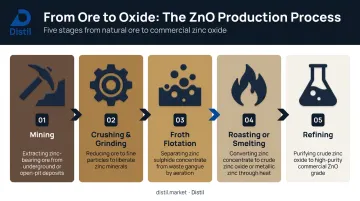
Each mineral in the table above enters a distinct processing chain before it becomes commercial ZnO. The steps are consistent across ore types:
- Mining — Open-pit or underground extraction of zinc ore
- Crushing and grinding — Mechanical reduction to increase surface area
- Froth flotation — Beneficiation to produce zinc concentrate
- Roasting or smelting — Thermal conversion of zinc sulfide concentrate to zinc oxide or metallic zinc
- Refining — Further purification to achieve target purity grades
The purity and trace-element profile of the original ore carries through every stage of this chain. Cosmetic and pharmaceutical ZnO therefore requires additional purification steps beyond what industrial grades demand. Suppliers serving those markets should be able to demonstrate traceability back to the source ore.
How Natural Zinc Sources Are Processed into Commercial Zinc Oxide
Three production routes convert natural zinc sources into commercial ZnO. Each yields a different purity and particle profile, which directly determines whether the output is suited for personal care or industrial applications.
The French (Indirect) Process
The French process is the preferred route for high-purity cosmetic and pharmaceutical ZnO. Refined metallic zinc is melted and vaporised above 907°C; the zinc vapour oxidises in air, and the resulting ZnO particles are collected. Starting from refined metal rather than raw ore concentrates means fewer impurities carry through — this process consistently yields approximately 99.7% ZnO.
The American (Direct) Process
The American process starts from zinc ore concentrates, zinc ash, or smelter by-products. Carbothermic reduction precedes oxidation, which introduces additional impurity pathways. The result is a lower-cost product better suited to industrial applications like rubber vulcanisation than to leave-on personal care.
The Wet Chemical Process
Zinc salts derived from ore processing (such as zinc sulfate or zinc acetate) are dissolved in water, precipitated as zinc carbonate or zinc hydroxide intermediates, then calcined at around 800°C to yield ZnO. This route offers precise control over particle morphology and is increasingly used for cosmetic-grade and nano-grade ZnO production.
Why Production Method Matters for Formulators
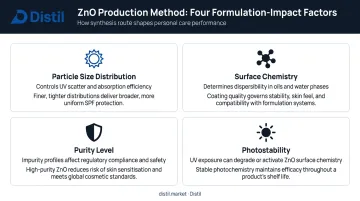
For personal care applications, knowing the production route is not just academic. It determines:
- Particle size distribution — affects UV scatter, SPF performance, and skin feel
- Surface chemistry — influences dispersibility and formulation stability
- Purity level — governs regulatory compliance and shelf life
- Photostability — determines how well a sunscreen formulation holds up over time
Zinc Oxide in Personal Care and Skincare Applications
Zinc oxide holds a unique regulatory position: it is the only broad-spectrum mineral UV filter approved by the US FDA as a sunscreen active ingredient, permitted at concentrations up to 25%. It blocks both UVB (280–320 nm) and UVA (320–400 nm) radiation, is classified as non-irritating, non-allergenic, and non-comedogenic, and is considered GRASE (Generally Recognised As Safe and Effective) under FDA's 2022 review.
Sunscreen and UV Protection
Modern sunscreen formulations use ZnO in two broad particle size categories:
- Micronised (non-nano) ZnO — Provides reliable physical UV protection; may produce some white cast but is preferred where nanoparticle considerations are a concern
- Nano-ZnO — Smaller particles do not scatter visible light, reducing the white cast associated with traditional mineral sunscreens
On the safety question: a 2019 study published in the Journal of Investigative Dermatology found no evidence of ZnO nanoparticle skin penetration or cellular toxicity following repeated application in human volunteers. The TGA's 2017 review similarly concluded that systemic absorption is highly unlikely.
Does Zinc Oxide Help with Wrinkles?
The most evidence-backed anti-aging contribution from zinc oxide is consistent daily UV protection — blocking the photo-ageing that causes wrinkles, pigmentation, and loss of elasticity. That is not a minor point; photoageing is the dominant driver of visible skin ageing.
Beyond UV blocking, zinc ions play a documented role in wound repair biology. A 2018 review published in PMC confirms zinc's significant functions across wound healing, including collagen synthesis support. At typical topical concentrations in cosmetic formulations, however, direct wrinkle-reversal effects are modest — the UV protection mechanism remains the primary anti-aging benefit.
Other Personal Care Applications
ZnO's utility extends well beyond sunscreen:
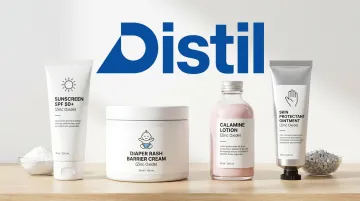
- Diaper rash and barrier creams — FDA's OTC Skin Protectant Monograph permits ZnO in ointment use from 25–40%, where it forms a protective film over irritated skin
- Calamine-based soothing products — Used as a photoprotecting and soothing agent in dermatology
- Acne-adjacent formulations — Included in zinc therapy dermatology reviews, though evidence relates more broadly to zinc rather than ZnO specifically
- Skin protectant ointments — Barrier and wound-care applications supported by the FDA skin protectant monograph
Personal care formulators sourcing ZnO grades — from sunscreen-grade micronised and nano-ZnO powders to pre-dispersed systems for barrier formulations — can work with Distil's personal care team for targeted trials and formulation support. The R&D team brings backgrounds from Dow, BASF, L'Oréal, Huntsman, and Reliance Industries.
Natural vs. Synthetic Zinc Oxide: What the Distinction Means for Formulators
The Regulatory Reality
The "natural vs. synthetic" framing applied to zinc oxide is more legally nuanced than it appears. Commercially produced ZnO — regardless of whether it was made via the French, American, or wet chemical route — originates from naturally occurring zinc minerals. Under COSMOS v4.0, which defines "natural origin" to include water, minerals, and ingredients of mineral origin, commercially produced ZnO qualifies as a mineral-origin ingredient.
ISO 16128-2:2017 provides calculation frameworks for natural-origin indexes, but a ZnO-specific index from ISO itself is not publicly available. Formulators should request the ISO 16128 calculation sheet directly from their ingredient supplier.
The cleaner framing for marketing and regulatory purposes: "Zinc oxide is a mineral-origin inorganic UV filter produced from natural zinc-bearing ores through controlled industrial purification."
What Actually Differs: Cosmetic Grade vs. Industrial Grade
Both cosmetic-grade and industrial-grade ZnO originate from the same natural source materials. What separates them:
- Meets 99.0–100.5% ZnO purity per USP benchmarks, with tightly controlled heavy metal limits (lead, arsenic, cadmium)
- Particle size distribution controlled for UV performance and skin feel
- Surface coatings (silicone, silica, alumina, or stearic acid types) engineered for dispersibility and photostability in leave-on formulations
- Comes with Certificates of Analysis confirming USP, BP, or EP compliance
The "natural" label does not determine product performance. Purity, particle size, and surface treatment do.
Green Chemistry and Biogenic Approaches to Zinc Oxide Synthesis
Plant extract–mediated (biogenic) ZnO synthesis is an active area of research. Plant-derived compounds act as natural reducing and capping agents, enabling ZnO nanoparticle formation at lower temperatures without harsh chemical reagents.
Two peer-reviewed examples illustrate the current state:
- Aloe vera extract — A 2020 study in Heliyon demonstrated ZnO biosynthesis using aloe vera, with SEM characterisation of the resulting particles
- Neem (Azadirachta indica) extract — A 2024 study in PMC reports ZnO nanoparticle biosynthesis with neem extract and characterisation of antibacterial and anticancer activity
The challenge is the gap between laboratory results and commercial reality. A 2024 green-synthesis review published in PMC states that traditional production methods offer higher yield, consistency, and scalability — and that green methods still face reproducibility and scale-up challenges. Regulators assess nano-ZnO by particle characteristics, concentration, coating, and exposure route regardless of whether the synthesis route was biogenic.

Biogenic ZnO is best described as emerging green chemistry, not a current mainstream supply option. For brands tracking these developments, the near-term priority is monitoring scale-up progress and regulatory guidance on biogenic nano-ZnO — both of which will determine how quickly these routes move from the lab into commercial supply chains.
Frequently Asked Questions
What is the natural source of zinc oxide?
Zincite is the only naturally occurring mineral form of zinc oxide, found in rare deposits at Franklin and Sterling Hill (New Jersey, USA) and Tsumeb, Namibia. All commercial ZnO is manufactured from zinc-bearing ores such as sphalerite (zinc sulfide) and smithsonite (zinc carbonate), making it nature-derived even though it is not directly mined in finished form.
Will zinc oxide help wrinkles?
Zinc oxide benefits ageing skin mainly by blocking UVA and UVB radiation, the leading driver of photo-ageing and wrinkles. Zinc ions support wound repair and collagen synthesis, but direct anti-wrinkle effects at standard topical concentrations are modest. The strongest evidence-backed contribution remains consistent daily broad-spectrum sun protection.
What is the difference between natural and synthetic zinc oxide?
All commercial zinc oxide originates from naturally occurring zinc minerals, so the "natural vs. synthetic" distinction largely refers to processing route. What differs for formulators is purity level, particle size, and surface treatment rather than any meaningful "natural" classification. Cosmetic-grade ZnO must meet strict purity and heavy metal specifications regardless of which production method was used.
Is zinc oxide safe for sensitive skin?
Zinc oxide ranks among the gentlest UV-filtering and skin-barrier ingredients available, classified as non-irritating, non-allergenic, and non-comedogenic. It is a go-to choice for sensitive, reactive, or infant skin formulations, and its physical UV-blocking mechanism does not involve chemical penetration.
What purity level of zinc oxide is required for personal care formulations?
Cosmetic-grade zinc oxide typically requires a minimum purity of 99.0–100.5% ZnO per USP benchmarks, with controlled limits on heavy metals including lead, arsenic, and cadmium. Formulators should always request a Certificate of Analysis and confirm the grade meets applicable regional pharmacopoeia standards (USP, BP, or EP) before use.
Can zinc oxide be produced from plant extracts?
Plant extract-mediated (biogenic) synthesis of ZnO nanoparticles is an active research area, using reducing agents from aloe vera, green tea, and neem. Production remains at laboratory or pilot scale; commercial cosmetic manufacturing still relies on conventional routes, and regulatory frameworks for biogenic ZnO in leave-on products continue to evolve.