What makes ZnO genuinely interesting is its amphoteric nature: it reacts as a base with acids and as an acid with bases, producing entirely different salts depending on conditions. That single chemical characteristic, combined with a wide-bandgap semiconductor structure and exceptional thermal stability, explains why ZnO appears across industries as different as sunscreen and surge arresters.
This article covers ZnO's crystal structure, physical and electronic properties, its amphoteric reactions with balanced equations, and how these fundamentals map directly onto industrial use cases — from rubber vulcanization to personal care formulations.
Key Takeaways
- ZnO is a white, odourless inorganic solid (molar mass 81.4 g/mol, density ~5.6 g/cm³) with amphoteric character — it reacts with both acids and bases
- Its hexagonal wurtzite structure (space group P6₃mc) gives it piezoelectricity, pyroelectricity, and a direct band gap of ~3.3 eV
- Acts as both an acid and base: dissolves in HCl to form zinc chloride and reacts with NaOH to form soluble zincate — a defining amphoteric behaviour
- 50–60% of global ZnO production goes into rubber vulcanisation; other major uses include personal care, ceramics, and electronics
- FDA-listed as GRAS and approved for topical use; handle with care in aquatic environments — classified Aquatic Acute 1 (H400) and Aquatic Chronic 1 (H410) under EU GHS
What Is Zinc Oxide? Formula, Structure, and Thermochromism
Identity and Basic Properties
Zinc oxide (formula ZnO, molar mass 81.4 g/mol) occurs naturally as the rare mineral zincite but is produced almost exclusively through synthetic industrial processes for commercial applications. According to PubChem, it is a white, odorless solid with:
- Density: ~5.6 g/cm³
- Melting/decomposition point: ~1975°C
- Water solubility: practically insoluble (~0.0004% at 18°C)
- Appearance: white powder that is hydrophilic but does not dissolve in water
Crystal Structure
A comprehensive peer-reviewed ZnO review identifies three polymorphic forms:
| Polymorph | Conditions | Structure |
|---|---|---|
| Wurtzite | Ambient (stable) | Hexagonal, space group P6₃mc |
| Zincblende | Metastable on cubic substrates | Cubic |
| Rocksalt | High pressure (~10 GPa) | Cubic |
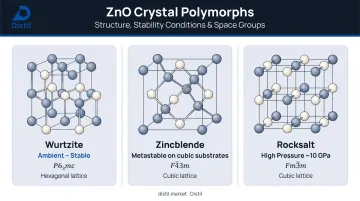
The wurtzite form dominates in virtually all applications. Both Zn²⁺ and O²⁻ adopt tetrahedral coordination, creating a highly ionic bond character. This non-centrosymmetric geometry is directly responsible for ZnO's piezoelectric and pyroelectric behaviour.
Thermochromic Behaviour
When heated in air, ZnO undergoes a reversible colour shift from white to yellow. This is not a chemical reaction but a result of minor non-stoichiometry (Zn₁₊ₓO): oxygen loss at elevated temperatures creates excess zinc interstitials that alter the material's optical properties. The colour returns to white on cooling. For processors and formulators, this behaviour serves as a straightforward visual indicator of thermal history — useful for quality checks during high-temperature manufacturing stages.
Physical Properties of Zinc Oxide
Mechanical and Thermal Properties
ZnO is a relatively soft material with a Mohs hardness of approximately 4.5, but its thermal properties are what drive industrial value:
- High melting stability (~1975°C) — useful in high-temperature ceramic processes
- Low thermal expansion coefficient — critical for dimensional stability in glazes and frits
- High thermal conductivity — contributes to heat dissipation in rubber compounds
These properties make ZnO particularly valuable as a ceramic flux and as a heat-management agent in rubber compounding, where thermal degradation resistance directly affects product lifespan.
Electronic and Optical Properties
ZnO is a well-documented n-type semiconductor with a direct wide band gap of 3.3 eV at 300 K. Key electronic benchmarks:
- Room-temperature bulk electron mobility: ~200 cm²/(V·s)
- Low-temperature peak mobility: ~2000 cm²/(V·s) at 50 K
This wide band gap translates to several practical advantages:
- High breakdown voltage — enables use in surge arrester varistors
- Low electronic noise — suitable for high-frequency devices
- UV emission capability — underlies ZnO-based LED and UV laser applications
ZnO also absorbs strongly across both UVA (320–400 nm) and UVB (280–320 nm) spectra. Its piezoelectric and pyroelectric properties, both arising from the non-centrosymmetric wurtzite structure, extend its utility further. Few inorganic materials serve simultaneously as a UV filter, a transducer material, and a functional semiconductor.
Chemical Properties and Amphoteric Nature of Zinc Oxide
Amphoteric means a compound can react as either an acid or a base depending on conditions. ZnO illustrates this directly: the same compound dissolves in hydrochloric acid to form a zinc salt, and dissolves in sodium hydroxide to form a zincate salt.
Reaction with Acids (ZnO Acting as a Base)
In acidic conditions, ZnO accepts protons and forms zinc salts with water:
ZnO + 2HCl → ZnCl₂ + H₂O
This pattern holds across mineral acids. With sulfuric acid: ZnO + H₂SO₄ → ZnSO₄ + H₂O. ZnO is nearly insoluble in neutral water but dissolves readily in acidic solutions — a useful property for controlled-release applications.
Reaction with Bases (ZnO Acting as an Acid)
In alkaline conditions, ZnO donates oxide ions and forms zincate complexes:
- Fusion (anhydrous, high temperature): ZnO + 2NaOH → Na₂ZnO₂ + H₂O (sodium zincate)
- Aqueous solution (~90°C): ZnO + 2NaOH + H₂O → Na₂[Zn(OH)₄] (sodium tetrahydroxozincate)
The product depends on the reaction medium: fusion yields the simple zincate (Na₂ZnO₂), while aqueous conditions with excess water produce the tetrahydroxozincate complex where zinc achieves four-coordinate hydroxide geometry.
Other Industrially Relevant Reactions
Beyond acid-base reactivity, ZnO participates in several high-temperature and catalytic reactions central to industrial processing:
| Reaction | Equation | Conditions | Application |
|---|---|---|---|
| Carbothermic reduction | ZnO + C → Zn(vapor) + CO | >950°C | Zinc smelting |
| Gas desulfurisation | ZnO + H₂S → ZnS + H₂O | 200–450°C | Syngas/natural gas purification |
| French process synthesis | 2Zn + O₂ → 2ZnO | ~910°C (zinc vapor) | Industrial ZnO manufacture |
| Sphalerite roasting | 2ZnS + 3O₂ → 2ZnO + 2SO₂ | High temperature | ZnO from ore |
| Dental cement formation | 3ZnO + 2H₃PO₄ → Zn₃(PO₄)₂ + 3H₂O | Aqueous | Zinc phosphate cements |
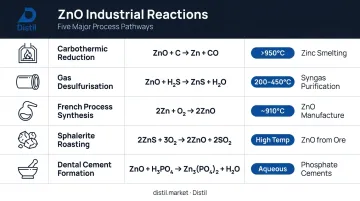
The carbothermic reduction route (>950°C) is preferred industrially over direct thermal decomposition (which requires ~1975°C), despite producing CO as a byproduct: the energy economics are considerably more favourable.
Zinc Hydroxide: The Amphoteric Sibling
ZnO absorbs moisture to form zinc hydroxide, Zn(OH)₂, which is also amphoteric:
- With acids: Zn(OH)₂ + H₂SO₄ → ZnSO₄ + 2H₂O
- With bases: Zn(OH)₂ + 2NaOH → Na₂[Zn(OH)₄] (aqueous)
- On heating: Zn(OH)₂ → ZnO + H₂O
This interconversion between ZnO and Zn(OH)₂ is relevant for storage stability — ZnO powders exposed to humid air gradually surface-convert to hydroxide, which can affect reactivity and performance in formulations.
n-Type Semiconductor Behaviour
Undoped ZnO is inherently n-type because minor non-stoichiometry (Zn₁₊ₓO) creates zinc interstitials that act as electron donors. This intrinsic electron-donor character makes undoped ZnO conductive without intentional doping, a key consideration when designing ZnO-based electronic devices where precise carrier concentration control is needed.
Industrial Applications of Zinc Oxide
Personal Care and Cosmetics
ZnO is listed under 21 CFR Part 352 as an allowed OTC sunscreen active ingredient at concentrations up to 25%. Its UV protection mechanism is physical rather than chemical: ZnO particles scatter, reflect, and absorb UV radiation without undergoing photochemical breakdown, making it photostable where chemical filters can degrade.
Key advantages over chemical UV filters:
- Broad-spectrum coverage across both UVA (including UVA1, 340–400 nm) and UVB
- No photodegradation products
- Non-irritating in typical formulations
- Approved as a GRAS food additive (21 CFR 182.8991)
Nano-grade ZnO (particle size <100 nm) is widely used in cosmetics to eliminate the white cast common with larger-particle mineral sunscreens.
EU Regulation 2016/621 permits both nano and non-nano ZnO as UV filters at up to 25%, with restrictions on inhalation-exposure formats.
Distil supplies ZnO UV filters in both powder and pre-dispersed formats — including coated, surface-treated, and micronized grades — for improved transparency and SPF performance. Distil also offers cosmetic esters such as coco-caprylate/caprate and neopentyl glycol diheptanoate, designed for co-formulation with mineral UV systems to improve skin feel without compromising SPF efficacy.
Rubber and Polymer Industry
According to a 2022 peer-reviewed rubber review, 50–60% of annual ZnO production is used in rubber applications — making it the single largest end-use segment globally.
ZnO functions as a vulcanization activator rather than a direct crosslinking agent. The mechanism:
- ZnO reacts with stearic acid to form zinc stearate in situ
- Zinc stearate activates the sulfur vulcanization accelerator system
- The activated system forms tighter, more uniform crosslinks throughout the rubber network
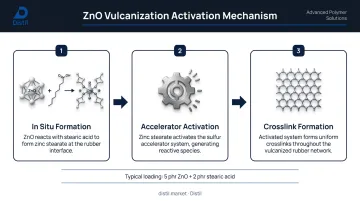
Typical loading is 5 phr ZnO + 2 phr stearic acid in tire formulations. Benefits include improved modulus, reduced heat buildup, and better abrasion resistance. Nanoparticle ZnO can reduce required loading to ~1.5 phr while maintaining or improving crosslink density — a direct cost and sustainability advantage given zinc's aquatic ecotoxicity profile.
Ceramics, Glass, and Construction
ZnO's combination of low thermal expansion, high melting stability, and reactivity with silica makes it valuable in several ways:
- Ceramic glazes: Small additions (1–3%) create glossy surfaces; higher amounts (8–15%) produce matte or crystalline zinc silicate finishes
- Glass formulations: Reduces thermal expansion and improves chemical durability
- Concrete and cement: Extends setting time, improves water resistance, and is used in quick-setting dental zinc phosphate cements
Electronics and Advanced Applications
ZnO's versatility extends well beyond bulk industrial use — its semiconductor properties underpin several distinct electronic functions:
- Varistors: Non-linear current-voltage characteristics make ZnO the active material in most metal-oxide surge arresters
- Transparent conductors: Aluminium-doped ZnO (AZO) offers a lower-cost alternative to indium tin oxide (ITO) in LCDs and solar cell front contacts
- ZnO nanorods detect H₂S, NO₂, and VOCs via surface conductance changes, making them effective gas sensors
- ZnO nanowire arrays convert mechanical vibration to electrical output, enabling piezoelectric energy harvesting
Other Industrial Uses
Beyond the major sectors above, ZnO serves several specialized roles:
- Gas desulfurization: ZnO guard beds remove H₂S from natural gas and syngas at 200–300°C before catalytic reforming, protecting downstream catalysts
- Nuclear applications: Depleted zinc oxide (with ≤1% ⁶⁴Zn) is injected into pressurized water reactor primary circuits at ~10 ppb to reduce corrosion-product release and stress corrosion cracking
- Pigments: "Zinc white" in paints and coatings
The global ZnO market is estimated at 2.36 million tons in 2025, projected to reach 2.92 million tons by 2031 at a 3.58% CAGR, according to Mordor Intelligence.
Safety, Toxicity, and Environmental Profile
Human Health
ZnO is FDA-approved as GRAS, non-irritating to skin and eyes in standard formulations, and widely used in wound care, diaper creams, and antifungal preparations. The primary occupational hazard is inhalation of ZnO fumes generated during welding galvanized steel or zinc smelting.
Exposure limits (OSHA/NIOSH):
| Limit Type | ZnO Fume | ZnO Dust |
|---|---|---|
| OSHA PEL (TWA) | 5 mg/m³ | 15 mg/m³ total / 5 mg/m³ respirable |
| NIOSH REL (TWA) | 5 mg/m³ | 5 mg/m³ |
| NIOSH Ceiling | 15 mg/m³ | 15 mg/m³ |
Exceeding these limits can cause metal fume fever — a reversible flu-like syndrome with chills, fever, muscular pain, and chest symptoms. Symptoms typically resolve within 24–48 hours after exposure ends.
Environmental Concerns
Beyond human health, ZnO's environmental profile has drawn increasing regulatory scrutiny. ECHA's harmonised classification lists ZnO as Aquatic Acute 1 (H400) and Aquatic Chronic 1 (H410) — very toxic to aquatic life with long-lasting effects. Two specific concerns are shaping current regulatory activity:
- A 2018 peer-reviewed study found uncoated ZnO induces coral bleaching by disrupting the coral-zooxanthellae symbiosis; effects were observed at concentrations as low as 100 µg/L
- Maui County Ordinance No. 5306 (effective October 2022) restricts chemical sunscreen filters and recommends non-nanotized ZnO or TiO₂ as reef-compatible alternatives
These regulations have created measurable commercial demand for non-nano, uncoated ZnO grades — formulated without chemical filters and verified at particle sizes above 100 nm — in mineral sunscreen development.
Frequently Asked Questions
Is zinc oxide amphoteric or acidic?
ZnO is amphoteric — it reacts with acids (such as HCl) to form zinc salts and with bases (such as NaOH) to form zincate salts. This distinguishes it from purely basic metal oxides like CaO or MgO, which react only with acids.
Is zinc oxide good or bad for your skin?
ZnO is broadly beneficial for skin. It is FDA-listed as an OTC sunscreen active, has anti-inflammatory and antibacterial properties, and is used in wound care and diaper creams. Topical use is considered safe; the concern is inhalation of ZnO powder or fumes, not skin contact.
Is zinc oxide 100% natural?
ZnO occurs naturally as the mineral zincite, but the overwhelming majority of commercial ZnO is synthetically manufactured via the French (indirect) process or direct thermal processes. Synthetic and naturally derived ZnO are chemically identical — the difference is production method, not molecular structure.
What are the main chemical reactions of zinc oxide?
The key reaction categories are:
The key reaction categories are:
- Reaction with acids → zinc salts + water
- Reaction with bases → zincate salts
- Carbothermic reduction to zinc metal at >950°C
- Reaction with H₂S for gas desulfurization at 200–450°C
- Thermal decomposition to zinc vapor + oxygen at ~1975°C
Is zinc oxide soluble in water?
ZnO is practically insoluble in neutral water (~0.0004% at 18°C). However, it dissolves readily in both acidic and alkaline solutions due to its amphoteric character. That insolubility makes ZnO stable in skin-care formulations and protective coatings without requiring additional solubility controls.
What is the difference between nano zinc oxide and regular zinc oxide?
Nano ZnO (particle size <100 nm per EU cosmetics definition) has higher surface area, greater UV absorption per unit mass, and less white cast than micron-scale ZnO — making it the preferred grade for transparent sunscreens. However, nano grades carry specific regulatory requirements and remain under review for aquatic environmental safety.