
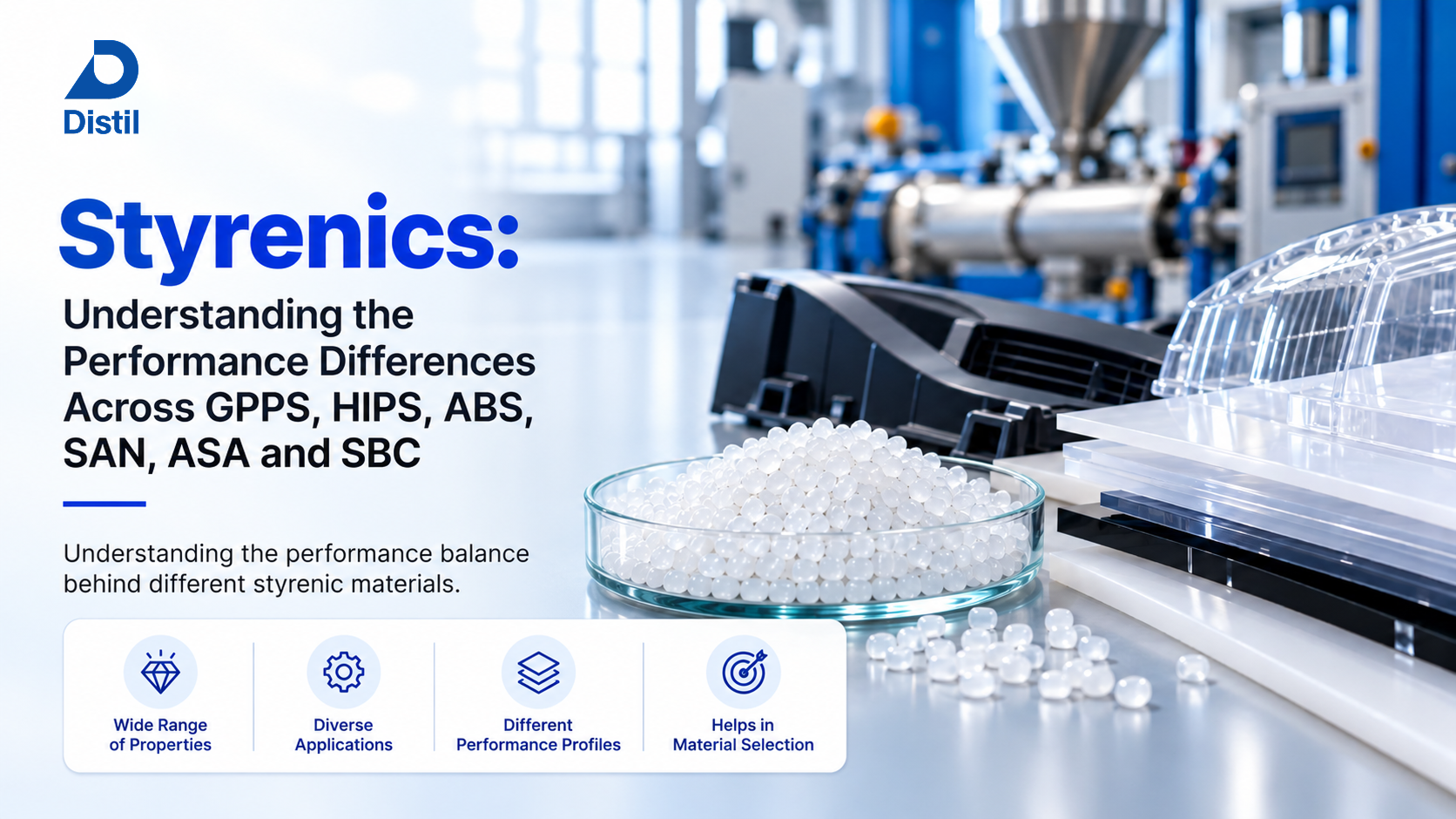
Styrenics cover a diverse group of materials that share a common styrenic backbone but offer distinctly different performance profiles. GPPS, HIPS, ABS, SAN, ASA and SBC can differ significantly in properties such as impact resistance, rigidity, optical clarity, chemical resistance, flexibility and weatherability.
For material selection, understanding these differences is important because different applications demand different combinations of performance.
The six styrenic materials—GPPS, HIPS, ABS, SAN, ASA and SBC—offer different balances of engineering properties. GPPS combines high clarity with high rigidity, while HIPS offers high impact resistance with medium stiffness. ABS provides a balance of high impact resistance and high stiffness. SAN combines high clarity with chemical resistance, ASA is positioned around high weatherability and UV stability, and SBC offers high flexibility with transparency.
These performance differences correspond to different application areas, ranging from transparent packaging and household products to appliance housings, automotive components, electronics housings and flexible packaging. Selecting between these materials therefore depends on the performance requirements of the intended application.
GPPS, HIPS, ABS, SAN, ASA and SBC belong to the same styrenic polymer family, but they are not interchangeable in terms of performance. Their individual property profiles create different opportunities across applications.
The key distinction lies in the balance of properties each material provides. Impact resistance, rigidity, optical clarity, chemical resistance, flexibility and weatherability are among the characteristics that differentiate these materials.
Rather than looking at styrenics as a single material category, it is useful to consider where each material sits across these performance requirements.
Different applications require different combinations of performance, from clarity and flexibility to strength and weatherability. The applications associated with the six materials illustrate how these differences translate into practical material choices.
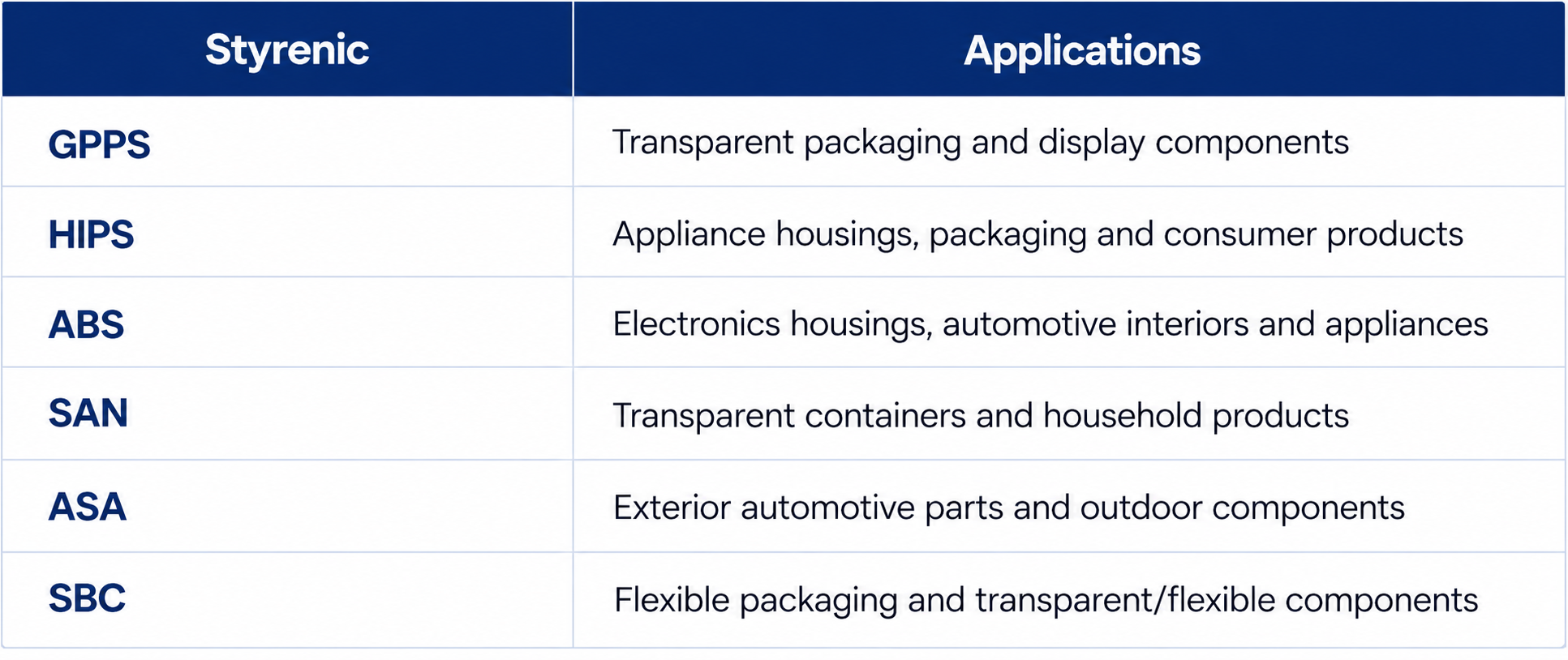
This range demonstrates the breadth of applications covered by the styrenic family. Transparency, impact performance, flexibility and outdoor performance can each become important depending on the end use.
A closer look at the key engineering properties helps clarify the differences between the materials.
Impact resistance relates to the ability to withstand sudden forces and shocks. It becomes one of the differentiating performance characteristics when comparing styrenic materials.
HIPS is identified with high impact performance, while ABS combines high impact with high stiffness.
Rigidity relates to maintaining shape and dimensional stability. The materials differ in how strongly this characteristic features within their overall performance balance.
GPPS is identified with high rigidity alongside high clarity, while HIPS is associated with high impact and medium stiffness. ABS provides a balance of high impact and high stiffness.
Optical clarity relates to transparency and light transmission. This property is particularly relevant to applications involving transparent components and packaging.
GPPS is positioned around high clarity and high rigidity, SAN around high clarity and chemical resistance, while SBC combines high flexibility with transparency.
Chemical resistance describes the ability to withstand exposure to chemicals, solvents and harsh environments. SAN is identified with high clarity and chemical resistance, making these two properties a defining part of its performance profile.
Flexibility enables elasticity and flexibility for dynamic applications. SBC is identified with high flexibility and transparency, giving it a distinct position among the six styrenic materials.
Weatherability relates to performance under UV exposure, heat and outdoor conditions. ASA stands out within the group for its combination of high weatherability and UV stability, with applications including exterior automotive parts and outdoor components.
The performance map places GPPS, HIPS, ABS, SAN, ASA and SBC across six engineering properties: impact resistance, rigidity, heat resistance, chemical resistance, optical clarity and weatherability.
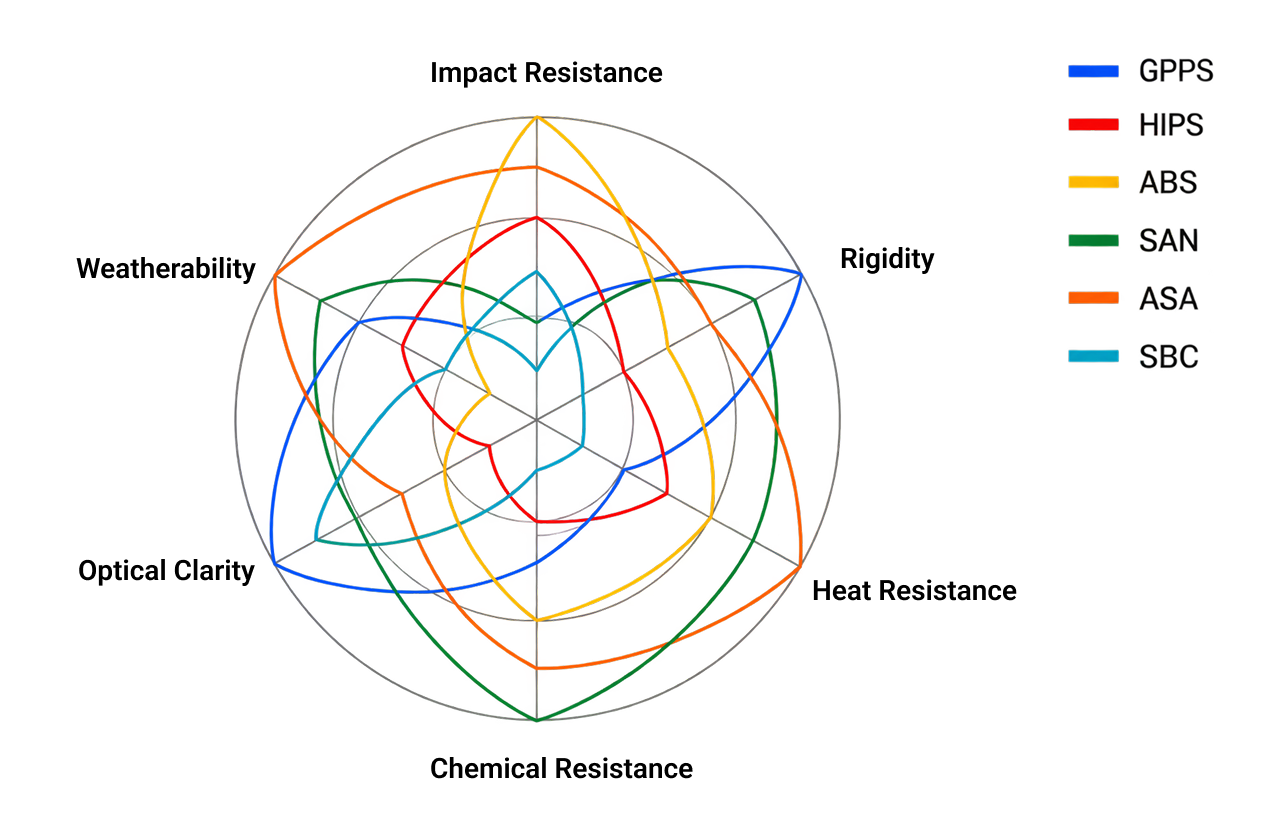
These differences illustrate why resin selection cannot be based on a single property alone. The relevant combination of performance requirements depends on the intended application.
The choice between GPPS, HIPS, ABS, SAN, ASA and SBC comes down to matching process and performance needs with the appropriate resin grade.
For applications where clarity and rigidity are important, GPPS offers a different performance balance from materials focused on impact, flexibility or weatherability. Similarly, applications requiring outdoor performance call for a different property profile from those requiring transparency or chemical resistance.
Understanding where each styrenic sits across the key engineering properties provides a starting point for grade selection and benchmarking.
The six materials are GPPS, HIPS, ABS, SAN, ASA and SBC. They share a common styrenic backbone but have different performance profiles.
GPPS is identified with high clarity and high rigidity.
HIPS is identified with high impact and medium stiffness, while ABS combines high impact with high stiffness.
SAN is identified with high clarity and chemical resistance.
ASA is identified with high weatherability and UV stability and is used for exterior automotive parts and outdoor components.
SBC is identified with high flexibility and transparency and is used in flexible packaging and transparent/flexible components.
The material selection approach is to match process and performance needs to the appropriate resin grade, with grade selection and benchmarking considered as part of the process.
Match your process and performance needs to the right resin grade.
For formulation details, reach out to polymers@distil.market.
READ MORE

READ MORE
READ MORE
READ MORE
READ MORE
READ MORE
READ MORE
READ MORE
READ MORE
READ MORE

READ MORE
.png)
We enable global brands to diversify production and accelerate sustainable sourcing while protecting IP.
Corporate Presentation
Follow us


© 2026 Distil. All rights reserved.


