
Switching an ABS (Acrylonitrile Butadiene Styrene) supplier involves more than comparing prices and technical datasheets. For toy manufacturers and procurement teams, choosing a new supplier means ensuring that the replacement material performs consistently without disrupting existing production.
Even when two ABS grades have similar specifications, differences in material quality and processing behaviour can affect product appearance, strength, dimensions and manufacturing efficiency.
A lower-priced material may initially seem like a good sourcing decision. However, if it increases production rejections, requires processing adjustments or affects product quality, the overall cost can be higher.
Before approving a new supplier or placing a bulk order, here are five important checks to consider.
Before switching ABS suppliers, manufacturers should evaluate more than the quoted material price. A successful supplier change requires checking material specifications, production compatibility, quality consistency and supply reliability.
The five critical checks are:
Evaluating these areas before placing bulk orders can help reduce supplier-switching risks and support more informed procurement decisions.
A lower purchase price does not always mean lower manufacturing costs. A new ABS grade may have a competitive price but could result in higher material wastage, production adjustments or rejected components.
Procurement teams should evaluate the overall cost of using the material rather than focusing only on its price per kilogram.
Key factors to consider:
A useful way to evaluate the difference is:
Cost Per Accepted Part = Total Production Cost ÷ Number of Accepted Parts
This gives procurement teams a more realistic basis for comparing suppliers.
A Technical Data Sheet (TDS) provides important information about an ABS grade. However, similar values on two datasheets do not necessarily guarantee similar performance during manufacturing.
Before selecting a replacement grade, compare the properties that directly affect your product and production requirements.
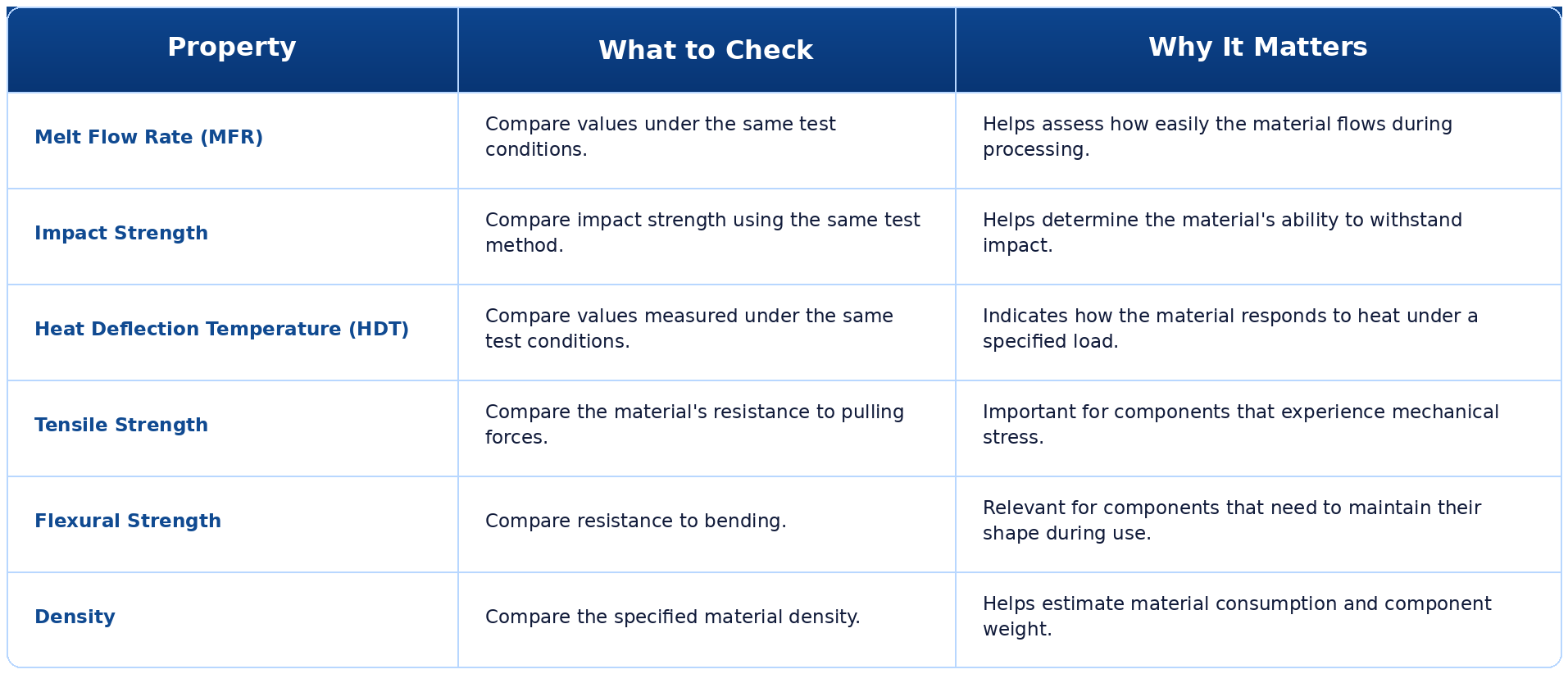
Before approving a new ABS supplier, request and review the relevant technical and quality documents.
A replacement ABS grade should work with your existing manufacturing setup as closely as possible.
Even when two grades have similar specifications, differences in processing behaviour can affect how the material fills the mould, cools and takes its final shape.
This can lead to dimensional variations, surface defects or difficulties during component assembly.
Important areas to evaluate during mould trials:
Before approving a replacement grade for bulk production, establish a baseline using your existing ABS material.
Compare the new grade against the existing material under comparable production conditions.
A practical qualification process should include:
A material sample that performs well during the initial trial does not automatically guarantee consistent quality in future deliveries.
For manufacturers, consistency across different material batches is just as important as the performance of the initial sample.
Variations in material quality can affect processing, product appearance and finished-component performance.
Material quality is only one part of a successful supplier relationship. A supplier must also be able to deliver the required material on time and support your production requirements.
Delays or inconsistent material availability can disrupt manufacturing schedules, increase inventory costs and affect customer commitments.
Before approving a new ABS supplier, use the following framework to review the key areas of material and supplier evaluation.
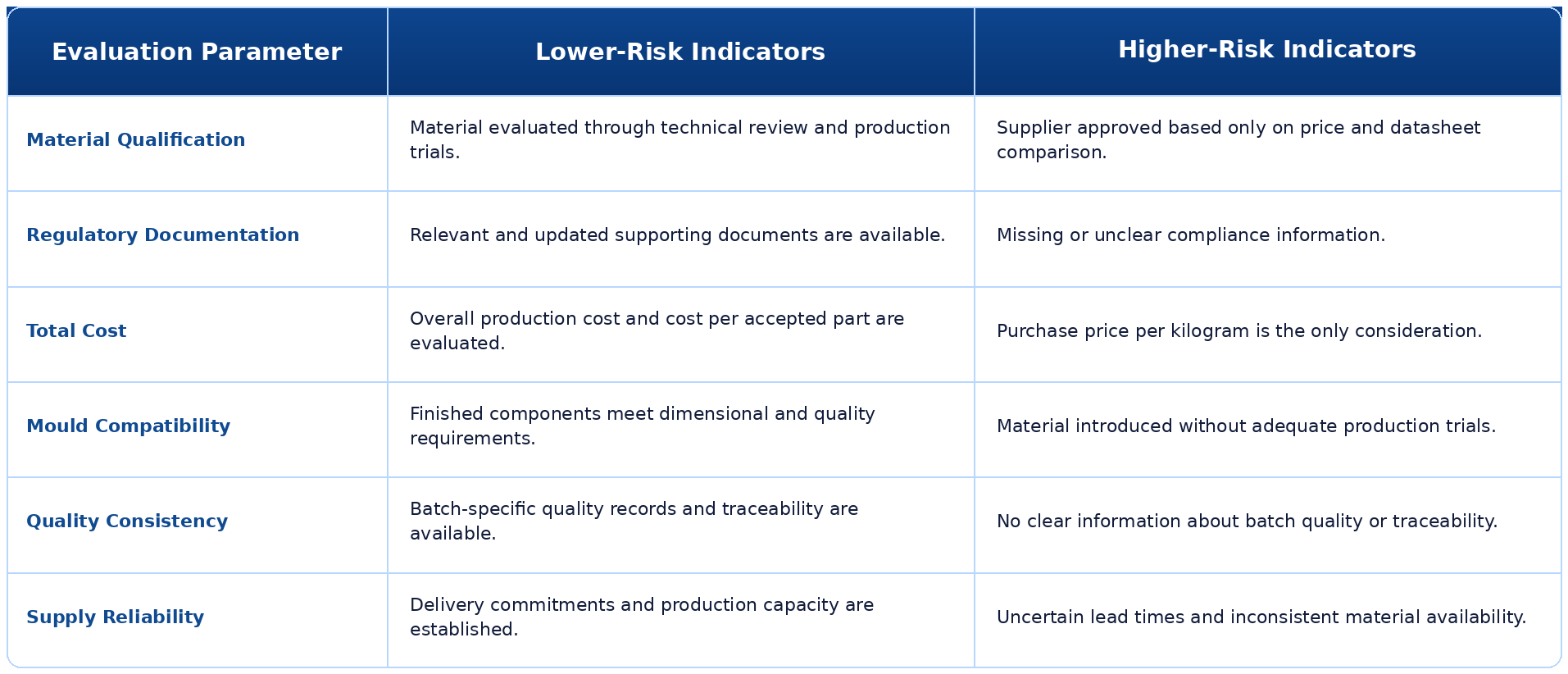
Melt Flow Rate (MFR) helps indicate how easily molten ABS flows under specified test conditions. However, it does not provide a complete picture of how the material will perform during actual injection moulding.
Other factors, including impact strength, processing conditions and mould compatibility, should also be evaluated. For this reason, comparing MFR alone is not sufficient to approve a replacement grade.
Different ABS grades can behave differently during moulding and cooling. These differences may affect the final dimensions, surface finish and fit of the moulded components.
If the replacement material produces dimensional variations, it may affect snap-fit connections and the assembly of different toy components. Production trials and dimensional checks help identify these issues before bulk production.
Manufacturers should request the relevant Technical Data Sheet (TDS), Safety Data Sheet (SDS) and batch-specific Certificate of Analysis (COA).
Depending on the destination market and finished product, additional regulatory declarations and chemical test reports may also be necessary. Examples include applicable EN 71, ASTM F963, CPSIA and REACH requirements.
The exact documentation and testing requirements should be determined based on the intended application and applicable regulations.
Choosing a replacement ABS grade requires more than comparing datasheets and purchase prices. Material compatibility, processing performance, product quality and supply consistency all play an important role in successful qualification.
At Distil.market, we help manufacturers and procurement teams identify suitable polymer grades and make more informed material sourcing decisions.
Evaluating a new ABS supplier?
Connect with Distil's Polymer Scientists to discuss your ABS requirements and material sourcing options.
Email: polymers@distil.market

READ MORE

READ MORE
READ MORE
READ MORE
READ MORE
READ MORE
READ MORE
READ MORE

READ MORE
READ MORE

READ MORE

READ MORE
READ MORE

READ MORE

We enable global brands to diversify production and accelerate sustainable sourcing while protecting IP.
Corporate Presentation
Follow us


© 2026 Distil. All rights reserved.


