
The lowest price per kilogram does not always translate into the lowest manufacturing cost per accepted part. When procuring Acrylonitrile Butadiene Styrene (ABS), the selected grade can influence component performance, moulding consistency, dimensional accuracy, production efficiency and rejection rates.
A lower-priced resin may appear attractive at the purchasing stage. However, if it requires longer processing cycles, contributes to inconsistent part quality or fails to meet the application's performance requirements, the initial savings may come at the expense of overall manufacturing efficiency.
For procurement and engineering teams, the challenge is to evaluate material cost alongside technical suitability, processing requirements and production performance.
This guide examines six important factors to consider when selecting ABS grades and explains how to assess their value beyond the quoted price per kilogram.
Before selecting an ABS grade, evaluate:
The objective is not necessarily to select the cheapest or most expensive grade. It is to identify the material that meets the application's requirements while delivering the most suitable overall manufacturing economics.
Impact strength is an important consideration when selecting ABS for components exposed to drops, collisions, sudden forces or mechanical shocks during use.
Although ABS is widely used for applications requiring a balance of toughness and rigidity, impact performance varies considerably between grades. The appropriate choice depends on the component design, operating environment and expected loading conditions.
Izod and Charpy impact tests measure a material's resistance to impact under specified test conditions. However, their results are not directly interchangeable because the methods can differ in specimen geometry, notch configuration, test orientation and other conditions.
Temperature is another important consideration. Some ABS grades experience a reduction in impact resistance as temperature decreases. A grade that performs adequately at room temperature may not provide the same performance in a cold operating environment.
The final component's performance can also differ from the properties reported on a resin datasheet. Weld lines, sharp corners, wall thickness transitions, moulding conditions and residual stresses may influence impact resistance in the finished part.
Selecting an ABS grade requires more than comparing published impact values. Its performance must be appropriate for the actual application and its operating conditions.
Mechanical stiffness determines how much a component deforms under an applied load. For ABS components that must maintain their shape, dimensional accuracy or structural function, stiffness is an important grade-selection criterion.
Two commonly reported properties help evaluate this behaviour:
These properties are related but not interchangeable. The appropriate measurement depends on the component's loading conditions and design requirements.
ABS combines acrylonitrile, butadiene and styrene in a multiphase polymer structure. Its mechanical properties depend on composition, rubber content, morphology and the overall formulation.
Increasing the rubber content can improve impact toughness, but it may also reduce stiffness and tensile strength. The actual balance varies between commercial grades.
Consequently, selecting a grade based exclusively on impact strength may result in excessive deformation under load. Conversely, prioritising stiffness without considering impact performance may create problems in applications where the component must withstand sudden forces.
Higher stiffness may allow a designer to reduce wall thickness in some applications. However, this depends on component geometry, loading conditions, buckling resistance, impact requirements and mouldability. A thinner design should always be validated rather than assumed to be feasible.
The selected grade should provide the required combination of stiffness and toughness while meeting the component's mechanical specifications.
Melt Flow Rate (MFR), sometimes referred to as Melt Flow Index (MFI), measures the mass of polymer that flows through a specified test die under defined temperature and load conditions over a set period.
For ABS, the applicable test conditions must be verified against the relevant standard and the supplier's datasheet. MFR values measured under different conditions should not be compared directly.
MFR is a useful screening parameter when assessing processing suitability. However, it does not fully describe how a polymer will behave during injection moulding.
Higher-MFR Grades
Higher-MFR grades may be suitable for thin-walled or complex components where easier filling is important. Depending on the grade and mould design, they may help reduce the injection pressure required to fill a cavity.
However, a higher MFR does not automatically guarantee shorter cycle times, lower clamping requirements or superior moulding quality.
Lower-MFR Grades
Lower-MFR grades may be appropriate for applications where their overall property profile meets the component's mechanical and processing requirements. However, they may require different processing conditions to achieve adequate mould filling.
A lower MFR does not automatically mean better impact strength, stiffness or environmental stress cracking resistance. These properties must be evaluated independently using grade-specific data.
MFR should be evaluated alongside other material properties and actual production results to determine whether a grade is suitable for the intended moulding process.
Dimensional accuracy and surface quality depend on several factors, including material characteristics, mould design, processing conditions and moisture control.
Two important considerations when procuring ABS are moulding shrinkage and the material's moisture condition before processing.
Moulding shrinkage refers to the dimensional difference between the mould cavity and the moulded part after processing and cooling, measured under specified conditions.
ABS shrinkage varies according to the grade, component geometry, mould design, processing conditions and measurement method. A published shrinkage range should therefore be treated as an initial reference rather than a guaranteed value for every component.
Inconsistent processing conditions or variation between material batches may contribute to dimensional variation. However, shrinkage problems should not automatically be attributed to resin quality; tooling, cooling, packing conditions and machine settings can also play a role.
ABS can absorb moisture from its surroundings. Depending on storage conditions and the specific grade, drying may be necessary before processing.
Excess moisture can contribute to surface defects such as splay or silver streaking. The extent and type of defect depend on the material condition and processing circumstances.
Drying requirements vary by grade and supplier. Recommended temperature, drying time and acceptable moisture levels should be taken from the manufacturer's processing guidance rather than treated as universal specifications.
Consistent dimensions and surface quality depend on selecting a suitable grade and maintaining controlled processing conditions throughout production.
Thermal performance matters when ABS components are exposed to elevated temperatures during operation, transport, assembly or secondary processing.
Two commonly used measurements help compare the thermal behaviour of different grades: Heat Deflection Temperature (HDT) and Vicat Softening Temperature.
HDT measures the temperature at which a standardised specimen reaches a specified deflection under a defined flexural load and test procedure.
The result depends on the applied stress and test conditions. HDT is useful for comparing grades, but it should not be treated as a direct measure of the maximum continuous operating temperature.
Vicat Softening Temperature measures the temperature at which a specified needle penetrates a defined distance into a material under prescribed test conditions.
The result depends on the test method and applied load. It provides a comparative indication of softening behaviour rather than a universal operating-temperature limit.
Selecting a grade with thermal properties beyond the application's actual requirements may increase material cost without delivering a meaningful benefit. Conversely, a grade that does not tolerate the application's thermal exposure may deform or lose performance.
The appropriate thermal requirements depend on the component's operating temperature, applied load, exposure duration, design and secondary processing requirements.
For example, a component exposed to a short paint-curing cycle may have different requirements from one subjected to prolonged elevated-temperature service. Suitability must be assessed for the specific exposure conditions.
HDT and Vicat values should be interpreted in the context of the component's complete operating environment rather than used independently to determine its service-temperature limits.
The purchase price per kilogram is only one component of the total cost of manufacturing an acceptable ABS part.
A lower-priced grade may increase overall costs if it results in higher material consumption, longer cycle times, greater rejection rates or additional quality-control requirements. Conversely, a higher-priced grade may deliver better economics if its verified production performance offsets the additional material cost.
The important distinction is between the price of the raw material and the cost of producing a part that meets the required specifications.
Account for the amount of resin consumed per moulding cycle, the grade's purchase price, runner waste and any material recovery or regrind practices.
Consider machine time, labour, energy and relevant production overheads. Where machine costs are calculated using an hourly rate, cycle time and production output directly affect the conversion cost per part.
Include rejected parts, inspection, rework, downtime and other quality-related expenses where applicable. Avoid counting the same cost twice when accounting for scrap.
The calculation must use the number of parts that actually meet the specified quality requirements, not simply the total number moulded.
Consider a hypothetical manufacturer evaluating two ABS grades for a component. The following example uses simplified assumptions to demonstrate how resin price, cycle time and rejection rate can affect manufacturing economics.
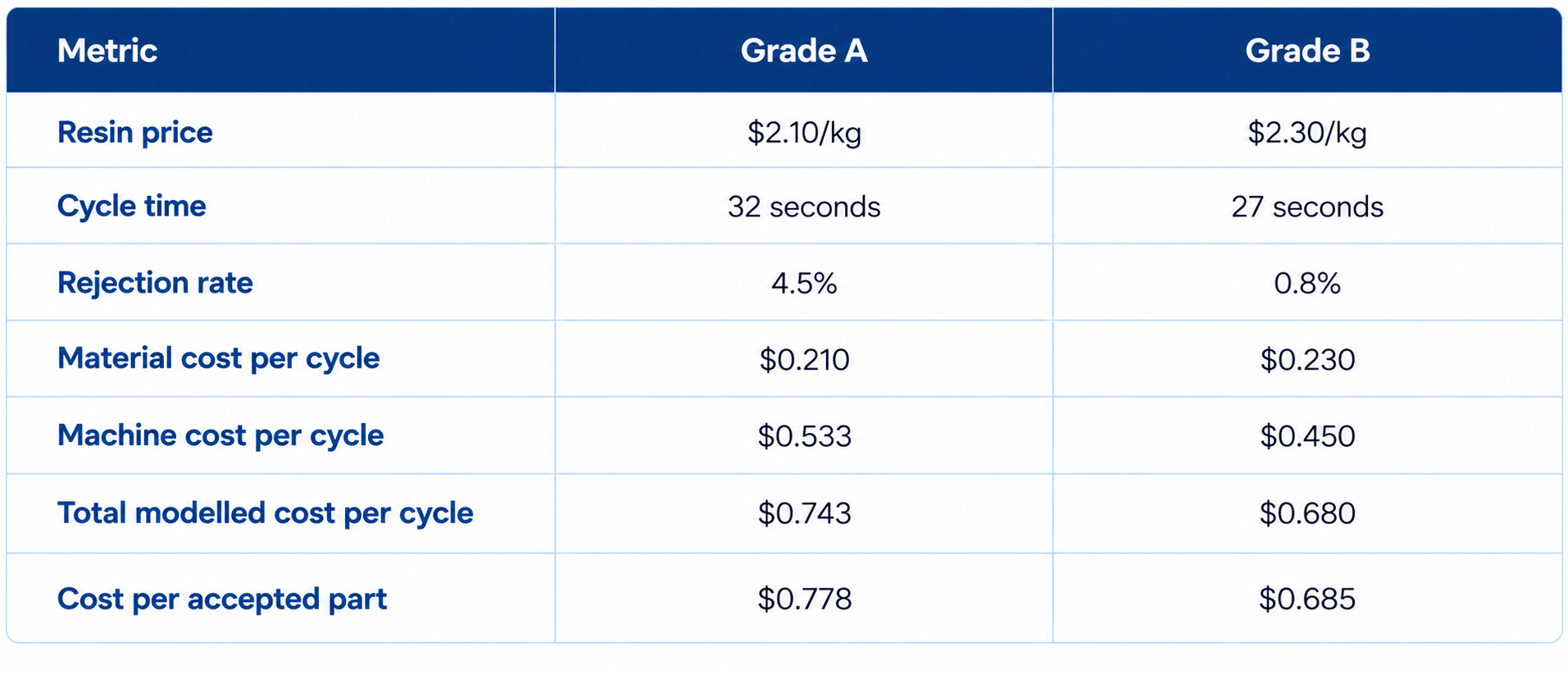
All figures are illustrative assumptions, not actual performance data for commercial ABS grades. The calculation assumes the stated cycle times and rejection rates are achieved in production.
Grade B has a higher resin purchase price per kilogram. However, under the assumptions above, its shorter cycle time and lower rejection rate reduce the modelled cost per accepted part from approximately $0.778 to $0.685.
That represents a reduction of approximately 11.9% in the modelled cost per accepted part.
The result does not establish that a higher-priced ABS grade will always be more economical. It demonstrates that the decision can change when processing performance and production yield are considered alongside resin price.
Actual savings must be established through comparable production trials, using verified cycle times, rejection rates, material consumption and conversion costs.
A reliable cost comparison considers both the purchase price and the verified cost of producing parts that meet quality requirements.
Selecting the right ABS grade requires collaboration between procurement, product design, quality and manufacturing teams.
Impact strength, stiffness, melt flow, dimensional stability and thermal performance all contribute to material suitability. However, none of these properties should be evaluated in isolation, and published datasheet values do not guarantee identical performance across different components or production environments.
A structured evaluation process helps manufacturers compare material options against technical requirements while identifying opportunities to reduce waste, improve production consistency and control manufacturing costs.
At Distil, informed material selection begins with understanding the application's requirements and evaluating material options against them.
Looking to evaluate ABS grades for your application?
Connect with Distil to discuss your material requirements and sourcing needs.
Email: polymers@distil.market
READ MORE

READ MORE
READ MORE
READ MORE
READ MORE

READ MORE
READ MORE

READ MORE

READ MORE
READ MORE

READ MORE

We enable global brands to diversify production and accelerate sustainable sourcing while protecting IP.
Corporate Presentation
Follow us


© 2026 Distil. All rights reserved.


