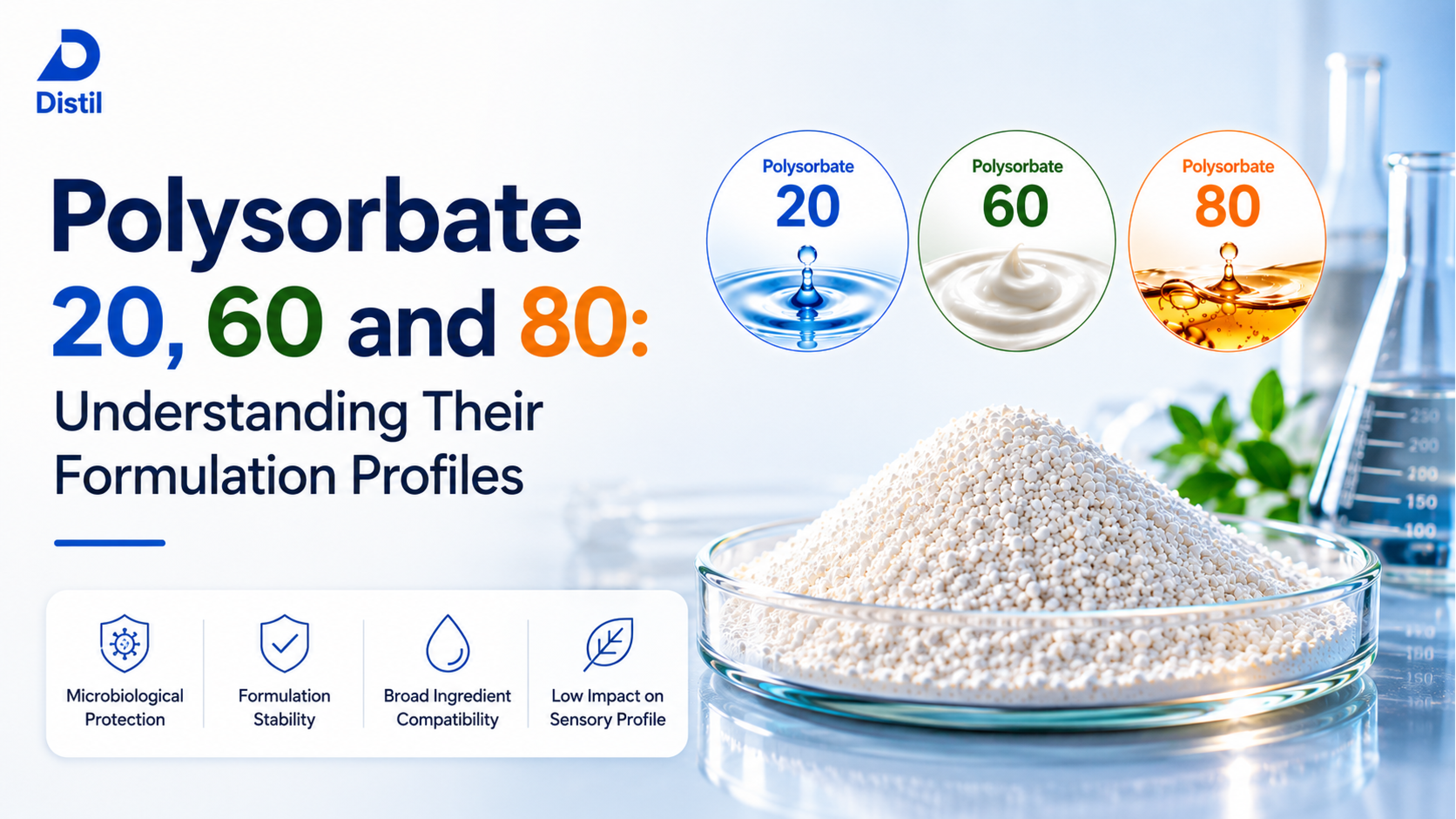
Polysorbate 20, 60 and 80 belong to the same Polysorbate family, but they have different formulation profiles. The distinction begins with their fatty acid components: Polysorbate 20 is lauric acid-based, Polysorbate 60 is stearic acid-based, and Polysorbate 80 is oleic acid-based. These differences contribute to differences in their physicochemical properties and formulation applications.
While their formulation roles can overlap, they are not interchangeable by default. Understanding the typical role of each material and the formulation being developed provides a more structured way to consider Polysorbate selection.
Polysorbate 20, 60 and 80 differ in their fatty acid components and consequently have different formulation applications. Polysorbate 20 is lauric acid-based and is commonly used for solubilization, including helping incorporate small amounts of oils or fragrance materials into water-based systems. Polysorbate 60 is stearic acid-based and is commonly used as an emulsifier or co-emulsifier in creams, lotions and other emulsion systems. Polysorbate 80 is oleic acid-based and is used in solubilization and emulsification applications, depending on the formulation.
The appropriate selection depends on the formulation context. For clear water products, the type of material requiring solubilization can distinguish between Polysorbate 20 and 80. For oil-in-water emulsions, the presence or absence of waxes or solid oils can point toward Polysorbate 60 or 80.
Polysorbate 20, 60 and 80 belong to the same Polysorbate family, but they differ in their fatty acid components. This difference plays an important role in how each material is typically used in formulations.
Polysorbate 20 is lauric acid-based and is commonly associated with solubilization applications.
It is often used to help incorporate small amounts of oils or fragrance materials into water-based systems, making it particularly relevant when developing clear water-based products.
Typical role: Solubilization
Common application: Water-based systems containing fragrance or small amounts of oil.
Polysorbate 60 is stearic acid-based and is commonly used as an emulsifier or co-emulsifier.
Its typical applications include creams, lotions and other oil-in-water emulsion systems. It can be particularly relevant when the formulation contains waxes or solid oils.
Typical role: Emulsification
Common application: Creams, lotions and emulsion systems
Polysorbate 80 is oleic acid-based and has a broader formulation role, appearing in both solubilization and emulsification applications.
For water-based systems, it can be considered when vegetable oils or lipophilic actives need to be incorporated. It can also be used in oil-in-water emulsions where waxes or solid oils are not present.
Typical role: Solubilization & emulsification
Common application: Water-based systems and oil-in-water emulsions.
Polysorbate 20 is lauric acid-based and is commonly used for solubilization. This includes helping incorporate small amounts of oils or fragrance materials into water-based systems.
For a clear water product where an oil or fragrance needs to be solubilized, the selection depends further on the material involved. When the light oil is a fragrance or essential oil, the selection pathway points toward Polysorbate 20.
This places Polysorbate 20 within a specific part of the broader range of solubilization applications covered by the three materials.
Polysorbate 60 is stearic acid-based and is commonly used as an emulsifier or co-emulsifier in creams, lotions and other emulsion systems.
For oil-in-water (O/W) emulsions, the formulation selection considers whether the oil phase contains waxes and, more specifically, whether waxes or solid oils are present. Where waxes or solid oils are present, the selection pathway points toward Polysorbate 60.
Polysorbate 80 is oleic acid-based and is used in both solubilization and emulsification applications, depending on the formulation.
For clear water products requiring solubilization, the selection pathway distinguishes Polysorbate 80 from Polysorbate 20 based on the material involved. When the light oils being considered are vegetable oils or lipophilic actives, the pathway points toward Polysorbate 80.
Polysorbate 80 also appears in the selection pathway for oil-in-water emulsions where waxes or solid oils are not present.
Its role therefore spans both solubilization and emulsification applications, with the specific formulation determining where it fits.
The formulation type provides the starting point for distinguishing between Polysorbate 20, 60 and 80.
First consider whether there is a need to solubilize an oil or fragrance. If light oils are involved, the material being solubilized becomes an important distinction:
The selection pathway then considers the oil phase and whether waxes or solid oils are present:
This approach reflects the broader distinction between the three materials: their formulation roles overlap, but the specific formulation requirements can lead toward different Polysorbate options.
They belong to the same Polysorbate family but differ in their fatty acid components. Polysorbate 20 is lauric acid-based, Polysorbate 60 is stearic acid-based, and Polysorbate 80 is oleic acid-based.
Polysorbate 20 is commonly used for solubilization, including helping incorporate small amounts of oils or fragrance materials into water-based systems.
Polysorbate 60 is commonly used as an emulsifier or co-emulsifier in creams, lotions and other emulsion systems.
Polysorbate 80 is used in solubilization and emulsification applications, depending on the formulation.
No. Their applications can overlap, but one Polysorbate should not automatically be substituted for another.
For clear water products, the selection considers whether fragrance or essential oils, or vegetable oils or lipophilic actives, need to be solubilized. For oil-in-water emulsions, the presence or absence of waxes or solid oils is considered. These pathways point toward Polysorbate 20, 60 or 80 depending on the formulation.
READ MORE

READ MORE
READ MORE
READ MORE
READ MORE
READ MORE

READ MORE
.png)
We enable global brands to diversify production and accelerate sustainable sourcing while protecting IP.
Corporate Presentation
Follow us


© 2026 Distil. All rights reserved.


