
Acrylonitrile Styrene Acrylate (ASA) is widely used in outdoor applications where UV exposure, weathering and long-term appearance retention are important. However, not all ASA grades offer the same balance of mechanical performance, thermal resistance, processability and surface quality. Selecting the right grade requires more than comparing raw material prices per kilogram (₹/kg).
For engineering, manufacturing and procurement teams, effective material selection means evaluating performance under actual service conditions, maintaining processing consistency and understanding the total cost of producing a defect-free finished part.
ASA is a weather-resistant thermoplastic used in applications that require outdoor durability and appearance retention. Unlike conventional ABS, which typically contains a polybutadiene rubber phase, ASA uses an acrylic rubber phase that generally provides improved resistance to UV exposure and weathering.
However, weatherability alone does not determine whether a grade is suitable for a particular component. Material selection should account for five key factors:
A lower purchase price does not necessarily translate into a lower production cost. Differences in material consumption, cycle time, rejection rates and finishing requirements can affect the final economics.
A structured grade evaluation helps manufacturers balance material performance, production efficiency and cost per accepted part.
Describing a material as weatherable does not establish whether it will meet the performance requirements of a specific application. Weathering performance varies with the formulation, stabilisation system, pigmentation, exposure conditions and required service life.
Before approving an ASA grade, manufacturers should evaluate the following parameters.
Assess resistance to UV exposure and environmental weathering using suitable accelerated weathering methods. Relevant measurements may include colour change, gloss retention and changes in mechanical properties after exposure.
Results should be interpreted against defined acceptance criteria rather than a universal colour-change or gloss-retention threshold.
Heat deflection temperature (HDT) provides information about a material's response to heat under a specified test load. It can help compare candidate grades, but it does not independently establish the maximum continuous-use temperature of a finished component.
Consider the component's operating temperature, loading conditions and dimensional requirements when evaluating thermal suitability.
Impact resistance is important for components exposed to handling, accidental impacts or low-temperature service conditions.
Compare results using the same test method, specimen preparation and conditioning requirements. Where outdoor exposure may affect mechanical performance, assess impact properties before and after an appropriate weathering or environmental conditioning programme.
Melt flow rate (MFR) can help compare the flow characteristics of candidate grades when measurements use identical test conditions.
However, MFR alone does not establish the complete processing window or predict the quality of a finished part. Mould design, processing temperatures, mould temperature, injection conditions and part geometry also influence processing performance.
For visible exterior components, evaluate the required colour, gloss, surface finish and resistance to handling-related damage.
The acceptance criteria should reflect the component's intended use. An exterior enclosure, a decorative trim component and an exposed functional part may have different surface requirements.
Comparing these parameters against an application-specific specification provides a more reliable basis for grade selection than relying on a generic description such as “weatherable ASA.”
Comparing ASA grades only on raw material cost (₹/kg) can overlook differences in performance, processing requirements and finished-part quality.
A more effective evaluation considers three areas: material performance, manufacturing behaviour and production economics.
Evaluate candidate grades against the component's expected service conditions.
Key considerations include:
The appropriate acceptance limits should be established before material qualification. They should reflect the intended application, customer specifications and applicable validation requirements.
A grade must be compatible with the intended manufacturing process and component design.
Melt Flow Rate (MFR): Compare MFR values only when the test method, temperature and load are consistent. Refer to the conditions stated in the technical datasheet before interpreting differences between grades.
Processing Window: Evaluate the recommended processing conditions and determine whether the material can be processed consistently using the available equipment and moulding setup.
Moisture Control: Follow the grade-specific drying instructions supplied by the manufacturer. Inadequate moisture control can contribute to surface defects and processing inconsistencies.
Production Trials: Assess filling behaviour, surface quality, dimensional stability and part ejection during trials. Processing performance should be confirmed under representative production conditions rather than inferred from a single datasheet value.
The cost of the finished component depends on more than the resin purchase price.
Important factors include:
The objective is to identify the grade that meets the component's requirements while delivering reliable manufacturing performance and an acceptable total cost.
Different outdoor components face different combinations of environmental exposure, mechanical loading, thermal stress and appearance requirements. The material should therefore be selected according to the specific component rather than its broad application category alone.
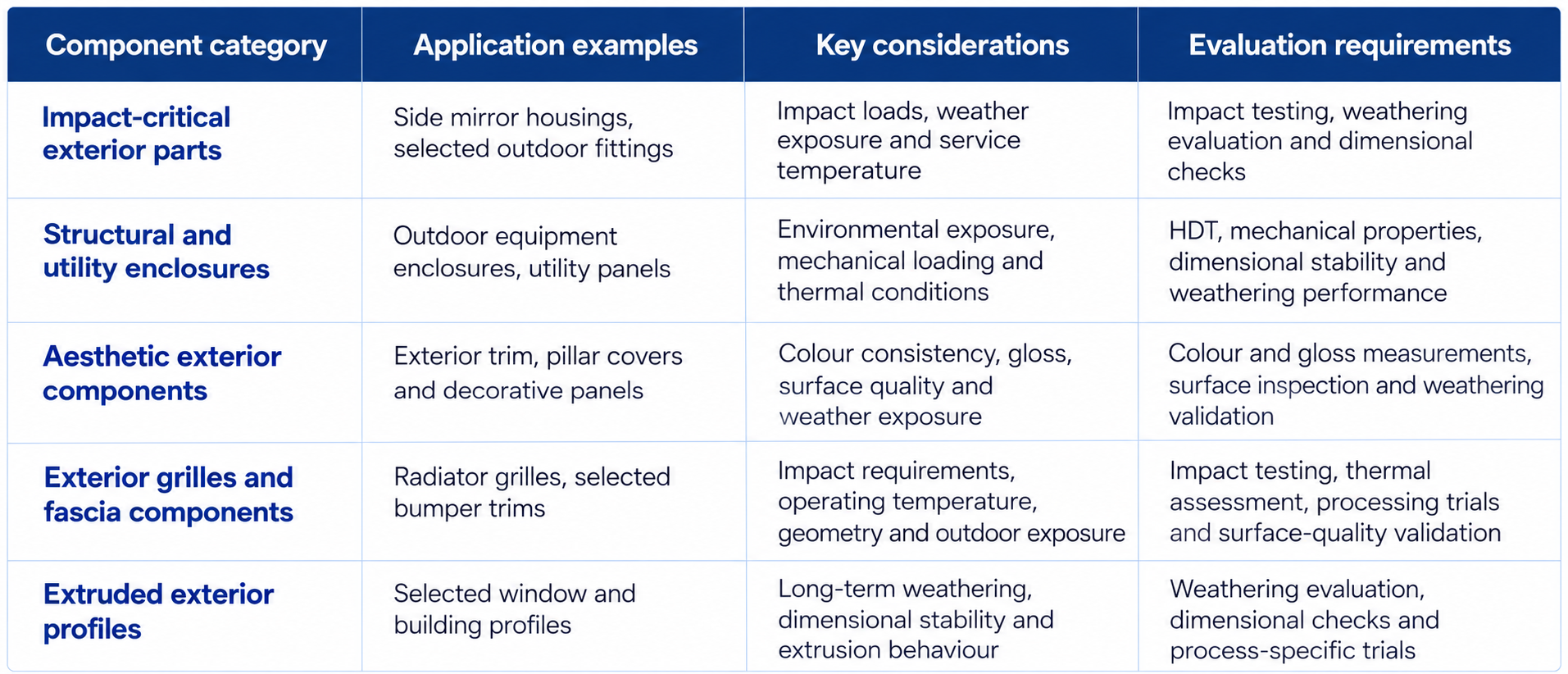
The examples above are starting points for material evaluation, not confirmation that every ASA grade is suitable for every listed application.
For each component, define the required service conditions, mechanical properties, appearance standards and applicable compliance requirements before selecting a grade.
Where a component has safety-critical, load-bearing or other specialised requirements, confirm suitability through application-specific engineering assessment and validation.
A lower-cost resin can result in higher production costs if it requires additional processing, finishing or quality control. Conversely, a higher-priced grade may offer better economics if it consistently produces acceptable parts with fewer secondary operations.
The relevant cost factors should be evaluated using production data.
Differences in material density can affect component weight and resin consumption. Actual material usage should be calculated using the selected grade and the final component design.
Cycle time influences machine utilisation and production capacity. Even small differences can accumulate across large production runs.
Compare grades under equivalent production conditions and use measured moulding-trial results to determine whether a material change affects cycle time.
Defects such as short shots, sink marks, warpage and surface blemishes can arise from several causes, including material characteristics, mould design and processing conditions.
Record actual defect and rejection rates during trials to determine whether a candidate grade improves production yield.
Certain pre-coloured ASA grades may allow exterior components to meet appearance and weathering requirements without additional painting.
Where the selected grade satisfies the relevant specifications, eliminating a coating operation may reduce processing time, equipment requirements and finishing-related rejects.
However, this benefit depends on the required surface finish, colour, durability and application. Painting or coating may still be necessary for some components.
Variation in material properties or processing conditions can affect dimensional accuracy, colour and surface quality. Evaluate supplier quality controls, batch consistency and the production process to understand their effect on finished-part acceptance.
A practical way to compare candidate grades is to calculate the total relevant production cost per accepted component.
Cost per accepted part = Total relevant production cost ÷ Number of accepted parts
The production cost can include:
Use a consistent calculation method for each candidate grade and avoid counting the same cost twice. Where possible, base the comparison on actual production or moulding-trial data.
Drying: Follow the selected ASA grade's technical datasheet for drying temperature, duration and target moisture content. Confirm that the drying equipment and material-handling conditions are appropriate before processing.
Regrind: Assess regrind separately according to supplier recommendations, moisture conditions and the required component quality. Do not assume that regrind can be processed under the same conditions as virgin material without validation.
Finishing: Before assuming that ASA can eliminate painting, confirm that the selected grade meets the component's appearance, colour and durability requirements in its intended service environment.
Before approving a new ASA grade or an alternative supplier, use the following questions to structure the technical evaluation.
Ask whether the reported results were obtained using an appropriate method, such as ISO 4892-2 or ASTM G155 for xenon-arc exposure. Confirm the exposure conditions, duration and properties measured.
Request measured colour-change data after a defined exposure period. Agree on the measurement method and acceptance limits based on the component's appearance requirements.
Ask for initial and post-exposure gloss measurements, including the measurement conditions and the relevant acceptance criteria.
Compare impact results under relevant test conditions. Where required, request data after weathering or environmental conditioning to assess performance retention.
Verify the test method, temperature and load for each candidate grade. MFR comparisons should use equivalent test conditions.
Review HDT and other relevant thermal data alongside the expected service temperature, loading conditions and dimensional requirements.
Ask about quality-control procedures, reported property variation, colour control and the documentation available for individual production lots.
Confirm whether the material has been evaluated on representative parts or comparable tool configurations. Where necessary, conduct moulding trials and application-specific testing before production approval.
Also confirm any regulatory, chemical, flammability or other compliance requirements applicable to the intended product and market.
ASA generally offers improved UV and weathering resistance compared with conventional ABS because it uses an acrylic rubber phase rather than the polybutadiene rubber phase typically found in ABS.
This can help preserve colour and surface appearance during outdoor exposure. Actual performance depends on the grade formulation, stabilisation, pigmentation and service conditions. UV-stabilised or protected ABS grades may also be suitable for some applications.
In suitable applications, yes. Certain pre-coloured ASA grades can provide the required appearance and weathering performance without additional painting.
The decision depends on the required colour, gloss, surface finish, durability and component specifications. Validate these requirements before eliminating an existing coating operation.
The relevant standards depend on the property being assessed.
These methods should not be treated as interchangeable in every case. Confirm the specific test procedure, conditions and reporting requirements before comparing grades.
Drying requirements vary by grade and equipment. Follow the manufacturer's technical datasheet for the recommended drying temperature, duration and moisture conditions.
Appropriate moisture control helps reduce the risk of processing and surface defects. Confirm the procedure during production trials rather than assuming one drying schedule applies to every ASA grade.
Resin price is only one component of the finished-part cost. Processing performance, material consumption, cycle time, finishing requirements and rejection rates can all influence production economics.
Comparing the total cost per accepted part provides a more meaningful basis for material selection than comparing ₹/kg alone.
Selecting the right ASA grade requires balancing weatherability, mechanical and thermal performance, processability and cost. A structured evaluation helps manufacturers compare candidate materials against actual application and production requirements.
Looking to evaluate an ASA grade or identify a suitable alternative for your application?
Connect with Distil's team for guidance on polymer sourcing and material specifications.
Email: polymers@distil.market

READ MORE

READ MORE
READ MORE
READ MORE

READ MORE
READ MORE

READ MORE

READ MORE
READ MORE

READ MORE
.png)
We enable global brands to diversify production and accelerate sustainable sourcing while protecting IP.
Corporate Presentation
Follow us


© 2026 Distil. All rights reserved.


