
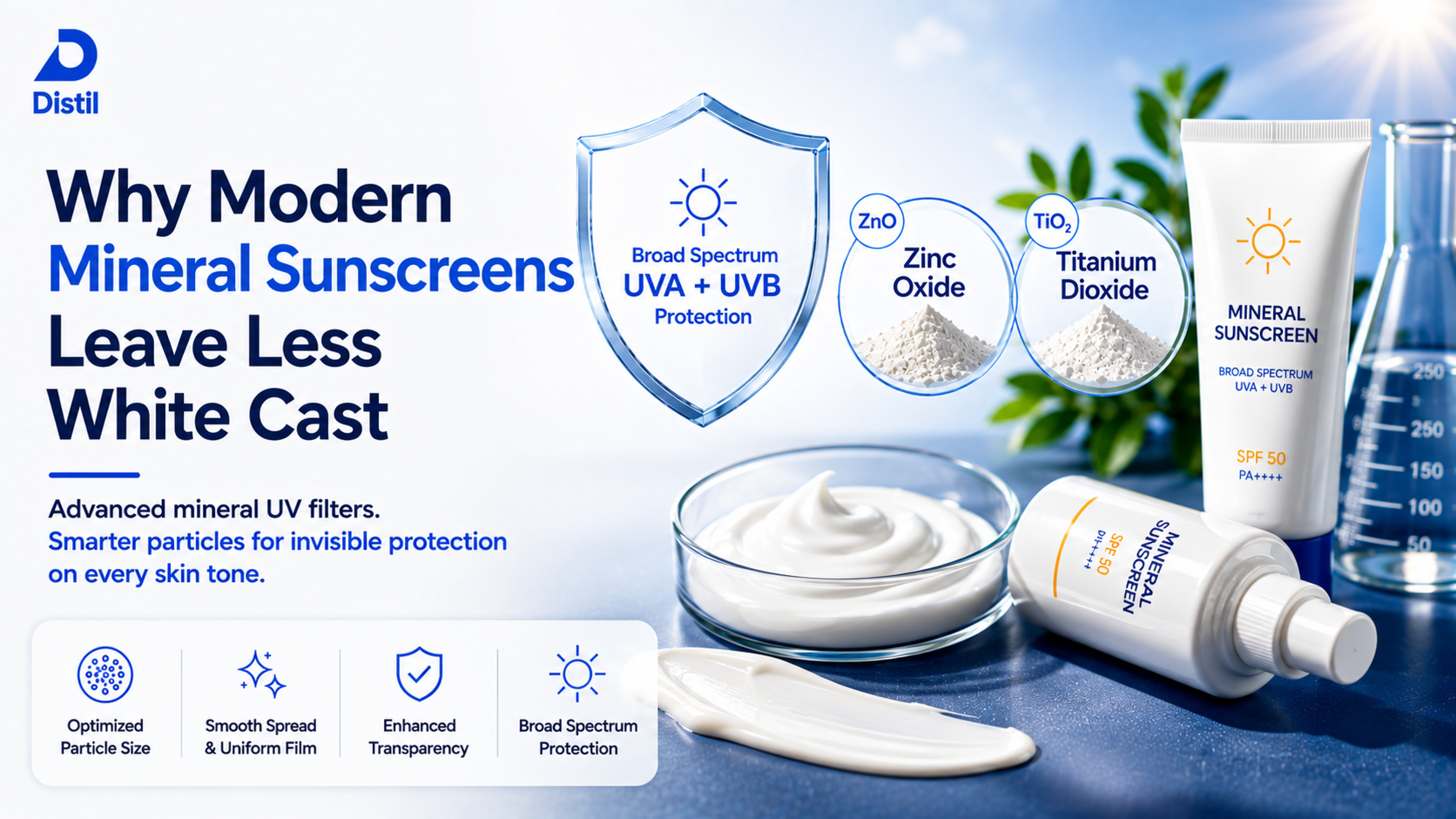
Zinc Oxide is a widely used mineral UV filter in sunscreen formulations, valued for its broad-spectrum protection. However, achieving a high-performing mineral SPF involves more than selecting the right filter level. Formulators must also manage how Zinc Oxide affects the product’s appearance, texture and application on skin.
Developing a Zinc Oxide-based sunscreen involves several interconnected formulation decisions. The mineral filter must be incorporated effectively into the system while maintaining the desired protection profile and an acceptable cosmetic finish.
One of the main challenges is visible whitening, which can become more noticeable depending on the mineral concentration, particle characteristics and dispersion quality. At the same time, factors such as spreadability, texture and after-feel can determine whether a product is comfortable and appealing to use.
Modern formulation approaches therefore look beyond filter concentration alone. Particle engineering, effective dispersion and careful selection of the formulation system can help address appearance and sensory challenges while supporting the intended SPF performance.
The objective is to create a mineral sunscreen that performs effectively without compromising the application experience.
Zinc Oxide functions as a mineral UV filter and is used in formulations designed to provide broad-spectrum protection. Its effectiveness within a finished sunscreen depends not only on the amount incorporated but also on how the material is distributed throughout the formulation.
The physical characteristics of the Zinc Oxide can influence factors such as dispersion, optical appearance and application behavior. Consequently, mineral SPF development requires attention to both the filter itself and the formulation environment in which it is used.
Rather than viewing Zinc Oxide simply as an SPF ingredient, formulators need to consider its interaction with the complete formulation system.
A characteristic challenge associated with mineral sunscreens is visible whitening after application. A product may provide the intended protection but still be less appealing if it leaves a pronounced white cast or uneven residue.
Several formulation variables can contribute to this effect, including:
Improving particle distribution can help create a more uniform application and may reduce the intensity of visible residue. This makes dispersion technology an important consideration when developing cosmetically elegant mineral SPF products.
The way a sunscreen moves across the skin is just as important as how it looks after application. Formulations that feel excessively heavy, drag during spreading or leave an uncomfortable film can negatively affect product acceptance.
Zinc Oxide can influence the rheology and sensory profile of a formulation, making the choice of supporting ingredients and formulation structure important. Developers may need to optimize:
The goal is to create a formulation that distributes consistently without sacrificing the characteristics expected from a modern sunscreen.
Dispersion is a critical part of working with mineral UV filters. Poorly distributed particles can affect both formulation consistency and the appearance of the finished product.
A well-designed dispersion system can contribute to more uniform distribution of Zinc Oxide throughout the formulation. This can support consistent application and help formulators better manage issues associated with visible whitening and texture.
For this reason, dispersion should be considered during the early stages of formulation development rather than treated as a secondary processing step.
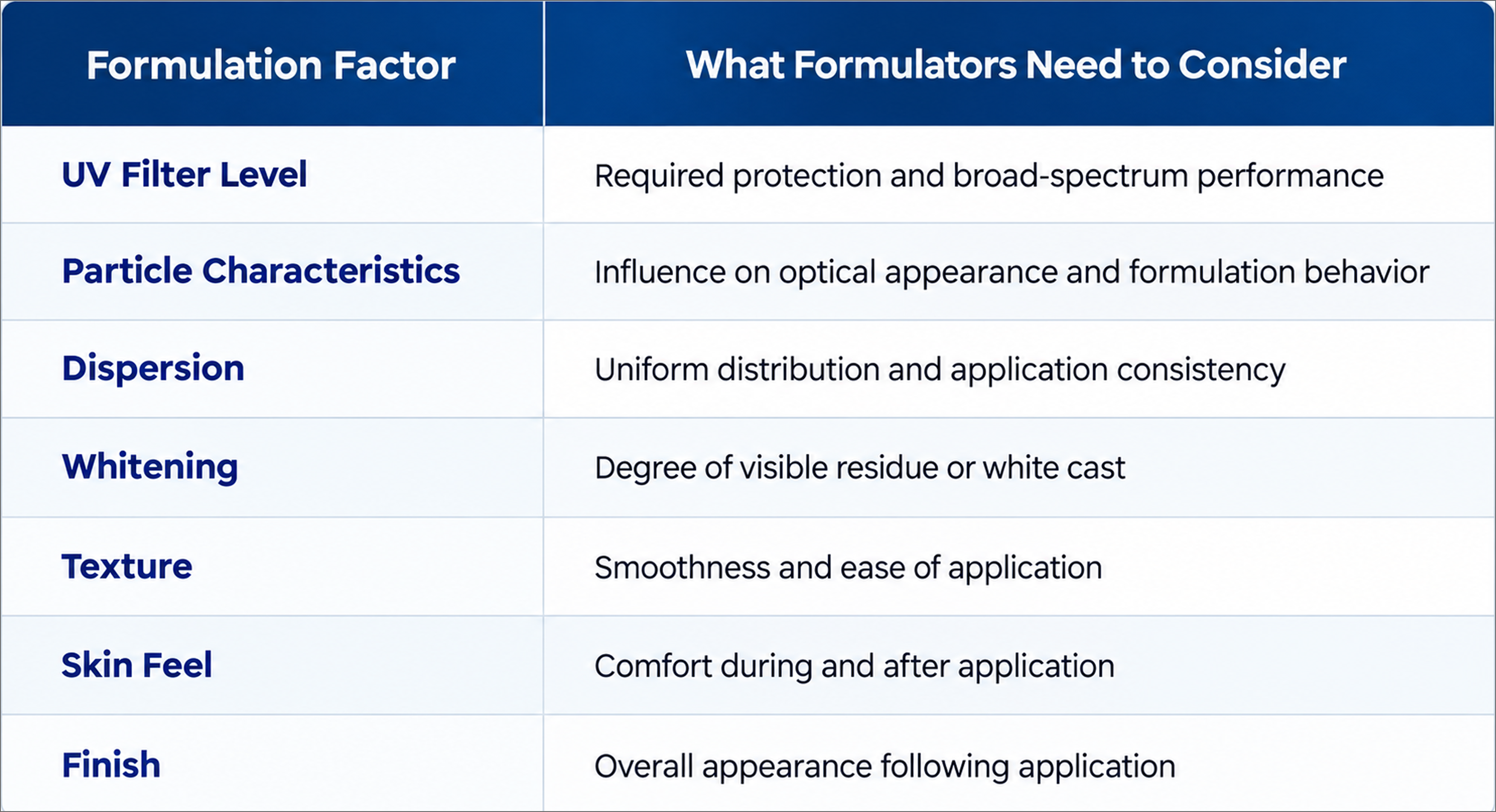
These factors should be evaluated as a complete formulation rather than optimized independently. A change made to improve one characteristic can influence another, which is why formulation trials and performance testing are essential.
The development of Zinc Oxide sunscreens is increasingly focused on combining functional performance with cosmetic acceptability. Consumers expect mineral SPF products to provide effective protection while also being easy to apply and comfortable to wear.
A successful formulation therefore needs to address the complete user experience—from initial spreading to the final appearance and feel on skin.
Careful control of Zinc Oxide characteristics, dispersion and formulation structure can help developers work toward this balance. The result is a mineral SPF designed not only around its UV-filter function, but also around how the finished product performs in real-world use.
Zinc Oxide is a mineral UV filter used in sunscreen formulations to provide broad-spectrum UV protection.
Mineral particles can scatter visible light, which may produce a noticeable white appearance on the skin. The extent of whitening can also depend on particle characteristics, concentration and dispersion.
Yes. Changes in mineral filter concentration can influence the physical and sensory properties of the formulation, including texture and spreadability.
Effective dispersion helps distribute Zinc Oxide more uniformly throughout the formulation. This can support consistent application and help manage appearance and texture-related challenges.
Important characteristics include spreadability, texture, skin feel, residue and the final finish after application.
Formulators can explore approaches such as particle engineering, optimized dispersion and appropriate formulation design to help manage visible whitening.
Not necessarily. Increasing the mineral filter level may support a higher protection target, but it can also affect appearance, texture and application properties. The appropriate level should therefore be determined as part of the overall formulation and performance evaluation.
The challenge is developing a formulation that delivers the intended UV protection while also achieving acceptable appearance, application and sensory properties.
Looking to develop transparent, broad-spectrum mineral sunscreens without compromising on sensory feel or stability?
Connect with Distil at pc@distil.market today to request technical data, samples, or expert guidance on optimizing your inorganic filter formulations.
READ MORE

READ MORE
READ MORE
READ MORE
READ MORE
READ MORE

READ MORE
.png)
We enable global brands to diversify production and accelerate sustainable sourcing while protecting IP.
Corporate Presentation
Follow us


© 2026 Distil. All rights reserved.


