
Styrene Acrylonitrile (SAN) is a versatile thermoplastic copolymer used in applications where transparency, rigidity and chemical resistance are important. However, SAN is not a single, uniform material. Commercial grades can differ in composition, molecular characteristics, melt flow behaviour and formulation, influencing their suitability for specific components and manufacturing processes.
For engineering and procurement teams, selecting or switching a SAN grade requires more than comparing the raw material purchase price per kilogram. The right material must meet the required performance specifications, process consistently under production conditions and deliver an acceptable cost per finished part.
Selecting the right SAN grade involves balancing three key considerations:
Differences in acrylonitrile content, molecular characteristics and grade formulation can influence SAN performance. However, the magnitude of these effects varies by grade and should be verified using technical data sheets and application-specific testing.
Before approving a new grade or switching suppliers, engineering and procurement teams should compare technical specifications under equivalent test conditions and validate the material in the intended application.
SAN is produced by copolymerizing styrene and acrylonitrile. Its composition and molecular characteristics influence the balance of properties that determine its suitability for different applications.
The proportion of acrylonitrile can influence chemical resistance, stiffness, thermal performance and melt behaviour. The effect of changing acrylonitrile content depends on the overall polymer composition and grade formulation.
When comparing grades, evaluate the actual reported properties rather than assuming that a higher acrylonitrile content automatically delivers better performance across every parameter.
Chemical compatibility should also be assessed against the specific substance involved, including its concentration, temperature, exposure duration and the mechanical stress experienced by the finished component.
Molecular weight and molecular weight distribution influence melt viscosity, flow behaviour and mechanical performance.
These characteristics can affect the pressure required to fill a mold, particularly in complex or thin-walled components. Their impact on toughness and resistance to environmental stress cracking, however, depends on the specific grade and application conditions.
For this reason, molecular characteristics should be considered alongside measured mechanical properties, melt flow data and actual molding performance.
Commercial SAN grades may differ in their additive packages and formulation. Depending on the grade, these differences can influence processing behaviour, mold release, colour stability and performance under relevant environmental conditions.
For transparent components, optical clarity should be evaluated using appropriate measurements rather than inferred from formulation alone. Haze, luminous transmittance and colour change are separate characteristics and should be assessed according to the requirements of the finished part.
A lower resin price does not necessarily translate into a lower manufacturing cost. Comparing SAN grades requires evaluating finished-part performance, process consistency and overall production economics.
The selected grade must meet the functional requirements of the component throughout its intended service life.
A grade that performs well in one property may not offer the best balance across all requirements. Selection should therefore be based on the complete application specification.
A SAN grade must also perform consistently on the production line.
Melt flow rate is a useful quality-control measurement, but it does not fully predict flow behaviour inside an injection mold. Actual processing conditions and application-specific trials remain important.
The economic value of a SAN grade should be assessed using the cost of producing acceptable components rather than resin purchase price alone.
Cost per accepted part = Total production cost ÷ Number of accepted parts
Total production cost may include:
For a meaningful comparison, evaluate alternative grades over equivalent production quantities and include the costs that genuinely differ between them.
A lower-priced grade may offer an economic advantage, but only if it meets the required specifications and performs reliably under production conditions.
The appropriate SAN grade depends on the component's design, operating environment, processing requirements and applicable compliance obligations. The following table outlines the factors to evaluate for different applications. It does not replace grade-specific technical data or validation.
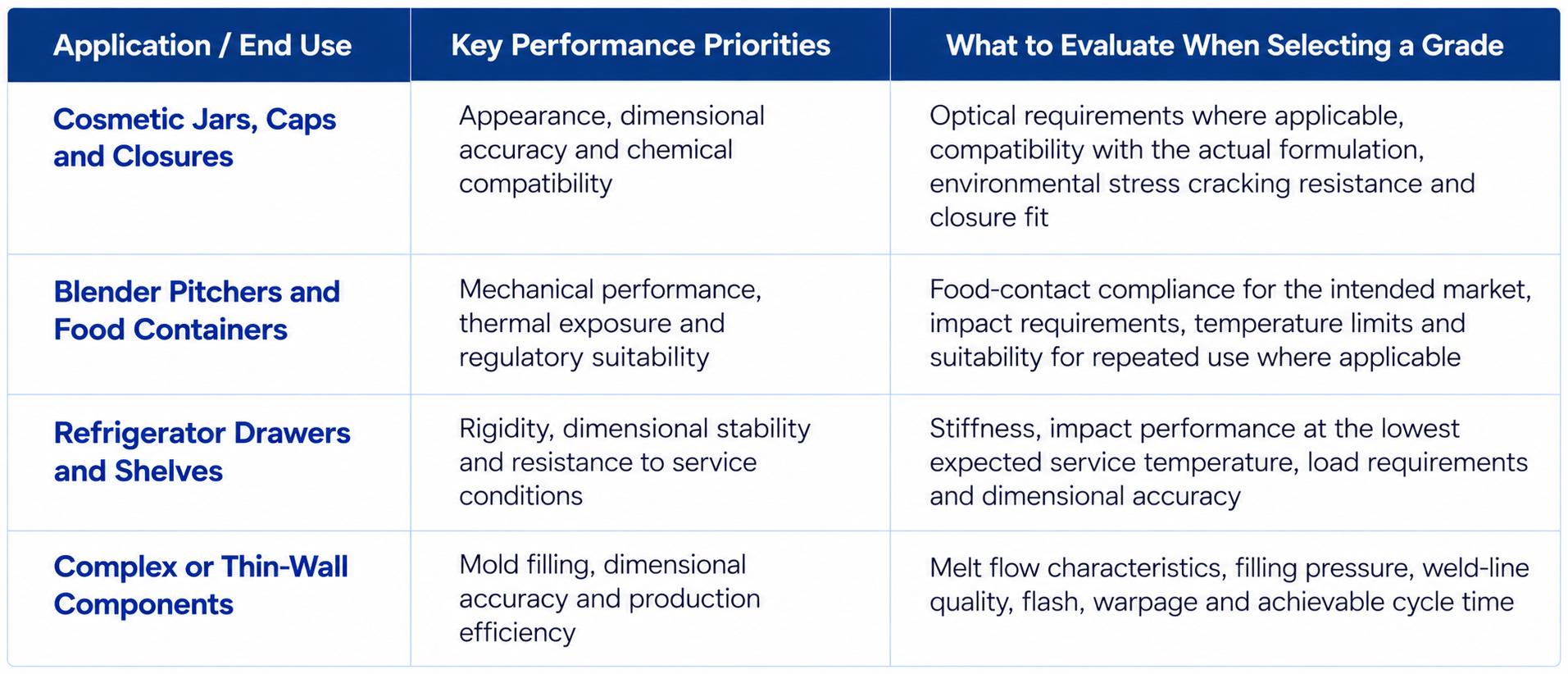
A grade that is suitable for one component may not meet the requirements of another, even when both use SAN.
For example, a transparent cosmetic container may prioritize appearance and compatibility with its contents, while a structural component may require greater emphasis on stiffness, dimensional stability and impact performance.
Food-contact suitability, dishwasher performance and other application-specific claims should be supported by documentation for the exact grade and intended conditions of use.
Switching to a lower-priced SAN grade without adequate validation can introduce additional manufacturing costs. The risks depend on the material, part design, tooling and production conditions.
Changes in material characteristics or processing behaviour can affect shrinkage, warpage and dimensional consistency. These differences may lead to fit-up issues, assembly difficulties or rejected components.
Compare critical dimensions and part performance using representative production trials before approving a grade change.
Residual stress can develop during molding due to factors such as filling behaviour, packing, cooling and component geometry. When a stressed part comes into contact with a compatible stress-cracking agent, premature cracking may occur.
Evaluate the selected grade under representative chemical exposure and mechanical stress conditions, especially for components that encounter oils, detergents, cosmetics or cleaning agents.
Differences in melt flow behaviour or processing requirements may require adjustments to molding parameters. If these adjustments are not properly controlled, they can contribute to defects such as short shots, flash, sink marks or dimensional variation.
A controlled production trial helps establish an appropriate processing window and determine whether the alternative grade can achieve the required quality and production yield.
An unvalidated material change may require additional setup trials, process adjustments, quality inspections and troubleshooting. These activities can reduce the expected savings from a lower raw material price.
The overall economic impact should therefore be assessed using actual production data wherever possible.
Before approving an alternative SAN grade or qualifying a new supplier, engineering and procurement teams should evaluate the following.
Confirm that haze and luminous transmittance are evaluated using the relevant methods, such as ASTM D1003 or ISO 14782 for haze, as applicable to the required measurement.
Check specimen thickness, surface condition, preparation and measurement conditions before comparing results.
Compare melt flow rate only when the test method, temperature, applied load and units are consistent.
ISO 1133-1 and ASTM D1238 are relevant methods for measuring the melt flow properties of thermoplastics. The applicable test conditions must be confirmed from the technical data sheet for each grade. Do not assume that values measured under different conditions are directly comparable.
Identify the actual chemicals, concentrations, temperatures and exposure durations relevant to the application.
Where environmental stress cracking is a concern, evaluate the material under representative mechanical stress as well as chemical exposure. A general chemical-resistance claim is not a substitute for application-specific validation.
Run a controlled trial using the intended mold and representative processing conditions.
Evaluate:
Record the processing conditions and compare the results against the incumbent grade.
Compare alternative grades using actual or representative production data.
Include material consumption, cycle time, machine costs, scrap, rework, downtime and relevant secondary operations. Use the same production basis and quality requirements for each option.
A grade should be considered economically preferable only when its overall cost and performance meet the defined acceptance criteria.
SAN grades can differ in polymer composition, molecular characteristics and formulation. These differences can influence melt flow, optical properties, chemical compatibility and mechanical performance. Comparing the relevant test data and conducting application-specific trials helps determine whether the differences matter in practice.
2. Which test standards are relevant when comparing SAN optical and melt flow properties?
ASTM D1003 covers haze and luminous transmittance of transparent plastics. ISO 14782 specifies a method for determining haze in transparent materials. ISO 1133-1 and ASTM D1238 are relevant to measuring melt flow properties of thermoplastics.
The correct method depends on the property being measured. Verify the applicable standard, test conditions and specimen requirements before comparing technical data sheets.
No. A lower purchase price may be offset by higher material losses, longer cycle times, additional processing costs or increased rejection rates. The most economical option is the grade that meets the required specifications at the lowest overall cost per accepted part.
Acrylonitrile content can influence SAN's chemical resistance, thermal behaviour and melt characteristics. However, the effect on processing depends on the overall grade formulation and other material characteristics. Compare grade-specific data and validate molding behaviour under actual production conditions rather than assuming that higher acrylonitrile content always requires higher processing temperatures or injection pressures.
Start by comparing technical data sheets, ensuring that test methods and conditions are comparable. Identify any differences that could affect the intended application, then conduct relevant chemical exposure, mechanical or optical testing as required. Finally, run a controlled production trial and compare quality, process stability, yield and cost per accepted part.
Selecting an appropriate SAN grade requires balancing material performance, processing requirements and overall production economics.
Whether you are benchmarking alternative suppliers, evaluating a material change or addressing polymer sourcing requirements, Distil can help connect your team with relevant material options and technical information to support the evaluation process.
Contact Distil for a Technical Consultation
Email: polymers@distil.market
READ MORE

READ MORE
READ MORE
READ MORE

READ MORE
READ MORE

READ MORE

READ MORE

READ MORE

READ MORE
.png)
We enable global brands to diversify production and accelerate sustainable sourcing while protecting IP.
Corporate Presentation
Follow us


© 2026 Distil. All rights reserved.


