
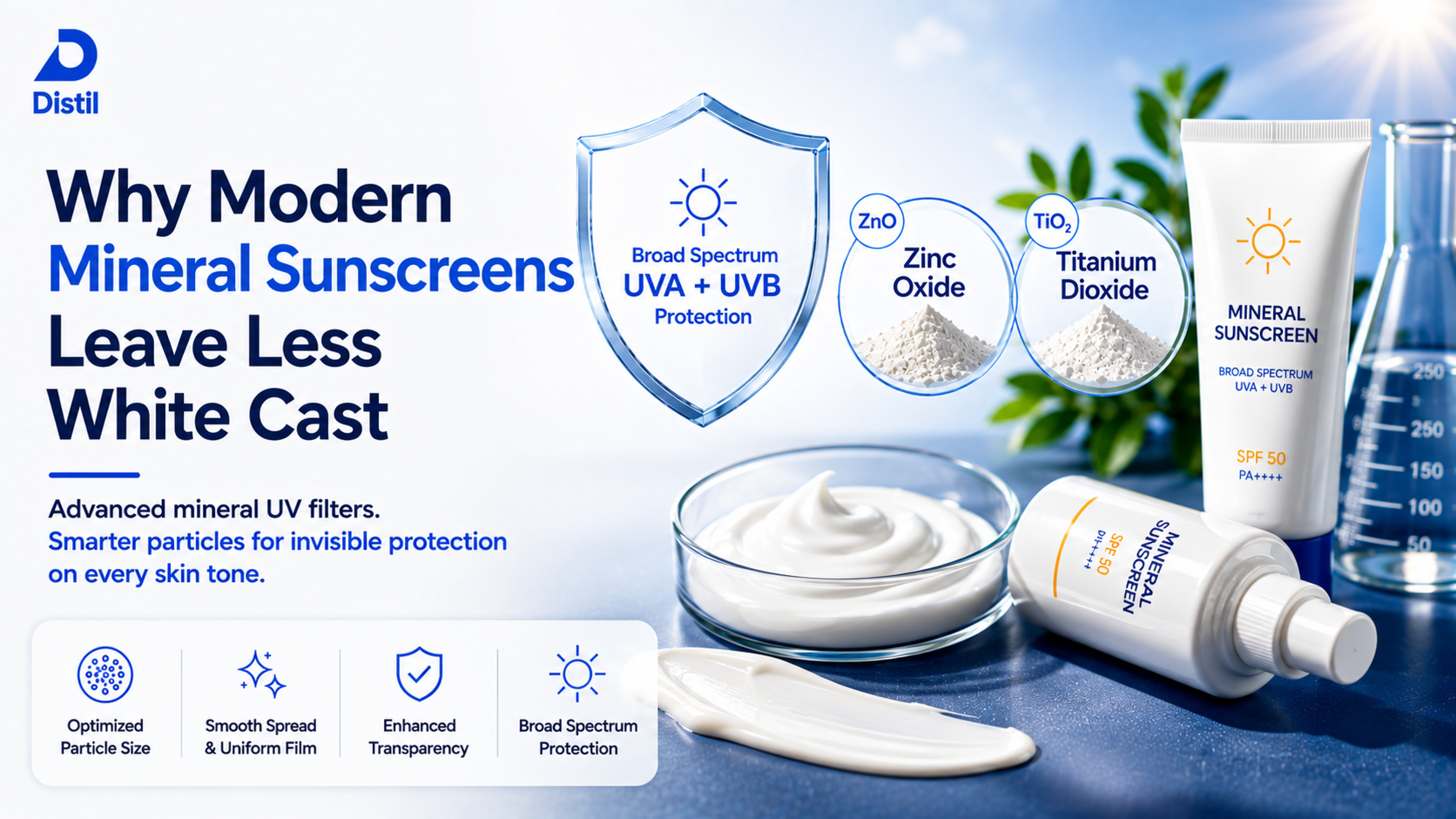
The white cast associated with earlier mineral sunscreens was primarily linked to particle size, although particle shape, morphology, and orientation also played a role. Earlier Zinc Oxide technologies ranged from 1000+ nm down to 200 nm, while Titanium Dioxide particles typically ranged from 150–300 nm. Larger particles reflect more incident visible light, producing the white appearance perceived on the skin.
Formulators have since reduced particle size and optimized particle shape. These changes allow formulations to spread more smoothly and form more uniform films, improving transparency and reducing white cast while optimizing SPF. However, increasing the concentration of inorganic UV filters can also impact transparency.
Early mineral sunscreens had a significant cosmetic drawback: they often left a white, chalky appearance on the skin. This effect was particularly noticeable on darker skin tones and could leave residue on hair, brows, or clothing—often leading to under-application.
This challenge was driven by particle optics rather than the UV filters themselves:
Optimizing particle engineering transformed the cosmetic performance of mineral UV filters:
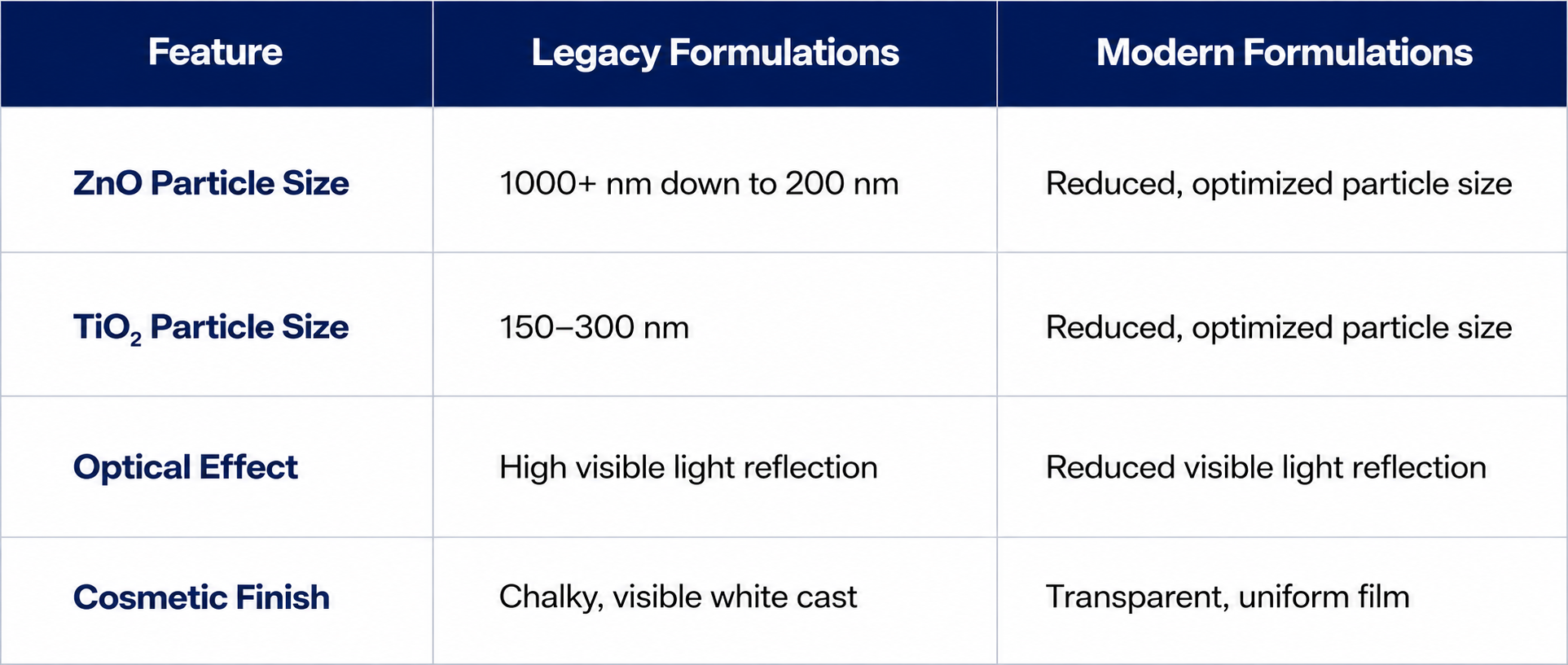
Particle size is a critical factor, but formulation loading also plays a key role. Research notes that increasing the concentration of inorganic UV filters directly reduces transparency:
Achieving optimal performance requires balancing particle specs with total active loading.
Larger ZnO and TiO₂ particles reflect more incident visible light, which is perceived as a white layer on the skin.
Earlier Zinc Oxide technologies ranged from 1000+ nm down to 200 nm, while Titanium Dioxide particles typically ranged from 150–300 nm.
Smaller particle sizes and optimized shapes allow formulations to spread smoothly, forming uniform films that reduce visible light reflection while maintaining UV protection.
Yes. Higher mineral concentrations reduce transparency, where Zinc Oxide can create a white appearance and Titanium Dioxide can impart a white or blue-white tint.
Looking to develop transparent, broad-spectrum mineral sunscreens without compromising on sensory feel or stability?
Connect with Distil at pc@distil.market today to request technical data, samples, or expert guidance on optimizing your inorganic filter formulations.
READ MORE

READ MORE
READ MORE
READ MORE
READ MORE
READ MORE

READ MORE
.png)
We enable global brands to diversify production and accelerate sustainable sourcing while protecting IP.
Corporate Presentation
Follow us


© 2026 Distil. All rights reserved.


