
Toy designs span a wide range of categories, from sensory and squishy toys to collectible figures, construction sets, racing vehicles and outdoor play equipment. Each category presents different material requirements, making polymer selection an important part of toy product development and manufacturing.
The choice of polymer influences the performance characteristics of individual components, including flexibility, rigidity, impact resistance, surface finish, dimensional stability and durability. Rather than selecting a resin based solely on the overall toy category, manufacturers need to match the material to the function, geometry and performance requirements of each component.
This guide explores key toy design categories relevant to 2026, the polymers commonly considered for these applications, and the technical and regulatory considerations manufacturers should evaluate before finalising a polymer grade.
Toy manufacturing involves a wide range of material requirements. Sensory toys require suitable softness, hardness control and elastic recovery, while collectible figures demand dimensional accuracy, surface quality and structural rigidity. Construction sets depend on precise fit, connection strength and repeated assembly performance. Toy vehicles require different polymers for their bodies, transparent covers, chassis, gears and flexible components.
Materials such as ABS, PP, HDPE, PC, POM, TPE, TPU, PVC, HIPS and GPPS offer different combinations of mechanical, thermal and processing characteristics for these applications.
The key to effective material selection is understanding the function of each component, evaluating grade-specific technical data, checking processing compatibility, validating performance through testing, and verifying applicable toy-safety and chemical requirements.
Sensory and squishy toys include fidget accessories, stress-relief toys, squeeze toys and products with textured grips. These applications require materials that provide the intended softness while maintaining suitable flexibility, tear resistance and recovery after repeated deformation.
Three polymer options are commonly considered for these applications:
For manufacturers developing these products, softness alone should not determine material selection. Hardness, tear strength, compression set, fatigue resistance and elastic recovery are equally important considerations.
The selected grade should also be evaluated for repeated squeezing, deformation and potential changes in material performance over the product's intended service life.
Miniature collectible figures, blind-box figurines, character toys and articulated action figures require materials that support detailed designs, dimensional accuracy and the structural requirements of individual components.
Different polymers serve different purposes:
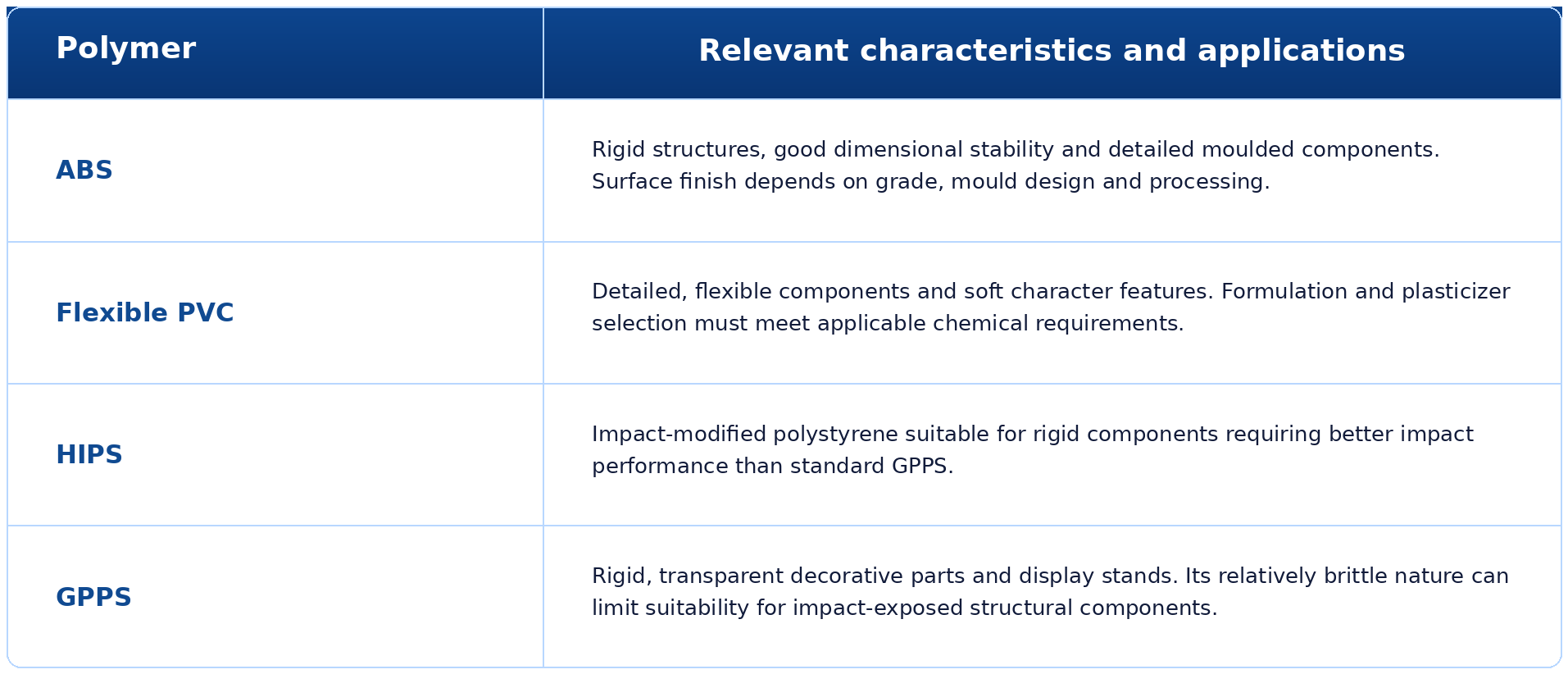
The selection depends on the balance between fine details, surface finish, flexibility and structural rigidity. Manufacturers should consider these requirements when evaluating materials for different parts of collectible figures and mini toys.
Additional considerations include snap-fit performance, joint retention, repeated articulation, stress concentration around small features and paint or coating adhesion.
For components expected to withstand drops or repeated handling, finished-part testing is essential. Impact performance depends on the selected grade, component geometry, wall thickness, processing conditions and test environment.
Interlocking building blocks, modular construction sets and mechanical building kits depend on dimensional consistency and precision across individual components.
Material selection plays an important role in achieving the required fit, connection strength and performance during repeated assembly and disassembly.
For construction toys, the material must support the intended fit and connection requirements. Manufacturers should validate:
An important consideration is clutch performance: the ability of interlocking components to connect securely while remaining easy to separate.
Clutch performance is not determined by the polymer alone. It depends on material stiffness, component geometry, dimensional tolerances, surface finish, mould design and processing consistency.
Toy cars, racing vehicles, track sets and remote-control cars combine multiple components, each with different material requirements.
A single polymer may not be suitable for every part of a vehicle. Material selection needs to reflect the function, mechanical loading and operating conditions of each individual component.
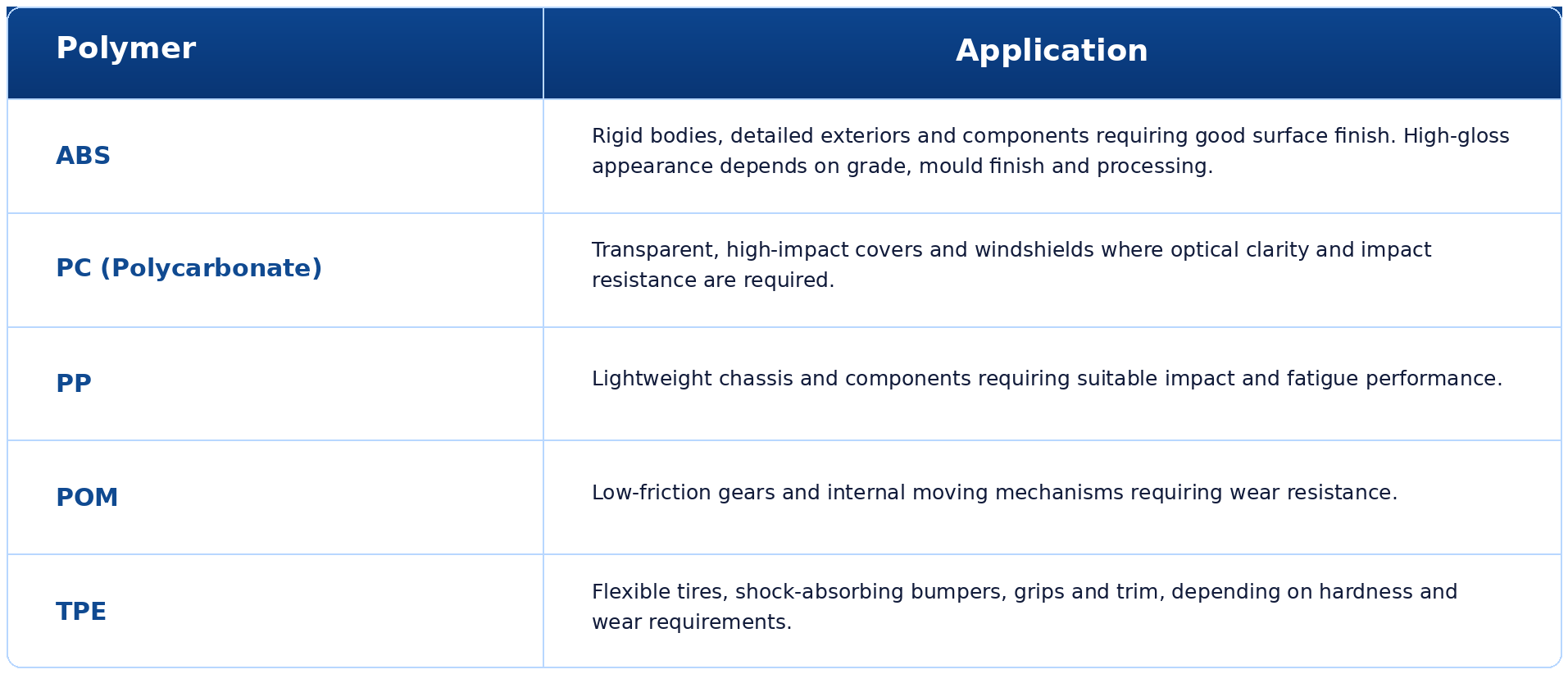
The key consideration is to select each polymer according to its component function and validate its performance in use.
Manufacturers should also evaluate gear wear, wheel abrasion, repeated mechanical loading, dimensional stability and compatibility between rigid and flexible components.
For transparent components, PC may be suitable where higher impact resistance is required. However, other transparent polymers may also be considered depending on optical requirements, impact exposure, cost and design constraints.
Dolls, character playsets and pretend-play products involve several types of components, from flexible figures to rigid accessories and assembled parts.
Fashion dolls, articulated figures, dollhouse furniture, accessories and interactive character toys have different material requirements.
Material selection should balance appearance, flexibility, dimensional accuracy and durability across assembled components.
For articulated dolls, manufacturers should also evaluate joint retention, repeated movement, fatigue performance and the risk of component detachment during use.
Toy kitchens, pretend appliances, play food, utensil sets, doctor kits and role-play products also require different material characteristics.
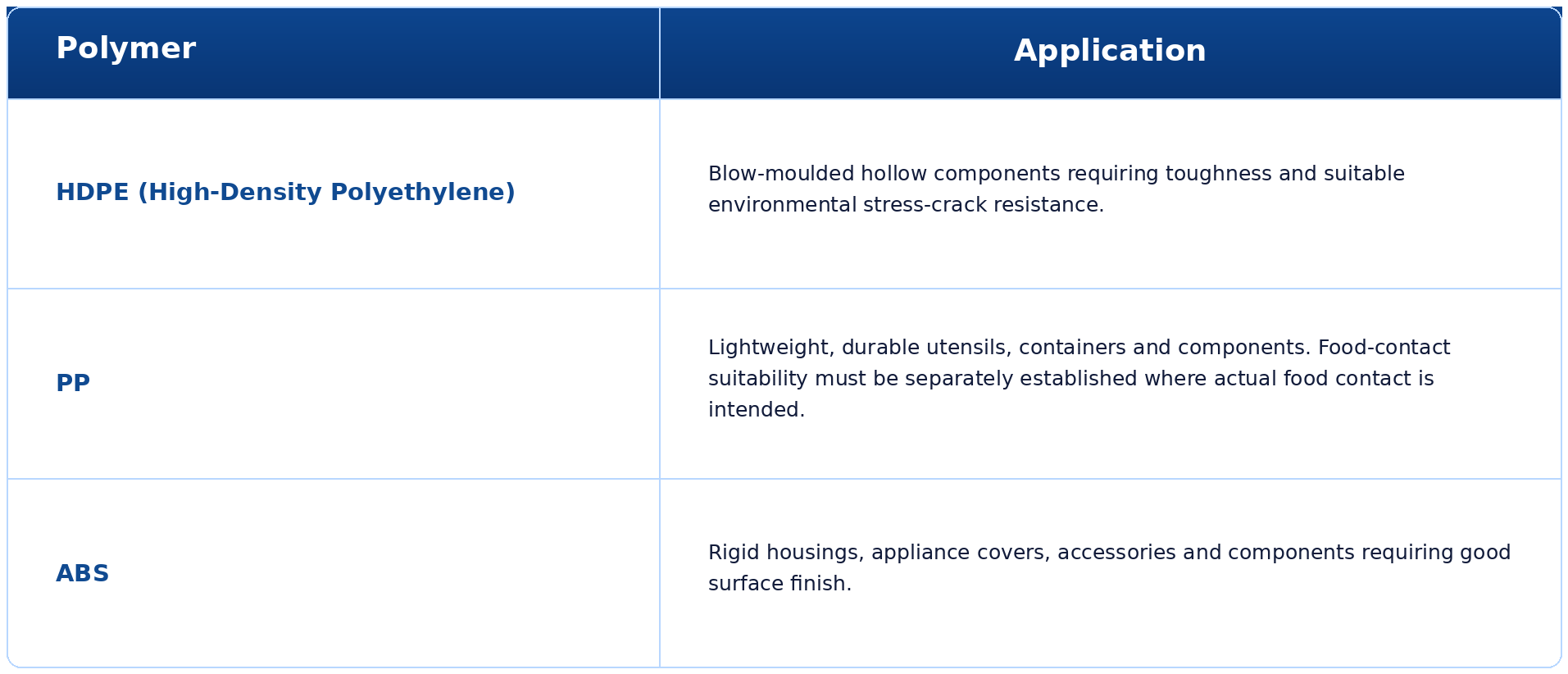
For these products, manufacturers should match the polymer to the moulding process, part geometry and required finish.
Where components are intended for actual food contact, applicable food-contact requirements must also be assessed. A food-contact grade does not automatically establish compliance with toy-safety requirements.
Outdoor and active-play toys include sand and water play sets, ride-on vehicles, playhouses and outdoor sports accessories.
Unlike many indoor toys, these applications place particular emphasis on weatherability, impact performance and resistance to environmental exposure.
The relevant polymer options include:
Before finalising a material, manufacturers should assess:
For products exposed to prolonged sunlight, standard indoor grades should not automatically be assumed suitable for outdoor use. UV-stabilized formulations and finished-component ageing tests may be necessary.
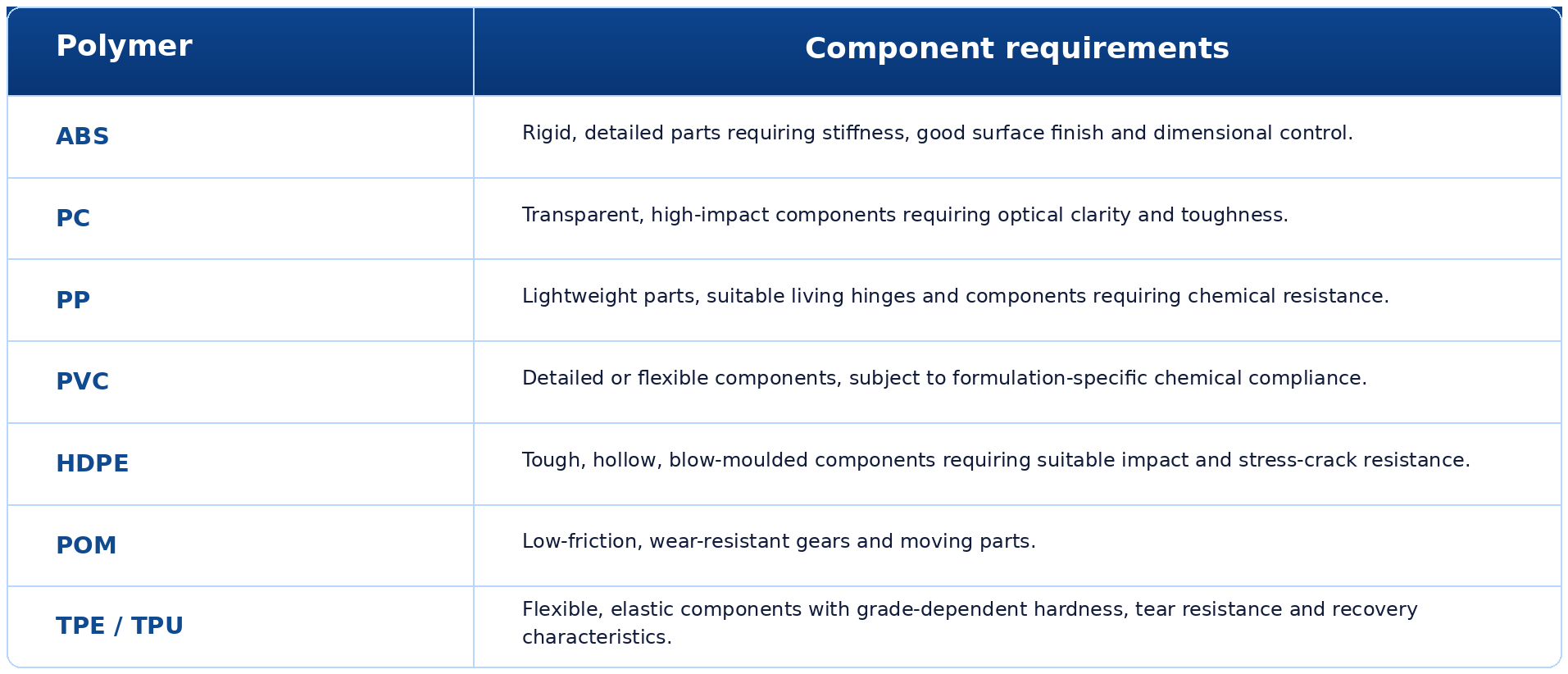
Selecting a polymer based only on the toy category can overlook the requirements of individual components. The same toy may contain rigid, flexible, transparent and moving parts, each requiring a different material approach.
The following comparison provides a starting point for matching polymers to component functions.
Evaluate the technical data of the proposed grade, including:
Check whether the selected grade is compatible with the intended processing method, such as injection moulding or blow moulding.
Melt flow values should only be compared when the test temperature and applied load are the same. Shrinkage and mechanical properties should also be evaluated using grade-specific technical documentation.
Assess whether the selected grade meets the actual component performance requirements through application-specific testing.
Depending on the toy design and component function, relevant tests may include:
The selection of tests should consider the intended age group, component design, foreseeable use and applicable toy-safety requirements.
Material property testing and finished-product safety testing serve different purposes. Both should be considered during product development and grade validation.
Ensure that the selected materials and finished toy meet the applicable safety and chemical requirements for the intended market.
Important regulatory frameworks include:
The European Union adopted Regulation (EU) 2025/2509, the new Toy Safety Regulation, which entered into force on 1 January 2026 and is scheduled to apply from 1 August 2030. Until its general application date, the existing Toy Safety Directive framework remains relevant, subject to the regulation's transition provisions.
Manufacturers should also assess applicable restrictions on lead, phthalates, certain elements, plasticizers and other restricted substances. Requirements depend on the target market, toy category, component accessibility and intended use.
A resin grade's technical data sheet or supplier declaration alone does not establish finished-toy compliance. The complete formulation, colourants, additives, coatings and assembled product may require assessment and testing.
Ultimately, selecting a resin is only the beginning. Grade validation, component performance and finished-product compliance matter just as much.
Commonly considered polymers include ABS, PP, HDPE, PC, POM, TPE, TPR, TPU, PVC, HIPS and GPPS. Their suitability depends on the component's intended function, processing method and performance requirements.
TPE/TPR, TPU and flexible PVC are relevant options.
TPE/TPR can offer softness, different hardness options and elastic recovery. TPU provides good abrasion and tear resistance in suitable grades, while flexible PVC supports softness and detailed moulding. The selected formulation must meet applicable chemical and toy-safety requirements.
ABS, flexible PVC, HIPS and GPPS are relevant options.
ABS is suitable for rigid, detailed components, while flexible PVC can be used for softer features and flexible limbs. HIPS may be considered for impact-modified rigid components, whereas GPPS is generally more appropriate for clear decorative parts and display bases due to its relatively brittle nature.
ABS, PC, PP, POM and TPE can serve different component functions.
These include rigid vehicle bodies (ABS), transparent impact-resistant covers (PC), lightweight chassis components (PP), gears (POM), and flexible tires or bumpers (TPE). The final choice depends on the component's mechanical, optical and processing requirements.
ABS is commonly considered for precision-moulded bricks and connectors because suitable grades can provide stiffness and dimensional stability. PP may be used for flexible clips and living hinges, while POM is suitable for low-friction gears and moving mechanisms.
The final selection should be validated for dimensional tolerances, connection strength and repeated assembly performance.
Manufacturers should evaluate technical data and processing compatibility, validate component performance through application-specific physical testing, and verify applicable toy-safety and chemical requirements.
Important considerations include MFR/MFI, shrinkage, impact strength, tensile properties, dimensional stability, fatigue performance and compliance with relevant requirements such as BIS standards, ASTM F963, CPSIA, EN 71 and REACH, depending on the target market.
Successful toy manufacturing begins with understanding what each component needs to deliver. From flexibility in sensory toys to precision in construction sets and weatherability in outdoor play products, material selection should reflect the intended application.
Choosing the right polymer grade and validating its performance can support product quality, processing consistency and long-term durability.
Developing your next toy range?
Contact Distil to discuss polymer selection, grade evaluation and specialty material sourcing.
Email: polymers@distil.market

READ MORE

READ MORE
READ MORE
READ MORE
READ MORE
READ MORE
READ MORE
READ MORE

READ MORE
READ MORE

READ MORE

READ MORE

READ MORE

READ MORE

We enable global brands to diversify production and accelerate sustainable sourcing while protecting IP.
Corporate Presentation
Follow us


© 2026 Distil. All rights reserved.


