
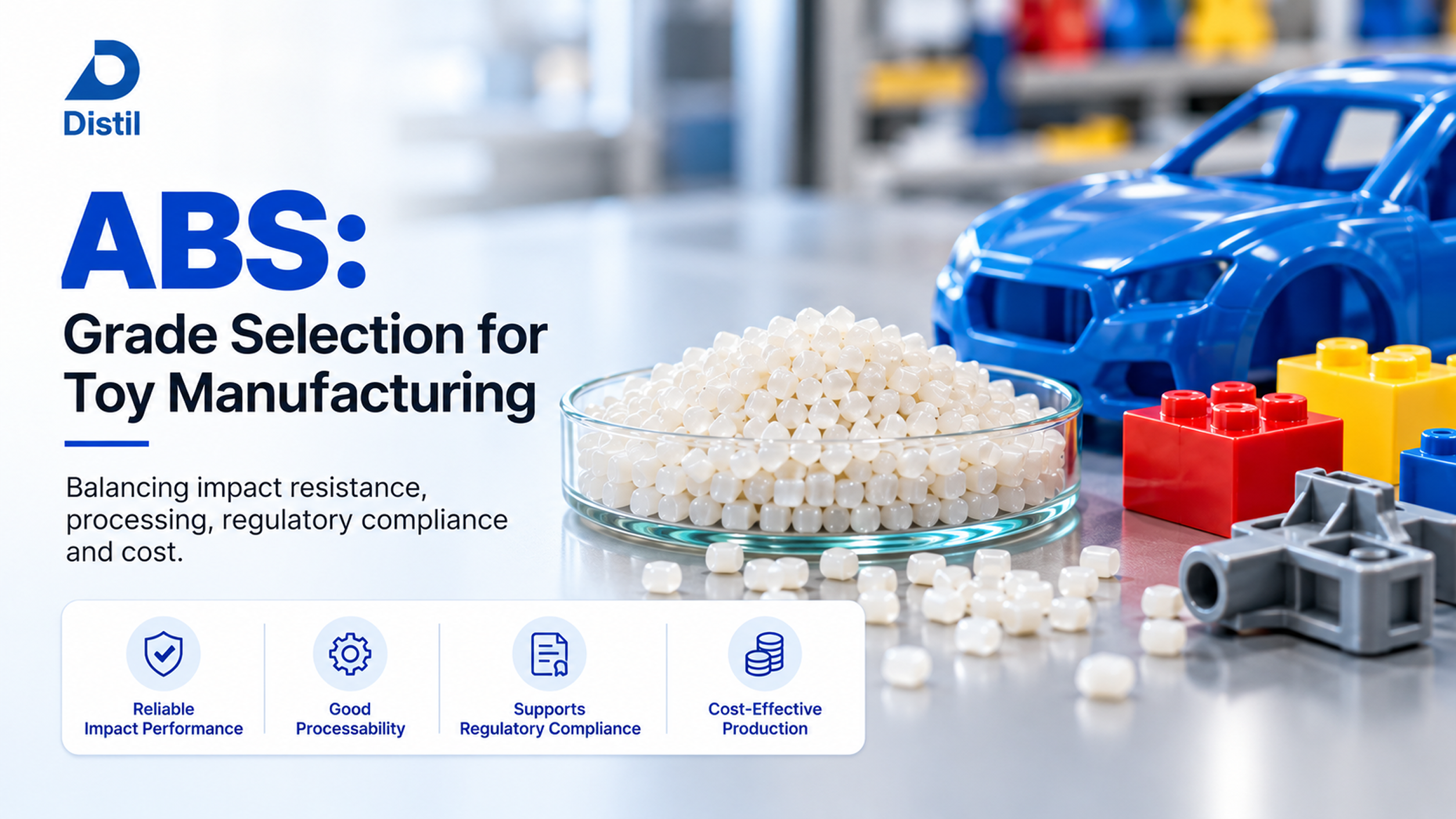
A toy component that cracks at a clip, joint or corner during a drop test raises an important engineering question: Is the selected ABS grade suited to the component’s mechanical requirements and manufacturing process?
The answer depends on more than impact strength alone. Component geometry, stress concentrations, weld-line locations and injection-moulding conditions can all influence failure. Selecting the right Acrylonitrile Butadiene Styrene (ABS) grade therefore requires evaluating material properties alongside part design, processing conditions, applicable safety requirements and total production cost.
For toy manufacturers, the challenge is to identify a material that delivers the required mechanical performance, maintains consistent surface quality, processes reliably and meets the applicable requirements for the intended market.
ABS is a terpolymer comprising acrylonitrile, butadiene and styrene. The proportions of these components, along with polymer morphology, molecular structure and grade formulation, influence its mechanical, thermal and processing characteristics.
Each component contributes to the overall property profile:
These contributions interact, meaning that changing one property can influence others. The resulting balance depends on the specific ABS grade rather than monomer proportions alone.
ABS grades are developed for different application requirements. High-impact grades may be appropriate for components exposed to drops, shocks or repeated handling. High-flow grades can be useful for thin-walled or geometrically complex parts that require reliable mould filling. General-purpose grades may provide a practical balance of stiffness, appearance and processability.
However, these categories should be treated as selection guides rather than universal performance classifications. A high-flow grade is not automatically unsuitable for impact-sensitive parts, just as a high-impact grade is not automatically the best choice for every toy component.
When comparing candidate grades, evaluate:
The key takeaway: Select ABS based on the combination of properties required by the finished component, not on a single specification or grade label.
Different toy components experience different mechanical loads and manufacturing constraints. Identifying the dominant requirement helps narrow the selection to grades that merit further evaluation.
Snap-fits and assembly clips must withstand deformation during assembly without cracking or developing unacceptable stress whitening. Components intended for repeated assembly and disassembly may also need to resist fatigue and long-term deformation.
Material properties alone do not determine snap-fit performance. Beam geometry, root radii, assembly deflection, local stress concentrations and moulded-in residual stresses can all affect reliability.
For critical components, validate the design through engineering calculations, simulation where appropriate, and physical assembly and durability testing.
Outer housings and shells often require a balance of stiffness, dimensional stability, surface appearance and resistance to everyday handling.
The appropriate grade depends on the part’s appearance requirements, structural function and exposure conditions.
A grade that performs well in a mechanical test may still require further evaluation if the finished component has demanding appearance or finishing requirements.
Thin-walled parts and components with complex flow paths can be challenging to mould. Insufficient flow, unsuitable gate placement or an inadequate processing window may result in short shots, weld lines or inconsistent surface appearance.
MFR is a useful screening parameter, but it does not directly predict the filling behaviour of every mould. Mould-flow simulation and production trials can help establish whether a candidate grade is suitable for the intended geometry.
If a component cracks during assembly or drop testing, investigate the complete failure mechanism before switching resin grades.
Review local geometry, root radii, weld-line positions, gate locations, packing conditions, cooling and residual stresses. These factors can interact with material properties and contribute to premature failure.
A grade change should be validated against the actual component and its operating requirements rather than approved solely on the basis of a supplier datasheet.
Material selection must account for the regulatory requirements applicable to the finished toy and its intended market. Mechanical performance and processing efficiency do not compensate for a failure to meet applicable safety requirements.
The compliance review should cover relevant substance restrictions, migration requirements, supporting supplier documentation and finished-product testing.
For toys placed on the European market, EN 71-3 addresses the migration of certain elements from toy materials. In the United States, ASTM F963 establishes applicable toy safety requirements, including provisions relevant to materials and chemical safety.
The applicable requirements depend on the product, its components, intended use and the current version of the relevant standard.
Manufacturers should establish which requirements apply and obtain appropriate supporting test reports and documentation. A resin supplier’s declaration should not be treated as automatic proof that every finished toy made from that resin is compliant.
Depending on the product and target market, the compliance review may need to address:
These requirements are not interchangeable, and not every regulation applies to every toy or resin in the same way. Manufacturers should maintain a market-specific compliance checklist and verify the current requirements before approving a material.
Reintroducing runner and sprue material can reduce waste, but repeated thermal and mechanical processing may alter material properties. The effects depend on the ABS formulation, processing history, temperature, residence time, shear conditions and contamination.
Changes in impact performance, flow behaviour, colour and batch consistency should be evaluated before approving regrind for production.
Manufacturers should establish a validated regrind limit for the specific grade and application, with appropriate controls for material segregation, traceability and quality testing. Where required, confirm that regrind use remains consistent with the applicable compliance and customer requirements.
The purchase price of ABS is only one component of the cost of manufacturing a toy part. A grade that costs less per kilogram may not deliver the lowest cost per acceptable component if it increases material consumption, cycle time, rejects or inspection requirements.
A more useful evaluation considers material yield, processing efficiency, quality performance and compliance-related risk.
Polymers are purchased by mass, while moulded parts have a defined volume. For a part with a fixed volume, a material with a lower density requires less mass per part.
The theoretical mass of the finished component can be estimated using:
Part mass = Part volume × Material density
For example, consider two illustrative materials with densities of 1.04 g/cm³ and 1.08 g/cm³. For an identical part volume, the lower-density material would use approximately 3.7% less material mass per part.
Conversely, for the same available mass of resin, the lower-density material could theoretically produce approximately 3.8% more equal-volume parts, assuming the same usable yield and no other production differences.
These figures are illustrative calculations, not a claim that every ABS grade falls within this density range. Use the actual density values in the supplier’s technical documentation when comparing candidate grades.
The final economic benefit also depends on purchase price, runner consumption, scrap, processing stability and the number of acceptable parts produced.
MFR can help screen materials for processing suitability, but it should not be used as a standalone predictor of injection pressure, mould filling or cooling time.
Production performance depends on material rheology, part geometry, gate design, mould temperature, melt temperature, packing conditions and the cooling system.
For example, reducing a theoretical production cycle from 20 seconds to 18 seconds increases potential output per unit of time by approximately 11.1%, assuming continuous operation and no other production constraint.
Actual productivity gains may be lower if machine availability, moulding defects, downstream assembly or other process limitations restrict output.
Material variability can affect processing stability and finished-part performance. A useful supplier evaluation should therefore consider the properties that are critical to the application and the supplier’s ability to maintain them consistently.
Relevant checks may include:
A certificate of analysis (COA) is useful when it reports the agreed properties and acceptance limits. Confirm which properties are actually measured for each lot rather than assuming every COA contains every performance metric.
Material substitutions can introduce additional qualification costs if the alternative grade has different properties, composition or supporting documentation.
Consider the potential cost of revalidation, production interruptions, rejected batches, additional testing and supply inconsistency alongside the purchase price.
The most meaningful comparison is the cost per acceptable finished part, incorporating material consumption, processing performance, quality losses and the relevant qualification requirements.
Before approving an alternative ABS supplier or switching grades for a toy manufacturing run, evaluate the following criteria.
A structured evaluation of these criteria helps engineering and procurement teams compare alternatives using measurable requirements rather than price or a single headline property.
Selecting the right ABS grade for toy manufacturing requires balancing impact resistance, stiffness, processing performance, surface quality and applicable safety requirements. The most suitable grade is one that meets the component's functional requirements while maintaining consistent moulding quality and cost efficiency.
For engineering and procurement teams, comparing technical data sheets is only the starting point. Evaluating tooling compatibility, validating performance through moulding trials and assessing the cost per acceptable finished part can help reduce material-related failures and improve production consistency.
Distil helps manufacturers evaluate polymer options against their application, processing and sourcing requirements.
The best ABS grade depends on the toy component's mechanical requirements, geometry, processing conditions and surface-finish expectations. High-impact grades may suit components exposed to drops and shocks, while high-flow grades may be useful for thin-walled or complex mouldings. The final choice should be validated against the required performance and applicable safety requirements.
Manufacturers should compare notched impact strength, tensile and flexural properties, melt flow rate (MFR), density, heat deflection temperature where relevant, surface appearance and dimensional stability. The selection should also consider processing conditions, supplier consistency and the documentation required for the intended market.
Melt flow rate is an indicator of how a polymer flows under specified test conditions. It can help manufacturers screen ABS grades for processing suitability. However, MFR alone does not determine mould filling, injection pressure or cycle time. Part geometry, gate design, melt and mould temperatures, injection speed and packing conditions also influence moulding performance.
No. High-impact ABS may be appropriate for components exposed to shocks or drops, but it is not automatically the best choice for every application. Some components require greater stiffness, dimensional stability, surface quality or easier mould filling. The grade should be selected according to the component's actual performance requirements and validated through testing.
Cracking can result from material selection, stress concentrations, weld lines, moulding conditions or a combination of these factors. Manufacturers should investigate the failure location, component geometry, gate placement, residual stresses and assembly loads. Reviewing the ABS grade alongside tooling and processing conditions helps identify the appropriate corrective action.
Requirements depend on the intended market and finished product. Relevant checks may include EN 71-3 for migration of certain elements in toys sold in applicable European markets, ASTM F963 for toys within its US scope, and applicable REACH substance requirements. Additional restrictions may apply depending on the product and market. Resin documentation should be supported by appropriate finished-product compliance assessment and testing.
Regrind may be reusable, but its suitability depends on the grade, processing history, contamination controls and finished-part requirements. Repeated processing can change material properties and appearance. Manufacturers should validate the permitted blend ratio, monitor quality and confirm that regrind use remains consistent with applicable safety requirements and customer specifications.
For a fixed component volume, a lower-density material requires less mass per part. However, density alone does not determine the lowest production cost. Manufacturers should also compare resin price, runner consumption, scrap rate, processing efficiency and the number of acceptable finished parts produced.
Depending on the application, manufacturers may request a technical data sheet (TDS), certificate of analysis (COA), safety data sheet (SDS), applicable regulatory declarations, supporting test reports and lot traceability information. The documents should match the specific grade and intended use. Confirm which properties are tested for each production lot.
Compare the candidate grade's documented properties, processing suitability, applicable compliance evidence, supply consistency and commercial terms. Conduct moulding trials and finished-part testing where necessary. The final decision should consider the cost per acceptable finished part rather than purchase price per kilogram alone.
Distil helps manufacturers evaluate polymer options against their application and processing requirements. For technical data sheets and ABS sourcing enquiries, contact polymers@distil.market.
READ MORE

READ MORE
READ MORE
READ MORE

READ MORE
READ MORE

READ MORE

READ MORE
READ MORE

READ MORE
.png)
We enable global brands to diversify production and accelerate sustainable sourcing while protecting IP.
Corporate Presentation
Follow us


© 2026 Distil. All rights reserved.


