
Static electricity can affect polymer films, packaging and finished products by causing dust attraction, film sticking and handling difficulties. In ESD-sensitive applications, uncontrolled charge can also become a concern for electronic components. Antistatic masterbatches provide a convenient way to incorporate static-control functionality into polymer formulations.
Static control is an important consideration when polymer products need to remain clean, easy to handle and suitable for applications where electrostatic charge must be managed.
Distil’s Novastat™ antistatic masterbatches are formulated for use in selected polymer systems to help control static-related issues across packaging, film, consumer and industrial applications. Depending on the grade and formulation, Novastat™ can contribute to reduced dust attraction, improved film handling and better control of surface charge.
The required antistatic performance depends on factors such as polymer type, additive concentration, processing conditions, humidity and the electrical requirements of the final product.
Static is generated when materials come into contact, separate or move against one another. Because many polymers are electrically insulating, charge can remain on their surfaces instead of dissipating quickly.
This can create practical problems during manufacturing and use:
The right static-control approach helps address these issues at the material-formulation level.
Novastat™ antistatic masterbatches are designed to introduce static-control functionality into compatible polymer formulations without requiring the additive to be handled as a separate powder or liquid during production.
Depending on the selected grade and application, Novastat™ can help:
The actual level of performance depends on the polymer matrix, dosage, processing method, environmental conditions and required electrical properties.
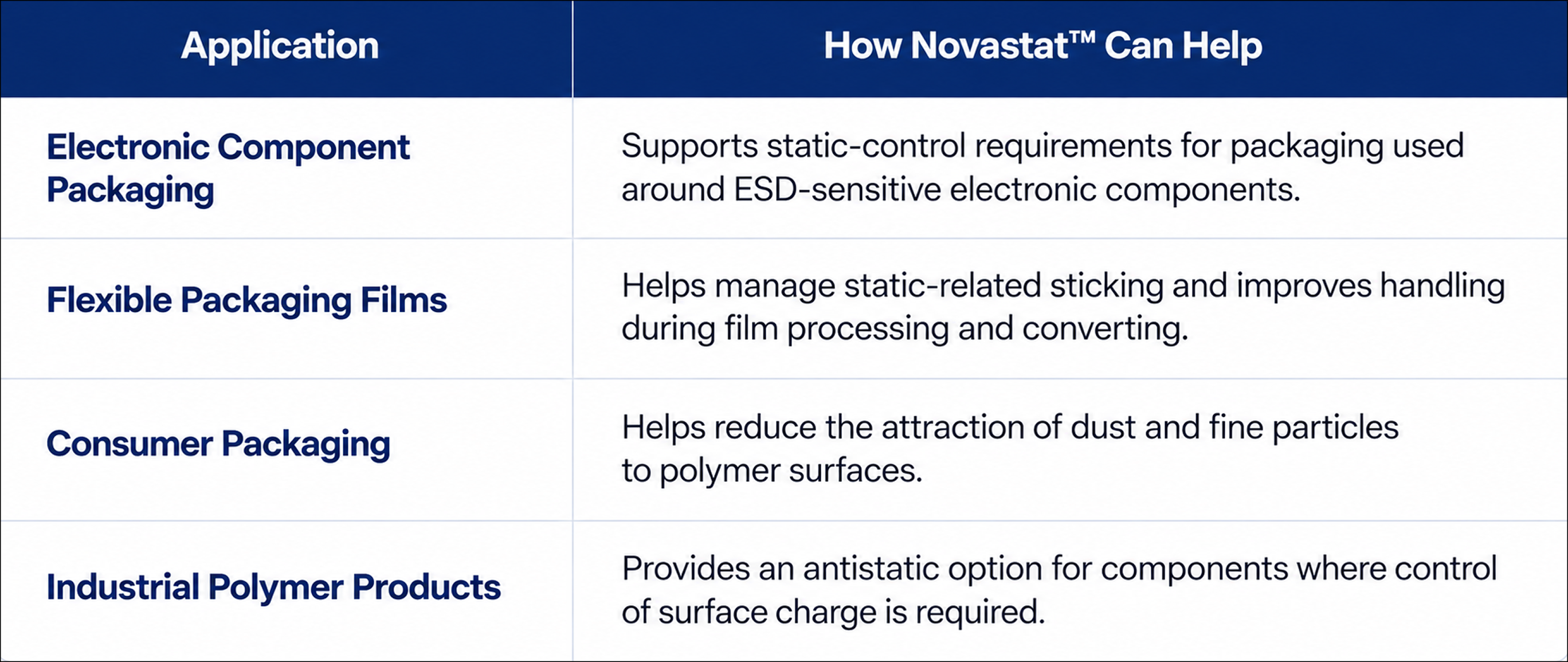
Film production and converting involve repeated contact, separation, winding, unwinding and movement of polymer surfaces. These operations can generate significant static charge.
Excessive charge may cause film layers to attract each other, interfere with separation or make automated handling less consistent. Incorporating a suitable antistatic masterbatch can help manage these effects and improve the behavior of the film during downstream operations.
For film applications, grade selection should take into account the polymer type, extrusion process, film structure, required antistatic level and operating environment.
Packaging used for electronic components requires careful consideration of electrostatic behavior. A material that allows charge to accumulate can contribute to an electrostatic discharge event that may affect sensitive devices.
Novastat™ can be considered as part of a polymer formulation intended for static-control applications. However, an antistatic additive alone should not be treated as a complete ESD protection system.
The appropriate material should be selected based on the required electrical properties, polymer system, processing conditions and relevant application or ESD requirements.
Static charge can make polymer surfaces more prone to attracting dust, lint and other fine particles. This can be particularly noticeable in products where visual cleanliness and surface appearance are important.
In suitable formulations, Novastat™ can help reduce static-related particle attraction and support a cleaner surface during handling and use.
For industrial components, controlling static can also help reduce unwanted attraction between polymer parts and surrounding materials, depending on the application.
Antistatic performance is not determined by additive concentration alone. The interaction between the masterbatch and the polymer matrix, together with processing and environmental conditions, can influence the final result.
Important factors include:
Selecting the appropriate Novastat™ grade therefore requires consideration of the complete formulation and processing system rather than the additive in isolation.
An antistatic masterbatch is a concentrated additive formulation incorporated into a polymer to help control electrostatic charge and reduce static-related effects in the finished product.
Polymer films can accumulate charge through contact and separation, friction, winding, unwinding and other mechanical processes. Since many polymers dissipate charge slowly, the static can remain on the surface.
Static can lead to film layers sticking together, difficulty during unwinding or stacking, inconsistent handling and attraction of dust and fine particles.
Novastat™ can be considered for polymer packaging applications where static control is required. For ESD-sensitive electronics, the selected formulation should meet the electrical and protection requirements of the specific application.
By helping control electrostatic charge on suitable polymer surfaces, Novastat™ can help reduce the attraction of dust and fine particles.
Suitability depends on the specific Novastat™ grade and polymer formulation. Polymer type, processing conditions, dosage and required performance should be considered during grade selection.
Performance can be influenced by the additive chemistry, polymer matrix, concentration, processing conditions, humidity, surface characteristics and end-use environment.
The appropriate grade should be selected based on the polymer, processing method, target electrical performance, addition level and final application.
READ MORE


READ MORE
READ MORE

READ MORE

READ MORE
READ MORE

READ MORE
.png)
We enable global brands to diversify production and accelerate sustainable sourcing while protecting IP.
Corporate Presentation
Follow us


© 2026 Distil. All rights reserved.


